Understanding the 2017 BMW i3 Range and Battery
If you own or are considering a used 2017 BMW i3, understanding its real-world range and how to charge it efficiently is essential. The 2017 model year was a pivotal one for the i3: BMW upgraded the battery from the original 22 kWh pack to a 33.2 kWh (usable ~29.4 kWh) lithium-ion NMC pack, significantly extending its reach. According to fueleconomy.gov, the 2017 BMW i3 BEV (battery electric vehicle, no range extender) carries an EPA-estimated range of 114 miles. The Range Extender (REx) variant, which pairs the electric motor with a small 2-cylinder gasoline generator, has an EPA-rated 97 miles of electric range before the gas engine kicks in.
Charging Levels Explained: How Fast Can You Add Range?
The 2017 BMW i3 supports three charging levels, but with important limitations you need to know before investing in equipment. The i3 uses a Type 1 (J1772) connector for AC charging and a CCS1 (Combo) connector for DC fast charging. However, DC fast charging was an optional extra on the 2017 i3 — not all used examples have it. Check the charge port: if there's a second, larger lower socket below the J1772 inlet, your car has CCS DC fast charging capability.
A critical distinction for any EV owner: kW (kilowatts) measures power — the rate at which energy flows into your car. kWh (kilowatt-hours) measures energy — the total capacity of your battery. Think of kW as the width of a pipe and kWh as the size of the tank you're filling. The 2017 i3 has a ~29.4 kWh usable battery and can accept up to 50 kW of DC fast charging power (if equipped).
| Level | Power (kW) | Miles of Range Added per Hour | Full Charge Time (0–100%) |
|---|---|---|---|
| Level 1 (120V household outlet) | ~1.4 kW | ~5 miles/hr | ~21 hours |
| Level 2 (240V, 32A max on i3) | ~7.4 kW | ~25 miles/hr | ~4.5 hours |
| DC Fast Charge (CCS, optional) | Up to 50 kW | ~150+ miles/hr (peak) | ~30 min (0–80%) |
The i3's onboard charger is limited to 7.4 kW on AC power (single-phase, 32 amps). This means even if you install a 48-amp Level 2 home charger capable of delivering 11.5 kW, the i3 will only draw 7.4 kW. You won't damage the car — the vehicle controls how much power it accepts — but you won't charge any faster than a 32-amp circuit can provide.
Home Charger Installation: Costs, Electrical Requirements, and Upgrades
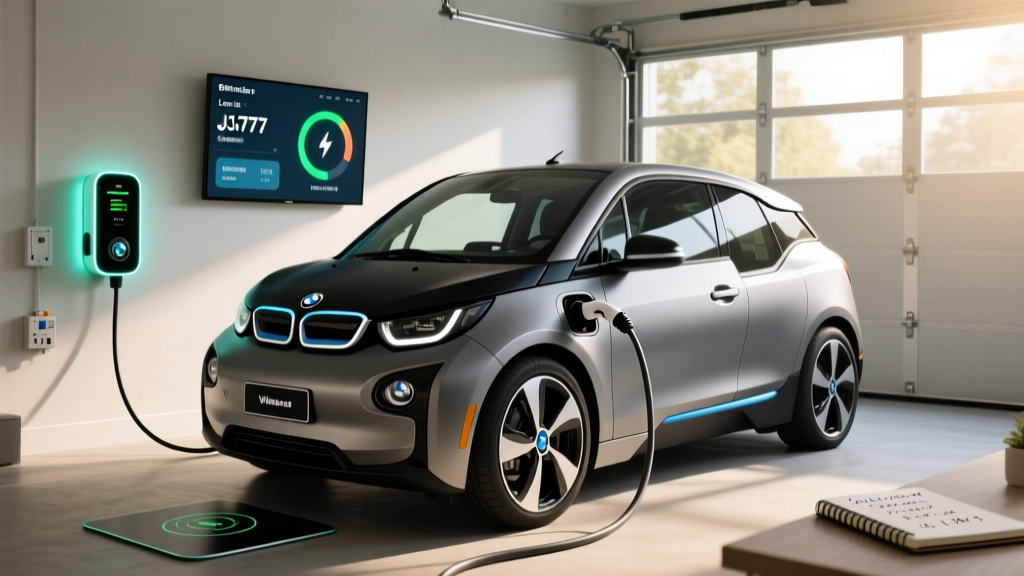
For daily driving, a Level 2 home charger is the practical standard. A full overnight charge on Level 2 easily replenishes the i3's ~29.4 kWh battery, giving you a fresh 114 EPA miles every morning.
Electrical Requirements for the 2017 BMW i3
Because the i3's onboard charger maxes out at 7.4 kW (32 amps at 240V), a 40-amp dedicated circuit is ideal. The National Electrical Code (NEC) requires that continuous loads (like EV charging) use no more than 80% of a circuit's rated capacity, so a 40A circuit safely delivers 32A to the car. You do not need a 60A circuit or a 48A charger for this vehicle — that capacity would go unused.
Key electrical specs:
- Voltage: 240V (same as a dryer or oven circuit)
- Amperage: 40A circuit (delivers 32A continuous to the vehicle)
- Wiring: 8 AWG copper (or 6 AWG aluminum) for a 40A circuit
- Outlet vs. hardwired: A NEMA 14-50 outlet offers flexibility; hardwired units avoid the ~$50–$100 outlet cost and may be required by some local codes for circuits above 40A
Do You Need a Panel Upgrade?
This is where costs can escalate. Most homes built after 1990 have a 200-amp electrical panel, which typically has enough spare capacity for a 40A EV circuit. Older homes with 100-amp service may need a panel upgrade — especially if you already have electric heating, an electric oven, and a dryer running simultaneously.
An electrician will perform a load calculation (per NEC Article 220) to determine if your panel can handle the added draw. If an upgrade is needed, expect to pay $1,500–$3,500 for a 200A panel replacement, plus permitting.
Installation Cost Breakdown
| Component | Simple Install (panel nearby) | Complex Install (long run, conduit) |
|---|---|---|
| Level 2 Charger (32–40A) | $350–$650 | $350–$650 |
| Electrician labor (2–4 hrs simple / 6–10 hrs complex) | $300–$600 | $900–$1,800 |
| Materials (wire, conduit, breaker) | $50–$150 | $200–$500 |
| Permit and inspection | $50–$200 | $50–$200 |
| Panel upgrade (if needed) | N/A | $1,500–$3,500 |
| Total | $750–$1,600 | $3,000–$6,650 |
Many utility companies offer rebates of $200–$500 for Level 2 charger installation — check with your local provider before starting work. Additionally, the federal Alternative Fuel Vehicle Refueling Property Credit (IRS Form 8911) may cover up to 30% of home charging equipment and installation costs (up to $1,000), though eligibility depends on your census tract and tax situation — consult a tax professional.
Connector Compatibility: What Plugs Into a 2017 BMW i3?
The connector landscape has shifted dramatically since the i3 was built. Here's what you need to know:
| Connector Type | Native on i3? | Adapter Needed? | Notes |
|---|---|---|---|
| J1772 (Level 1 & 2 AC) | ✅ Yes | No | Standard for all public Level 2 stations in North America |
| CCS1 (DC Fast) | ✅ Yes (if optioned) | No | Most Electrify America and EVgo stations use CCS1 |
| NACS (Tesla) | ❌ No | Yes — J1772-to-NACS or CCS-to-NACS | Required to use Tesla Superchargers (now opening to non-Tesla EVs via NACS adapters, ~$200–$300) |
| CHAdeMO (DC Fast) | ❌ No | Not available | CHAdeMO is being phased out in North America; no adapter exists to CCS |
Practical advice: For home Level 2 charging, any J1772 charger will plug directly into the i3. If you plan to use Tesla Superchargers on road trips (many of which now serve non-Tesla EVs through the "Open Supercharger" program), you'll need a NACS-to-J1772 adapter for AC or a NACS-to-CCS adapter for DC fast charging. These adapters typically cost $175–$300 from brands like Lectron or A2Z.
Charging Cost: Home vs. Public vs. Gas
One of the strongest arguments for the i3 is its low running cost. The 2017 BMW i3 BEV is rated at 111 MPGe combined, which translates to roughly 30 kWh per 100 miles of driving (or 0.30 kWh/mile).
| Scenario | Rate | Cost Per Mile | Annual Cost (12,000 mi) |
|---|---|---|---|
| Home charging (off-peak, national avg) | $0.13/kWh | $0.039 | $468 |
| Home charging (California peak) | $0.30/kWh | $0.090 | $1,080 |
| Public Level 2 (ChargePoint, avg) | $0.25/kWh | $0.075 | $900 |
| DC Fast Charging (Electrify America) | $0.48/kWh | $0.144 | $1,728 |
| Gas car (30 MPG, $3.50/gal) | $3.50/gallon | $0.117 | $1,404 |
Home off-peak charging makes the i3 extraordinarily cheap to run — roughly one-third the fuel cost of a comparable 30 MPG gas car. Even at California's peak residential rates, you're saving money. The caveat: relying exclusively on DC fast charging at public rates erases most of the cost advantage. A home Level 2 charger is essential for economical i3 ownership.
Recommended Level 2 Chargers for the 2017 BMW i3
Since the i3 caps AC charging at 7.4 kW (32A), you don't need the most powerful charger on the market. A quality 32A or 40A unit is the sweet spot — enough to max out the i3's onboard charger while leaving headroom if you upgrade to a higher-capacity EV later.
Best Value: Emporia Vue Level 2
- Power output: 40A / 9.6 kW (i3 will draw 32A / 7.4 kW)
- Connector: J1772 (native fit for i3)
- Cable length: 24 feet
- Smart features: Wi-Fi, app scheduling, energy monitoring, solar integration
- Price: ~$399
- Why for i3: Excellent energy tracking helps you monitor charging costs; 40A circuit future-proofs your install
Best Smart Charger: ChargePoint Home Flex
- Power output: Configurable 16A–50A (set to 32A or 40A for i3)
- Connector: J1772 (NACS version also available)
- Cable length: 23 feet
- Smart features: Wi-Fi, Alexa/Google integration, scheduled charging, public station finder in app
- Price: ~$549
- Why for i3: Adjustable amperage lets you match exactly what your electrical panel supports; robust app ecosystem
Budget Pick: Lectron V-BOX Pro (32A)
- Power output: 32A / 7.4 kW — perfectly matches i3's onboard charger limit
- Connector: J1772
- Cable length: 20 feet
- Smart features: Basic app, no Wi-Fi scheduling
- Price: ~$280
- Why for i3: No wasted capacity; straightforward plug-and-charge operation; lowest cost entry point
Safety, Electrical Code, and Installation Best Practices
EV charging is a continuous, high-draw electrical load — the equivalent of running a space heater at full blast for 4+ hours. Proper installation isn't optional.
- Dedicated circuit: Your Level 2 charger must be on its own dedicated circuit — it cannot share with any other outlet or appliance.
- GFCI protection: NEC 2023 and later require GFCI (Ground Fault Circuit Interrupter) protection for all EV charging outlets. Hardwired units may have GFCI built in. If your charger uses a NEMA 14-50 outlet, your electrician should install a GFCI breaker (~$50–$80 additional).
- Outdoor rating: If your charger is installed outside (garage-less homes, driveways), ensure the unit carries a NEMA 4 or IP65 weather rating. All three chargers recommended above are outdoor-rated.
- Permit and inspection: Most jurisdictions require an electrical permit for new 240V circuits. The inspection verifies wire gauge, breaker sizing, grounding, and GFCI compliance. Skipping the permit risks insurance claim denial if an electrical fire occurs.
- Cable management: A wall-mounted hook or cable organizer prevents the cord from lying on the ground where it can be driven over or tripped on.
Frequently Asked Questions
How much does it cost to install a home EV charger for a 2017 BMW i3?
For a straightforward installation where your electrical panel is near the garage and has sufficient capacity, expect $750–$1,600 total (charger + electrician + permit). If your panel needs upgrading or the wire run is long (through walls, attic, or underground conduit), costs can reach $3,000–$6,650. The i3 only needs a 40A circuit, which is less demanding than chargers for larger-battery EVs.
How fast will each charging level add range to my i3?
Level 1 (120V) adds about 5 miles per hour — fine for overnight top-ups if you drive less than 40 miles daily. Level 2 (240V, 32A) adds about 25 miles per hour, fully recharging the i3 in roughly 4.5 hours. DC fast charging (if equipped) can add 80% in about 30 minutes at a 50 kW CCS station, though the charge rate tapers significantly above 80% State of Charge.
Which connector and charger is compatible with my 2017 BMW i3?
The i3 uses a J1772 connector for all AC charging (Level 1 and Level 2) — this is the North American standard and works with virtually every public Level 2 station. For DC fast charging, the i3 uses CCS1 (if the DC fast-charge option was selected when new). To use Tesla Superchargers, you'll need a NACS adapter.
How much does charging cost per mile vs. gas?
At the national average residential electricity rate of $0.13/kWh, the i3 costs about $0.039 per mile to charge at home — roughly one-third the cost of fueling a 30 MPG gas car at $3.50/gallon ($0.117/mile). Over 12,000 miles per year, that's a savings of about $936 annually with home charging.
What electrical upgrades might I need?
If your home has a 200-amp panel with available capacity, you likely need nothing beyond a new 40A breaker and wiring. If you have a 100-amp panel, or your panel is near capacity with existing loads (electric heat, dryer, oven), you may need a panel upgrade to 200A — a $1,500–$3,500 job. Some utilities offer "make-ready" programs that cover the cost of wiring from the street to your panel. A licensed electrician's load calculation is the definitive answer.
Can I use a Tesla Supercharger with my 2017 BMW i3?
Yes, but only with an adapter. Tesla has opened select Supercharger stations to non-Tesla EVs through its "Charge with NACS" program. You'll need a NACS-to-CCS adapter (for DC fast charging, ~$200–$300) and must use the Tesla app to initiate the session. Note that the i3's 50 kW DC fast charge cap means you won't take advantage of the 150–250 kW speeds that Superchargers can deliver to newer EVs.