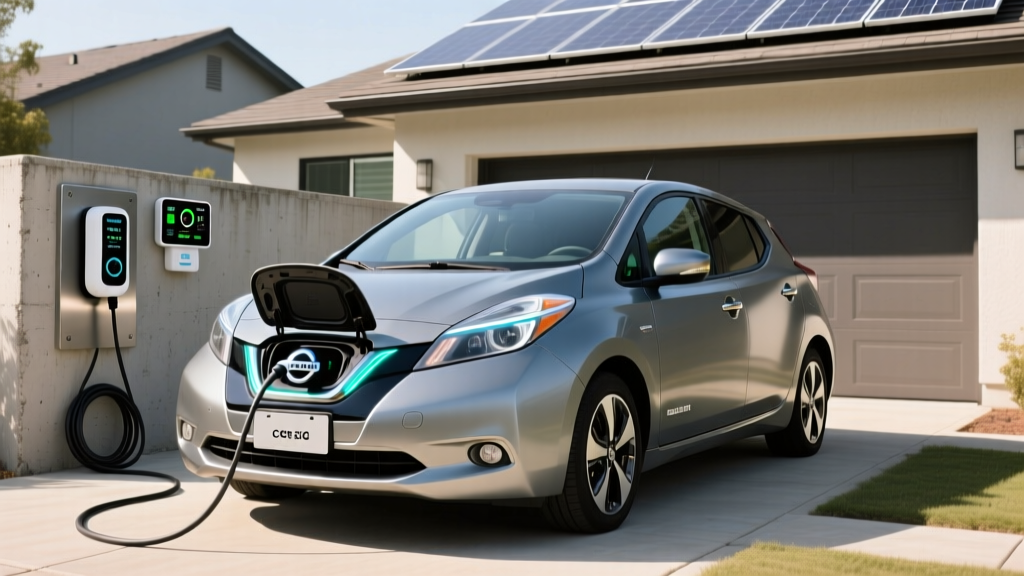
The 2016 Nissan Leaf remains one of the most popular used electric vehicles on the road in 2026, with thousands of owners still relying on it for daily commuting. If you own one or are considering a used purchase, understanding the real-world range and charging options is critical to getting the most out of this early-generation EV. This guide covers the exact EPA numbers, battery degradation realities, and a complete home charging setup tailored to the Leaf's specific CHAdeMO connector and 24 kWh battery.
2016 Nissan Leaf Range: EPA vs. Real World
The 2016 Nissan Leaf comes in two battery configurations depending on trim and production date. The standard 24 kWh battery pack (SV and S trims) carries an EPA-estimated range of 84 miles. The upgraded 30 kWh battery (available on SL trim and later SV models) bumps that to an EPA-estimated 107 miles.
| Spec | 24 kWh (S/SV) | 30 kWh (SL/SV) |
|---|---|---|
| Battery (usable) | ~22 kWh | ~28 kWh |
| Chemistry | NMC (Lithium Manganese) | NMC (Lithium Manganese) |
| EPA Range | 84 miles | 107 miles |
| Real-World Highway | ~65–75 mi | ~85–95 mi |
| Real-World Cold Weather | ~50–60 mi | ~65–75 mi |
| MPGe (combined) | 114 MPGe | 112 MPGe |
| kWh/100 mi | 30 kWh | 30 kWh |
| Motor Output | 80 kW (107 hp) | 80 kW (107 hp) |
| 0–60 mph | ~10.2 sec | ~10.2 sec |
Source: fueleconomy.gov
Charging Levels Explained: How Fast Will Each Level Add Range?
The 2016 Leaf uses a J1772 connector for Level 1 and Level 2 AC charging, and a CHAdeMO connector for DC fast charging. This is important because the industry has largely standardized around CCS1 and NACS (Tesla) for newer EVs, meaning CHAdeMO infrastructure is shrinking — though it still exists at many Electrify America and EVgo stations.
Before comparing speeds, let's clarify the critical distinction: kW (kilowatts) measures power — the rate at which electricity flows into your car. kWh (kilowatt-hours) measures energy — the total capacity of your battery. Think of kW as the flow rate of a hose and kWh as the size of the bucket.
| Level | Power (kW) | Voltage/Amperage | Miles Added per Hour | 0–100% Time (24 kWh) |
|---|---|---|---|---|
| Level 1 (120V) | 1.4 kW | 120V / 12A | ~4–5 mi/hr | ~20 hours |
| Level 2 (240V, 16A) | 3.3 kW | 240V / 16A | ~11–13 mi/hr | ~7 hours |
| Level 2 (240V, 30A)* | 6.6 kW | 240V / 30A | ~22–25 mi/hr | ~3.5 hours |
| DC Fast (CHAdeMO) | ~50 kW peak | ~390V DC | ~100+ mi/hr (initial) | ~30 min (0–80%) |
* The 6.6 kW onboard charger was an upgrade package on SV and standard on SL trims. Base S models are limited to 3.3 kW regardless of the charger you plug into.
For a 24 kWh Leaf, Level 1 charging is viable only for overnight top-ups if your daily commute is under 30 miles. Level 2 at 3.3 kW will comfortably replenish a full day's driving overnight. If your Leaf has the 6.6 kW onboard charger option, a properly wired 30A/240V circuit will cut charge time in half.
Home Charging Installation: Requirements, Costs & Panel Considerations
Installing a dedicated Level 2 home charger is the single best upgrade for any Leaf owner. Here's what's involved electrically and financially.
Electrical Requirements
For the 3.3 kW onboard charger (base S trim), you need a 240V / 20A dedicated circuit (NEMA 14-50 or hardwired). For the 6.6 kW option, you need a 240V / 30–40A dedicated circuit. A licensed electrician will pull a new circuit from your main panel using appropriately gauged wire (typically 10 AWG for 30A, 8 AWG for 40A, or 6 AWG for 50A).
Panel Upgrade Reality
Many homes built before 2000 have 100A electrical panels. Adding a 30–40A EV circuit may push total load beyond 80% of panel capacity, triggering a code-required panel upgrade to 200A. This is the single biggest variable in installation cost and can add $1,500–$3,000 to the project. Ask your electrician for a load calculation before committing.
| Component | Low End | High End | Notes |
|---|---|---|---|
| Level 2 EVSE Equipment | $250 | $650 | J1772 plug, 16–32A |
| Electrician Labor (circuit + install) | $400 | $1,200 | Varies by run distance |
| Permit & Inspection | $50 | $200 | Required by most jurisdictions |
| Panel Upgrade (if needed) | $1,500 | $3,000 | 100A → 200A service |
| Total (no panel upgrade) | $700 | $2,050 | |
| Total (with panel upgrade) | $2,200 | $5,050 |
The federal Residential Clean Energy Credit (IRS §25D) covers 30% of equipment and installation costs up to $1,000 for EV charger installations through 2032. This applies to your primary residence. Check with a tax professional for eligibility specifics.
CHAdeMO Connector Compatibility & the Adapter Situation
The 2016 Nissan Leaf is one of the last mainstream EVs to use the CHAdeMO DC fast charging standard. As of 2026, the North American market has consolidated around NACS (Tesla's connector, now the industry standard adopted by Ford, GM, Rivian, Hyundai, and others) and CCS1. This creates a practical challenge for Leaf owners seeking public fast charging.
| Connector | Used By | 2016 Leaf Compatible? |
|---|---|---|
| J1772 (AC Level 1/2) | All non-Tesla EVs (2010–2024) | ✅ Yes — native |
| CHAdeMO (DC Fast) | Nissan Leaf, Mitsubishi Outlander PHEV | ✅ Yes — native |
| CCS1 (DC Fast) | GM, Ford, VW, BMW, Hyundai, Kia | ❌ No adapter available |
| NACS / Tesla (DC Fast) | Tesla, Ford, GM, Rivian (2025+) | ❌ No adapter available |
| Tesla J1772 Mobile Connector | Tesla (with adapter) | ✅ Leaf uses J1772 natively |
Key takeaway: Your Leaf can use any Level 2 J1772 station in the country. For DC fast charging, you must seek stations with CHAdeMO connectors — still available at many Electrify America, EVgo, and independent locations, but declining. There is no commercially available CHAdeMO-to-CCS or CHAdeMO-to-NACS adapter. Plan road trips using apps like PlugShare or A Better Routeplanner and filter for CHAdeMO availability.
Equipment Recommendations: Best Home Chargers for the 2016 Leaf
Since the Leaf uses a J1772 AC inlet, you have a wide selection of Level 2 home chargers. The limiting factor is your Leaf's onboard charger: 3.3 kW (16A max) for base models, or 6.6 kW (30A max) for upgraded trims. Buying a 48A charger won't charge your Leaf faster — the car limits the draw. However, a higher-amperage charger provides future-proofing if you later upgrade to a newer EV.
Emporia Level 2 EV Charger
- Output: 48A / 11.5 kW (240V)
- Connector: J1772
- Cable: 24 ft
- Smart Features: Wi-Fi, app scheduling, energy monitoring, solar integration
- Price: ~$399
- Best For: Budget-conscious buyers wanting smart features; future-proof for next EV
ChargePoint Home Flex
- Output: Up to 50A / 12 kW (240V, adjustable)
- Connector: J1772
- Cable: 23 ft
- Smart Features: Wi-Fi, app scheduling, Alexa integration, amperage dial
- Price: ~$549
- Best For: Reliable brand with excellent app; adjustable amperage matches any panel
Grizzl-E Smart
- Output: 40A / 9.6 kW (240V)
- Connector: J1772
- Cable: 24 ft
- Smart Features: OCPP-compatible, Wi-Fi, over-the-air updates
- Price: ~$449
- Best For: Cold-climate durability (rated to -40°F); Canadian-built
For a Leaf with the 3.3 kW onboard charger, even a basic 16A/240V unit like the Lectron 16A ($199) will deliver maximum speed. But spending more on a 40–48A unit protects your investment when you eventually move to a newer EV with faster onboard charging.
Cost to Charge: Home vs. Public vs. Gas Comparison
One of the strongest arguments for owning a 2016 Leaf in 2026 is the dramatically lower fueling cost, especially if you charge at home on off-peak electricity rates.
| Scenario | Rate | Cost for Full Charge (24 kWh) | Cost per Mile |
|---|---|---|---|
| Home Off-Peak | $0.10/kWh | $2.40 | $0.029/mi |
| Home Average | $0.16/kWh | $3.84 | $0.046/mi |
| Public Level 2 | $0.25/kWh | $6.00 | $0.071/mi |
| DC Fast (CHAdeMO) | $0.40/kWh | $9.60 | $0.114/mi |
| Gas Car (30 MPG, $3.40/gal) | $3.40/gal | — | $0.113/mi |
At home off-peak rates, the Leaf costs roughly one-quarter of what a 30 MPG gas car costs per mile. Even at public DC fast-charging rates, the Leaf is roughly cost-competitive with gasoline. If your utility offers time-of-use (TOU) rates and you schedule charging for overnight (typically 11 PM – 6 AM), your fueling cost drops to pennies per day.
Safety, Code & Outdoor Installation Considerations
Any Level 2 installation must comply with NEC (National Electrical Code) Article 625 and local amendments. Key requirements include:
- Dedicated circuit: The EV charger must be on its own breaker — no sharing with outlets or appliances.
- GFCI protection: NEC 2020 and later require GFCI breakers for outdoor receptacles used for EV charging. Many EVSEs have built-in GFCI, but your local inspector may still require a GFCI breaker.
- Outdoor rating: If mounted outside, the EVSE must carry a NEMA 4 (weatherproof) rating. All units recommended above meet this standard.
- Cable management: The charging cable should not stretch across walkways or driveways where it creates a trip hazard. Wall-mounted cord retractors or cable organizers solve this.
- Permit and inspection: Most jurisdictions require an electrical permit for new 240V circuits. Skipping the permit risks insurance denial in the event of a fire and may trigger fines at home sale.
Charging the 2016 Leaf in 2026: Practical Tips for Owners
With a decade of real-world data on the 2016 Leaf, several best practices have emerged for maximizing both range and battery longevity:
- Avoid frequent DC fast charging. The Leaf's passively cooled battery (no liquid thermal management) heats up significantly during 50 kW CHAdeMO sessions. Repeated fast charging accelerates degradation — especially in hot climates like Arizona or Texas. Use DC fast charging for road trips, not daily routine.
- Charge to 80% for daily use. While the Leaf lacks a built-in charge-limit setting (unlike newer EVs), you can use your EVSE's app scheduling to stop charging at a calculated time that yields approximately 80% state of charge. This reduces stress on the NMC cells.
- Precondition while plugged in. If your Leaf has the remote climate control feature (via the NissanConnect EV app or timer), activate cabin heating/cooling while still connected to shore power. This draws from the grid instead of the battery, preserving range.
- Monitor battery health bars. The capacity gauge on the dash (far right instrument cluster) shows 12 bars when new. A 2016 Leaf in 2026 showing 10–11 bars is typical and indicates moderate degradation. Below 9 bars suggests significant capacity loss and may warrant a battery health check at a Nissan dealer.
- Use Level 2 as your primary charging method. It's the sweet spot for speed and battery health — fast enough to replenish daily use overnight, gentle enough to avoid thermal stress.
Frequently Asked Questions
How much does it cost to install a home EV charger for a 2016 Nissan Leaf?
Expect $700–$2,050 for a standard installation (equipment + electrician + permit) if your electrical panel has spare capacity. If a panel upgrade from 100A to 200A is needed, add $1,500–$3,000. The federal §25D tax credit covers 30% of costs up to $1,000.
How fast will each charging level add range to my 2016 Leaf?
Level 1 (120V) adds roughly 4–5 miles per hour. Level 2 at 3.3 kW adds 11–13 miles per hour. Level 2 at 6.6 kW adds 22–25 miles per hour. DC fast charging (CHAdeMO, 50 kW) can add 50+ miles in 30 minutes, but tapers significantly above 80% state of charge.
Which connector and charger is compatible with my 2016 Leaf?
The 2016 Leaf uses a J1772 connector for AC charging (Level 1 and Level 2) — this is universal for all non-Tesla Level 2 chargers. For DC fast charging, it uses CHAdeMO. There are no CHAdeMO-to-CCS or CHAdeMO-to-NACS adapters available, so plan fast charging stops around stations that still offer CHAdeMO cables.
How much does charging cost per mile vs. gas?
Charging at home on off-peak electricity ($0.10/kWh) costs about $0.03 per mile — roughly one-quarter the cost of a 30 MPG gas car at $3.40/gallon ($0.11/mile). Even at public DC fast-charging rates ($0.40/kWh), the Leaf costs about $0.11/mile, essentially matching gasoline.
What electrical upgrades might I need?
If your home has a 100A panel that's already near capacity, you may need a 200A panel upgrade ($1,500–$3,000). For most homes with 200A service, adding a 20–40A dedicated 240V circuit requires only a new breaker, wire run, and receptacle (or hardwire). A licensed electrician can perform a load calculation to determine your specific needs.
Is the 2016 Leaf battery warranty still valid?
Nissan's original battery warranty was 8 years/100,000 miles against capacity loss below 9 of 12 bars. For a 2016 model, this warranty expired in 2024 by time (regardless of mileage). Replacement battery costs in 2026 range from $5,500–$8,500 including labor, depending on whether you source a new, refurbished, or salvaged pack.
Can I use a Tesla home charger with my 2016 Leaf?
The Tesla Wall Connector uses a NACS (Tesla) plug and is not directly compatible with the Leaf's J1772 inlet. While Tesla sells a J1772 adapter for their Mobile Connector, the Wall Connector does not have a J1772 adapter option for non-Tesla vehicles. Stick with J1772-native chargers like the ChargePoint Home Flex or Emporia for direct compatibility.
For official range and efficiency data, consult fueleconomy.gov. For tax credit details on home charger installation, see the IRS Residential Clean Energy Credit page.