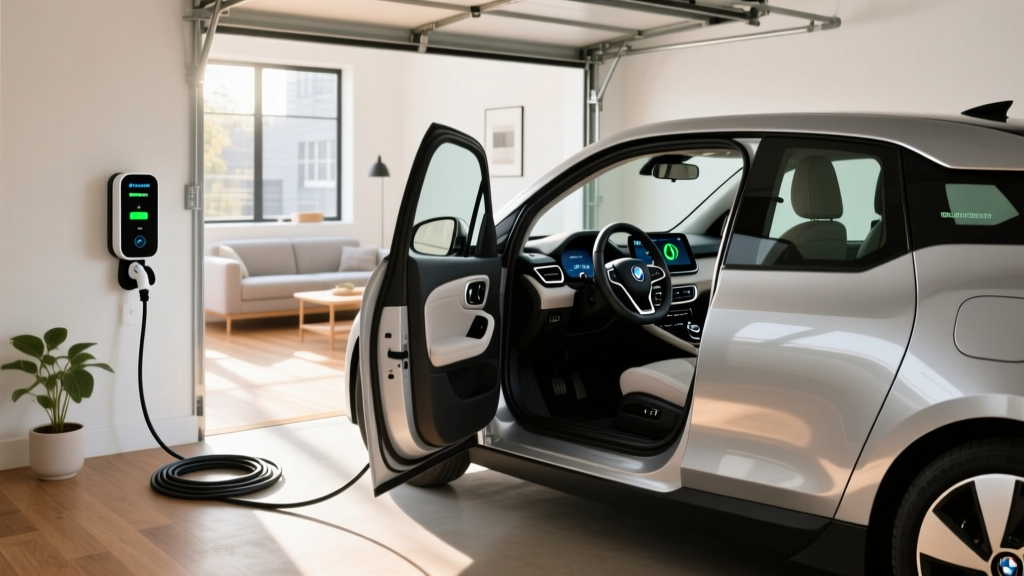
The 2016 BMW i3 remains one of the most distinctive early EVs on the used market, with its carbon-fiber-reinforced plastic body, tight city turning radius, and peppy 170-hp electric motor. But if you're buying or already own one, understanding its real-world range and the best way to charge it at home and on the road is essential. The EPA-rated 2016 BMW i3 range is 81 miles for the standard 60-Ah battery model and 114 miles for the later 94-Ah variant introduced mid-year. Real-world highway driving, cold weather, and climate control use can reduce those figures by 15–30%, making a smart home charging strategy non-negotiable.
This guide breaks down exactly what it takes to keep an i3 charged efficiently — from Level 1 trickle charging on a standard outlet to Level 2 home installations and DC fast charging on the road. We'll cover connector compatibility (the i3 uses CCS1 and, on earlier builds, a CHAdeMO option), installation costs, equipment recommendations, and what you'll actually pay per mile compared to a gas car.
EPA estimate: 81 miles (60 Ah) / 114 miles (94 Ah)
Real-world highway (65-75 mph): ~60–68 miles (60 Ah) / ~85–95 miles (94 Ah)
Cold weather (below 32°F): Expect 20–30% reduction due to cabin heating and battery chemistry limitations
City/commute with regen: Can meet or slightly exceed EPA estimates thanks to aggressive regenerative braking
The i3's NMC lithium-ion battery lacks active thermal management (it uses passive air cooling), which means extreme temperatures hit range harder than in liquid-cooled packs like Tesla or Hyundai's. Source: EPA fueleconomy.gov.
Charging Levels Explained: What Each Adds to Your i3
Before installing anything, you need to understand the three charging tiers and what they mean for the i3's relatively small battery. The 2016 i3's usable battery capacity is approximately 18.8 kWh (60 Ah model) or 27.2 kWh (94 Ah model). Because the battery is small, charging times are shorter than larger EVs — but charge rate limitations still apply.
A critical distinction: kW (kilowatts) measures power — how fast energy flows into the car. kWh (kilowatt-hours) measures energy — the total capacity of the battery. Think of kW as the width of a hose and kWh as the size of the bucket.
| Level | Voltage | Max Power (kW) | Miles of Range Added/Hour | i3 60 Ah Full Charge Time | i3 94 Ah Full Charge Time |
|---|---|---|---|---|---|
| Level 1 (120V outlet) | 120V | 1.2–1.4 kW | ~4–5 miles | ~14–16 hours | ~20–22 hours |
| Level 2 (240V home/public) | 240V | 7.4 kW (i3 onboard limit) | ~25–30 miles | ~2.5–3 hours | ~3.5–4 hours |
| DC Fast Charging | 400V+ | 47 kW (CCS1 peak) | ~90–120 miles (in 30 min) | 10–80% in ~25 min | 10–80% in ~35 min |
The i3's onboard AC charger maxes out at 7.4 kW, meaning even if you plug into a 48-amp (11.5 kW) Level 2 station, the car will only accept 7.4 kW. For DC fast charging, the i3 supports CCS1 at up to approximately 47 kW — adequate for its small battery but modest by 2026 standards. Note that DC charging speed tapers significantly above 80% state of charge (SoC) to protect battery health, which is why 10–80% time is the standard benchmark.
Home Charger Installation: Electrical Requirements and Costs
For daily driving, a Level 2 home charger is the single best upgrade for any i3 owner. Level 1 charging from a standard 120V outlet technically works, but at ~4 miles of range per hour, it won't replenish a depleted 94-Ah battery overnight if you've driven more than ~80 miles.
Electrical Specifications
Because the i3's onboard charger tops out at 7.4 kW (32 amps at 240V), you need a dedicated 40-amp, 240-volt circuit (EVSEs must be derated to 80% of circuit capacity per NEC code, so a 40A circuit supports a 32A continuous draw). A 50-amp circuit with a 40-amp charger also works and gives you future-proofing headroom if you eventually upgrade to an EV with a higher onboard charge rate.
Panel Upgrade Considerations
Older homes — particularly those built before 1990 — often have 100-amp electrical panels. Adding a 40-amp dedicated circuit may require a panel upgrade to 200 amps, which is one of the most significant hidden costs in home EV charging. A licensed electrician will perform a load calculation to determine if your existing panel can handle the additional draw alongside HVAC, electric range, dryer, and other circuits.
| Component | Cost Range | Notes |
|---|---|---|
| Level 2 EVSE (charger unit) | $300–$700 | 32A–48A smart chargers; Wi-Fi-enabled models on the higher end |
| Electrician labor (standard install) | $500–$1,500 | Assumes panel is nearby, conduit run under 30 ft, no drywall repair |
| Permit and inspection | $50–$200 | Varies by municipality; required for code compliance |
| Electrical panel upgrade (if needed) | $1,500–$3,500 | 100A → 200A service upgrade; common in pre-1990 homes |
| Total (no panel upgrade) | $850–$2,400 | Typical scenario for modern homes with adequate panel capacity |
| Total (with panel upgrade) | $2,350–$5,900 | Worst-case for older homes needing full service upgrade |
Always hire a licensed electrician and pull a permit. Unpermitted electrical work can void your homeowner's insurance and create fire risk. The National Electrical Code (NEC Article 625) requires GFCI protection for outdoor EVSE installations and specifies that EV chargers must be on a dedicated circuit — not shared with other appliances.
Connector Compatibility: CCS1, CHAdeMO, and the i3
The 2016 BMW i3 uses the CCS1 (Combined Charging System) connector for DC fast charging and the standard J1772 connector for Level 1 and Level 2 AC charging. This was BMW's standard for North American i3 models.
However, some early i3 builds (2014–early 2015) were equipped with CHAdeMO DC fast charging ports instead. By 2016, BMW had standardized on CCS1, but it's worth verifying your specific vehicle's DC port type by checking the charge port door or your owner's manual.
| Connector | Use Case | i3 Compatibility | Adapter Needed? |
|---|---|---|---|
| J1772 | Level 1 & 2 AC charging | ✅ Native | No |
| CCS1 | DC fast charging | ✅ Native (2016 models) | No |
| CHAdeMO | DC fast charging | ⚠️ Some early builds only | N/A — verify your vehicle |
| NACS (Tesla) | Tesla Supercharger network | ❌ Not native | Yes — CCS1-to-NACS adapter (~$200–$300) required for Supercharger access |
As Tesla opened its Supercharger network to non-Tesla EVs via the NACS standard, CCS1-equipped i3 owners can access Superchargers using a CCS1-to-NACS adapter. BMW has not issued an official adapter, but third-party options from brands like Lectron and A2Z are available. Confirm that the adapter supports the i3's 47 kW DC charge rate before purchasing. Tesla's built-in Magic Dock adapters at some Supercharger stalls can also work without a separate dongle.
Cost to Charge the i3: Per-Mile Economics vs. Gas
One of the strongest arguments for the i3 as a commuter car is its low operating cost. With an EPA-rated efficiency of 137 MPGe combined (60 Ah) or 111 MPGe combined (94 Ah with range extender), the i3 sips electricity. Here's what that translates to in dollars.
| Scenario | Rate | Cost for Full Charge (94 Ah / 27.2 kWh) | Cost Per Mile |
|---|---|---|---|
| Home off-peak (utility time-of-use) | $0.08–$0.12/kWh | $2.18–$3.26 | $0.02–$0.03 |
| Home standard rate | $0.14–$0.18/kWh | $3.81–$4.90 | $0.03–$0.04 |
| Public Level 2 (ChargePoint, EVgo) | $0.25–$0.49/kWh | $6.80–$13.33 | $0.06–$0.12 |
| DC Fast Charging (Electrify America) | $0.35–$0.55/kWh | $9.52–$14.96 | $0.08–$0.13 |
| Gas car comparison (30 MPG, $3.50/gal) | — | — | $0.12 |
At home on off-peak rates, the i3 costs roughly 2–3 cents per mile to drive — about one-quarter the cost of a 30-MPG gas car at $3.50/gallon. Even on public DC fast chargers at premium rates, the i3's small battery keeps absolute costs low. A full charge from near-empty rarely exceeds $15.
For context on utility rates and time-of-use plans, check your local utility's EV-specific rate schedules. Many utilities offer overnight rates below $0.10/kWh specifically to incentivize home EV charging.
Recommended Home Chargers for the BMW i3
Since the i3's onboard charger caps at 7.4 kW (32A), you don't need a 48-amp charger to max out its capability — but buying a higher-output unit gives you flexibility for future EVs. Here are three solid options spanning budget to premium.
Emporia Level 2 EV Charger
- Power output: 48A / 11.5 kW (i3 will use 32A / 7.4 kW)
- Connector: J1772 (NACS version also available)
- Cable length: 24 ft
- Smart features: Wi-Fi, app-based scheduling, energy monitoring, solar integration
- Price: ~$399
- Best for: Budget-conscious buyers who want smart scheduling to exploit off-peak rates
ChargePoint Home Flex
- Power output: Up to 50A / 12 kW (adjustable via dip switches)
- Connector: J1772 (NACS adapter included in newer kits)
- Cable length: 23 ft
- Smart features: Wi-Fi, ChargePoint app, Alexa integration, scheduled charging
- Price: ~$549
- Best for: i3 owners who want a proven brand with broad public network integration
Grizzl-E Smart
- Power output: 40A / 9.6 kW
- Connector: J1772 (NACS version available)
- Cable length: 24 ft
- Smart features: Wi-Fi, OCPP compatibility, adjustable amperage, outdoor-rated (NEMA 4)
- Price: ~$499
- Best for: Outdoor installations and cold-climate owners; built in Canada with -40°F rating
Any of these units will fully charge the i3 94 Ah in 3.5–4 hours on a 40-amp circuit. For the 60 Ah model, expect 2.5–3 hours. Hardwired installations are preferred over plug-in NEMA 14-50 outlets for reliability and to avoid the NEC requirement for GFCI breakers on receptacle-based EVSEs (which can cause nuisance tripping).
Public Charging with the i3: Networks and Practical Tips
The i3's CCS1 connector gives it access to the majority of public DC fast-charging networks in the U.S., including Electrify America, EVgo, and ChargePoint. With a CCS1-to-NACS adapter, Tesla Supercharger access is also available at participating stations.
However, the i3's ~47 kW peak DC charge rate means it won't take advantage of 150–350 kW ultra-fast chargers any quicker than a standard 50 kW unit. Don't pay premium rates for 350 kW stalls when a 50 kW charger will fill the i3 at the same speed.
Cold-weather charging tip: The i3's passive battery thermal management means DC fast charging slows dramatically in cold weather. BMW includes a battery preconditioning feature — enable it via the iDrive navigation system by setting a charging station as your destination. This warms the battery to an optimal temperature before you arrive, improving charge acceptance. Without preconditioning in sub-freezing temperatures, expect DC charge rates to drop to 15–25 kW initially, extending your 10–80% time significantly.
Safety and Code Considerations for Home Charging
EV charging installation must comply with NEC Article 625 and local building codes. Key requirements include:
- Dedicated circuit: The EVSE must be on its own breaker — not shared with other loads like a dryer or HVAC system.
- GFCI protection: Required for outdoor receptacle-based installations. Hardwired EVSEs have built-in ground-fault protection and typically don't require a GFCI breaker (which can cause nuisance trips).
- Outdoor rating: If your charger is installed outside, the unit must be rated at least NEMA 3R (rain-resistant) or NEMA 4 (weatherproof). All three recommended chargers above meet this standard.
- Cable management: NEC requires that charging cables not create a trip hazard. Wall-mounted cable organizers or retractors are recommended.
- Ventilation: Not required for the i3's sealed lithium-ion battery, but your electrical panel area should have adequate clearance per code.
Always have your installation inspected by the local authority having jurisdiction (AHJ). An unpermitted install can create liability issues and may not be covered by homeowner's insurance in the event of an electrical fire.
Frequently Asked Questions
How much does it cost to install a home EV charger for the BMW i3?
A typical Level 2 home installation costs $850–$2,400 including the charger unit, electrician labor, and permit — assuming your electrical panel has sufficient capacity. If a panel upgrade from 100A to 200A is needed, total costs can reach $2,350–$5,900. Get at least two quotes from licensed electricians and confirm they pull a permit.
How fast will each charging level add range to the i3?
Level 1 (120V) adds roughly 4–5 miles per hour. Level 2 (240V at 32A) adds about 25–30 miles per hour and fully charges the 94-Ah model in ~3.5–4 hours. DC fast charging at 47 kW adds approximately 90–120 miles of range in 30 minutes, with a 10–80% charge taking 25–35 minutes depending on battery variant and temperature.
Which connector and charger is compatible with my 2016 BMW i3?
The 2016 i3 uses J1772 for AC charging (Level 1 and 2) and CCS1 for DC fast charging. Any J1772 Level 2 home charger will work. For Tesla Supercharger access, you'll need a CCS1-to-NACS adapter. Verify whether your specific vehicle has CCS1 or CHAdeMO for DC charging — 2016 models should be CCS1.
How much does charging cost per mile vs. a gas car?
Charging at home on off-peak rates costs approximately $0.02–$0.03 per mile for the i3, compared to roughly $0.12 per mile for a 30-MPG gas car at $3.50/gallon. Even public DC fast charging at premium rates ($0.35–$0.55/kWh) costs around $0.08–$0.13 per mile — comparable to or cheaper than gasoline.
What electrical upgrades might I need for a home charger?
You'll need a dedicated 40-amp, 240-volt circuit. Homes with 100-amp electrical panels (common in pre-1990 construction) may require a panel upgrade to 200 amps ($1,500–$3,500). An electrician will perform a load calculation to determine if your existing panel can support the additional circuit. Other potential upgrades include running new conduit, upgrading the meter base, or adding a sub-panel if the garage is far from the main panel.
Does the 2016 i3 qualify for any federal tax credits today?
The federal §30D new-vehicle tax credit no longer applies to the i3, as it is no longer sold new and BMW's credit allocation was exhausted years ago. However, if you're purchasing a used i3 from a dealer, you may qualify for the used EV credit of up to $4,000 (30% of the sale price, capped at $4,000) under IRS rules, subject to income limits ($75,000 single / $150,000 joint) and a sale price cap of $25,000. Verify current eligibility at IRS.gov or consult a tax professional.
Is the i3's battery still reliable in 2026?
The i3's NMC battery has shown moderate degradation over time. Expect 10–20% capacity loss over 8–10 years depending on climate and charging habits. BMW's original battery warranty was 8 years / 100,000 miles (covering defects and capacity below 70%). For a 2016 model, this warranty has expired or is expiring. Battery replacement costs approximately $8,000–$12,000 through BMW, though third-party refurbishment options exist for less. Hot climates and frequent DC fast charging accelerate degradation.