If you are shopping for a used first-generation Nissan Leaf or already own one, the single most important number to understand is how much range the 24 kWh battery actually delivers after years of use — and how to charge it efficiently in 2026's evolving connector landscape. The 2015 Leaf was the final model year for the original 24 kWh pack before Nissan bumped capacity to 30 kWh for 2016, making it a popular budget EV on the used market. But its CHAdeMO connector, modest DC fast-charge rate, and age-related battery degradation demand a realistic ownership plan.
Real-World Range on a 2015 Nissan Leaf: Beyond the EPA Sticker
The EPA rated the 2015 Nissan Leaf at 84 miles of combined range when new, drawing from a 24 kWh lithium-manganese oxide (LMO) battery pack with roughly 21-22 kWh usable. That number was conservative even in 2015. In 2026, with a battery that is now over a decade old, the realistic range depends heavily on the pack's State of Health (SoH).
EPA (when new): 84 miles
Expected today (80-85% SoH): 65-72 miles in mild weather
Highway at 70 mph: 55-62 miles
Cold weather (below 32°F): 45-55 miles
Worst-case (cold + highway + degraded pack at 70% SoH): ~40 miles
Most 2015 Leafs still on the road show between 9 and 11 capacity bars out of 12 on the dashboard — Nissan's crude but useful SoH indicator. Each lost bar represents roughly 7-8% capacity loss. A Leaf showing 10 bars retains approximately 80-83% of its original capacity, yielding around 68 miles of mixed driving in temperate conditions. You can get a more precise reading using the LeafSpy OBD2 app, which reports exact SoH percentage, cell voltage variance, and battery temperature — essential tools for any used-Leaf buyer.
The Leaf's efficiency remains strong at roughly 30 kWh/100 miles (or about 3.3 miles per kWh), according to fueleconomy.gov. That efficiency is what keeps the car viable despite the small pack: it simply does not waste energy.
Charging Levels Explained: What the 2015 Leaf Can Accept
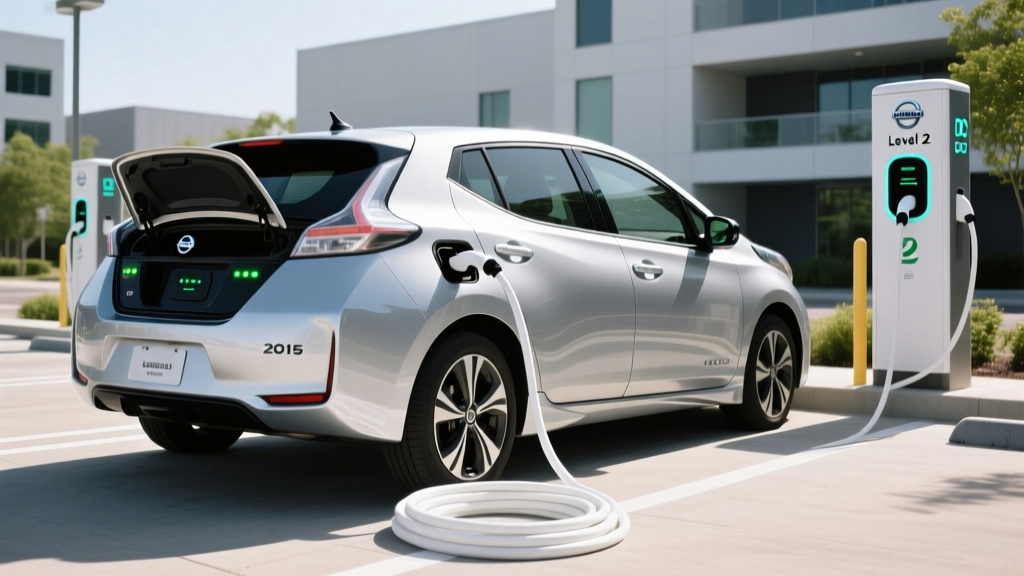
The 2015 Leaf uses a J1772 connector for Level 1 and Level 2 AC charging, and a CHAdeMO connector for DC fast charging (if equipped with the optional Quick Charge port — base S trims sometimes lacked it). Understanding the difference between kW (power — how fast energy flows) and kWh (energy — how much the battery holds) is critical. Think of kW as the width of a hose and kWh as the bucket size. The 2015 Leaf's bucket is 24 kWh; the hose width varies by charger.
| Level | Power (kW) | Miles Added per Hour | Full Charge Time (0-100%) | Connector |
|---|---|---|---|---|
| Level 1 (120V) | 1.2-1.4 kW | ~4-5 miles/hr | ~20-22 hours | J1772 |
| Level 2 (240V) | 3.3 kW (Leaf's onboard limit) | ~11-13 miles/hr | ~7-8 hours | J1772 |
| DC Fast Charge | ~40-50 kW peak | ~100-120 miles/hr (at peak) | ~30 min (0-80%) | CHAdeMO |
A critical limitation: the 2015 Leaf's onboard AC charger maxes out at 3.3 kW. Even if you plug into a 7.2 kW or 11.5 kW Level 2 station, the Leaf will only draw 3.3 kW. This means a 40-amp or 48-amp home charger will not charge this car any faster than a basic 16-amp, 240V unit. Save your money on overkill hardware.
On DC fast charging, the Leaf peaks around 40-50 kW when the battery is warm and at a low State of Charge (below 30%). However, the charge curve tapers significantly above 80%, and the Leaf lacks active battery thermal management — it relies on passive air cooling. In hot weather or after repeated fast charges, you may see the notorious "Rapidgate" throttling, where charge speeds drop to protect the overheating pack. Expect a 20-80% DC fast charge to take roughly 25-35 minutes under normal conditions.
Home Charger Installation: Costs, Electrical Requirements, and Gotchas
For daily charging, a Level 2 home setup is the practical standard. Since the 2015 Leaf only accepts 3.3 kW, you have flexibility: a modest 240V/16A circuit delivers the car's maximum, but many owners install a 240V/40A circuit to future-proof for their next EV.
| Item | Budget Install | Standard Install | Complex Install |
|---|---|---|---|
| EVSE Hardware (Level 2) | $200-$350 | $350-$600 | $500-$700 |
| Electrician Labor | $300-$500 | $500-$1,000 | $1,000-$2,500 |
| Permit & Inspection | $50-$150 | $100-$250 | $150-$350 |
| Panel Upgrade (if needed) | N/A | N/A | $1,500-$3,500 |
| Total Range | $550-$1,000 | $950-$1,850 | $3,150-$7,050 |
Electrical requirements: A 3.3 kW charge rate needs only a 240V/20A dedicated circuit (16A continuous draw, per NEC 80% rule). However, installing a 240V/40A or 240V/50A circuit with a NEMA 14-50 outlet is the smart play — it costs only slightly more in wire and breaker, and it supports 7.2-9.6 kW chargers for your next vehicle. Always use a licensed electrician and pull a permit; unpermitted work can void home insurance and complicate resale.
Panel upgrade reality: Many older homes (pre-1990) have 100A electrical panels. Adding a 40A EV circuit may push total load past 80% of panel capacity, triggering a requirement to upgrade to a 200A panel — a $1,500-$3,500 job. Before committing, ask your electrician for a load calculation. Some utilities offer panel-upgrade rebates that offset this cost.
Safety and code considerations: The NEC requires a dedicated circuit (no sharing with other appliances), GFCI protection for outdoor installations, and a disconnect within sight of the charger if hardwired. For outdoor mounting, choose an EVSE rated NEMA 4 (weather-resistant). The 2015 Leaf's J1772 inlet is not waterproof when the plug is partially inserted, so always seat the connector fully.
CHAdeMO in 2026: Connector Compatibility and the Adapter Problem
The 2015 Leaf is one of the last widely available EVs using the CHAdeMO DC fast-charging standard. As of 2026, the North American charging landscape has shifted decisively toward NACS (Tesla's connector, now SAE J3400) and CCS1. This creates a practical challenge for Leaf owners.
| Connector Standard | Leaf Compatible? | Adapter Available? | Network Access |
|---|---|---|---|
| J1772 (AC Level 1/2) | ✅ Native | N/A | All public AC stations |
| CHAdeMO (DC Fast) | ✅ Native | N/A | Electrify America (limited), EVgo, independent stations |
| CCS1 (DC Fast) | ❌ No | No reliable adapter exists | N/A |
| NACS / J3400 (DC Fast) | ❌ No | No CHAdeMO-to-NACS adapter | Tesla Superchargers inaccessible |
The hard truth: there is currently no commercially available adapter that lets a CHAdeMO-equipped Leaf charge at a CCS1 or NACS DC fast charger. CHAdeMO-to-CCS adapters have been rumored for years but never materialized due to the communication-protocol differences between the standards. This means Leaf owners are restricted to the shrinking CHAdeMO network.
Practical workarounds: use PlugShare or A Better Routeplanner to filter for CHAdeMO stations. EVgo maintains the largest CHAdeMO presence in the US. Electrify America still supports CHAdeMO at many legacy stations but has not expanded it. For road trips longer than the Leaf's range allows, plan around CHAdeMO availability or accept that this car is best suited as a commuter and local errand vehicle.
Charging Cost Per Mile: Leaf vs. Gasoline Car
One of the 2015 Leaf's strongest arguments in 2026 is operating cost. At roughly 30 kWh/100 miles (3.3 mi/kWh), the Leaf is among the most efficient EVs ever sold, and that efficiency translates directly to pennies-per-mile savings.
| Scenario | Rate | Leaf Cost/Mile | Gas Car Cost/Mile (30 MPG) |
|---|---|---|---|
| Home charging (off-peak) | $0.10/kWh | $0.030 | $0.117 ($3.50/gal) |
| Home charging (standard rate) | $0.16/kWh | $0.048 | $0.117 |
| Public Level 2 | $0.30/kWh | $0.090 | $0.117 |
| DC Fast Charging (public) | $0.45/kWh | $0.135 | $0.117 |
At home on a standard rate, the Leaf costs roughly 4.8 cents per mile to fuel — about 60% less than a 30 MPG gas car at $3.50/gallon. Even on expensive public DC fast charging, the Leaf's small battery limits the damage: a 0-80% charge (about 17 kWh) costs roughly $7.65 at $0.45/kWh. The math strongly favors home charging, where a full charge costs $2.40-$3.84.
Recommended Level 2 Chargers for the 2015 Leaf
Because the Leaf caps at 3.3 kW, you do not need an expensive 48-amp charger. A quality 16-amp or 32-amp unit delivers full speed. That said, investing in a higher-amperage unit makes sense if you plan to upgrade to a newer EV within a few years.
Output: 40A / 9.6 kW (Leaf uses 3.3 kW)
Connector: J1772
Cable: 24 ft
Smart Features: Wi-Fi, app scheduling, energy monitoring
Price: ~$399
Why: Cheapest smart charger with full amperage; great for solar-home integration.
Output: Up to 50A / 12 kW (adjustable via DIP switch)
Connector: J1772 (NACS version also available)
Cable: 23 ft
Smart Features: Wi-Fi, Alexa, scheduled charging, detailed app
Price: ~$549
Why: Adjustable amperage fits any panel; future-proofs for your next EV.
Output: 40A / 9.6 kW
Connector: J1772
Cable: 24 ft
Smart Features: OCPP-compatible, app control
Price: ~$449
Why: NEMA 4 rated, -40°F to 122°F operating range, built in Canada for harsh climates.
For the 2015 Leaf specifically, the Emporia Vue is the value pick — it delivers more power than the Leaf can use, includes smart scheduling to exploit off-peak electricity rates, and costs under $400. The included EV charger qualifies for the residential energy credit (30% of equipment cost, up to $1,000, per IRS §25E) if installed at your primary residence through 2032 — confirm eligibility with a tax professional.
Maximizing Range and Battery Life on an Aging 24 kWh Pack
With a battery this age, how you charge and drive directly determines how many usable miles remain. A few evidence-based practices:
- Avoid daily 100% charges. The Leaf's LMO chemistry degrades faster at high SoC. Charge to 80% for daily use (use the car's built-in charge timer or your EVSE's scheduling feature). Reserve 100% for days you need maximum range.
- Minimize DC fast charging in heat. The passive-cooled pack heats up significantly during 40-50 kW charges. Repeated same-day fast charges in summer trigger thermal throttling and accelerate long-term degradation. If you must fast-charge, do it in the morning when ambient temperatures are lower.
- Precondition the cabin while plugged in. The Leaf's resistive cabin heater draws 3-5 kW — a massive hit on a 24 kWh pack. Preconditioning while connected to shore power warms the cabin without draining the battery. Use the NissanConnect app or the car's timer function.
- Drive at moderate speeds. The Leaf's efficiency drops sharply above 65 mph due to aerodynamic drag. At 75 mph, expect 20-25% less range than at 55 mph.
- Monitor SoH with LeafSpy. A $20 OBD2 dongle and the LeafSpy Lite app give you dealer-level battery diagnostics. Track SoH monthly; a sudden drop may indicate a failing cell module.
Frequently Asked Questions
How much does it cost to install a home EV charger for a 2015 Leaf?
A basic 240V/20A installation with a budget EVSE runs $550-$1,000 if your electrical panel has spare capacity. A standard install with a smart charger and a 40A circuit (recommended for future-proofing) costs $950-$1,850. If your home needs a panel upgrade from 100A to 200A, add $1,500-$3,500. Always get a licensed electrician's load calculation before committing.
How fast will each charging level add range to the Leaf?
Level 1 (120V) adds about 4-5 miles per hour — overnight charging yields roughly 40-50 miles, enough for many commutes. Level 2 (240V) adds 11-13 miles per hour, fully replenishing the pack in 7-8 hours. DC fast charging at a CHAdeMO station can take the pack from 20-80% in about 25-35 minutes, adding roughly 45-50 miles of range.
Which connector and charger is compatible with my 2015 Leaf?
For AC charging, the Leaf uses the J1772 connector — universal across all non-Tesla public Level 2 stations and all home Level 2 EVSEs. For DC fast charging, it uses CHAdeMO, available at EVgo and some Electrify America stations. There is no adapter to use CCS1 or NACS/Tesla Supercharger DC fast stations with a Leaf.
How much does charging the Leaf cost per mile compared to gas?
At home on average electricity ($0.16/kWh), the Leaf costs about 4.8 cents per mile — roughly 60% cheaper than a 30 MPG gas car at $3.50/gallon (11.7 cents/mile). On off-peak rates ($0.10/kWh), the Leaf drops to 3 cents per mile. Public DC fast charging at $0.45/kWh is the one scenario where the Leaf can cost slightly more per mile than gas, but most owners charge at home 90%+ of the time.
What electrical upgrades might I need for a home charger?
Most homes built after 1990 with a 200A panel need only a new 240V circuit and breaker ($300-$600 in labor). Homes with 100A panels may need a load calculation; if the panel is near capacity, a 200A upgrade ($1,500-$3,500) may be required. Some utilities and states offer rebates for panel upgrades tied to EV adoption — check with your local utility and the DSIRE incentive database.
Is the 2015 Leaf still a good buy in 2026?
As a second car, city commuter, or errand runner within its 60-70 mile real-world envelope, yes — especially at used prices of $5,000-$8,000. Its efficiency, low operating cost, and hatchback practicality remain compelling. But buyers must accept the limited DC fast-charging network, degraded battery reality, and the need for reliable home or workplace charging. If your daily round trip exceeds 50 miles or you need road-trip capability, look at a newer Leaf (40 or 62 kWh) or a used Chevy Bolt with CCS fast charging.