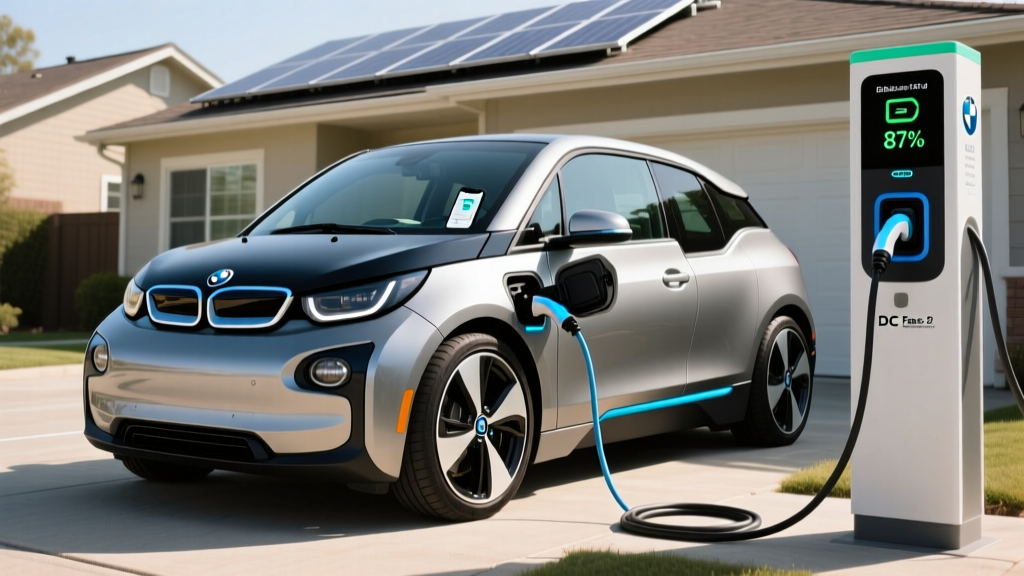
The 2015 BMW i3 RWD with Range Extender (REx) occupies a unique space in the used-EV market. Its 22 kWh battery (18.8 kWh usable) paired with a 647cc two-cylinder gasoline generator means owners need to think about charging differently than pure BEV drivers. This guide covers every charging scenario you will encounter — from a standard 120V wall outlet to DC fast charging — plus realistic home installation costs, connector compatibility, and what you will actually spend per mile in 2026.
Understanding the 2015 BMW i3 REx Battery and Electrical System
Before plugging in, you need the numbers that define your charging experience. The 2015 i3 REx carries an 18.8 kWh usable lithium-ion (NMC) battery pack. The EPA rated its all-electric range at 72 miles, with the range extender adding roughly another 70-80 miles on a full 1.9-gallon fuel tank, for a combined range around 150 miles. Real-world electric range hovers between 55-65 miles in mixed driving, dropping to 45-50 miles in cold weather or sustained highway speeds above 70 mph.
The onboard charger accepts up to 7.4 kW on Level 2 AC (single-phase, 32A). On DC fast charge, the 2015 i3 REx peaked at approximately 50 kW via its Combo (CCS1) port — though only if equipped with the DC Fast Charging option package. Without that option, you are limited to AC charging only, which is a critical detail to verify before purchasing a used example.
- Battery: 22 kWh gross / 18.8 kWh usable (NMC chemistry)
- EPA electric range: 72 miles (real-world: 55-65 mi)
- Onboard AC charger: 7.4 kW max (32A, 240V)
- DC fast charge: 50 kW max (CCS1) — only with DC option
- Charge port: CCS1 (Combo) — Type 1 J1772 for AC, CCS pins for DC
- Fuel tank: 1.9 gallons (range extender)
Charging Levels Explained: Speeds in kW and Miles Per Hour
EV charging operates across three tiers. Understanding the difference between kW (power — how fast energy flows) and kWh (energy — what your battery stores) is essential. Think of kW as the flow rate of a hose and kWh as the bucket size.
| Level | Voltage / Amps | Max Power (kW) | Miles of Range Added Per Hour | Full Charge Time (0-100%) |
|---|---|---|---|---|
| Level 1 (120V household) | 120V / 12A | 1.4 kW | ~4-5 miles | ~14-16 hours |
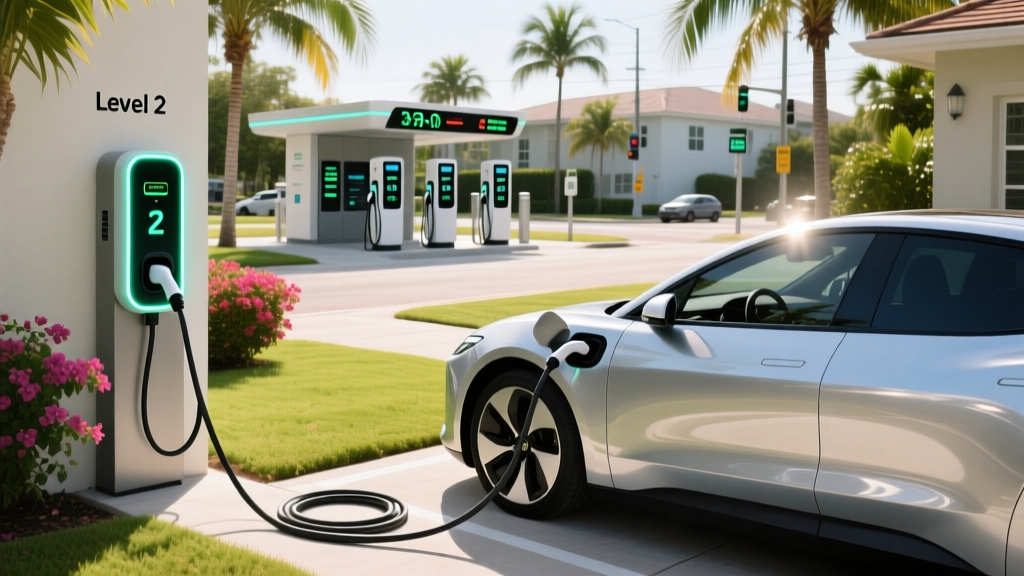
| Level 2 (240V home/public) | 240V / 32A | 7.4 kW | ~22-25 miles | ~2.5-3 hours |
| DC Fast (50 kW CCS) | 400V DC | 50 kW | ~120+ miles (first 30 min) | ~30 min (0-80%) |
Real-world charging curve note: The i3's DC fast-charge curve peaks at 47-50 kW between 0-50% state of charge, then tapers significantly. Expect 0-80% in roughly 30 minutes at a 50 kW station, but 80-100% can take another 20-25 minutes. On road trips, plan to charge to 80% and move on — that is where the math favors speed.
Home Charger Installation: Electrical Requirements and Costs
The 2015 i3 REx's 18.8 kWh battery is small enough that even a modest Level 2 charger replenishes it overnight with ease. Most owners install a 240V / 32A (7.7 kW output) or 40A (9.6 kW output) Level 2 station. Because the car's onboard charger caps at 7.4 kW, a 32A circuit is technically sufficient — but installing a 40A or 48A unit future-proofs for your next EV.
Electrical Requirements
- Circuit: Dedicated 240V circuit, 40A breaker minimum (for a 32A charger) or 50A breaker (for a 40A charger). NEC requires continuous loads to use only 80% of breaker capacity.
- Wire: 6 AWG copper for 40A circuits; 4 AWG for 50A circuits. Longer runs may require upsizing to prevent voltage drop.
- Panel capacity: Most homes with a 200A service panel have sufficient headroom. Homes with 100A panels or heavy existing loads (electric heat, hot tub, workshop) may need a panel upgrade or a load-management device.
- Permit: Required in virtually all jurisdictions for new 240V circuits. Your electrician typically pulls this.
- GFCI: NEC 2020+ requires GFCI protection for EV receptacles (NEMA 14-50). Hardwired units may be exempt in some jurisdictions — confirm locally.
| Component | Low Estimate | High Estimate | Notes |
|---|---|---|---|
| Level 2 charger unit (32A-48A) | $250 | $700 | Varies by brand, smart features, cable length |
| Electrician labor (2-6 hours) | $400 | $1,500 | Depends on run length, wall material, attic/crawlspace access |
| Materials (wire, conduit, breaker) | $100 | $400 | Longer runs and conduit requirements increase cost |
| Permit and inspection | $50 | $250 | Varies by municipality |
| Panel upgrade (if needed) | $1,500 | $3,500 | Only if existing panel lacks capacity; 100A→200A upgrade |
| Total (no panel upgrade) | $800 | $2,850 | Most installations fall in the $1,200-$1,800 range |
| Total (with panel upgrade) | $2,300 | $6,350 | Older homes with 100A service |
Panel upgrade reality check: If your home was built before 1990 and still has a 100A panel, budget for an upgrade or at minimum a load calculation by a licensed electrician. Some utilities offer rebates that offset panel-upgrade costs — check with your provider before starting work.
Connector Compatibility: What Plugs Into the 2015 i3 REx?
The 2015 BMW i3 REx uses a CCS1 (Combo) charge port. This means:
- AC charging (Level 1 and Level 2): Uses the J1772 connector (the upper portion of the CCS port). Every public Level 2 station in North America has a J1772 plug.
- DC fast charging: Uses the full CCS1 connector (J1772 + two DC pins below). Most non-Tesla DC fast stations in the U.S. provide CCS1.
- Tesla Superchargers: The i3 cannot natively use Tesla's NACS connector or Supercharger network. As of 2026, Tesla has opened some Superchargers to non-Tesla vehicles via the Magic Dock adapter (built into the Supercharger pedestal at select locations), but availability remains limited. For reliable DC fast charging, rely on Electrify America, EVgo, and ChargePoint networks.
- CHAdeMO: The i3 does not use CHAdeMO. If you encounter a station with only CHAdeMO connectors (increasingly rare), you cannot charge there without a prohibitively expensive and impractical adapter.
| Connector Type | Compatible? | Where You'll Find It | Adapter Needed? |
|---|---|---|---|
| J1772 (Level 1/2 AC) | Yes — native | All public L2 stations, home chargers | None |
| CCS1 (DC Fast) | Yes — native (with DC option) | Electrify America, EVgo, ChargePoint DC | None |
| NACS / Tesla (DC Fast) | No — not native | Tesla Superchargers | Magic Dock at select stations only |
| CHAdeMO (DC Fast) | No | Legacy Nissan Leaf stations (declining) | N/A — no practical adapter |
Cost to Charge: Per-Mile Economics vs. Gasoline
One of the strongest arguments for the i3 REx is its low operating cost on electric miles. Here is what charging actually costs across common scenarios, compared to the range-extender gasoline engine (which averages roughly 39 MPG combined per fueleconomy.gov).
| Scenario | Cost per kWh / Gallon | Cost to Fill Battery / Tank | Miles Gained | Cost Per Mile |
|---|---|---|---|---|
| Home charging (off-peak, $0.12/kWh) | $0.12/kWh | $2.26 (18.8 kWh) | 65 mi (real-world) | $0.035 |
| Home charging (peak, $0.22/kWh) | $0.22/kWh | $4.14 | 65 mi | $0.064 |
| Public Level 2 ($0.35/kWh avg) | $0.35/kWh | $6.58 | 65 mi | $0.101 |
| DC Fast Charging ($0.48/kWh avg) | $0.48/kWh | $9.02 (0-80%, ~15 kWh) | 52 mi | $0.174 |
| Range Extender gasoline ($3.50/gal, 39 MPG) | $3.50/gal | $6.65 (1.9 gal tank) | 74 mi | $0.090 |
The takeaway: Home off-peak charging at $0.035/mile is roughly one-third the cost of the range extender on gasoline and one-fifth the cost of a comparable 30 MPG gas car at $0.117/mile. Even public DC fast charging at $0.174/mile can exceed gasoline costs — which is why home charging is where the economics work best for i3 REx owners.
With an 18.8 kWh battery, your maximum cost for a full home charge is between $2.26 and $4.14 depending on your electricity rate. That small battery is an economic advantage: you are not paying to fill a 75-100 kWh pack every night.
Recommended Level 2 Chargers for the BMW i3 REx
Because the i3 caps AC charging at 7.4 kW (32A), you do not need a 48A charger to get maximum speed — but buying one gives you flexibility for future vehicles. Here are proven units suited to the i3's needs:
Emporia Level 2 Smart Charger
- Power output: 48A / 11.5 kW (240V)
- Connector: J1772 (compatible with i3 natively)
- Cable length: 24 ft
- Smart features: Wi-Fi, app scheduling, energy monitoring, solar integration
- Price: ~$399
- Best for: Budget-conscious buyers who want smart scheduling for off-peak rates
ChargePoint Home Flex
- Power output: Up to 50A / 12 kW (configurable 16A-50A)
- Connector: J1772
- Cable length: 23 ft
- Smart features: Wi-Fi, app control, Alexa integration, flexible amperage settings
- Price: ~$649
- Best for: Owners who want to dial amperage to match their circuit capacity
Grizzl-E Smart
- Power output: 40A / 9.6 kW (240V)
- Connector: J1772
- Cable length: 24 ft
- Smart features: OCPP protocol, app control, outdoor-rated (IP67)
- Price: ~$449
- Best for: Outdoor installation in harsh climates; rugged build
Tesla Universal Wall Connector
- Power output: 48A / 11.5 kW (240V)
- Connector: NACS + J1772 adapter built into cable
- Cable length: 24 ft
- Smart features: Wi-Fi, Tesla app, OTA updates
- Price: ~$599
- Best for: Households with both Tesla and non-Tesla EVs (future-proofing)
Any of these units will charge the i3 REx at its maximum 7.4 kW AC rate. The difference is what happens when you eventually upgrade to an EV with a larger onboard charger.
Public Charging Networks for the i3 REx
On the road, your DC fast-charging options depend on whether your specific 2015 i3 was equipped with the DC Fast Charging package (a $750 option when new). Verify this before purchase: look for the CCS pins (two large round pins below the J1772 portion) in the charge port. If they are blanked out, your car is AC-only.
Best networks for the i3 REx in 2026:
- Electrify America: Largest CCS1 DC network; stations typically offer 50-350 kW chargers. Your i3 will draw up to 50 kW. Plug & Charge is supported on BMW models — the car authenticates automatically.
- EVgo: Extensive urban CCS1 coverage, often paired with retail locations. Pricing averages $0.30-$0.48/kWh depending on region and membership tier.
- ChargePoint: Mix of Level 2 and DC fast stations; strong workplace and retail presence.
Charging time at a 50 kW DC station (i3 REx with DC option):
- 10-80% in approximately 25-30 minutes
- 10-50% in approximately 12-15 minutes (peak power zone)
- Above 80%, power tapers to ~20 kW, then ~7 kW above 90%
With only 72 miles of electric range (and realistically 55-65), DC fast charging is essential for any trip beyond your daily commute. Plan routes around charger availability using apps like PlugShare or A Better Routeplanner.
Safety, Code, and Installation Best Practices
EV charging is a high-draw, continuous electrical load — it runs at maximum amperage for hours. This places demands on your home wiring that exceed typical appliance circuits.
- Dedicated circuit: Your Level 2 charger must have its own dedicated circuit. Never share with other appliances.
- NEMA 14-50 vs. hardwired: A NEMA 14-50 receptacle offers portability (take the charger when you move) but requires GFCI protection under NEC 2020+, which can cause nuisance tripping with some chargers. Hardwired installations avoid the GFCI requirement in many jurisdictions and provide a more reliable connection.
- Outdoor rating: If installing outside, ensure the charger is rated at least IP55 (splash-resistant) or IP67 (submersion-resistant). The Grizzl-E and ChargePoint Home Flex both carry outdoor ratings.
- Cable management: A 24-foot cable drags on the ground and collects dirt. Consider a holster or retractable cable management system, especially for garage installations.
- Utility notification: Some utilities require you to notify them before installing an EV charger. Many offer time-of-use (TOU) rate plans that can cut your charging costs by 40-60% — call your utility before installation.
Frequently Asked Questions
How much does it cost to install a home EV charger for the BMW i3?
Expect $1,200-$1,800 for a typical installation (charger + electrician + permit) if your electrical panel has sufficient capacity. If you need a panel upgrade from 100A to 200A, add $1,500-$3,500. The i3's small battery and 7.4 kW onboard charger mean you can use a relatively affordable 32A charger and a standard 40A circuit, keeping costs on the lower end.
How fast will each charging level add range to my i3 REx?
Level 1 (120V) adds roughly 4-5 miles per hour — adequate only for topping up if you drive under 30 miles daily. Level 2 (240V, 32A) adds about 22-25 miles per hour and fully recharges the 18.8 kWh battery in 2.5-3 hours. DC fast charging at 50 kW can add approximately 45-50 miles in 20 minutes.
Which connector and charger is compatible with the 2015 BMW i3 REx?
The i3 uses the CCS1 (Combo) port. For AC charging (home and public Level 2), you need a J1772 connector — this is universal in North America. For DC fast charging, you need a CCS1 connector, available at Electrify America, EVgo, and ChargePoint DC stations. Tesla Superchargers are not natively compatible.
How much does charging the i3 cost per mile compared to gas?
Home off-peak charging costs approximately $0.035/mile — roughly one-third the cost of the range extender on gasoline ($0.090/mile at $3.50/gal and 39 MPG). Public DC fast charging at $0.48/kWh costs about $0.174/mile, which is more expensive than using the range extender. Maximize home charging to realize the i3's economic advantage.
What electrical upgrades might my home need?
Homes with a 200A panel typically need no upgrade — a 40A circuit for the i3's charger is well within capacity. Homes with older 100A panels, electric heating, or heavy existing loads may need a panel upgrade ($1,500-$3,500) or a smart load-management device that throttles the charger when other appliances draw heavily. Always have a licensed electrician perform a load calculation before installation.
Does the 2015 i3 REx qualify for any tax credits in 2026?
As a used vehicle, the 2015 i3 REx may qualify for the federal used clean vehicle credit under IRS §30D — up to $4,000 or 30% of the sale price (whichever is less) if purchased from a dealer for $25,000 or less, with buyer income caps ($75,000 single / $150,000 joint). The vehicle must be at least two model years old (which it is). Verify current eligibility on irs.gov and confirm with a tax professional, as rules and eligible vehicle lists update regularly.
Can I charge my i3 REx at Tesla Superchargers?
Not directly. The i3 uses CCS1, while Tesla Superchargers use NACS. Some Tesla Supercharger stations now feature a built-in "Magic Dock" CCS adapter for non-Tesla vehicles, but these locations are limited. For reliable DC fast charging, use Electrify America or EVgo.
Sources: U.S. EPA / fueleconomy.gov for range and efficiency data; IRS.gov for used clean vehicle credit rules; BMW Group press archives for original vehicle specifications. Installation cost estimates based on 2026 electrician rate surveys. Always confirm local code requirements with a licensed electrician.