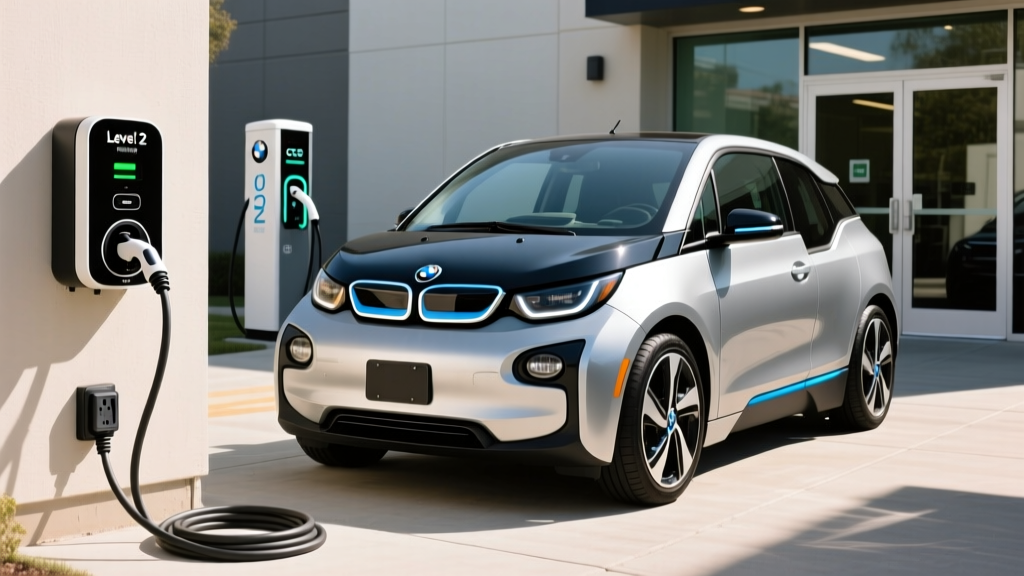
The 2015 BMW i3 base with Range Extender (REx) remains one of the most distinctive plug-in vehicles on the used market. Its 22 kWh battery pack (18.8 kWh usable) paired with a 647cc two-cylinder gasoline generator gives it a dual personality: a short-range electric commuter and a gas-assisted road-tripper. But that small battery also means charging habits matter enormously. Whether you've just picked one up or are evaluating a used listing, this guide covers exactly how to charge the 2015 BMW i3 REx at home, in public, and on the road — with real numbers, not marketing gloss.
2015 BMW i3 REx: Battery, Range, and Charging Specs at a Glance
Before we talk chargers, let's ground the discussion in the i3 REx's actual hardware. The 2015 model year uses Samsung SDI lithium-ion cells in a 96-series configuration, yielding 22 kWh gross / 18.8 kWh usable capacity. The EPA rated it at 72 miles of electric-only range and a combined 117 MPGe. The range extender kicks in only when the battery drops to roughly 6% state of charge (SoC), adding approximately 78 more miles on its 1.9-gallon fuel tank for a combined gas+electric range of about 150 miles.
| Specification | 2015 BMW i3 REx |
|---|---|
| Battery (gross / usable) | 22 kWh / 18.8 kWh |
| EPA electric-only range | 72 miles |
| Total range (electric + REx gas) | ~150 miles |
| MPGe (combined) | 117 MPGe |
| Onboard AC charger | 7.4 kW (single-phase) |
| DC fast charge max | ~50 kW (CCS1 / Combo) |
| 10–80% DC fast charge time | ~25 minutes |
| Level 2 full charge time (0–100%) | ~3 hours |
| Level 1 full charge time (0–100%) | ~20 hours |
| AC charging connector (US) | J1772 (Type 1) |
| DC fast connector (US) | CCS1 (Combo) |
| Charge port location | Right rear quarter panel |
Real-world range reality: The EPA's 72-mile electric figure assumes moderate temperatures and mixed driving. Expect 55–65 miles in sustained highway driving at 70+ mph, and as low as 45–55 miles in sub-30°F winter conditions without preconditioning. The REx generator mitigates range anxiety, but it's a comfort net — not a substitute for planning charges on longer trips.
Charging Levels Explained: How Fast Will Each Add Range?
EV charging is measured in kilowatts (kW), which is the rate of power delivery. The battery stores energy measured in kilowatt-hours (kWh). Think of kW as how fast water flows from a hose, and kWh as the total volume in the bucket. For the i3 REx's 18.8 kWh usable battery, here's what each level delivers:
| Level | Power (kW) | Voltage / Amperage | Miles of Range Added per Hour | Full Charge (0–100%) Time |
|---|---|---|---|---|
| Level 1 (standard outlet) | 1.4 kW | 120V / 12A | ~5 mi/hr | ~20 hours |
| Level 2 (home/public AC) | 7.4 kW (max) | 240V / 32A | ~25 mi/hr | ~3 hours |
| DC Fast Charge (CCS1) | ~50 kW (peak) | DC direct to battery | ~100+ mi/hr (10–80%) | ~25 min (10–80%) |
A few nuances matter for the i3 REx specifically:
- Level 1 is viable for light commuters. If you drive 30 miles round-trip and can plug in overnight (10+ hours), Level 1 adds enough to cover daily use. It's slow, but the i3's small battery makes it more practical than on a 100 kWh pack.
- Level 2 is the sweet spot. At 7.4 kW, the i3's onboard charger maxes out at 32 amps on 240V. Installing a 40-amp circuit (which delivers 32A continuous per NEC 80% rule) is ideal. A 48-amp charger won't charge the i3 any faster — the car limits intake to 7.4 kW.
- DC fast charging tops out around 50 kW. The i3 was an early CCS1 adopter. On a 50 kW or higher station, it pulls its peak rate only between roughly 10–50% SoC, then tapers. Expect the 10–80% charge in about 25 minutes. Above 80%, the curve drops sharply to protect the cells — don't plan your road trip around charging past 80% at DC stations.
Home Charger Installation: Electrical Requirements, Costs, and Panel Upgrades
Installing a Level 2 home charger for the 2015 BMW i3 REx is one of the highest-return upgrades an EV owner can make. But costs vary dramatically depending on your electrical panel, distance from panel to charge location, and local permit requirements.
Electrical Requirements for the i3 REx
The i3's 7.4 kW onboard charger draws 32 amps at 240 volts. Per the National Electrical Code (NEC), continuous loads must be on a circuit rated at 125% of the draw, meaning you need a 40-amp dedicated circuit with appropriately sized wire (8 AWG copper for most runs). A 50-amp circuit with 6 AWG wire is also common and provides future-proofing for a next EV with a larger onboard charger.
Panel Upgrade: The Hidden Cost
Homes built before 2000 often have 100-amp or 150-amp main service panels. Adding a 40-amp EV circuit to an already-loaded panel may require a panel upgrade to 200 amps, which adds $1,500–$3,000+ to your total cost. Signs you might need an upgrade:
- Main breaker is 100A or 150A
- No open breaker slots
- Existing high-draw appliances (electric range, dryer, HVAC) already consume most of the panel's capacity
- Electrician performs a load calculation and flags insufficient headroom
Some utilities and state programs offer rebates for panel upgrades tied to EV adoption — check with your local provider.
| Cost Component | Low Estimate | High Estimate | Notes |
|---|---|---|---|
| Level 2 charger (hardware) | $300 | $700 | 32A–40A, J1772 connector |
| Electrician labor (standard install) | $500 | $1,500 | Varies by run length, wall type |
| Electrical permit | $50 | $250 | Required in most jurisdictions |
| Panel upgrade (if needed) | $1,500 | $3,500 | 100A → 200A service upgrade |
| Total (no panel upgrade) | $850 | $2,450 | |
| Total (with panel upgrade) | $2,350 | $5,950 |
Federal incentive note: The Alternative Fuel Vehicle Refueling Property Credit (IRS Form 8911) may cover up to 30% of home charging equipment and installation costs (up to $1,000) for eligible taxpayers in qualifying census tracts. Eligibility depends on income and location — consult a tax professional and review current-year IRS guidance.
Connector Compatibility: J1772, CCS1, and the NACS Question
The 2015 BMW i3 REx uses two connectors:
- J1772 (Type 1) for all AC charging (Level 1 and Level 2)
- CCS1 (Combo) for DC fast charging — the CCS1 connector adds two DC pins below the J1772 inlet
| Connector Type | i3 REx Port? | Where You'll Find It | Adapter Needed? |
|---|---|---|---|
| J1772 (AC Level 1/2) | Yes | Home chargers, public Level 2 stations, workplaces | No |
| CCS1 (DC Fast) | Yes (if equipped with DC fast charge option) | Electrify America, EVgo, most non-Tesla DC stations | No |
| NACS / Tesla (DC + AC) | No | Tesla Superchargers, growing number of stations | Yes — CCS1-to-NACS adapter (~$150–$250) |
| CHAdeMO (DC Fast) | No | Limited legacy stations, some Nissan Leaf networks | Not practical (no widely available adapter) |
Critical note: Not all 2015 i3 REx models were equipped with the DC fast charging option. BMW offered it as a standalone add-on (approximately $700 at purchase). Check the vehicle's charge port: if you see only a single J1772 inlet with no lower DC pins, the car lacks CCS1 DC fast charging capability. This significantly limits road-trip practicality.
As of 2026, the charging landscape is shifting toward NACS (the Tesla connector). Electrify America, EVgo, and other networks are adding NACS cables alongside CCS1, and Tesla Superchargers now welcome non-Tesla EVs at select locations via the Tesla app. A CCS1-to-NACS adapter expands the i3's DC fast-charging options considerably for road trips.
Cost to Charge: Per-Mile Economics vs. Gasoline
One of the strongest ownership arguments for the i3 REx is its low cost per mile on electricity. Here's how charging costs break down across scenarios, using the 18.8 kWh usable battery and EPA-rated efficiency of roughly 29 kWh/100 miles (or ~0.29 kWh per mile):
| Charging Scenario | $/kWh | Cost for Full Charge (18.8 kWh) | Cost per Mile (electric) |
|---|---|---|---|
| Home Level 2 — off-peak utility rate | $0.08 | $1.50 | $0.023 |
| Home Level 2 — average US residential | $0.16 | $3.01 | $0.046 |
| Public Level 2 (ChargePoint, etc.) | $0.25–$0.40 | $4.70–$7.52 | $0.072–$0.116 |
| DC Fast Charge (Electrify America, EVgo) | $0.35–$0.55 | $6.58–$10.34 | $0.101–$0.159 |
Gas comparison: The i3 REx's range extender achieves approximately 39 MPG combined when running on gasoline. At $3.50/gallon, that's roughly $0.090 per mile. Home off-peak charging at $0.08/kWh costs about one-quarter as much per mile as the REx generator. Even at average residential rates, electric driving is roughly half the per-mile cost of the gas extender.
The takeaway: maximize your electric-only miles by charging at home, and treat the REx as a safety net rather than a primary power source. Owners who charge nightly and commute under 50 miles may go months between fill-ups of the 1.9-gallon tank.
Recommended Home Chargers for the BMW i3 REx
Since the i3 REx caps AC charging at 7.4 kW (32 amps), you don't need the most powerful charger on the market — but you do want reliability, a quality cable, and smart features. Here are three strong picks for 2026:
Emporia Vue Smart EV Charger (40A / 48A model)
- Power output: Configurable up to 48A (9.6 kW); set to 40A for i3 compatibility
- Connector: J1772
- Cable length: 24 feet
- Smart features: Wi-Fi, app scheduling, solar integration, energy monitoring via Emporia Vue panel
- Price: ~$350–$400
- Why for the i3: Budget-friendly, excellent energy tracking, and the scheduling feature lets you target off-peak utility rates automatically.
ChargePoint Home Flex (up to 50A)
- Power output: Adjustable 16A–50A via app; set to 32A–40A for i3
- Connector: J1772
- Cable length: 23 feet
- Smart features: Wi-Fi, Alexa/Google Home, ChargePoint app scheduling, public network integration
- Price: ~$550–$650
- Why for the i3: Proven reliability, strong app ecosystem, and the adjustable amperage means it adapts if you upgrade to a higher-power EV later.
Grizzl-E Smart (40A)
- Power output: 40A (9.6 kW max; i3 will draw 32A / 7.4 kW)
- Connector: J1772
- Cable length: 24 feet
- Smart features: Wi-Fi (Smart model), OCPP-compatible, basic scheduling
- Price: ~$400–$500
- Why for the i3: Built in Canada for extreme temperatures (rated to -40°F), rugged outdoor enclosure, and simple setup. Great for garage or outdoor mounting in cold climates.
Any of these units will fully charge the i3 REx from empty in roughly 3 hours on a 40-amp circuit. The i3's onboard charger is the bottleneck, not the station — so spending extra on a 48-amp or 80-amp charger won't speed up this car, but it will future-proof for your next EV.
Safety, Code, and Installation Best Practices
EV charging involves sustained high-current draw over many hours — a more demanding electrical load than most household appliances. Proper installation protects your home and your vehicle:
- Dedicated circuit: Your Level 2 charger must be on its own dedicated breaker — never shared with other outlets or appliances.
- GFCI protection: NEC 2020 and later require GFCI (Ground Fault Circuit Interrupter) protection for EV outlets in garages. Hardwired installations may have different requirements depending on local code. Your electrician will handle this.
- Outdoor rating: If mounting outside, ensure the charger carries an outdoor rating (NEMA 4 or IP65 minimum). The Grizzl-E and ChargePoint Home Flex are both outdoor-rated.
- Permit and inspection: Most jurisdictions require an electrical permit for a new 240V circuit. The permit ensures an inspector verifies the work. Skipping this risks insurance claim denials if an electrical fire occurs.
- Wire gauge: 40-amp circuits require minimum 8 AWG copper; 50-amp circuits require 6 AWG. For runs over 50 feet, your electrician may upsized wire to prevent voltage drop.
- No extension cords: Never use an extension cord with a Level 2 charger. If the cable doesn't reach, relocate the charger or have an electrician move the outlet.
Public Charging and Road Trips with the i3 REx
The i3 REx's small battery and 50 kW DC fast-charge ceiling shape how road trips work in practice. Here's the realistic playbook:
- Plan DC stops around the 10–80% window. Charging from 10% to 80% takes about 25 minutes at a 50 kW+ CCS1 station. Charging from 80% to 100% can take nearly as long due to the taper curve — it's faster to resume driving and stop again later.
- Use the REx strategically. On stretches with sparse charging infrastructure, let the range extender run. It's less efficient than home electricity but keeps you moving. Refuel the 1.9-gallon tank at any gas station.
- Precondition the battery. If your i3 has the preconditioning feature (available via the BMW Connected app or departure timer), activate it before DC fast charging. A warm battery charges faster and reduces cell stress. This is especially critical in winter when cold-soaked batteries charge dramatically slower.
- Apps to rely on: PlugShare, A Better Routeplanner, and the Electrify America/EVgo apps for station availability. Filter by CCS1 connectors and verify station status before routing.
For reference, the EPA's fueleconomy.gov listing for the 2015 i3 REx confirms the 72-mile electric range and 117 MPGe figures used throughout this guide.
Frequently Asked Questions
How much does it cost to install a home EV charger for the 2015 BMW i3 REx?
Expect $850–$2,450 for a standard Level 2 installation (charger hardware, electrician labor, and permit) if your electrical panel has sufficient capacity. If a panel upgrade from 100A to 200A service is needed, total costs rise to $2,350–$5,950. Always get a load calculation from a licensed electrician before committing.
How fast will each charging level add range to the i3 REx?
Level 1 (120V) adds about 5 miles of range per hour. Level 2 (240V, 32A) adds about 25 miles per hour and fully charges the 18.8 kWh battery in roughly 3 hours. DC fast charging at 50 kW adds over 100 miles per equivalent hour and takes about 25 minutes from 10% to 80% SoC.
Which connector and charger is compatible with my 2015 BMW i3 REx?
For AC charging (Level 1 and Level 2), the i3 uses the J1772 connector — the universal standard for non-Tesla EVs in North America. For DC fast charging, it uses CCS1 (Combo), provided the DC fast charge option was equipped at purchase. For Tesla Supercharger access, a CCS1-to-NACS adapter is required.
How much does charging the i3 REx cost per mile compared to gasoline?
At a typical residential electricity rate of $0.16/kWh, driving on battery costs about $0.046 per mile. The range extender on gasoline (39 MPG combined at $3.50/gallon) costs about $0.090 per mile. Home off-peak rates ($0.08/kWh) drop the electric cost to just $0.023 per mile — roughly one-quarter the cost of the gas generator.
What electrical upgrades might I need to charge the i3 REx at home?
At minimum, you need a dedicated 40-amp, 240-volt circuit with 8 AWG copper wire. If your home's main service panel is 100A or 150A and already near capacity, a panel upgrade to 200A may be required — adding $1,500–$3,500 to the project. A licensed electrician will perform a load calculation to determine your panel's headroom.
Does my 2015 i3 REx have DC fast charging?
Not necessarily. BMW offered DC fast charging as an optional add-on (~$700) on the 2015 i3. Inspect the charge port on the right rear quarter panel: if you see only the round J1772 inlet with no additional DC pins below it, the car does not have CCS1 DC fast charging. This is a critical factor when evaluating used listings.