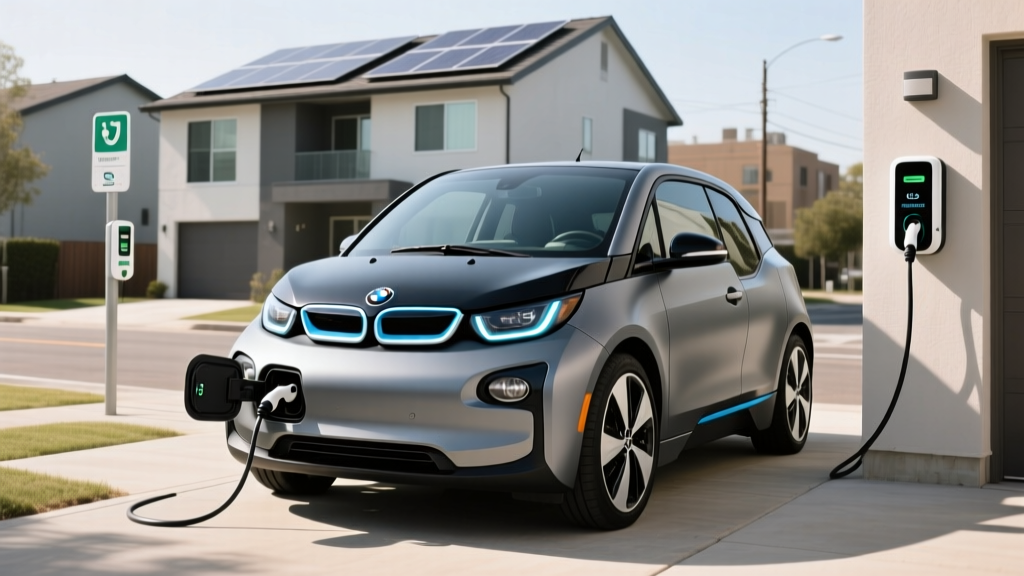
The 2015 BMW i3 Range Extender (REx) occupies a unique space in the used EV market: a plug-in electric city car paired with a 647cc two-cylinder gasoline generator that kicks in when the battery depletes. With a modest 18.8 kWh battery pack (roughly 16.5 kWh usable), its charging needs differ sharply from modern long-range BEVs. This guide breaks down exactly how to charge a 2015 i3 REx at home, on the road, and what it all costs in 2026.
Understanding the 2015 BMW i3 Range Extender Battery and Powertrain
Before plugging in, it helps to know what you're working with. The 2015 i3 REx carries an 18.8 kWh lithium-ion (NMC chemistry) battery pack, with approximately 16.5 kWh usable capacity thanks to a top and bottom buffer designed to prolong battery life. The EPA rated the pure-electric range at 72 miles before the range-extending gasoline engine activates, giving a combined gas-electric range of roughly 150 miles.
| Spec | Value |
|---|---|
| Battery Capacity (Total / Usable) | 18.8 kWh / ~16.5 kWh |
| Battery Chemistry | NMC (Nickel Manganese Cobalt) |
| EPA Electric-Only Range | 72 miles |
| Combined Range (Electric + Gas) | ~150 miles |
| EPA MPGe (Electric) | 117 MPGe |
| EPA MPG (Gas REx Mode) | 39 MPG combined |
| Onboard Charger (Level 2 AC) | 7.4 kW (single-phase) |
| DC Fast Charge (CCS Combo) | Optional — 50 kW peak |
| AC Charging Port | Type 1 (J1772) |
| DC Charging Port (if equipped) | CCS1 (Combo) |
| 0–60 mph | 7.9 seconds |
| Horsepower | 170 hp (electric motor) |
Charging Levels Explained: How Fast Can You Refill the i3 REx?
The i3 REx supports three charging levels, though DC fast charging was an optional extra and not all 2015 models have it. Here is what each level delivers on this specific vehicle:
| Level | Voltage / Power | Miles of Range Added Per Hour | Full Charge Time (0–100%) |
|---|---|---|---|
| Level 1 (120V household outlet) | 120V / ~1.4 kW | ~4–5 miles/hr | ~16–18 hours |
| Level 2 (240V home/public AC) | 240V / up to 7.4 kW | ~22–25 miles/hr | ~3 hours |
| DC Fast Charge (CCS, if equipped) | ~50 kW peak | ~80+ miles in 30 min | 0–80% in ~25–30 min |
kW vs. kWh — the critical distinction: kW (kilowatts) measures the rate of charging, like water pressure from a hose. kWh (kilowatt-hours) measures the total energy stored in the battery, like the size of the bucket. The i3 REx's 16.5 kWh usable battery is the bucket; a 7.4 kW Level 2 charger is the flow rate filling it.
Level 1: The Emergency Trickle
Every i3 REx ships with a 120V Level 1 charging cable. At roughly 1.4 kW, it adds about 4–5 miles of electric range per hour. A full charge from empty takes 16–18 hours. This is adequate only if you drive less than 30 miles daily and can charge overnight. For a REx owner who primarily drives electric and uses gas sparingly, Level 1 is workable but slow.
Level 2: The Daily Standard
The i3's onboard charger accepts up to 7.4 kW on Level 2 AC power. This means a full charge in approximately 3 hours — practical for overnight top-ups or midday charging at workplace stations. Since the battery is small, you rarely need a 48A or 80A home charger; even a 32A (7.7 kW) unit will max out the car's onboard acceptance.
DC Fast Charging: The Road-Trip Option
If your 2015 i3 REx was optioned with DC fast charging (CCS Combo port), it can accept up to 50 kW at a public DC fast charger. The small battery means the charge curve stays relatively flat — you can go from roughly 10% to 80% in 25–30 minutes. Above 80%, the rate tapers significantly to protect cell health. Without the DC fast-charge option, your i3 has only the J1772 AC port and cannot use CCS or CHAdeMO stations.
Home Charger Installation: Electrical Requirements and Costs
For most i3 REx owners, a Level 2 home charger is the sweet spot. Because the car maxes out at 7.4 kW, you do not need the most powerful (or expensive) charger on the market. A 32-amp, 240V circuit delivering 7.7 kW is ideal — it slightly exceeds the car's acceptance rate, giving you headroom for a future EV upgrade.
Electrical Requirements
- Circuit: Dedicated 40-amp breaker (for a 32A continuous-load charger) or 50-amp breaker (for a 40A charger)
- Voltage: 240V single-phase (standard US residential split-phase)
- Wire gauge: 6 AWG copper for 40A; 8 AWG for some 32A runs depending on distance
- Outlet vs. hardwired: NEMA 14-50 outlet offers portability; hardwired units avoid the outlet cost but are fixed
- GFCI protection: Required by NEC 2020+ for EV receptacles in garages; many modern chargers have built-in GFCI
Panel Upgrade Considerations
Many homes built before 2000 have 100-amp or even 60-amp main electrical panels. Adding a 40A dedicated circuit to an already-loaded 100A panel may require a panel upgrade to 200 amps, which is one of the largest variables in installation cost. A licensed electrician will perform a load calculation per NEC Article 220 to determine if your panel has sufficient headroom.
| Component | Typical Cost Range | Notes |
|---|---|---|
| Level 2 Charger (32A–40A) | $350–$700 | Brands: ChargePoint, Emporia, Wallbox, Grizzl-E |
| Electrician Labor (standard install) | $400–$1,200 | Depends on run length from panel to garage |
| Electrical Materials (wire, conduit, breaker) | $150–$400 | Longer runs and conduit requirements add cost |
| Permit and Inspection | $50–$250 | Varies by municipality; required in most jurisdictions |
| Panel Upgrade (if needed) | $1,500–$3,500 | 100A → 200A service upgrade |
| Total (no panel upgrade) | $950–$2,550 | Most common scenario for modern homes |
| Total (with panel upgrade) | $2,450–$6,050 | Older homes or high-load panels |
The IRS §30D tax credit does not cover home charging equipment for existing homes (that was the §30C alternative fuel infrastructure credit, which has separate eligibility rules and caps). Check afdc.energy.gov for state and utility rebates that may offset your charger or installation cost.
Connector Compatibility: What Plugs Into the 2015 i3 REx?
The 2015 BMW i3 REx predates the industry-wide shift to NACS (the Tesla-designed connector now becoming the North American standard). Here is what fits and what requires an adapter:
| Connector Type | Compatible? | Details |
|---|---|---|
| J1772 (Type 1 AC) | Yes — native | Standard AC charging port on all i3 models |
| CCS1 (Combo DC) | Only if DC fast-charge optioned | Lower portion of port; not all 2015 i3s have it |
| CHAdeMO | No | Never offered on the i3 |
| NACS (Tesla) | Requires adapter | Tesla J1772 adapter included with most Tesla chargers; works for AC only |
| Tesla Supercharger | No (without CCS adapter + network access) | DC Superchargers require CCS adapter; Tesla has opened some stations to non-Tesla EVs via the Tesla app, but only CCS-equipped vehicles |
Practical advice: For home Level 2 charging, any J1772 charger works natively. If you buy a Tesla Wall Connector (NACS), you'll need the Tesla-to-J1772 adapter (~$100–$200 aftermarket, or BMW/Tesla OEM when available). For public DC fast charging, confirm your i3 has the CCS port — look for the two extra DC pins below the standard J1772 inlet. If your i3 lacks DC fast charging, you are limited to AC public chargers (Level 2), which is fine for a car with a 72-mile electric range and a gasoline backup.
Cost to Charge: Home Electricity vs. Public vs. Gas
One of the strongest ownership arguments for the i3 REx is low fueling cost on electric miles. Here is how it breaks down with the car's 16.5 kWh usable battery and 72-mile EPA electric range:
| Scenario | Rate | Cost for Full Charge (16.5 kWh) | Cost Per Mile (Electric) |
|---|---|---|---|
| Home — off-peak utility rate | $0.09/kWh | $1.49 | $0.021/mile |
| Home — average US rate | $0.17/kWh | $2.81 | $0.039/mile |
| Public Level 2 (network pricing) | $0.25–$0.49/kWh | $4.13–$8.09 | $0.057–$0.112/mile |
| DC Fast Charge (Electrify America, EVgo) | $0.35–$0.56/kWh | $5.78–$9.24 | $0.080–$0.128/mile |
| Gasoline (REx mode, premium 91 octane) | $3.80/gallon (2026 avg) | $7.22 (1.9 gal tank) | $0.097/mile at 39 MPG |
Even at the national average residential electricity rate, the i3 REx costs roughly 4 cents per mile on electricity — about a third of what you'd pay running the gasoline range extender, and roughly a quarter of what a 30 MPG gasoline car costs at $3.80/gallon ($0.127/mile).
The gasoline range extender is best understood as a safety net for longer trips or when charging is unavailable. For daily commuting under 60 miles, most i3 REx owners report going weeks without the gas engine activating — keeping maintenance and fuel costs minimal.
Recommended Level 2 Chargers for the 2015 BMW i3 REx
Because the i3's onboard charger caps at 7.4 kW, you do not need a 48A or 80A unit. A 32-amp charger (7.7 kW output) is the cost-effective sweet spot. Here are three strong options for 2026:
Emporia Vue Smart Charger
- Power: 48A max (configurable down to 32A)
- Connector: J1772 (native fit for i3)
- Cable length: 24 ft
- Smart features: Wi-Fi, app scheduling, solar integration, energy monitoring
- Price: ~$399
- Why for i3: Budget-friendly smart charger with granular amperage control; set to 32A to match the car's 7.4 kW acceptance
ChargePoint Home Flex
- Power: Up to 50A (configurable via dip switch)
- Connector: J1772
- Cable length: 23 ft
- Smart features: Wi-Fi, app, Alexa, scheduling, charge history
- Price: ~$549
- Why for i3: Reliable brand with wide utility-rebate eligibility; set to 40A circuit / 32A continuous for the i3
Grizzl-E Smart
- Power: 40A max
- Connector: J1772
- Cable length: 24 ft
- Smart features: Wi-Fi, OCPP-compatible, app scheduling
- Price: ~$449
- Why for i3: Rugged, outdoor-rated (NEMA 4), Canadian-built; ideal for unheated garages or outdoor installs
Safety note: Whichever charger you choose, ensure it is UL-listed (or ETL-listed to UL standards). The i3 REx's small battery means less thermal stress during charging, but proper circuit protection, a dedicated breaker, and GFCI compliance are non-negotiable per NEC requirements. For outdoor installations, select a charger rated NEMA 4 or higher.
Public Charging Networks: Where Can the i3 REx Plug In?
The 2015 i3 REx can use any public Level 2 (J1772) station. For DC fast charging (if your car is equipped), it uses CCS1. Here is the 2026 network landscape:
- ChargePoint / EVgo / Blink (Level 2): J1772 native — plug in directly. Typical speeds of 6.6–7.2 kW will max out the i3's onboard charger.
- Electrify America (DC Fast): CCS1 native — plug in directly if your i3 has the DC port. Expect ~40–47 kW sustained, tapering above 85% SoC.
- Tesla Superchargers (NACS): Not directly compatible. Some Supercharger stations have been opened to non-Tesla CCS vehicles via the Tesla app, but your i3 needs the CCS port and a physical CCS-to-NACS adapter. As of 2026, adapter availability and network access remain limited for non-Tesla vehicles.
- Public Level 2 (workplaces, malls, parking garages): The i3's most common public charging scenario. A 2–3 hour shopping trip or workday will fully replenish the 16.5 kWh battery.
Given the i3 REx's gasoline backup, public DC fast charging is less critical than for a pure BEV. Most owners find that home Level 2 plus occasional public Level 2 covers daily needs, with the range extender handling longer trips.
Battery Longevity and Charging Best Practices
The 2015 i3 REx is now over a decade old, and battery degradation is a legitimate consideration. BMW's original high-voltage battery warranty was 8 years / 100,000 miles with a capacity-retention threshold of 70%. Most 2015 i3s are now out of warranty. Real-world data from i3 owner communities suggests average degradation of 10–18% after 8–10 years, meaning a car that originally delivered 72 electric miles may now deliver 58–65 miles.
To minimize further degradation:
- Avoid frequent 100% charges: Set your i3's charge limit to 80–90% for daily use if your routine allows. Use 100% only before longer trips.
- Minimize DC fast charging: Occasional DC fast charges are fine, but daily use accelerates cell wear on older NMC packs.
- Don't let it sit at 0% or 100%: Store the car at roughly 50–60% SoC if it won't be driven for a week or more.
- Precondition while plugged in: The i3 supports departure-time preconditioning. Warming or cooling the cabin while on shore power preserves range and reduces battery stress.
Frequently Asked Questions
How much does it cost to install a home EV charger for a 2015 BMW i3 REx?
For a standard installation without a panel upgrade, expect $950–$2,550 total, including a 32A–40A Level 2 charger ($350–$700), electrician labor ($400–$1,200), materials ($150–$400), and permits ($50–$250). If your home requires a 100A-to-200A panel upgrade, add $1,500–$3,500. The i3's modest 7.4 kW acceptance means you do not need the most expensive charger or highest-amperage circuit.
How fast will each charging level add range to the i3 REx?
Level 1 (120V) adds roughly 4–5 miles of electric range per hour. Level 2 (240V at 7.4 kW) adds about 22–25 miles per hour, fully recharging the 16.5 kWh usable battery in around 3 hours. DC fast charging (50 kW CCS, if equipped) can add roughly 50 miles in 20 minutes or reach 80% in 25–30 minutes.
Which connector and charger is compatible with my 2015 BMW i3 REx?
All 2015 i3 REx models use a J1772 (Type 1) connector for AC charging. DC fast charging uses CCS1 (Combo), but only if the car was originally optioned with it — check for the two additional DC pins below the J1772 inlet. Any J1772 Level 2 home charger works natively. NACS (Tesla) chargers require a J1772 adapter for AC use.
How much does charging cost per mile compared to gas?
At the US average residential electricity rate of $0.17/kWh, the i3 REx costs approximately $0.039 per mile on electricity. Running the gasoline range extender at $3.80/gallon (premium) costs about $0.097 per mile at 39 MPG. Home charging is roughly 60% cheaper per mile than the gasoline backup, and up to 80% cheaper on off-peak utility rates.
What electrical upgrades might I need for a home charger?
The most common upgrade is a dedicated 40A or 50A 240V circuit from your main panel. If your panel is already near capacity (common in older homes with 100A service), a full panel upgrade to 200A may be required, adding $1,500–$3,500. A licensed electrician will perform a NEC Article 220 load calculation to determine your panel's available capacity. Some utilities offer free or discounted load assessments.
Is it worth installing a Level 2 charger for a car with only 72 miles of electric range?
Yes — for most i3 REx owners, Level 2 is essential. A full charge in ~3 hours means you can top up during the day or overnight reliably. Level 1 at 1.4 kW would take 16+ hours for a full charge, making it impractical as a primary charging method. The small battery actually makes Level 2 highly cost-effective: the charger pays for itself quickly through gasoline savings.
Can I use a Tesla Supercharger with my 2015 i3 REx?
Not directly. The i3 uses J1772/CCS1 connectors, while Tesla Superchargers use NACS. Some Supercharger stations have opened to non-Tesla CCS vehicles via the Tesla app, but this requires your i3 to have the optional CCS DC port and a CCS-to-NACS adapter. For most i3 REx owners, the gasoline range extender eliminates the need for DC fast charging on road trips entirely.