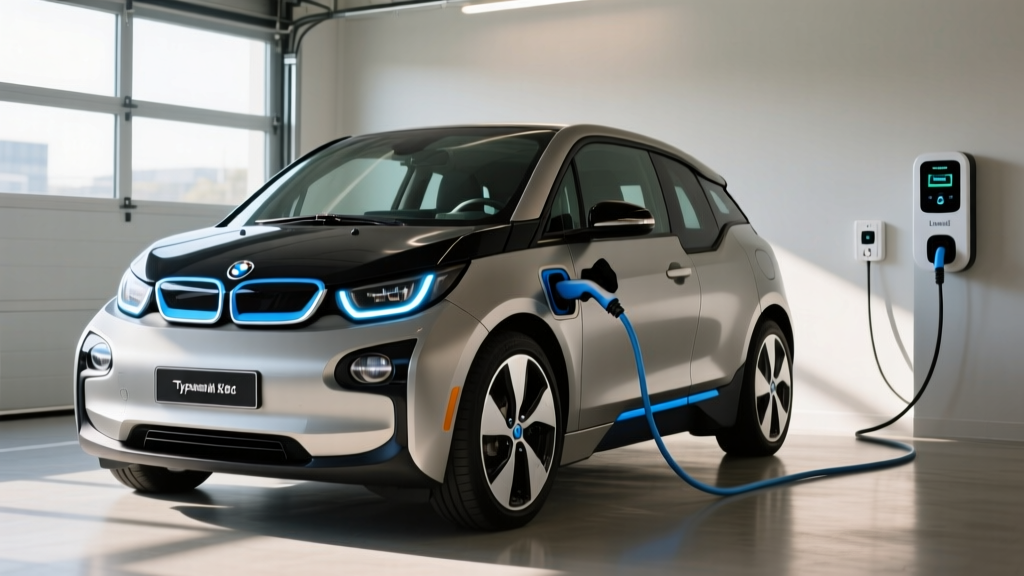
The 2015 BMW i3 with Range Extender (REx) is one of the most distinctive plug-in vehicles on the used market. Its 22 kWh lithium-ion battery (18.8 kWh usable) delivers an EPA-rated 72 miles of pure electric range, with a 647cc two-cylinder gasoline engine kicking in afterward to push total range past 150 miles. In 2026, it remains a practical short-commute EV with a gas safety net — but its small battery and aging charging hardware mean you need a precise charging strategy, not guesswork.
This guide covers every charging scenario for the 2015 i3 REx: what each level delivers in real-world miles, what your home electrical panel actually needs, which connectors fit, and what you'll spend per mile versus a gas car.
2015 BMW i3 REx: Battery and Charging Specs at a Glance
| Spec | Value |
|---|---|
| Battery (gross / usable) | 22 kWh / 18.8 kWh |
| Battery chemistry | NMC (nickel-manganese-cobalt), Samsung SDI cells |
| EPA electric range | 72 miles |
| Real-world electric range | 55–68 miles (highway/cold weather cuts 15–25%) |
| Onboard AC charger | 7.4 kW (single-phase, 32A max) |
| DC fast charge (CCS1) | ~47 kW peak (optional on US models) |
| DC fast charge (CHAdeMO) | ~47 kW peak (with adapter, rare on US models) |
| Level 2 AC time (0–100%) | ~3 hours at 7.4 kW |
| DC fast 0–80% | ~25 minutes |
| Range Extender engine | 647cc twin-cylinder, ~34 HP, holds SoC ~6% |
| MPGe (electric) | 117 MPGe combined (fueleconomy.gov) |
| MPG (gas REx mode) | 39 MPG combined |
Real-world note: The i3's EPA 72-mile electric range assumes moderate temperatures and mixed driving. Expect 55–60 miles on a pure highway run at 70+ mph, and similar losses in freezing weather due to cabin heating drawing from the battery. The REx engine preserves roughly 6% SoC — it does not recharge the battery to full.
Charging Levels Explained: Speed, Power, and Real Miles Added
The most common mistake new EV owners make is confusing kW (power — how fast energy flows) with kWh (energy — how much the battery holds). Think of kW as the diameter of the hose and kWh as the size of the bucket. The i3's bucket is 18.8 kWh usable; the hose size determines how quickly you fill it.
| Level | Voltage / Amps | Power (kW) | Miles of Range per Hour | Full Charge Time (0–100%) |
|---|---|---|---|---|
| Level 1 (standard outlet) | 120V / 12A | ~1.4 kW | ~5 mi/hr | ~14 hours |
| Level 2 (home/public AC) | 240V / 32A | 7.4 kW (car-limited) | ~26 mi/hr | ~3 hours |
| DC Fast (CCS1) | 400V DC | ~47 kW peak | ~150+ mi/hr (tapers above 80%) | ~25 min (0–80%) |
Why Level 1 is a last resort: At 1.4 kW, a fully depleted i3 needs 14 hours on a standard household outlet. That works for overnight top-ups if you drive under 30 miles daily, but it won't recover a full battery in a single night from empty.
Level 2 is the sweet spot: The i3's onboard charger caps at 7.4 kW, so installing a 48A home charger won't speed things up. A 32A (7.7 kW) Level 2 unit matches the car perfectly and delivers a full charge in about 3 hours — more than enough to wake up with a full battery every morning.
DC fast charging reality: The i3 peaks at roughly 47 kW on CCS1, but only between 10–50% SoC. Above 80%, the charge curve tapers sharply to protect the NMC cells, dropping below 15 kW. Plan DC sessions for 10–80% only; the last 20% is painfully slow and better done on Level 2.
Home Charger Installation: Electrical Requirements and Real Costs
For the 2015 i3 REx, a 32A Level 2 charger on a dedicated 40A, 240V circuit is the optimal home setup. Here's what that actually involves:
Electrical Requirements
- Circuit: Dedicated 40A, 240V breaker (supports continuous 32A draw per NEC 80% rule)
- Wire gauge: 8 AWG copper (6 AWG for runs over 50 feet)
- Outlet: NEMA 14-50 receptacle or hardwired connection (hardwired preferred for outdoor installs — no GFCI breaker trip issues)
- Panel capacity: Your main panel needs at least 40A of spare capacity. Older homes with 100A service often need a panel upgrade to 200A.
Panel Upgrade Reality
If your home has a 100A main panel — common in houses built before 1990 — adding a 40A EV circuit may push total calculated load past code limits. A panel upgrade to 200A typically costs $1,500–$3,500 before the EV circuit work begins. Have a licensed electrician perform a load calculation (NEC Article 220) before committing to hardware.
Installation Cost Breakdown
| Item | Cost Range | Notes |
|---|---|---|
| Level 2 charger (32–40A, 240V) | $350–$700 | See equipment picks below |
| Electrician labor (standard install) | $500–$1,500 | Varies by run length, wall type, conduit |
| Electrical materials (wire, breaker, conduit) | $150–$400 | Longer runs = more wire cost |
| Permit and inspection | $50–$250 | Required by most jurisdictions |
| Panel upgrade (if needed) | $1,500–$3,500 | Only if existing panel lacks capacity |
| Total (no panel upgrade) | $1,050–$2,850 | Most homes with 200A service |
| Total (with panel upgrade) | $2,550–$6,350 | Older homes with 100A service |
The federal Residential Clean Energy Credit (IRS Form 5695) covers 30% of EV charger equipment and installation costs up to $1,000 through 2032 — potentially saving you $300–$600 on a standard install. Check with a tax professional for eligibility.
Connector Compatibility: What Plugs Into the 2015 i3?
The 2015 BMW i3 REx sold in the United States uses the SAE J1772 connector for Level 1 and Level 2 AC charging. For DC fast charging, US-spec models were available with either CCS1 (Combo) or, rarely, CHAdeMO as a factory option.
| Connector | Charging Type | i3 Compatibility | Adapter Needed? |
|---|---|---|---|
| J1772 | Level 1 / Level 2 AC | Native (standard port) | No |
| CCS1 (Combo) | DC fast | Factory option (most US REx models) | No if equipped |
| CHAdeMO | DC fast | Rare factory option | No if equipped |
| NACS (Tesla) | Level 2 AC / DC fast | Not native | Yes — J1772-to-NACS or CCS-to-NACS adapter ($150–$300) |
The NACS adapter question in 2026: With Tesla opening its Supercharger network to non-Tesla EVs via NACS, many i3 owners want access. You'll need a CCS1-to-NACS adapter (such as the Lectron or A2Z adapter, ~$200–$300) to use Tesla Superchargers. For Level 2 Tesla Destination Chargers, a simpler J1772-to-NACS adapter (~$150) works. Verify your i3 actually has the CCS1 DC port before buying a CCS adapter — check the charge port door for the two extra DC pins below the J1772 inlet.
Level 2 Charger Recommendations for the i3 REx
Since the i3 caps AC charging at 7.4 kW (32A), you don't need a 48A or 80A charger. A quality 32–40A unit is ideal. Here are three proven options in 2026:
ChargePoint Home Flex (up to 50A)
- Power output: Configurable 16–50A (set to 32A for i3; use 40A circuit)
- Connector: J1772 (native for i3)
- Cable length: 18 or 24 feet
- Smart features: Wi-Fi, app scheduling, energy tracking, Alexa integration
- Price: ~$550–$650
- Why it fits: Flexible amperage means it grows with your next EV. UL-listed, NEMA 4 outdoor-rated.
Emporia Vue Level 2 Charger (48A)
- Power output: Up to 48A (i3 will draw 32A max)
- Connector: J1772
- Cable length: 24 feet
- Smart features: Wi-Fi, solar integration, load management, app control
- Price: ~$400–$450
- Why it fits: Best value in smart chargers. Load-management feature lets you share a circuit with other appliances — useful if panel capacity is tight.
Grizzl-E Smart (40A)
- Power output: 40A (i3 draws 32A)
- Connector: J1772
- Cable length: 24 feet
- Smart features: Wi-Fi, OCPP-compatible, adjustable amperage via DIP switches
- Price: ~$400–$500
- Why it fits: Built in Canada, IP67-rated for harsh outdoor conditions, 3-year warranty. Simple and rugged.
Cost to Charge: Per-Mile Economics vs. Gasoline
The 2015 i3 REx uses about 0.27 kWh per mile in electric mode (117 MPGe combined per EPA data). Here's what that costs in different scenarios:
| Scenario | $/kWh | Cost per Mile | Full Charge Cost (18.8 kWh) |
|---|---|---|---|
| Home off-peak (utility TOU rate) | $0.08–$0.12 | $0.022–$0.032 | $1.50–$2.26 |
| Home standard rate | $0.14–$0.18 | $0.038–$0.049 | $2.63–$3.38 |
| Public Level 2 (ChargePoint, EVgo) | $0.25–$0.49 | $0.068–$0.132 | $4.70–$9.21 |
| DC fast (Electrify America, Tesla) | $0.35–$0.55 | $0.095–$0.149 | $6.58–$10.34 |
| Gasoline (REx mode, 39 MPG, $3.40/gal) | — | $0.087 | — |
The takeaway: Home off-peak charging at $0.025/mile is roughly one-third the cost of the i3's own gasoline REx mode ($0.087/mile) and one-tenth the cost of a 25 MPG gas car at $3.40/gallon ($0.136/mile). Public DC fast charging at $0.45/kWh ($0.122/mile) is actually more expensive than the i3's own gas engine. The math is clear: home Level 2 charging is where the savings live.
For a 30-mile daily commute charged at home off-peak, expect roughly $0.75/day or $22/month in electricity — versus $102/month in gasoline for the same distance in a 25 MPG car.
Safety, Code, and Best Practices
- Dedicated circuit: NEC 625 requires EV charging equipment to be on a dedicated circuit — no sharing with other outlets or appliances.
- GFCI protection: 2020 NEC and later require GFCI protection for outdoor receptacles used for EV charging. Hardwired installations may be exempt in some jurisdictions — ask your electrician.
- Outdoor rating: If installing outdoors, use a NEMA 4 (or IP65+) rated charger. All three picks above meet this standard.
- Cable management: Use a wall-mounted holster or cable reel to keep the cord off the ground and prevent trip hazards and water damage.
- i3-specific tip: The i3's charge port is on the right rear quarter panel. Plan your charger location and cable length so the cord reaches comfortably without stretching across a driveway.
Frequently Asked Questions
How much does it cost to install a home EV charger for the 2015 i3?
A standard Level 2 home installation (40A circuit, 32A charger) runs $1,050–$2,850 if your electrical panel has sufficient capacity. If your home has an older 100A panel that needs upgrading to 200A, total costs can reach $2,550–$6,350. The federal Residential Clean Energy Credit covers 30% of the cost up to $1,000.
How fast will each charging level add range to the i3?
Level 1 (120V) adds about 5 miles per hour. Level 2 (240V, 7.4 kW) adds roughly 26 miles per hour — filling the 72-mile battery in about 3 hours. DC fast charging at 47 kW peaks can add 50+ miles in 15 minutes but tapers significantly above 80% SoC.
Which connector and charger are compatible with my 2015 i3 REx?
All US-spec 2015 i3 models use J1772 for Level 1 and Level 2 charging. For DC fast charging, most have CCS1 — verify by checking for two extra DC pins below the J1772 inlet. To use Tesla Superchargers, you'll need a CCS1-to-NACS adapter (~$200–$300). Any J1772 Level 2 charger at 32A or higher will work perfectly.
How much does charging cost per mile versus gasoline?
Home off-peak charging costs about $0.025 per mile — roughly one-third the cost of the i3's own REx gasoline mode ($0.087/mile at 39 MPG and $3.40/gallon). Public DC fast charging at $0.45/kWh costs about $0.12/mile, which is actually more expensive than the i3's gas engine. Charge at home whenever possible.
What electrical upgrades might I need for a home charger?
You need a dedicated 40A, 240V circuit with 8 AWG copper wire. Homes with 200A service usually have sufficient capacity. Homes with 100A panels (common pre-1990) often require a panel upgrade to 200A, costing $1,500–$3,500. A licensed electrician can perform a load calculation to determine if an upgrade is necessary before any work begins.
Does the 2015 i3 REx battery degrade, and how does that affect charging?
After 10+ years, expect 15–25% capacity loss on the 22 kWh NMC pack, reducing real-world electric range from 72 miles to roughly 55–60 miles. BMW's original 8-year/100,000-mile battery warranty (covering drops below 70% capacity) has expired for most 2015 models. Degraded batteries also accept charge slightly slower at the top of the curve, though peak DC fast-charge rates remain similar in the 10–50% SoC window.