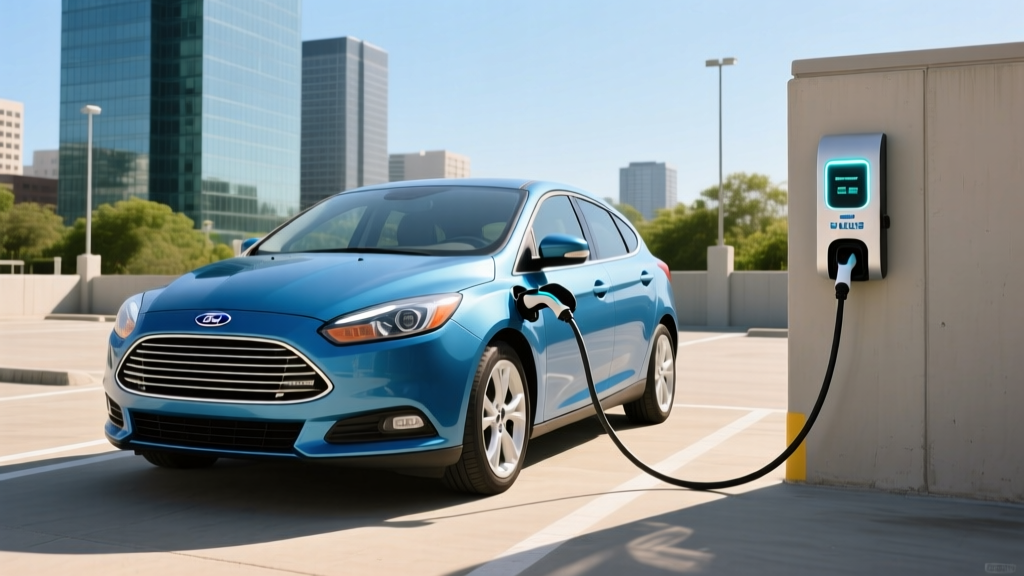
The 2014 Ford Focus Electric was Ford's first mass-market battery-electric vehicle, built on the popular Focus hatchback platform and aimed squarely at urban commuters and eco-conscious early adopters. With an EPA-estimated 76 miles of range from a 23 kWh liquid-cooled lithium-ion battery, it was never designed for road trips — but for daily driving within its envelope, it remains a remarkably efficient and usable used EV in 2026.
If you own a 2014 Focus Electric or are considering picking one up on the used market, understanding its real-world range, charging behavior, and home charging setup requirements is essential. This guide covers everything from the EPA sticker to actual highway and cold-weather performance, plus a detailed breakdown of what it takes to install a Level 2 home charger — including costs, electrical requirements, and equipment picks.
2014 Ford Focus Electric Range: EPA vs. Real World
The EPA rated the 2014 Focus Electric at 76 miles of combined range with an efficiency of 105 MPGe (32 kWh/100 mi). That figure comes from a 23 kWh usable battery (approximately 33.5 kWh gross capacity with a large protective buffer). Ford equipped this generation with a liquid-cooled thermal management system — a significant advantage over the passively cooled Nissan Leaf of the same era, which suffered more noticeable degradation in hot climates.
EPA Combined: 76 miles
Highway (70 mph, moderate temps): ~60–68 miles
City/stop-and-go (with regen): ~78–85 miles
Cold weather (below 32°F, heater on): ~48–58 miles
Hot weather (95°F+, A/C max): ~65–72 miles
The Focus Electric's liquid cooling helps preserve range and battery health in extreme temperatures compared to air-cooled competitors, but physics still applies: cabin heating in winter can cut range by 25–35%. The car's relatively small battery means every mile matters — preconditioning while plugged in is critical to maximizing usable range in cold months.
| Spec | Value |
|---|---|
| EPA Range | 76 miles |
| Battery (Usable / Gross) | 23 kWh / ~33.5 kWh |
| Battery Chemistry | Lithium-Ion (NMC), liquid-cooled |
| Efficiency | 105 MPGe (32 kWh/100 mi) |
| Motor Output | 143 hp / 184 lb-ft torque |
| 0–60 mph | ~9.2 seconds |
| Onboard Charger (AC) | 6.6 kW |
| DC Fast Charging | Not available (no DC port) |
| Charge Connector | J1772 (Level 1 & Level 2) |
| Original MSRP | $29,200 (before $7,500 federal credit at launch) |
| Battery Warranty (Original) | 8 years / 100,000 miles |
Charging Levels Explained: Speeds and Range Added Per Hour
Before discussing home installation, it's critical to understand the three EV charging levels and what they mean for a 23 kWh battery. kW (kilowatts) measures charging power — the rate at which energy flows into the battery. kWh (kilowatt-hours) measures energy capacity — the total amount of energy stored. Think of kW as the speed of water flowing through a hose and kWh as the size of the bucket.
| Level | Voltage / Amperage | Power (kW) | Miles of Range Added Per Hour | Full Charge Time (23 kWh) |
|---|---|---|---|---|
| Level 1 (standard outlet) | 120V / 12A | ~1.4 kW | ~3–4 mi/hr | ~16–20 hours |
| Level 2 (dedicated 240V) | 240V / 30A | ~6.6 kW (car's max) | ~20–24 mi/hr | ~3.5–4 hours |
| DC Fast Charging | N/A | N/A | N/A | Not supported |
The 2014 Focus Electric does not have a DC fast-charging port. This is the single biggest practical limitation of the car: you cannot use CCS, CHAdeMO, or Tesla Supercharger stations for rapid top-ups. All charging happens through the J1772 AC port at a maximum rate of 6.6 kW. The good news? With only 23 kWh to fill, even Level 2 charging gets you from empty to full in under four hours — fast enough to fully replenish overnight or during a work shift.
For this car, Level 1 charging (a standard 120V household outlet) is actually viable if your daily driving is under 30 miles round-trip. Plugging in overnight yields roughly 30–40 miles of recovered range — enough for most commutes. But Level 2 is strongly recommended for convenience, battery thermal management activation, and ensuring a full charge every morning.
Home Level 2 Charger Installation: Electrical Requirements and Costs
Installing a Level 2 home charger for the Focus Electric is straightforward from an electrical standpoint because the car's onboard charger caps at 6.6 kW. You don't need a 48-amp circuit to max out this car — a 240V / 30-amp dedicated circuit (delivering 24 amps continuous, per the 80% NEC rule for EVSE) is sufficient to hit the full 6.6 kW charge rate.
Electrical Requirements at a Glance
- Voltage: 240V (same as a dryer or oven outlet)
- Circuit amperage: 30A minimum (supports 24A continuous draw = 5.76 kW); 40A circuit recommended for future-proofing (supports 32A continuous = 7.7 kW)
- Wire gauge: 10 AWG copper for 30A; 8 AWG for 40A (THHN in conduit or NM-B/Romex where code allows)
- Breaker: Dedicated double-pole breaker — do NOT share with other appliances
- GFCI protection: Required by NEC 2017+ (Article 511.8 and 625.54) for all EV receptacles; most hardwired EVSE units include built-in GFCI
- Permit: Required in virtually all US jurisdictions for new circuit installation; inspection ensures code compliance and protects insurance coverage
Do You Need a Panel Upgrade?
This is the question that separates a $500 installation from a $3,000+ project. Most homes built after 1990 have a 200-amp main service panel, which typically has enough spare capacity for a 30A or 40A EV circuit. However, older homes (pre-1980s) may have 100A or even 60A panels that are already near capacity with modern loads (HVAC, electric dryer, oven, water heater).
An electrician will perform a load calculation (per NEC Article 220) to determine if your panel can handle the additional circuit. If it can't, options include:
- Panel upgrade to 200A: $1,500–$3,500 (depending on utility coordination, conduit runs, and local labor rates)
- Smart load management device: Devices like the Emporia Load Management or Span smart panel can dynamically limit EV charging when other loads are high — avoiding a panel upgrade for $300–$800 installed
- Lower-amperage circuit: Running a 20A circuit (delivering 3.8 kW) may be enough for the Focus Electric's overnight needs and reduces panel strain
| Component | Low Estimate | High Estimate | Notes |
|---|---|---|---|
| Level 2 EVSE Equipment | $200 | $650 | Smart vs. dumb charger; 24–40A models |
| Electrician Labor (standard install) | $300 | $1,200 | Depends on panel-to-garage distance, conduit, drywall work |
| Permit & Inspection | $50 | $250 | Varies by municipality |
| Panel Upgrade (if needed) | $1,500 | $3,500 | Only if load calculation requires it |
| Total (No Panel Upgrade) | $550 | $2,100 | Most homes with 200A panel fall here |
| Total (With Panel Upgrade) | $2,050 | $5,600 | Older homes with 100A service |
Federal incentive note: The IRS §30C Alternative Fuel Vehicle Refueling Property Credit offers up to 30% of installation costs (max $1,000) for home EV charger installations, subject to census-tract eligibility requirements. Consult a tax professional and verify current-year rules at irs.gov before claiming.
Connector Compatibility: What Plugs Into a 2014 Focus Electric?
The 2014 Focus Electric uses the J1772 connector for all AC charging (Level 1 and Level 2). This is the universal standard for non-Tesla EVs sold in North America and remains the connector used by the vast majority of public Level 2 stations in 2026.
| Connector | Type | Used By | Focus Electric Compatible? |
|---|---|---|---|
| J1772 | AC (Level 1 & 2) | All non-Tesla EVs; most public L2 stations | ✅ Yes — native port |
| NACS (Tesla) | AC & DC | Tesla vehicles; 2025+ Ford, GM, Rivian, others | ⚠️ With Tesla J1772 adapter (AC only, ~$150–250) |
| CCS1 | DC Fast Charging | Most modern non-Tesla EVs | ❌ No — car has no DC port |
| CHAdeMO | DC Fast Charging | Nissan Leaf, Mitsubishi (legacy/declining) | ❌ No — car has no DC port |
For home charging, any J1772 Level 2 EVSE will work natively. If you want access to Tesla Destination Chargers (Level 2 at hotels, restaurants, and shopping centers), you can purchase a Tesla-to-J1772 adapter ($150–$250 from brands like Lectron or Teslaplug). This opens up thousands of additional public Level 2 locations — a meaningful advantage for a car with 76 miles of range that benefits from frequent opportunistic top-ups.
Level 2 Charger Equipment Recommendations for the Focus Electric
Because the Focus Electric's onboard charger maxes out at 6.6 kW, you don't need to overspend on a 48-amp charger. A quality 24-amp or 32-amp Level 2 EVSE on a 30A or 40A circuit will fully utilize the car's charging capability while leaving room for a future EV upgrade. Here are three proven options across budget tiers:
Budget Pick: Emporia Level 2 EV Charger
- Power output: Up to 48A (11.5 kW) — adjustable down to 24A/32A for the Focus Electric
- Connector: J1772
- Cable length: 24 feet
- Smart features: Wi-Fi, app scheduling, solar integration, energy monitoring via Emporia Vue panel
- Price: ~$399
- Best for: Owners who want energy tracking and solar-aware charging on a budget
Best Overall: ChargePoint Home Flex
- Power output: Up to 50A (12 kW) — adjustable via DIP switch; set to 32A for Focus Electric
- Connector: J1772 (NACS version also available for newer EVs)
- Cable length: 23 feet
- Smart features: Wi-Fi, ChargePoint app scheduling, Alexa integration, detailed session history
- Price: ~$549
- Best for: Reliability-focused buyers who want a proven brand with broad public network integration
Premium Pick: Tesla Wall Connector (with J1772 adapter)
- Power output: Up to 48A (11.5 kW)
- Connector: NACS native; use a NACS-to-J1772 adapter (~$150–200) for the Focus Electric
- Cable length: 24 feet
- Smart features: Wi-Fi, OTA updates, load sharing between multiple units, Tesla app integration
- Price: ~$420 (charger) + ~$175 (adapter) = ~$595 total
- Best for: Households planning to add a Tesla in the future — one charger serves both vehicles
For the Focus Electric specifically, the ChargePoint Home Flex set to 32A on a 40A circuit is the sweet spot: it delivers the car's full 6.6 kW rate, works reliably in outdoor-rated installations, and the ChargePoint app provides useful charge-session logging to track battery health over time.
Cost to Charge: Per-Mile Cost vs. Gasoline
One of the strongest ownership arguments for the Focus Electric — even in 2026 — is the dramatically lower fuel cost. At 32 kWh/100 miles (per fueleconomy.gov), the car's efficiency makes it one of the cheapest vehicles to "fuel" regardless of energy source.
| Scenario | Rate ($/kWh) | Cost for Full Charge | Cost Per Mile |
|---|---|---|---|
| Home (off-peak / time-of-use) | $0.09 | $2.07 | $0.027/mi |
| Home (national avg. residential) | $0.17 | $3.91 | $0.051/mi |
| Public Level 2 (ChargePoint, etc.) | $0.30 | $6.90 | $0.090/mi |
| Gasoline equivalent (30 MPG car @ $3.40/gal) | — | $8.73 (equiv.) | $0.113/mi |
Even at the national residential average of $0.17/kWh, the Focus Electric costs roughly $0.05 per mile to drive — less than half the cost of a 30 MPG gas car at $3.40/gallon. If your utility offers time-of-use rates with off-peak pricing around $0.09/kWh, the cost drops to under $0.03 per mile. Over 12,000 annual miles, that's a fuel savings of $700–$1,000 per year compared to a comparable gas Focus.
Safety, Code Compliance, and Installation Best Practices
EV charging involves sustained high-current draw over many hours — far more demanding on wiring than intermittent loads like a dryer. Following electrical code isn't just bureaucratic compliance; it protects your home from fire risk and ensures insurance coverage in the event of an incident.
- Dedicated circuit: The EVSE must be on its own breaker — never share with outlets, lights, or appliances. Shared circuits risk overloading and breaker trips during long charging sessions.
- GFCI protection: NEC 2017 and later requires ground-fault circuit interrupter protection for EV receptacles. Hardwired EVSE units typically include internal GFCI; if using a NEMA 14-50 receptacle, a GFCI breaker is required (adding ~$50–$100 to the panel cost).
- Outdoor rating: If your charger is installed outside or in an open carport, ensure the EVSE is rated NEMA 4 (weatherproof) and the connector holster protects the plug from rain and debris.
- Cable management: A 24-foot cable dragging on a garage floor degrades over time. Wall-mounted cable organizers ($20–$40) extend cord life and prevent tripping hazards.
- Permit and inspection: Skipping a permit saves $50–$250 upfront but voids insurance coverage for electrical fires and can cause problems at home sale. Always pull a permit and schedule the inspection.
- Use a licensed electrician: DIY EV charger installations are strongly discouraged. A licensed electrician ensures proper wire gauge, torque specs on breakers (a common fire cause when loose), and code compliance. Verify their EVSE installation experience — not all electricians are familiar with the continuous-load requirements specific to EV charging.
Frequently Asked Questions
How much does it cost to install a home EV charger for the 2014 Focus Electric?
For most homes with a 200A panel and a short conduit run from panel to garage, expect to pay $550–$2,100 total (equipment + electrician + permit). If your home has a 100A panel that needs upgrading, add $1,500–$3,500 for the panel work. The Focus Electric's modest 6.6 kW onboard charger means you can use a lower-amperage circuit (30A), which keeps wire and breaker costs on the lower end.
How fast will each charging level add range to the Focus Electric?
Level 1 (120V) adds approximately 3–4 miles per hour — enough for a 30-mile commute if plugged in for 8–10 hours. Level 2 (240V, 30A) adds approximately 20–24 miles per hour, filling the 23 kWh battery from empty to full in about 3.5–4 hours. DC fast charging is not supported on this vehicle.
Which connector and charger is compatible with my 2014 Focus Electric?
The Focus Electric uses the J1772 connector for all charging. Any J1772 Level 2 EVSE will work directly. For access to Tesla Destination Chargers, a Tesla-to-J1772 adapter ($150–$250) is needed. The car has no DC fast-charging port, so CCS1 and CHAdeMO connectors are not applicable.
How much does charging cost per mile compared to gasoline?
At the national residential electricity average of $0.17/kWh, the Focus Electric costs approximately $0.05 per mile to charge. A comparable 30 MPG gas car at $3.40/gallon costs about $0.11 per mile. Charging at home on off-peak rates can drop the cost to under $0.03 per mile — roughly a quarter of the gasoline cost.
What electrical upgrades might I need for a Level 2 charger?
If your home has a 200A service panel with spare breaker slots and passing load calculation, you likely need only a new 30A or 40A double-pole breaker and a conduit run to the charger location. If your panel is 100A or older, or if the load calculation shows insufficient headroom, a panel upgrade to 200A ($1,500–$3,500) or a smart load management device ($300–$800) may be required. Always have a licensed electrician perform the load calculation before committing to equipment purchases.
Is the 2014 Focus Electric battery still under warranty in 2026?
The original battery warranty was 8 years / 100,000 miles from the vehicle's in-service date. For a 2014 model, that warranty expired in 2022 at the latest. Any battery replacement is now an out-of-pocket expense. Used Focus Electric batteries from salvage yards run $2,000–$4,000; new replacement packs (if available through Ford) can exceed $8,000 installed. Given the car's used-market value of $4,000–$8,000 in 2026, a battery replacement may not be economically justified — making pre-purchase battery health assessment critical. Use an OBD-II reader with EV-capable software (like LeafSpy-compatible tools or Ford-specific FORScan) to check State of Health (SoH) before buying.
Does the 2014 Focus Electric qualify for any tax credits in 2026?
The federal §30D new clean vehicle credit does not apply to used EV purchases in the traditional sense. However, the §25E Used Clean Vehicle Credit offers up to $4,000 (or 30% of sale price, whichever is lower) for qualifying used EVs purchased from a dealer for $25,000 or less. The Focus Electric's 2026 used-market price typically qualifies. Income caps apply ($75,000 single / $150,000 married filing jointly), and the credit can be transferred to the dealer at point of sale as an instant discount. Verify current eligibility rules at irs.gov.
Sources: EPA fueleconomy.gov — 2014 Ford Focus Electric · IRS §30D / §25E Clean Vehicle Credits · IRS §30C Refueling Property Credit