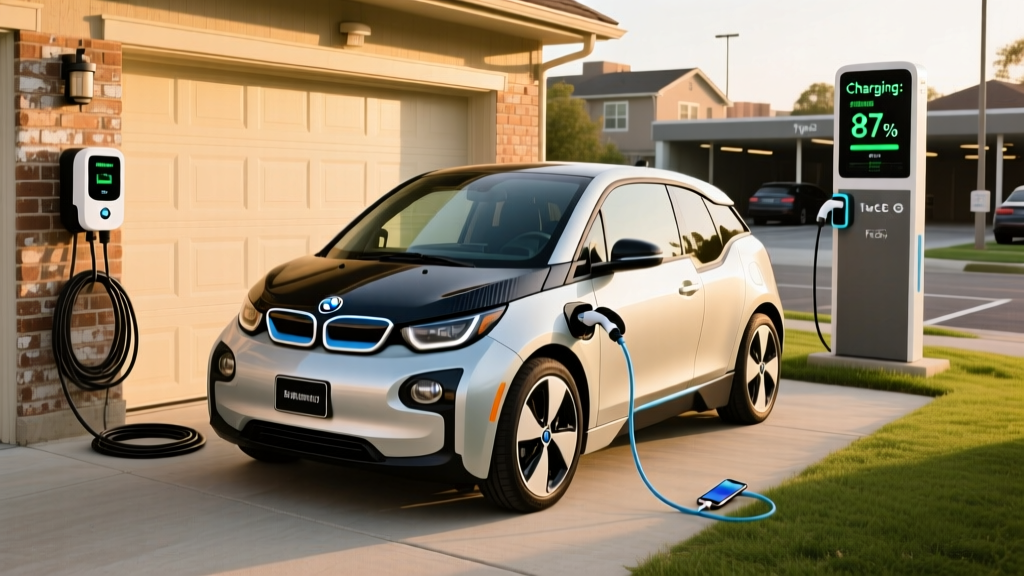
The 2014 BMW i3 hatchback with range extender (REx) is one of the most distinctive plug-in vehicles on the used market. Its 22 kWh battery (roughly 18.8 kWh usable) delivers an EPA-rated 72 miles of electric range, while the 647cc two-cylinder gasoline generator adds another ~80 miles of driving before you need a pump. That makes it a practical commuter with a safety net — but only if you understand its charging profile, which differs meaningfully from modern long-range EVs.
This guide covers every charging scenario an i3 REx owner will encounter in 2026: home Level 1 and Level 2 setup, DC fast charging limitations, connector compatibility (and the adapters you'll likely need), real installation costs, and what you'll actually spend per mile versus a gas car.
2014 BMW i3 REx: Battery, Range, and Charging Specs at a Glance
| Spec | 2014 BMW i3 REx |
|---|---|
| Battery (total / usable) | 22 kWh / ~18.8 kWh |
| Chemistry | NMC (nickel manganese cobalt) |
| EPA electric range | 72 miles |
| REx gasoline range | ~80 miles (combined ~150 mi) |
| EPA MPGe (electric mode) | 117 MPGe combined |
| Onboard charger (AC) | 7.4 kW (single-phase) |
| DC fast charge max | ~47 kW (CCS Combo 1, optional) |
| 10–80% DC fast charge | ~25 minutes (if equipped with DC option) |
| Level 2 full charge (0–100%) | ~3 hours at 7.4 kW |
| Connector (AC) | J1772 |
| Connector (DC, if equipped) | CCS1 Combo |
| Range extender engine | 647cc 2-cyl, 34 HP generator |
Charging Levels Explained: What the 2014 i3 REx Can Accept
Before buying equipment, you need to understand the three charging levels and how they apply to a vehicle with a relatively small battery. The i3's 22 kWh pack charges quickly by modern standards — but only if your equipment matches its onboard capabilities.
| Level | Voltage | Max Power (kW) | Miles of Range Added per Hour | Full Charge Time (i3 REx) |
|---|---|---|---|---|
| Level 1 (standard outlet) | 120V | 1.2–1.4 kW | ~4–5 mi/hr | ~14–16 hours |
| Level 2 (home/public AC) | 240V | Up to 7.4 kW (i3 limit) | ~22–25 mi/hr | ~3 hours |
| DC Fast Charging | 400V DC | ~47 kW peak (i3 limit) | ~120–140 mi/hr (at peak) | 10–80% in ~25 min |
Key distinction: kW (kilowatts) measures the rate of energy delivery — think of it as the width of the pipe. kWh (kilowatt-hours) measures the total energy stored in the battery — the size of the tank. The i3's 22 kWh battery is the tank; a 7.4 kW Level 2 charger is the pipe filling it.
The i3's 7.4 kW onboard AC charger is its bottleneck for home and public AC charging. Even if you install a 48-amp (11.5 kW) Level 2 charger, the car will only draw 7.4 kW. That's actually good news: you don't need the most powerful home charger on the market, and a more modest 32-amp unit will nearly max out the car's capability.
Home Charger Installation: Electrical Requirements and Real Costs
Most i3 REx owners will want a Level 2 home charger — it's the difference between waking up to a full battery every morning and spending half a day on a trickle charge. Here's what's involved.
Electrical Requirements
- Circuit: A dedicated 40-amp, 240V circuit is ideal. This supports up to 32 amps continuous draw (NEC code requires circuits rated at 125% of continuous load), which delivers ~7.7 kW — just above the i3's 7.4 kW ceiling.
- Wire gauge: Typically 8 AWG copper (or 6 AWG for longer runs over 50 feet).
- Outlet vs. hardwired: A NEMA 14-50 outlet offers portability; hardwired units are often cheaper to install and eliminate one failure point.
- Panel capacity: Your electrical panel must have room for a 40-amp double-pole breaker. Most modern 200-amp panels handle this easily. Older 100-amp panels in pre-2000 homes may require an upgrade.
Installation Cost Breakdown
| Item | Low End | High End | Notes |
|---|---|---|---|
| Level 2 charger (equipment) | $250 | $650 | 32A–40A, 240V, J1772 connector |
| Electrician labor | $400 | $1,200 | Depends on run length, conduit, wall type |
| Permit & inspection | $50 | $250 | Varies by municipality |
| Electrical panel upgrade (if needed) | $1,500 | $3,500 | 100A → 200A service; ~15% of older homes |
| Total (no panel upgrade) | $700 | $2,100 | Typical for most homeowners |
| Total (with panel upgrade) | $2,200 | $5,600 | Older homes with 100A service |
The IRS §30D and §25E credits may help offset costs: the §25E credit covers up to $1,000 or 30% of home charging equipment and installation costs (whichever is less) for qualifying taxpayers. Eligibility depends on income limits and whether your home is in an eligible census tract — consult a tax professional for your specific situation.
Connector Compatibility: What Plugs Into a 2014 i3?
The 2014 BMW i3 uses the J1772 connector for all AC charging (Level 1 and Level 2). This is the standard for all non-Tesla EVs sold in North America. If your i3 was optioned with DC fast charging (not all were — check your vehicle), it has a CCS1 Combo port below the J1772 inlet.
| Connector | Used For | 2014 i3 REx Compatible? | Adapter Needed? |
|---|---|---|---|
| J1772 | Level 1 & Level 2 AC | Yes (native) | None |
| CCS1 Combo | DC fast charging | Yes (if DC option equipped) | None |
| NACS (Tesla) | Tesla Superchargers & Destination | AC only with adapter; no DC Supercharger access | Tesla J1772 adapter (included with some chargers) or aftermarket NACS→J1772 (~$150–$250) |
| CHAdeMO | Legacy DC fast charging | No | No practical adapter exists |
The NACS situation in 2026: As the industry shifts to NACS (Tesla's connector, now standardized as SAE J3400), newer public chargers increasingly feature NACS cables. The i3 can use Tesla Destination Chargers (Level 2) with a simple J1772 adapter, but it cannot access Tesla Superchargers — Tesla has not opened DC Supercharger access to CCS-equipped vehicles like the i3 as of early 2026. For DC fast charging, rely on Electrify America, EVgo, and ChargePoint stations with CCS1 connectors.
Important: Verify whether your specific i3 has the DC fast charge option. BMW charged roughly $700 for it when new. Look for the CCS1 port (a larger, oval-shaped inlet below the standard J1772 port) or check the iDrive menu for a "DC Fast Charging" indicator. Without it, your maximum charge speed is 7.4 kW regardless of the station.
Cost to Charge: Per-Mile Economics vs. Gasoline
The i3 REx's small battery means low charging costs — even at public rates. Here's how the math works out in 2026.
| Scenario | Rate | Cost for Full Charge (~19 kWh) | Cost per Mile (electric) |
|---|---|---|---|
| Home, off-peak utility rate | $0.12/kWh | $2.28 | $0.032/mi |
| Home, standard residential rate | $0.16/kWh | $3.04 | $0.042/mi |
| Public Level 2 (ChargePoint, etc.) | $0.28/kWh | $5.32 | $0.074/mi |
| DC fast charging (EVgo, EA) | $0.42/kWh | $7.98 | $0.111/mi |
| REx gasoline mode | $3.40/gal, ~36 MPG | — | $0.094/mi |
| Average gas car (28 MPG) | $3.40/gal | — | $0.121/mi |
Home charging at off-peak rates makes the i3 REx extraordinarily cheap to run — roughly 3.2 cents per mile, or one-quarter the cost of an average gas car. Even on the REx's gasoline engine, the car's exceptional efficiency keeps costs below 10 cents per mile.
DC fast charging is the most expensive option and, for the i3, rarely necessary. With only 72 miles of electric range, most daily driving is covered by overnight Level 2 charging. Reserve DC fast charging for the occasional mid-day top-up on longer trips where the REx engine would otherwise burn gasoline.
Recommended Home Chargers for the 2014 BMW i3 REx
Since the i3 caps AC charging at 7.4 kW (roughly 32 amps at 240V), you don't need a 48-amp charger. A 32-amp or 40-amp unit is the sweet spot — enough to max out the car without overspending on hardware or requiring a heavier-gauge wire run.
Emporia Level 2 Charger
- Power output: 40A / 9.6 kW max (i3 will draw 7.4 kW)
- Connector: J1772 (native)
- Cable length: 24 ft
- Smart features: Wi-Fi, app scheduling, energy monitoring, solar integration
- Price: ~$350–$400
- Best for: Budget-conscious owners who want smart scheduling for off-peak rates
ChargePoint Home Flex
- Power output: Configurable 16A–50A (set to 40A for i3; 9.6 kW max)
- Connector: J1772 (native)
- Cable length: 23 ft
- Smart features: Wi-Fi, app control, Alexa integration, detailed charging history
- Price: ~$550–$650
- Best for: Owners who may upgrade to a higher-power EV later (adjustable amperage)
Enel X JuiceBox 40
- Power output: 40A / 9.6 kW max
- Connector: J1772 (native)
- Cable length: 25 ft
- Smart features: Wi-Fi, app scheduling, usage tracking
- Price: ~$450–$500
- Best for: Straightforward, reliable daily charging with a proven brand
Tesla Universal Wall Connector
- Power output: Up to 48A / 11.5 kW (i3 will draw 7.4 kW via J1772 adapter)
- Connector: NACS with integrated J1772 adapter
- Cable length: 24 ft
- Smart features: Wi-Fi, OTA updates, power sharing between two units
- Price: ~$600
- Best for: Households with both a Tesla and a J1772 vehicle like the i3
For the i3 REx specifically, the Emporia offers the best value — its smart scheduling lets you charge during off-peak utility hours automatically, maximizing the 3-cent-per-mile advantage. The ChargePoint Home Flex is the better long-term play if you plan to eventually replace the i3 with a vehicle that can accept higher AC charge rates (11.5 kW or more).
Safety and Electrical Code Considerations
EV charging draws sustained high current for hours — this is not like plugging in a space heater for 20 minutes. Proper installation matters.
- Dedicated circuit: Your Level 2 charger must be on its own dedicated double-pole breaker. No sharing with other outlets or appliances.
- GFCI protection: NEC 2020 and later requires GFCI protection for EV receptacles (NEMA 14-50 outlets). Hardwired chargers are exempt from this requirement, which is one reason many electricians prefer hardwiring.
- Outdoor rating: If your charger is mounted outside, ensure it carries a NEMA 4 (or IP65+) weather rating. All the units recommended above are outdoor-rated.
- Connector holster: Use a holster or cable management system to keep the connector off the ground and protected from moisture, debris, and vehicle damage.
- Permit and inspection: Most jurisdictions require an electrical permit for a new 240V circuit. The inspection ensures wire gauge, breaker sizing, and grounding meet code. Skipping the permit risks insurance claim denials if a fire occurs.
- Surge protection: Consider a whole-home surge protector ($150–$300 installed) if your area experiences frequent lightning or grid fluctuations. EV onboard chargers are sensitive electronics.
Public Charging With the 2014 i3 REx: Practical Tips
The i3 REx's small battery changes the public-charging calculus. With 72 miles of electric range and a gasoline backup, you have flexibility that pure EVs lack. Still, understanding where and how to charge publicly saves time and money.
Level 2 public chargers (grocery stores, workplaces, parking garages) will add roughly 22–25 miles of range per hour — enough to fully recharge during a shopping trip or workday. Use apps like PlugShare or ChargePoint to find J1772-compatible stations near your regular routes.
DC fast chargers are worth using only if your i3 has the CCS option and you're mid-trip trying to maximize electric miles. The i3 peaks at ~47 kW and tapers significantly above 80% state of charge, so keep DC sessions to a 10–80% top-up (~25 minutes). Charging beyond 80% on DC is painfully slow and not worth the time or per-kWh premium.
Charge curve reality: The i3's DC fast-charge curve holds near 47 kW from roughly 10% to 55% SoC, then tapers to ~30 kW through 70%, and drops further to under 15 kW above 85%. This is normal lithium-ion behavior — the battery management system protects cell health by reducing current as cells approach full charge.
Frequently Asked Questions
How much does it cost to install a home EV charger for the 2014 i3?
A typical installation with a 40-amp, 240V dedicated circuit and a mid-range Level 2 charger costs $700–$2,100 when no panel upgrade is needed. If your home has an older 100-amp panel, a service upgrade to 200 amps adds $1,500–$3,500. Always get a detailed quote from a licensed electrician that separates equipment, labor, and permit costs.
How fast will each charging level add range to my i3 REx?
Level 1 (120V) adds roughly 4–5 miles per hour. Level 2 (240V, 32A) adds roughly 22–25 miles per hour, fully recharging the 22 kWh battery in about 3 hours. DC fast charging (if equipped) can add up to 120–140 miles per hour at peak, though the i3's small battery means a 10–80% session takes only about 25 minutes.
Which connector and charger are compatible with my 2014 BMW i3?
The i3 uses a J1772 connector for all AC charging. Any Level 2 home charger with a J1772 plug will work. For DC fast charging, your i3 must have been optioned with the CCS1 Combo port. The i3 cannot use Tesla Superchargers or CHAdeMO stations. A NACS-to-J1772 adapter allows use of Tesla Destination Chargers (Level 2 only).
How much does charging cost per mile versus gasoline?
At home off-peak rates ($0.12/kWh), charging the i3 costs roughly 3.2 cents per mile. Even at standard residential rates, it's about 4.2 cents per mile. The i3's REx gasoline mode costs roughly 9.4 cents per mile at $3.40/gallon. A comparable gas car averaging 28 MPG costs about 12.1 cents per mile. Home charging delivers roughly a 3–4× cost advantage.
What electrical upgrades might I need for a home charger?
The most common upgrade is a panel capacity increase from 100A to 200A service, needed in roughly 15% of older homes. Other potential needs include: replacing a Federal Pacific or Zinsco panel (known safety hazards, $1,500–$2,500 replacement), running new conduit for long wire runs (over 50 feet from panel to garage), or installing a sub-panel if your garage is detached. A licensed electrician's load calculation will determine exactly what's required.
Can I charge my i3 REx with just a standard 120V outlet?
Yes, but slowly. Level 1 charging delivers about 4–5 miles of range per hour, meaning a full charge takes 14–16 hours. For an i3 with 72 miles of range, this is workable if your daily commute is under 40 miles and the car is parked overnight for 10+ hours. However, Level 2 is strongly recommended for convenience and battery thermal management.
Does the range extender engine charge the battery while parked?
No. The i3's range extender is a series hybrid system — the gasoline engine generates electricity only while driving, and only when the battery drops to approximately 6% state of charge. It does not function as a stationary generator and cannot charge the battery while parked.
Sources: EPA fuel economy data via fueleconomy.gov, BMW i3 technical specifications. Federal tax credit rules per IRS.gov. Verify current eligibility with a tax professional.