Why the 2012 Range Rover Supercharged Still Comes Up in EV Conversations
If you've searched for the 2012 Range Rover Supercharged lately, you're likely weighing one of two decisions: buying a used luxury SUV at a bargain price, or deciding whether to trade one in for a modern electric vehicle. The L322-generation Range Rover with its 5.0-liter supercharged V8 is a legend — 510 horsepower, commanding road presence, and a cabin that still feels premium over a decade later. But it's also a vehicle that returns roughly 12 MPG combined and costs a small fortune to fuel and maintain.
This guide directly compares what it costs to drive the 2012 Range Rover Supercharged against owning a modern EV — with a deep focus on charging infrastructure, home installation costs, and per-mile energy expenses. Whether you're considering the swap or just running the numbers, you'll find exact figures here, not marketing fluff.
Fuel Cost Reality: The 2012 Range Rover Supercharged by the Numbers
Before we talk EV charging, let's establish the baseline. The 2012 Range Rover Supercharged carries an EPA rating of 12 city / 18 highway / 14 combined MPG according to fueleconomy.gov. With a 27.7-gallon tank and premium fuel required, here's what that means in 2026 dollars:
| Metric | Value |
|---|---|
| EPA Combined MPG | 14 MPG |
| Annual Miles (avg.) | 12,000 |
| Gallons Consumed/Year | ~857 gallons |
| Premium Fuel Price (2026 avg.) | ~$4.50/gallon |
| Annual Fuel Cost | ~$3,857 |
| Cost Per Mile | ~$0.32/mile |
That's $0.32 per mile just in fuel — before oil changes, supercharger belt service, air suspension repairs, or the inevitable transmission work that L322 owners know well. For context, most modern EVs cost between $0.04 and $0.14 per mile to charge, depending on your electricity source and rate structure.
EV Charging Levels Explained: Speeds, Power, and Range Added
Understanding EV charging starts with one critical distinction: kW (kilowatts) measures power — how fast energy flows into the battery. kWh (kilowatt-hours) measures energy — the total capacity of the battery, like gallons in a fuel tank. You'll see both throughout this guide, and they are never interchangeable.
Here's how the three charging levels break down for real-world EV ownership:
| Level | Voltage | Power (kW) | Miles of Range/Hour | Best For |
|---|---|---|---|---|
| Level 1 | 120V AC | 1.0–1.9 kW | 3–5 mi/hr | Overnight top-offs, PHEVs, low-mileage drivers |
| Level 2 | 240V AC | 7.2–19.2 kW | 25–75 mi/hr | Daily home charging, workplace, shopping centers |
| DC Fast Charge | 400–800V DC | 50–350 kW | 150–1,200+ mi/hr | Road trips, highway corridors, quick top-ups |
For a typical EV with an 80 kWh battery (e.g., a Ford Mustang Mach-E Extended Range or Hyundai Ioniq 5), here are representative 10–80% charging times:
- Level 1 (1.4 kW): ~40+ hours — impractical for full charges
- Level 2 (11.5 kW / 48A): ~5–6 hours — ideal overnight charge
- DC Fast (150 kW peak): ~25–30 minutes (10–80%), tapering significantly above 80% due to the charge curve
- DC Fast (350 kW peak, 800V architecture): ~18 minutes (10–80%) on compatible vehicles like the Ioniq 5 or Porsche Taycan
Charge curve reality: Peak kW is never sustained across the entire session. A charger rated at 150 kW may deliver that rate only between 10–50% State of Charge (SoC), then taper to 50 kW or lower above 80%. This is why manufacturers quote 10–80% times rather than 0–100%.
Home EV Charger Installation: Costs, Electrical Requirements, and Panel Upgrades
This is the question every prospective EV owner asks: How much does it cost to install a home EV charger? The honest answer depends heavily on your home's electrical panel, the distance from panel to garage or driveway, and local permit requirements.
Electrical Requirements for Level 2 Home Charging
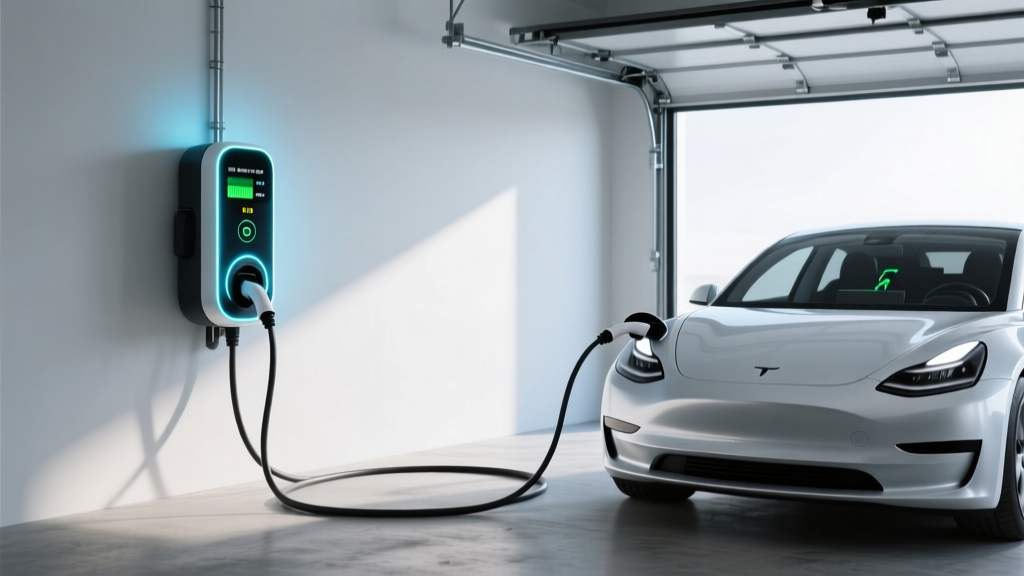
A proper Level 2 home charger requires a dedicated 240V circuit, typically rated for 40A to 60A. The most common setup is a NEMA 14-50 outlet (the same type used by electric ranges and RV hookups) or a hardwired wall connector. Here's what each approach demands:
- NEMA 14-50 outlet on a 50A breaker: Supports up to 40A continuous draw (9.6 kW). Allows charger portability.
- Hardwired 60A circuit: Supports up to 48A continuous draw (11.5 kW). No outlet needed; more reliable for daily use.
- Hardwired 80A circuit: Supports up to 64A continuous draw (15.3–19.2 kW). Requires a robust panel; compatible with higher-end chargers.
Does Your Panel Need an Upgrade?
Homes built before 2000 often have 100A or 150A electrical panels. Adding a 50A EV circuit to a 100A panel that's already serving electric range, dryer, and HVAC may exceed safe capacity. A panel upgrade to 200A is common in older homes and is the single biggest variable in installation cost. Newer homes with 200A service usually accommodate a Level 2 circuit without issue.
Some homeowners use a smart load-management device (like the Emporia Smart Panel or Span Drive integration) to avoid a panel upgrade by dynamically sharing capacity between the EV charger and other circuits.
| Component | Low Estimate | High Estimate |
|---|---|---|
| Level 2 Charger Equipment | $350 | $750 |
| Electrical Permit | $50 | $300 |
| Electrician Labor (simple install, same wall as panel) | $400 | $1,200 |
| Electrician Labor (long run, conduit, trenching) | $1,200 | $3,500 |
| Panel Upgrade (100A → 200A, if needed) | $1,500 | $4,000 |
| Total (no panel upgrade) | $800 | $2,500 |
| Total (with panel upgrade) | $2,300 | $6,500 |
Always get a licensed electrician's assessment before purchasing equipment. Many utilities offer rebates of $250–$1,000 for Level 2 installations, and some states provide additional incentives — check your local utility and AFDC state incentive database for current programs.
Safety and Code Considerations
- Dedicated circuit: NEC code requires a dedicated breaker for EV charging — you cannot share with other appliances.
- GFCI protection: 2020 NEC and later requires GFCI protection for outlet-based EV chargers (hardwired units have built-in ground fault protection).
- Outdoor rating: If your charger mounts outside, ensure it carries a NEMA 4 or IP65 rating for weather resistance.
- Cable management: Wall-mounted cord retractors or J-hooks prevent tripping hazards and cable damage.
Connector Compatibility: NACS, CCS1, CHAdeMO, and Adapters
The EV charging connector landscape has shifted dramatically. As of 2026, the North American Charging Standard (NACS), developed by Tesla, has become the dominant connector for new EVs. Here's which connector your vehicle uses and what adapters you might need:
| Connector | Brands Using It | Notes |
|---|---|---|
| NACS (Tesla) | Tesla (all), Ford, GM, Rivian, Volvo, Polestar, Hyundai/Kia (2025+), BMW, Mercedes-Benz | Native access to Tesla Supercharger network; fastest-growing standard |
| CCS1 | VW ID.4 (pre-2025), older BMW i4/iX, Chevy Bolt (discontinued), legacy models | Access Electrify America, EVgo, ChargePoint DC network |
| CHAdeMO | Nissan Leaf (legacy only) | Effectively discontinued for new vehicles; limited new DC station buildout |
Adapter needs: If you own a CCS1-equipped EV but want Supercharger access, a CCS-to-NACS adapter (available from Tesla and third parties for ~$200–$250) unlocks the Supercharger network. NACS-native vehicles can use NACS-to-CCS adapters (~$200) to charge at Electrify America and other CCS stations. Most new EVs shipping in 2025–2026 include NACS ports natively, making adapters unnecessary for new buyers.
Cost Per Mile: EV Charging vs. the 2012 Range Rover Supercharged
This is where the math gets compelling. Let's compare energy costs across realistic charging scenarios against the Range Rover's premium fuel bill:
| Scenario | Rate | Vehicle Efficiency | Cost/Mile |
|---|---|---|---|
| Home Level 2 (off-peak utility rate) | $0.12/kWh | 3.0 mi/kWh (100 MPGe) | $0.04 |
| Home Level 2 (standard residential rate) | $0.18/kWh | 3.0 mi/kWh | $0.06 |
| Public Level 2 (ChargePoint, workplace) | $0.25/kWh | 3.0 mi/kWh | $0.08 |
| DC Fast Charging (Electrify America) | $0.48/kWh | 3.0 mi/kWh | $0.16 |
| Tesla Supercharger V4 (avg.) | $0.35/kWh | 3.5 mi/kWh (Model Y) | $0.10 |
| 2012 Range Rover Supercharged | $4.50/gal premium | 14 MPG combined | $0.32 |
At 12,000 miles per year, the annual energy cost comparison looks like this:
- EV (home charging, off-peak): ~$480/year
- EV (mix of home + public DC fast): ~$960/year
- 2012 Range Rover Supercharged: ~$3,857/year
That's a $2,897 to $3,377 annual savings on energy alone — before accounting for the Range Rover's higher maintenance burden (oil changes, supercharger coolant service, air suspension, timing chain guides). Over a 5-year ownership period, the energy savings alone could offset $14,500–$16,885 of an EV's purchase price.
Equipment Picks: Level 2 Home Chargers Worth Buying in 2026
Not all Level 2 chargers are equal. Here are four well-regarded options across different budgets, with exact specs:
Tesla Wall Connector (Gen 4)
- Power Output: Up to 11.5 kW (48A) on a 60A circuit
- Connector: NACS native; J1772 adapter included
- Cable Length: 24 feet
- Smart Features: Wi-Fi, OTA updates, load sharing between multiple units, access control
- Price: ~$475
- Best For: Tesla and NACS-native EV owners; best value-to-power ratio
ChargePoint Home Flex
- Power Output: Configurable from 16A–50A (up to 12 kW on 60A circuit)
- Connector: J1772 (NACS adapter available) or NACS version
- Cable Length: 23 feet
- Smart Features: Wi-Fi, Alexa integration, scheduling, energy tracking via app
- Price: ~$550–$650
- Best For: Multi-EV households needing flexible amperage settings
Emporia Level 2 EV Charger
- Power Output: Up to 11.5 kW (48A)
- Connector: J1772 (NACS adapter available)
- Cable Length: 24 feet
- Smart Features: Wi-Fi, integrates with Emporia Vue energy monitor, solar-aware scheduling
- Price: ~$399
- Best For: Budget-conscious buyers who want energy monitoring and solar integration
Grizzl-E Smart
- Power Output: Up to 10 kW (40A)
- Connector: J1772
- Cable Length: 24 feet
- Smart Features: OCPP-compatible, works with multiple apps, over-the-air updates
- Price: ~$449
- Best For: Cold-climate durability (rated to -40°F); simple, rugged design
Should You Trade the 2012 Range Rover Supercharged for an EV?
The decision isn't purely financial — the L322 has character that no current EV SUV fully replicates. But if you're running the numbers objectively:
- Annual fuel savings: $2,900–$3,400/year with home charging
- Maintenance savings: $800–$1,500/year (no oil changes, fewer brake replacements due to regenerative braking, no air suspension failures on most EVs)
- Federal tax credit: Under current IRS §30D rules, qualifying new EVs may receive up to $7,500 — subject to MSRP caps ($80,000 for SUVs), buyer income limits ($300K joint / $150K single), and battery critical-mineral sourcing requirements. Point-of-sale transfer is available at participating dealers.
- Home charger investment: $800–$2,500 one-time (or up to $6,500 if a panel upgrade is needed), paid back in under two years through fuel savings alone
If you drive 12,000+ miles per year and have access to home charging, the math strongly favors an EV swap. If the Range Rover is a weekend vehicle driven 3,000 miles a year, the payback timeline stretches considerably — and the emotional case for keeping it gets stronger.
Frequently Asked Questions
How much does it cost to install a home EV charger?
A straightforward Level 2 installation on an existing 200A panel typically costs $800–$2,500 total (equipment, permit, and electrician labor). If your home needs a panel upgrade from 100A to 200A, add $1,500–$4,000. Always get a quote from a licensed electrician before purchasing a charger.
How fast will each charging level add range?
Level 1 (120V) adds 3–5 miles per hour. Level 2 (240V) adds 25–75 miles per hour depending on amperage. DC fast charging can add 150–1,200+ miles per hour at peak rates, though real sessions taper significantly above 80% SoC. A typical 10–80% DC fast charge takes 18–35 minutes depending on the vehicle's architecture and charger power.
Which connector/charger is compatible with my EV?
Most 2025–2026 EVs use the NACS connector natively (Tesla, Ford, GM, Rivian, Hyundai, Kia, BMW, Volvo, and others). Older or remaining CCS1 vehicles can use adapters for Supercharger access. CHAdeMO is limited to legacy Nissan Leafs. Check your vehicle's charge port or owner's manual to confirm.
How much does charging cost per mile vs gas?
Home EV charging costs $0.04–$0.06 per mile at typical residential electricity rates. Public DC fast charging runs $0.10–$0.16 per mile. The 2012 Range Rover Supercharged costs approximately $0.32 per mile in premium fuel — roughly 5–8× more than home EV charging.
What electrical upgrades might I need?
The most common upgrade is a panel capacity increase from 100A to 200A service, needed when your existing panel can't safely support an additional 40–60A dedicated circuit. Homes with existing 200A+ service typically need only a new breaker and wiring run. A licensed electrician can assess your panel's remaining capacity during a site visit.
Does the 2012 Range Rover Supercharged have any hybrid or EV variant?
No. The 2012 model year (L322 generation) was offered exclusively with internal combustion engines — either the 5.0L naturally aspirated V8 or the 5.0L supercharged V8. Land Rover did not introduce a plug-in hybrid Range Rover until the 2018 P400e (PHEV), and a fully electric Range Rover is expected for the 2026–2027 model year as an announced future model.