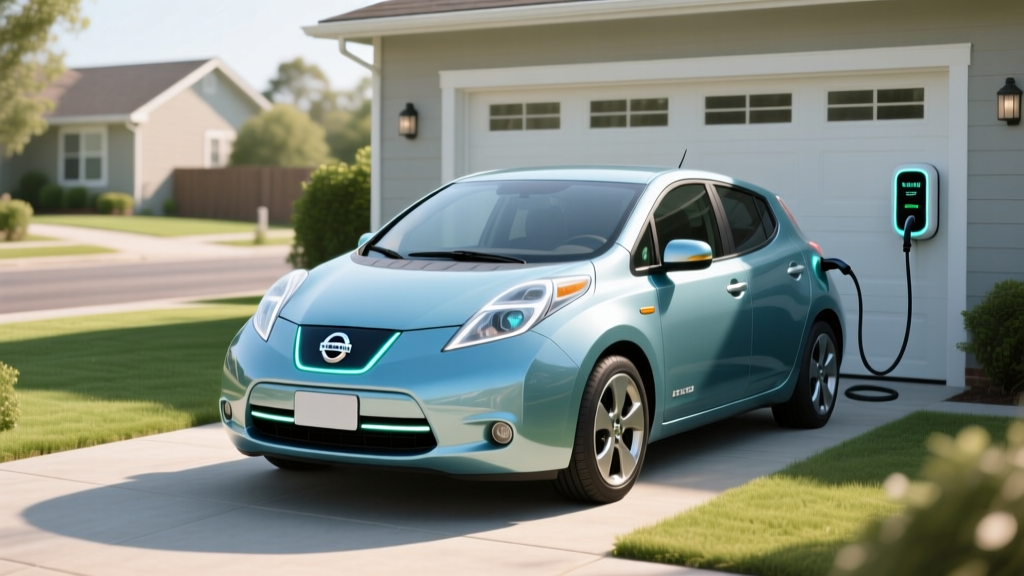
The 2012 Nissan Leaf was the first mass-market battery electric vehicle sold in the United States, and over a decade later, thousands of these cars are still on the road — many as budget-friendly second EVs, commuter cars, or starter electrified vehicles for new owners. If you've just picked up a used 2012 Leaf or are considering one, you need to understand what its modest 24 kWh battery pack means for daily driving, how to charge it efficiently at home, and what infrastructure you'll need.
This guide covers the 2012 Nissan Leaf range in real-world terms, breaks down every charging level with exact speeds, walks through a complete home charger installation cost analysis, and helps you choose the right equipment. We'll also compare your per-mile charging costs against gasoline so you can see whether this pioneering EV still makes financial sense in 2026.
Understanding the 2012 Nissan Leaf Range: EPA vs. Real World
The 2012 Nissan Leaf carries an EPA-estimated range of 73 miles on a full charge, powered by a 24 kWh lithium-ion battery pack (approximately 21.6 kWh usable). That number was competitive at launch, but a decade-plus of battery degradation changes the picture significantly for any used example you'll find today.
EPA sticker: 73 miles (when new).
Expect today (2026, average used pack): 50–65 miles depending on battery State of Health (SoH). Check the dashboard capacity bars — a 12-bar car retains roughly 85%+ of original capacity; an 8-bar car may deliver only 45–50 miles.
Highway driving at 70 mph: subtract ~15%.
Cold weather (below 32°F): subtract 25–35% due to cabin heating load and reduced battery chemistry efficiency.
The Leaf's battery uses laminated lithium-ion cells with an air-cooled thermal management system — a design choice that keeps weight and cost down but accelerates degradation in hot climates. Owners in Arizona, Texas, and the Southeast often see faster capacity loss than those in cooler Pacific Northwest or Northeast environments. Nissan's original battery capacity warranty covered 5 years/60,000 miles against dropping below 4 bars (of 12), but that warranty has long expired for 2012 models.
For context on efficiency, the 2012 Leaf achieves 99 MPGe combined (99 city / 98 highway) per fueleconomy.gov. In practical terms, that translates to roughly 30 kWh per 100 miles of mixed driving.
Charging Levels Explained: Speeds, kW, and Miles Per Hour
Before we get into specific times for the Leaf, let's clarify the critical distinction between kW (kilowatts) and kWh (kilowatt-hours). Kilowatts measure the rate of power delivery — think of it as how fast water flows through a hose. Kilowatt-hours measure total energy — the size of the bucket you're filling. The 2012 Leaf's battery holds about 21.6 kWh of usable energy, and the charger's kW output determines how quickly that bucket fills.
| Charging Level | Voltage | Max Power (kW) | Miles of Range Per Hour | Full Charge Time (0–100%) |
|---|---|---|---|---|
| Level 1 (Standard Outlet) | 120V | 1.2–1.4 kW | ~4–5 miles | ~20–22 hours |
| Level 2 (Home/Public AC) | 240V | 3.3 kW (Leaf's onboard limit) | ~12–14 miles | ~7–8 hours |
| DC Fast Charging (CHAdeMO) | 400V+ DC | ~46 kW peak | ~80–100 miles (equivalent) | ~30 min (0–80%) |
A critical limitation of the 2012 Leaf: its onboard charger is rated at just 3.3 kW for Level 2 AC charging. Even if you plug into a 7.2 kW or 11.5 kW public Level 2 station, the Leaf will only draw 3.3 kW. Later model years (2013+) offered an optional 6.6 kW onboard charger upgrade, but the 2012 model year did not have this option. This means your home charger investment should be right-sized — there's no benefit to installing a 48-amp station for this car.
Home Charger Installation: Electrical Requirements & Costs
Most 2012 Leaf owners will find that a Level 2 home charger is the sweet spot for overnight charging, fully replenishing the small battery pack in 7–8 hours. Here's what you need to know about the electrical requirements and installation costs.
Electrical Requirements for a 2012 Leaf Home Charger
Since the Leaf's onboard charger maxes out at 3.3 kW, a 240V / 16-amp circuit is technically sufficient (3.3 kW ÷ 240V = ~14 amps). However, most electricians recommend installing a 240V / 20-amp or 30-amp dedicated circuit for future-proofing, especially if you plan to upgrade to a newer EV eventually. A NEMA 14-50 outlet (240V/50A) is the most versatile option for long-term flexibility.
Key requirements:
- Dedicated circuit: The EV charger must have its own breaker — no sharing with other appliances.
- GFCI protection: NEC 2020 and later require ground-fault circuit interrupter protection for EV charging outlets in garages and outdoor locations.
- Outdoor rating: If installing outside, both the outlet and charger must carry a NEMA 4 (weatherproof) rating.
- Permit: Most jurisdictions require an electrical permit for EV charger installation, typically $50–$150.
Do You Need a Panel Upgrade?
This is the variable that can dramatically change your installation cost. If your home has a 100-amp electrical panel (common in homes built before the 1990s), adding a 20–30 amp dedicated EV circuit may push you over the panel's capacity, especially if you already run electric range, dryer, and HVAC. A licensed electrician will perform a load calculation (per NEC Article 220) to determine if your panel can handle the addition.
If you need a panel upgrade from 100A to 200A, expect to add $1,500–$3,500 to your project. Homes with 200A panels already in place typically have ample headroom for a Level 2 charger circuit.
| Component | Simple Install (Near Panel) | Complex Install (Far from Panel / Upgrade Needed) |
|---|---|---|
| Level 2 Charger (Equipment) | $250–$400 | $300–$600 |
| Electrical Permit | $50–$100 | $75–$150 |
| Electrician Labor (20A–30A circuit, short run) | $300–$600 | $800–$1,500 |
| Conduit, Wiring, Outlet (NEMA 14-50 or hardwired) | $100–$200 | $300–$800 |
| Panel Upgrade (if needed) | — | $1,500–$3,500 |
| Total Estimated Cost | $700–$1,300 | $2,975–$6,550 |
The good news for 2012 Leaf owners: because the car draws only 3.3 kW, you can often use a lower-amperage circuit and thinner-gauge wire, which reduces labor and material costs compared to installing a circuit for a modern 11.5 kW-capable EV. A simple 20-amp circuit run from a nearby panel can be one of the most affordable home EV charging setups available.
Connector Compatibility: CHAdeMO, J1772, and the NACS Transition
The 2012 Nissan Leaf uses two connector types, and understanding them is essential for both home charging and public charging access.
| Connector Type | Use Case | Notes |
|---|---|---|
| J1772 (Type 1) | Level 1 & Level 2 AC charging | Standard for all non-Tesla EVs in North America. The Leaf's AC charge port accepts J1772 natively. |
| CHAdeMO | DC Fast Charging | The Leaf's DC fast-charge port (on SV and SL trims; S trim lacked DC fast charge). Japanese standard, now declining in the US. |
| NACS (Tesla) | Tesla Superchargers | NOT directly compatible. Requires a CHAdeMO-to-NACS adapter — currently limited availability and not officially supported by Nissan. Tesla Supercharger access for non-Tesla EVs uses Magic Dock (J1772 adapter built in) at select stations, but only for AC-equivalent speeds on CHAdeMO vehicles. |
| CCS1 | Most modern DC fast chargers | NOT directly compatible. CHAdeMO-to-CCS adapters exist but are expensive ($300–$500+) and rare. Most CHAdeMO stations still operate alongside CCS stalls. |
The CHAdeMO situation deserves attention. As the North American charging industry has standardized around CCS1 and increasingly NACS, CHAdeMO infrastructure is shrinking. Electrify America has phased out CHAdeMO connectors on new installations, and many older CHAdeMO stations face maintenance challenges. However, networks like EVgo still maintain CHAdeMO connectors at many urban locations, and the 2012 Leaf's modest range means most charging will happen at home anyway.
For practical daily use: install a J1772 Level 2 charger at home, and use apps like PlugShare or ChargeHub to map CHAdeMO-equipped public stations near your routes.
How Much Does Charging Cost? Per-Mile Comparison vs. Gasoline
One of the strongest arguments for the 2012 Leaf — even with its limited range — is the dramatically lower fuel cost compared to a gasoline vehicle. Let's break it down with concrete numbers.
| Scenario | Cost per kWh or Gallon | Cost Per Mile | Annual Cost (12,000 mi) |
|---|---|---|---|
| Home Charging (national avg. residential) | $0.16/kWh | $0.048 | $576 |
| Home Charging (off-peak utility rate) | $0.09/kWh | $0.027 | $324 |
| Public Level 2 (network pricing) | $0.30/kWh | $0.090 | $1,080 |
| DC Fast Charging (CHAdeMO, avg.) | $0.40/kWh | $0.120 | $1,440 |
| Gasoline Car (30 MPG avg, $3.40/gal) | $3.40/gallon | $0.113 | $1,360 |
At home on a standard residential rate, the 2012 Leaf costs roughly $0.048 per mile to "fuel" — less than half the cost of a 30 MPG gasoline car. If your utility offers time-of-use (TOU) rates and you charge overnight at off-peak pricing, that drops to under $0.03 per mile. Over 12,000 miles of annual driving, home charging saves approximately $780–$1,036 per year compared to gasoline.
However, exclusive reliance on DC fast charging erases most of the savings advantage. At $0.40/kWh, public fast charging costs slightly more per mile than gasoline. This reinforces the core ownership equation for the 2012 Leaf: home charging is essential to making this car economical.
For a full charge of the Leaf's 21.6 kWh usable battery at home (national average $0.16/kWh), you'll pay approximately $3.46 for 50–65 real-world miles of range. That's roughly the cost of a cup of coffee for a day's worth of commuting.
Recommended Home Charging Equipment for the 2012 Leaf
Because the 2012 Leaf's onboard charger is limited to 3.3 kW, you don't need the most powerful (or expensive) Level 2 station on the market. A quality 16-amp or 24-amp charger is ideal — it fully supports the Leaf's maximum charge rate while leaving headroom for a future EV upgrade. Here are proven options:
Power: Up to 48A (11.5 kW) — Leaf will draw 3.3 kW (14A)
Connector: J1772
Cable Length: 24 ft
Smart Features: Wi-Fi, app scheduling, energy monitoring, TOU optimization
Price: ~$299
Best For: Budget-conscious buyers who want smart scheduling and energy tracking
Power: Adjustable 16A–50A (up to 12 kW) — set to 16A for Leaf
Connector: J1772 (NACS adapter available)
Cable Length: 23 ft
Smart Features: Wi-Fi, app, Alexa integration, amperage adjustable for panel limits
Price: ~$499
Best For: Future-proofing — adjustable amperage fits any panel, works with future EVs
Power: Up to 40A (9.6 kW)
Connector: J1772
Cable Length: 24 ft
Smart Features: OCPP-compatible, app control, extreme cold rated (-40°F)
Price: ~$399
Best For: Cold-climate owners and outdoor installations
Power: 16A (3.8 kW) — matches Leaf closely
Connector: J1772
Cable Length: 20 ft
Smart Features: Basic LED status, no Wi-Fi
Price: ~$159
Best For: Minimal budget, plug-and-charge simplicity
Editor's recommendation: For a 2012 Leaf specifically, the Emporia Level 2 offers the best value. Its smart scheduling features let you program charging during off-peak utility hours (maximizing savings), and the energy monitoring helps track your exact charging costs. The 48A max output is overkill for the Leaf but ensures the charger remains useful if you later upgrade to a vehicle with a faster onboard charger.
DC Fast Charging Realities: Charge Curve and CHAdeMO Access
The 2012 Leaf supports DC fast charging via CHAdeMO at a peak rate of approximately 46 kW — but only under ideal conditions (low State of Charge, moderate battery temperature). In practice, you should understand how the charge curve works.
Like all lithium-ion batteries, the Leaf charges fastest at a low State of Charge (SoC) and progressively slows as it fills. Expect roughly:
- 0–50% SoC: ~35–46 kW sustained — adds roughly 35 miles in 15 minutes
- 50–80% SoC: ~20–30 kW as the battery management system tapers current to protect cells
- 80–100% SoC: ~5–10 kW trickle — DC fast charging above 80% is inefficient and unnecessary
Practical 10–80% charging time on a CHAdeMO DC fast charger: approximately 25–35 minutes. This is adequate for a meal break on a short road trip but significantly slower than modern EVs charging at 150–350 kW on CCS or NACS infrastructure.
A thermal management caveat: the 2012 Leaf uses passive air cooling for its battery, not liquid cooling. During repeated DC fast charging sessions or in hot weather, the battery temperature rises, and the car's battery management system will throttle charge speed to prevent cell damage — a phenomenon the Leaf community calls "Rapidgate." If you plan to DC fast charge more than once per day, expect progressively slower sessions.
Federal Tax Credits and Incentives for Home Charging Equipment
Under IRS §30D and the Alternative Fuel Vehicle Refueling Property Credit (§30C), homeowners may qualify for a tax credit covering 30% of home EV charger equipment and installation costs, up to $1,000. However, this credit has significant eligibility constraints as of 2026:
- Location requirement: The charger must be installed in a census tract classified as non-urban or meeting specific low-income criteria (per IRA provisions).
- Income limits: Vary by filing status and are adjusted annually.
- Equipment must be new: Used chargers do not qualify.
- Non-refundable credit: It reduces your tax liability but does not generate a refund if your liability is zero.
Consult a tax professional and verify current-year eligibility on irs.gov before assuming you'll receive the credit. Many state and utility programs also offer rebates for Level 2 charger installation — check your local utility's EV programs for additional savings that can stack with federal incentives.
Frequently Asked Questions
How much does it cost to install a home EV charger for a 2012 Nissan Leaf?
A straightforward installation with a 20A/240V circuit near your electrical panel typically costs $700–$1,300 total (equipment, electrician labor, wiring, and permit). Complex installations requiring long wire runs, conduit, or a panel upgrade can range from $2,975–$6,550. Because the Leaf only needs 3.3 kW, you can often use a smaller, less expensive circuit than modern EVs require.
How fast will each charging level add range to the 2012 Leaf?
Level 1 (120V outlet): approximately 4–5 miles of range per hour. Level 2 (240V, 3.3 kW): approximately 12–14 miles per hour. DC fast charging (CHAdeMO): approximately 35 miles in 15 minutes at peak rate, tapering significantly above 50% SoC.
Which connector and charger is compatible with my 2012 Leaf?
For Level 1 and Level 2 AC charging, the Leaf uses the J1772 connector — the North American standard. Any J1772 Level 2 home charger will work. For DC fast charging, the Leaf uses CHAdeMO (SV and SL trims only; the base S trim lacks DC fast charge capability). The Leaf is not compatible with CCS1 or NACS/Tesla connectors without specialized adapters, which are expensive and have limited availability.
How much does charging cost per mile vs. gas?
Charging at home on the national average residential rate ($0.16/kWh), the 2012 Leaf costs about $0.048 per mile. A 30 MPG gasoline car at $3.40/gallon costs about $0.113 per mile — more than double. However, exclusive use of DC fast charging at $0.40/kWh pushes the Leaf to $0.12/mile, slightly more than gas. Home charging access is the key to EV economics.
What electrical upgrades might I need for a home charger?
The most common upgrade is a panel capacity increase from 100A to 200A ($1,500–$3,500) if your existing panel can't accommodate a new 20–30A dedicated circuit. Other potential upgrades include replacing a Federal Pacific or Zinsco panel (known safety hazards, $2,000–$4,000 replacement), adding a sub-panel in the garage, or upgrading service from the utility. A licensed electrician's load calculation will determine your specific needs. Always get a permit — unpermitted electrical work can void home insurance and create fire risk.
Is the 2012 Leaf still practical as a daily driver in 2026?
For a single-car household with a commute under 25 miles each way and home charging access, yes — the 2012 Leaf remains a functional, ultra-low-cost commuter. For multi-car households, it excels as a dedicated around-town second car. However, its 50–65 mile real-world range (with degradation), lack of liquid battery cooling, shrinking CHAdeMO infrastructure, and absence of modern ADAS features make it unsuitable as a primary vehicle for longer commutes, frequent highway driving, or hot-climate owners. Buy it for what it is: an affordable, efficient city EV — not a road-trip car.