Why Compare a 2012 Jaguar XJ Supercharged to Electric Vehicles?
The 2012 Jaguar XJ Supercharged remains a striking luxury sedan — its 5.0-liter supercharged V8 produces 470 horsepower and 424 lb-ft of torque, launching the car from 0-60 mph in approximately 4.9 seconds. But that performance comes at a steep ongoing cost. With an EPA rating of 15 mpg city and 23 mpg highway (roughly 18 mpg combined per fueleconomy.gov), owners are spending significantly more per mile than EV drivers in 2026.
This guide breaks down exactly what it costs to fuel the XJ Supercharged versus charging a modern electric vehicle — covering home charging installation, public charging costs, per-mile economics, and whether switching makes financial sense for current Jaguar owners.
Fuel Cost Showdown: 2012 Jaguar XJ Supercharged vs EV Charging
The 2012 XJ Supercharged has a 21.1-gallon fuel tank. At the 2026 national average of $3.45 per gallon for premium unleaded (required by Jaguar), a full tank costs approximately $72.80. With 18 mpg combined, that delivers roughly 380 miles of range — meaning your cost per mile sits around $0.192.
Compare that to a 2026 EV charged primarily at home on off-peak electricity rates:
| Vehicle / Scenario | Energy Cost | Efficiency | Cost Per Mile |
|---|---|---|---|
| 2012 Jaguar XJ Supercharged (premium gas) | $3.45/gal | 18 mpg combined | $0.192 |
| EV — Home Level 2 (off-peak $0.13/kWh) | $0.13/kWh | 3.5 mi/kWh (typical sedan) | $0.037 |
| EV — Home Level 2 (peak $0.28/kWh) | $0.28/kWh | 3.5 mi/kWh | $0.080 |
| EV — Public DC Fast ($0.48/kWh avg) | $0.48/kWh | 3.5 mi/kWh | $0.137 |
| EV — Electrify America Peak ($0.64/kWh) | $0.64/kWh | 3.5 mi/kWh | $0.183 |
Even at peak DC fast-charging rates, a modern EV costs less per mile than the XJ Supercharged. At home off-peak rates, the EV saves roughly $0.155 per mile — or about $2,325 annually at 15,000 miles driven.
Charging Levels Explained: Speeds, kW Ratings, and Miles Per Hour
Understanding EV charging requires distinguishing between kW (kilowatts), which measures power flow rate, and kWh (kilowatt-hours), which measures total energy delivered. Think of kW as how fast water flows through a hose, and kWh as the total gallons in the bucket.
| Level | Voltage | Power (kW) | Miles Added/Hour | Best For |
|---|---|---|---|---|
| Level 1 (120V household) | 120V AC | 1.0–1.4 kW | 3–5 mi/hr | Overnight top-ups, PHEVs |
| Level 2 (240V home/public) | 240V AC | 7.2–19.2 kW | 25–70 mi/hr | Daily home charging |
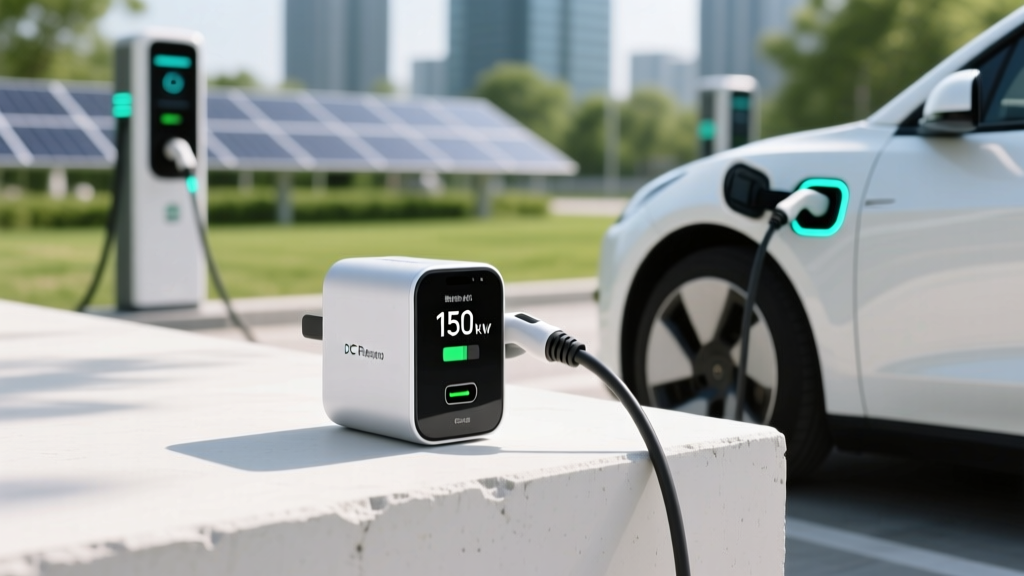
| DC Fast Charging | 200–800V DC | 50–350 kW | 150–1,200+ mi/hr | Road trips, rapid top-ups |
For context, a typical 2026 EV sedan with an 82 kWh battery charging at a Level 2 home station (11.5 kW / 48A) will add approximately 40 miles of range per hour. A full 10-80% charge takes roughly 5 hours — easily completed overnight.
On a 250 kW DC fast charger, that same vehicle can go from 10-80% in approximately 18-22 minutes, though actual speed depends on the vehicle's charge curve. Most EVs peak at their maximum kW only between roughly 10-40% state of charge, then taper progressively to protect battery health.
Home EV Charger Installation: Costs, Electrical Requirements, and Panel Upgrades
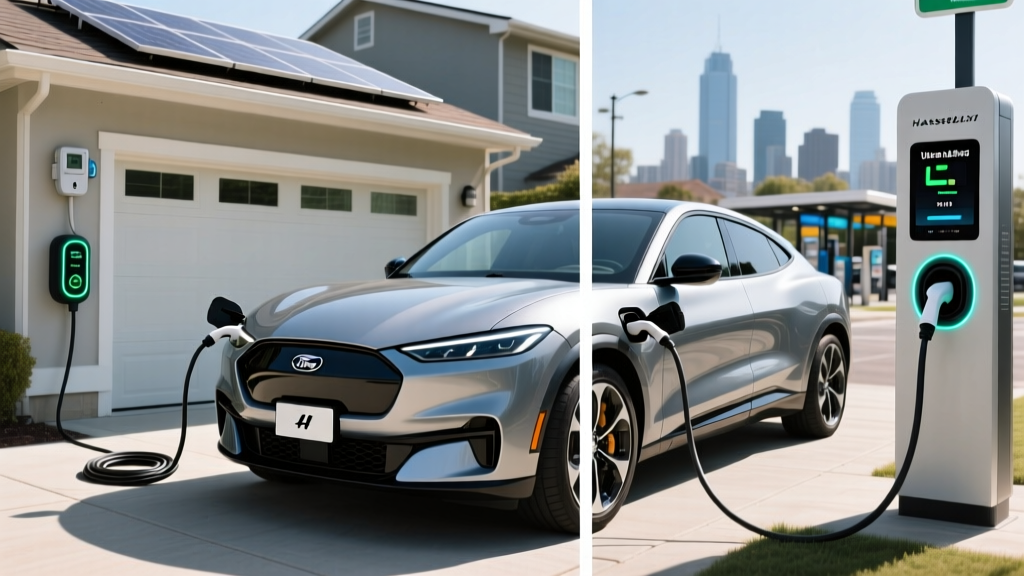
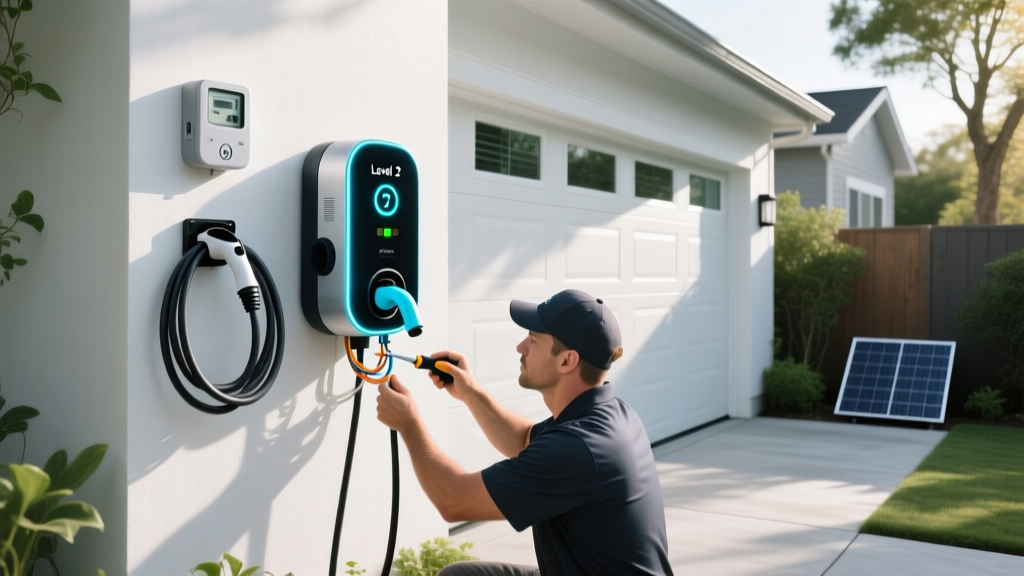
Installing a Level 2 home charger is the single most impactful upgrade for EV ownership. Here's what's involved:
Electrical Requirements
A typical Level 2 home charger requires a 240V dedicated circuit — similar to what an electric dryer or oven uses. Most EV owners install a 40A or 60A circuit, which supports charging at 9.6 kW or 14.4 kW respectively (EVs draw 80% of the circuit's rated amperage continuously per NEC code).
Homes built after 2000 typically have 200A electrical panels with available capacity. Older homes — particularly those with 100A service — may require a panel upgrade before adding a dedicated EV circuit.
Installation Cost Breakdown
| Component | Typical Cost Range | Notes |
|---|---|---|
| Level 2 Charger (hardware) | $350–$750 | Smart chargers with WiFi at higher end |
| Electrician labor (standard install) | $500–$1,500 | Depends on panel-to-garage distance |
| Electrical permit | $50–$200 | Required in most jurisdictions |
| Panel upgrade (if needed) | $1,500–$4,000 | 100A → 200A service upgrade |
| Conduit/wiring (long runs) | $200–$800 | Over 50ft from panel adds cost |
| Total (no panel upgrade) | $900–$2,450 | Most common scenario |
| Total (with panel upgrade) | $2,400–$6,450 | Older homes with 100A service |
The IRS Residential Clean Energy Credit covers 30% of home charging equipment and installation costs (up to $1,000 annually through 2032), which can offset $270–$735 of a standard installation.
Connector Compatibility: NACS, CCS, and CHAdeMO in 2026
The connector landscape has consolidated significantly. As of 2026, nearly all new EVs sold in North America use the NACS (North American Charging Standard) connector, originally developed by Tesla. The CCS1 connector is being phased out on new vehicles but remains on many 2022-2024 models. CHAdeMO is effectively legacy-only (Nissan Leaf, Mitsubishi Outlander PHEV).
| Connector | Vehicles Using It (2026) | Public Network Access | Adapter Availability |
|---|---|---|---|
| NACS (Tesla standard) | Tesla (all), Ford, GM, Rivian, Volvo, Polestar, Hyundai/Kia (2025+), most new models | Tesla Supercharger network + growing third-party | N/A (native) |
| CCS1 | 2022-2024 Ford, GM, VW, Hyundai/Kia, BMW, Mercedes models | Electrify America, EVgo, ChargePoint DC | CCS-to-NACS adapters ($200-$400) for Supercharger access |
| CHAdeMO | Nissan Leaf, Mitsubishi Outlander PHEV (legacy) | Limited and declining | No practical adapter to NACS/CCS for DC charging |
If you're switching from a 2012 Jaguar XJ Supercharged to a new 2026 EV, you'll almost certainly get a NACS-equipped vehicle with direct Supercharger access — the most reliable DC fast-charging network in North America.
Equipment Recommendations: Top Level 2 Home Chargers for 2026
Tesla Universal Wall Connector
- Power Output: 11.5 kW (48A on 60A circuit)
- Connector: NACS with integrated CCS adapter
- Cable Length: 24 feet
- Smart Features: WiFi, scheduling, power sharing between two units
- Price: $599
- Best For: Tesla owners and anyone wanting maximum compatibility
ChargePoint Home Flex
- Power Output: Up to 12 kW (50A adjustable)
- Connector: NACS or CCS (configurable)
- Cable Length: 23 feet
- Smart Features: WiFi, app scheduling, Alexa integration, energy tracking
- Price: $549
- Best For: Non-Tesla EVs, smart-home integration
Emporia Level 2 EV Charger
- Power Output: 11.5 kW (48A)
- Connector: NACS (2025+ models)
- Cable Length: 24 feet
- Smart Features: WiFi, solar integration, energy monitoring, load management
- Price: $399
- Best For: Budget-conscious buyers with solar panels
Safety, Code Compliance, and Installation Best Practices
EV charger installation must comply with the National Electrical Code (NEC Article 625) and local amendments. Key requirements:
- Dedicated circuit: Your Level 2 charger needs its own breaker — no sharing with other appliances
- GFCI protection: Required for outdoor installations and recommended for garages per 2023 NEC updates
- Outdoor rating: If mounting outside, ensure the charger carries a NEMA 4 (weatherproof) rating — most modern units do
- Wire gauge: 6 AWG copper for 48A/60A circuits; your electrician will size appropriately
- Permit and inspection: Nearly all jurisdictions require an electrical permit and post-installation inspection — skipping this can void home insurance coverage
Never use extension cords or plug adapters to circumvent proper installation. A quality Level 2 charger on a correctly sized circuit will operate safely for 15+ years with zero maintenance.
Is Switching from the XJ Supercharged Worth It? A 5-Year Cost Analysis
Let's model 15,000 miles/year over 5 years (75,000 miles total) comparing the 2012 Jaguar XJ Supercharged to a 2026 EV sedan (e.g., Tesla Model 3 Long Range or Hyundai Ioniq 6):
- XJ Supercharged fuel cost: 75,000 mi ÷ 18 mpg × $3.45/gal = $14,375
- EV home charging cost: 75,000 mi ÷ 3.5 mi/kWh × $0.15/kWh avg = $3,214
- Fuel savings over 5 years: $11,161
Add in the XJ's higher maintenance costs (supercharger coolant service, premium oil changes, transmission fluid, aging air suspension) versus an EV's minimal maintenance (cabin filter, tire rotation, wiper fluid), and total ownership savings can exceed $15,000-$18,000 over five years — enough to cover a significant portion of a new EV purchase after the §30D federal tax credit (up to $7,500, subject to MSRP caps, income limits, and battery sourcing requirements).
Frequently Asked Questions
How much does it cost to install a home EV charger?
A standard Level 2 home charger installation costs $900–$2,450 including equipment, electrician labor, and permit — assuming your electrical panel has available capacity. Homes needing a 100A-to-200A panel upgrade should budget $2,400–$6,450 total. The IRS Residential Clean Energy Credit covers 30% of costs up to $1,000.
How fast will each charging level add range?
Level 1 (120V) adds 3-5 miles per hour — suitable only for PHEVs with small batteries. Level 2 (240V, 48A) adds approximately 40 miles per hour, fully recharging most EVs overnight. DC fast charging at 250 kW can add 200+ miles in 15-20 minutes, though actual speed depends on battery state of charge and temperature.
Which connector/charger is compatible with my EV?
For 2026 model-year vehicles, nearly all new EVs use NACS (Tesla's connector standard). If you own a 2022-2024 EV, it likely has CCS1 — which can access Tesla Superchargers via a $200-$400 adapter. CHAdeMO is limited to older Nissan Leaf and Mitsubishi models with declining infrastructure support.
How much does charging cost per mile vs gas?
Home EV charging at off-peak rates ($0.13/kWh) costs approximately $0.037 per mile — about 80% less than the 2012 Jaguar XJ Supercharged at $0.192 per mile. Even expensive public DC fast charging ($0.48-$0.64/kWh) at $0.14-$0.18 per mile remains cheaper than premium gasoline in the XJ.
What electrical upgrades might I need?
Homes with 200A service (most post-2000 construction) typically need no upgrade. Homes with 100A service, older wiring (knob-and-tube or aluminum), or panels at near-capacity may require a panel upgrade ($1,500-$4,000) before adding a 60A EV circuit. A licensed electrician can assess your panel's available amperage during a site visit.