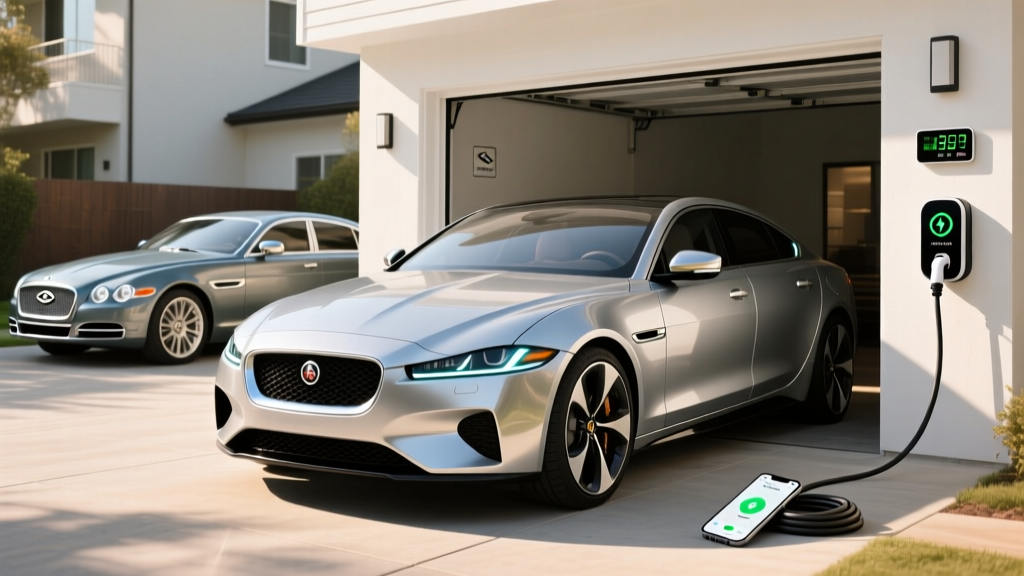
If you're coming from a supercharged V8 luxury sedan — say, a 2011 Jaguar XJ XJL Supercharged with its 5.0L AJ-V8 pushing 470 hp and sipping fuel at roughly 15 MPG combined — the jump to an electric vehicle is as much about rethinking "refueling" as it is about the car itself. That Jaguar's 18.4-gallon tank gave you about 276 miles of range and took five minutes to fill at any gas station. An EV reverses that equation: refueling is slower but can happen while you sleep at home, and the per-mile cost drops dramatically.
This guide covers exactly what you need to charge an EV at home and on the road in 2026, from electrical requirements to real-world costs, so you can plan the transition with hard numbers instead of guesswork.
The Three Charging Levels: kW Speeds and Miles Per Hour
EV charging is measured in kW (kilowatts), which is the rate of power delivery — think of it like the diameter of a hose. The battery capacity is measured in kWh (kilowatt-hours), which is the total energy stored — the size of the bucket. Confusing the two is the most common mistake new EV owners make.
Here's what each level delivers in practical terms:
| Level | Voltage | Power (kW) | Miles of Range Added Per Hour | Best For |
|---|---|---|---|---|
| Level 1 | 120V AC | 1.0–1.4 kW | 3–5 mi/hr | Overnight top-ups, PHEVs, low-mileage drivers |
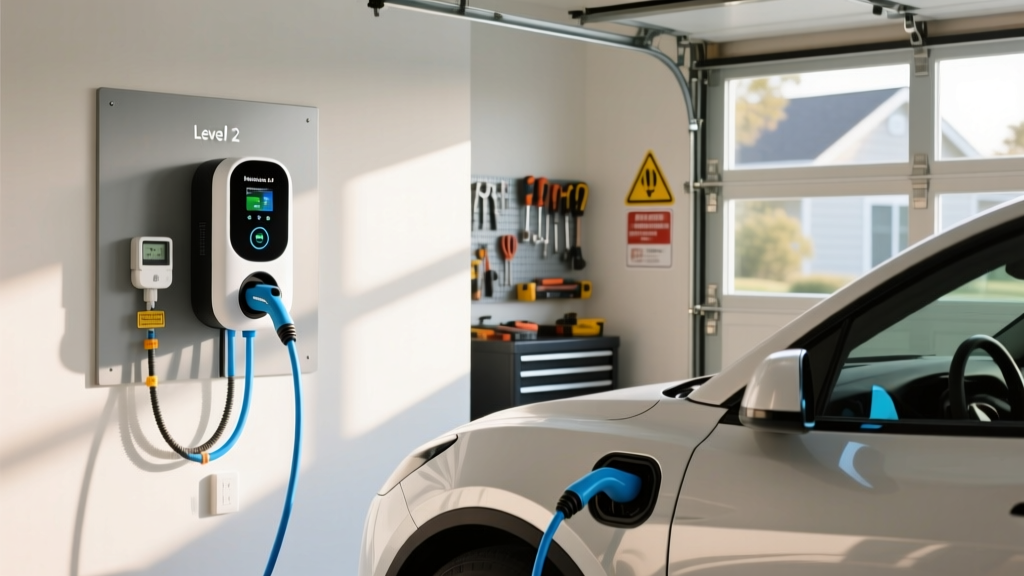
| Level 2 | 240V AC | 3.3–19.2 kW | 12–75 mi/hr | Daily home charging, most EVs |
| DC Fast Charging | 400–800V DC | 50–350 kW | 150–1,200+ mi/hr (peak) | Road trips, rapid top-ups |
A typical modern EV with an 80 kWh battery charging on a 48-amp Level 2 circuit (11.5 kW) will go from 10% to 80% in roughly 5.5 hours. On a 150 kW DC fast charger, that same 10–80% session takes about 25–30 minutes, though peak rate only holds until roughly 50–60% state of charge before the charge curve tapers to protect the battery.
How Much Does It Cost to Install a Home EV Charger?
The total cost of a Level 2 home charging setup varies widely depending on your electrical panel's capacity, the distance from the panel to the charger location, and local permit fees. Here's a realistic breakdown for a 240V / 48-amp (11.5 kW) hardwired installation:
| Component | Typical Cost Range | Notes |
|---|---|---|
| Level 2 Charger Unit | $350–$750 | Smart Wi-Fi-enabled, 40–48A, 25 ft cable |
| Electrician Labor | $600–$2,000 | Depends on run length, wall type, conduit needs |
| Electrical Permit | $50–$250 | Varies by municipality |
| Panel Upgrade (if needed) | $1,500–$4,000 | Older 100A panels often need upgrade to 200A |
| Total (no panel upgrade) | $1,000–$3,000 | Most homes with 200A service |
| Total (with panel upgrade) | $2,500–$7,000 | Common in pre-2000 homes |
Panel upgrade reality check: If you're coming from a home built before 2000 with a 100-amp electrical panel, adding a 48-amp EV circuit (which requires a 60-amp breaker per the NEC 125% continuous-load rule) may push your panel past its safe capacity. A licensed electrician will perform a load calculation to determine whether an upgrade to 200A service is required. This is the single biggest variable in installation cost and one that's easy to overlook when budgeting.
The federal government and many utilities offer rebates for home charger installation. Check IRS guidelines on the Residential Clean Energy Credit for current-year eligibility on certain energy-related home improvements, and contact your local utility for charger-specific rebates that can offset $200–$500 of equipment costs.
Which Connector and Charger Is Compatible with My EV?
As of 2026, the North American charging connector landscape has largely consolidated around NACS (North American Charging Standard), the connector pioneered by Tesla. Most major automakers — Ford, GM, Rivian, Volvo, Hyundai, Kia, and others — have transitioned to NACS on new vehicles. However, CCS1-equipped EVs from model years 2020–2025 remain common on the road and in the used market.
| Connector | Brands Using It | Adapter Needed? |
|---|---|---|
| NACS (Tesla-style) | Tesla, Ford, GM, Rivian, Volvo, Polestar, Hyundai, Kia (2025+), Mercedes-Benz (2026+) | No — native on new models |
| CCS1 | Hyundai/Kia (pre-2025), VW ID.4 (pre-2026), BMW iX, older Ford/GM EVs | NACS-to-CCS adapter for Tesla Superchargers (~$150–$250) |
| CHAdeMO | Nissan Leaf (legacy), Mitsubishi Outlander PHEV | Largely deprecated; few new DC stations include it |
If you buy a home Level 2 charger in 2026, choose one with a NACS connector if your EV has a NACS port, or a J1772 connector (the legacy Level 2 standard) with a NACS adapter if your vehicle uses NACS. Most smart chargers now ship with NACS as the default or offer it as an option. For CCS1 vehicles, a J1772-to-CCS adapter is available, though many CCS1 owners simply use a J1772 home charger since CCS1 and J1772 share the same AC pins for Level 2 charging.
Charging Cost Per Mile: EV vs. the 2011 Jaguar XJ XJL Supercharged
The 2011 Jaguar XJ XJL Supercharged achieves roughly 15 MPG combined per EPA estimates on fueleconomy.gov. At $3.50/gallon (a moderate 2026 national average for premium), that's $0.233 per mile in fuel alone.
An efficient EV consuming 3.0 miles per kWh (roughly 33 kWh/100mi, typical for a midsize sedan) charged under different scenarios:
| Scenario | Rate ($/kWh) | Cost Per Mile | Annual Fuel Cost (12,000 mi) |
|---|---|---|---|
| Home Off-Peak (utility TOU rate) | $0.08–$0.12 | $0.027–$0.040 | $320–$480 |
| Home Standard Rate | $0.14–$0.18 | $0.047–$0.060 | $560–$720 |
| Public Level 2 (ChargePoint, etc.) | $0.25–$0.40 | $0.083–$0.133 | $1,000–$1,600 |
| DC Fast Charging (Electrify America, EVgo) | $0.35–$0.55 | $0.117–$0.183 | $1,400–$2,200 |
| 2011 Jaguar XJ XJL (Premium Gas) | $3.50/gal | $0.233 | $2,800 |
Even at the most expensive public DC fast charging rates, the EV costs less per mile than the supercharged Jaguar. Charging at home on off-peak rates saves roughly $2,300–$2,500 per year over 12,000 miles compared to the Jaguar's fuel bill. Over five years, that's $11,500–$12,500 in fuel savings — enough to cover the home charger installation and a meaningful chunk of the EV's purchase premium.
Real-World Charging Times for Common EV Battery Sizes
Charge times depend on battery capacity (kWh), the charger's power output (kW), and the vehicle's onboard charger limit for AC charging. Here are realistic 10–80% times for common battery sizes you'll encounter in 2026 EVs:
- 60 kWh battery (e.g., base Tesla Model 3 RWD): 42 kWh needed for 10–80%. On an 11.5 kW Level 2 charger: ~3.7 hours. On a 150 kW DC fast charger: ~22 minutes (with charge-curve taper above 60% SoC).
- 80 kWh battery (e.g., Hyundai Ioniq 5 Long Range): 56 kWh for 10–80%. On 11.5 kW Level 2: ~4.9 hours. On a 250 kW DC fast charger: ~18 minutes (the Ioniq 5's 800V architecture sustains high charge rates longer than 400V systems).
- 100 kWh battery (e.g., Ford F-150 Lightning Extended Range): 70 kWh for 10–80%. On 11.5 kW Level 2: ~6.1 hours. On a 150 kW DC fast charger: ~35 minutes.
Charge-curve reality: DC fast charging does not sustain peak kW from 10% to 80%. A vehicle rated for 250 kW peak may only hold that rate between 10–35% SoC before stepping down to 150 kW, then 100 kW, then 50 kW as it approaches 80%. This is why 10–80% times are the standard benchmark — charging past 80% slows dramatically and is best done at home on Level 2.
Recommended Home Level 2 Chargers for 2026
Based on reliability, smart features, cable management, and power output, here are three chargers that cover most home-installation scenarios:
Emporia Vue Level 2 Smart Charger
- Power Output: 48 amps / 11.5 kW (240V, hardwired)
- Connector: NACS or J1772 (selectable at purchase)
- Cable Length: 24 feet
- Smart Features: Wi-Fi, app scheduling, solar integration, energy monitoring, load management
- Price: ~$399
- Best For: Budget-conscious buyers who want full smart features and energy tracking
ChargePoint Home Flex (2nd Gen)
- Power Output: Up to 50 amps / 12 kW (240V, hardwired or NEMA 14-50 plug)
- Connector: NACS or J1772
- Cable Length: 25 feet
- Smart Features: Wi-Fi, Alexa/Google integration, ChargePoint network access, amperage configurable via DIP switch
- Price: ~$599
- Best For: Flexibility — plug-in option for renters or those who may move; adjustable amperage to match panel capacity
Tesla Wall Connector (Gen 4)
- Power Output: 48 amps / 11.5 kW (240V, hardwired)
- Connector: NACS native; includes J1772 adapter in box
- Cable Length: 24 feet
- Smart Features: Wi-Fi, over-the-air updates, power sharing between two units on one circuit, vehicle-specific access control
- Price: ~$450
- Best For: Tesla owners and NACS-equipped EV drivers who want a clean, reliable, no-app-required experience
Safety, Electrical Code, and Installation Requirements
EV charging is a continuous electrical load, which means the National Electrical Code (NEC) requires the circuit breaker to be rated at 125% of the charger's maximum draw. A 48-amp charger needs a 60-amp breaker; a 40-amp charger needs a 50-amp breaker. This is non-negotiable for safety and code compliance.
Key installation requirements to discuss with your licensed electrician:
- Dedicated circuit: The EV charger must have its own dedicated circuit — it cannot share with other appliances or outlets.
- Wire gauge: A 60-amp circuit typically requires 6 AWG copper wire (THHN in conduit) or 4 AWG for longer runs to minimize voltage drop.
- GFCI protection: The 2023 NEC and later editions require GFCI protection for outdoor receptacles used for EV charging. Hardwired installations may not require a GFCI breaker, but your local AHJ (Authority Having Jurisdiction) may interpret this differently — your electrician will confirm.
- Outdoor rating: If the charger is mounted outdoors or in an unenclosed carport, it must carry a NEMA 4 (weatherproof) rating. All three chargers recommended above are NEMA 4 rated.
- Permit and inspection: Virtually all jurisdictions require a permit and post-installation inspection for a new 240V circuit. Skipping this risks voiding your homeowner's insurance if an electrical fire occurs.
Frequently Asked Questions
Can I just plug an EV into a regular 120V outlet?
Yes, but Level 1 charging at 120V delivers only 1.0–1.4 kW, adding roughly 3–5 miles of range per hour. For a vehicle with a 75 kWh battery, a full charge from empty takes 55–75 hours. Level 1 works for plug-in hybrids with small batteries (10–20 kWh) or for EV drivers who travel fewer than 30 miles daily and can charge overnight. For most BEV owners, it's impractical as a primary charging method.
What electrical upgrades might I need for a Level 2 charger?
The most common upgrade is a panel replacement from 100A to 200A service ($1,500–$4,000), especially in homes built before 2000. You may also need a new conduit run from the panel to the garage or driveway, a sub-panel if your main panel is full, or a smart load-management system if your panel is at capacity but you want to avoid a full upgrade. Your electrician's load calculation will determine which path is required.
How fast will each charging level add range to a typical EV?
Level 1 (120V): 3–5 miles per hour. Level 2 at 32 amps / 7.7 kW: roughly 25–30 miles per hour. Level 2 at 48 amps / 11.5 kW: roughly 40–45 miles per hour. DC fast charging at 150 kW: roughly 500+ miles per hour at peak, though this rate only holds for 10–20 minutes before tapering. These figures assume a vehicle efficiency of about 3.0 mi/kWh; less efficient vehicles (large SUVs, trucks) will add fewer miles per hour at the same kW rate.
Is it cheaper to charge at home or use public chargers?
Home charging is almost always cheaper. Off-peak residential electricity at $0.10/kWh yields a per-mile cost of about $0.03. Public DC fast chargers at $0.40–$0.55/kWh cost $0.13–$0.18 per mile — still less than premium gasoline in the Jaguar, but 4–6× more than home charging. If your daily driving is covered by overnight home charging, public chargers become a road-trip expense rather than a daily one.
Do I need a smart charger or is a basic unit fine?
A basic non-connected charger works perfectly for plugging in and charging. However, a smart charger ($50–$150 more) offers scheduling to take advantage of off-peak utility rates, energy monitoring to track your EV's share of your electric bill, remote start/stop via phone, and integration with solar panels or home batteries. For most buyers spending $1,000+ on installation, the marginal cost of a smart charger is worthwhile.
Will my 2011 Jaguar XJ XJL Supercharged's garage setup work for an EV?
The physical space is fine — a charger mounts to the wall and takes up less room than a shelf. The question is electrical: that garage likely has standard 120V outlets and possibly a 240V dryer outlet. If your home has a 200-amp panel with available capacity, an electrician can run a dedicated 60-amp circuit to the garage for a Level 2 charger. If your panel is older or at capacity, budget for an upgrade. The transition from a supercharged V8 to an EV is mostly an electrical-infrastructure project — the driving part is easy.