From HEMI V8 to Kilowatts: What Changes When You Go Electric
If you've spent years behind the wheel of a 2010 Dodge Charger SRT8 — that 6.1L HEMI V8 pushing 425 hp and returning a combined 15 MPG — the jump to an electric vehicle is a paradigm shift, not just a powertrain swap. You're trading the rumble of exhaust for the whine of an inverter, gas station stops for charging sessions, and miles-per-gallon for kilowatt-hours-per-100-miles. But here's what most SRT8 veterans don't anticipate: the charging ecosystem is more nuanced than simply plugging in.
This guide breaks down every charging level, connector type, home installation requirement, and cost comparison you need to understand before your first EV fills the garage where that Charger used to sit. We'll use precise numbers — because if you knew your SRT8's 0-60 in 4.8 seconds, you deserve to know your EV's 10-80% charge time in minutes.
First, a critical distinction: kW (kilowatts) measures power — the rate of energy delivery, like water pressure from a hose. kWh (kilowatt-hours) measures energy — the total amount stored in your battery, like gallons in a tank. A 240 kW DC fast charger delivers power rapidly; a 75 kWh battery stores the energy capacity. Never confuse the two.
Charging Levels Explained: Speeds, Power, and Miles Per Hour
EV charging falls into three tiers. Each delivers different power (kW), which translates to different range recovery rates (miles of driving added per hour of charging).
| Level | Voltage | Power (kW) | Miles of Range/Hour | Best For |
|---|---|---|---|---|
| Level 1 | 120V AC | 1.0–1.9 kW | 3–5 mi/hr | Overnight top-ups, PHEVs, emergencies |
| Level 2 | 240V AC | 3.3–19.2 kW | 12–75 mi/hr | Daily home charging, workplace, destinations |
| DC Fast Charge | 400–900V DC | 50–350+ kW | 150–1,000+ mi/hr | Road trips, highway corridors, quick stops |
Real-world context: A typical 2026 EV with a 75 kWh battery (EPA range ~280 miles) charging on a Level 2 home station at 11.5 kW (48A) will go from 20% to 80% in roughly 4 hours. On a 150 kW DC fast charger, that same 20-80% session takes approximately 22–28 minutes — but only if the battery is preconditioned and ambient temperatures are moderate. Cold batteries (<40°F) can double DC charging times due to reduced charge acceptance rates.
DC fast charging follows a charge curve: the battery accepts peak power between roughly 10-50% state of charge, then progressively tapers. A vehicle rated at 250 kW peak might sustain that rate for only 5-8 minutes before throttling to 150 kW, then 75 kW above 80%. This is why manufacturers quote 10-80% times rather than 0-100%.
Home Charger Installation: Electrical Requirements, Costs, and Gotchas
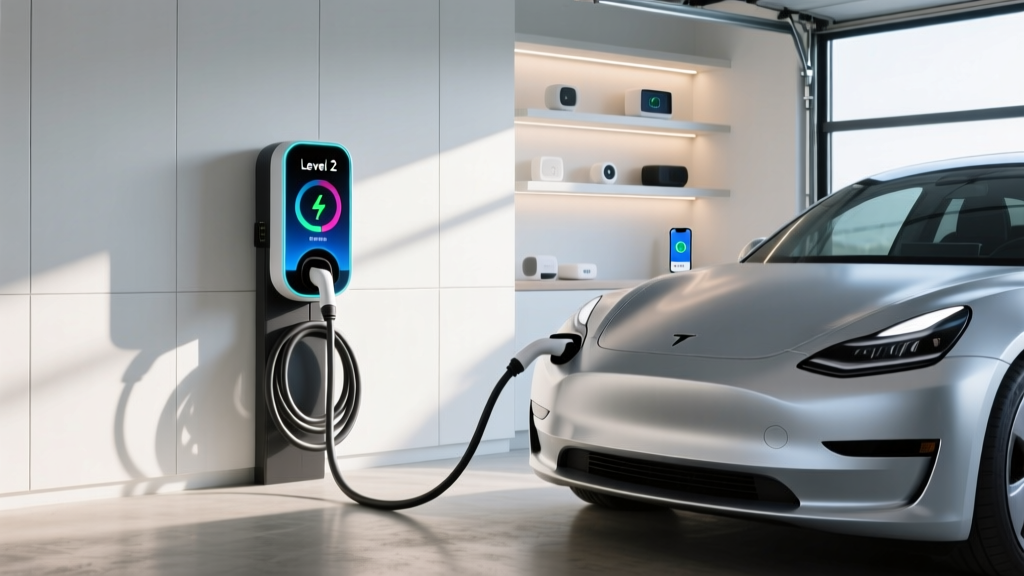
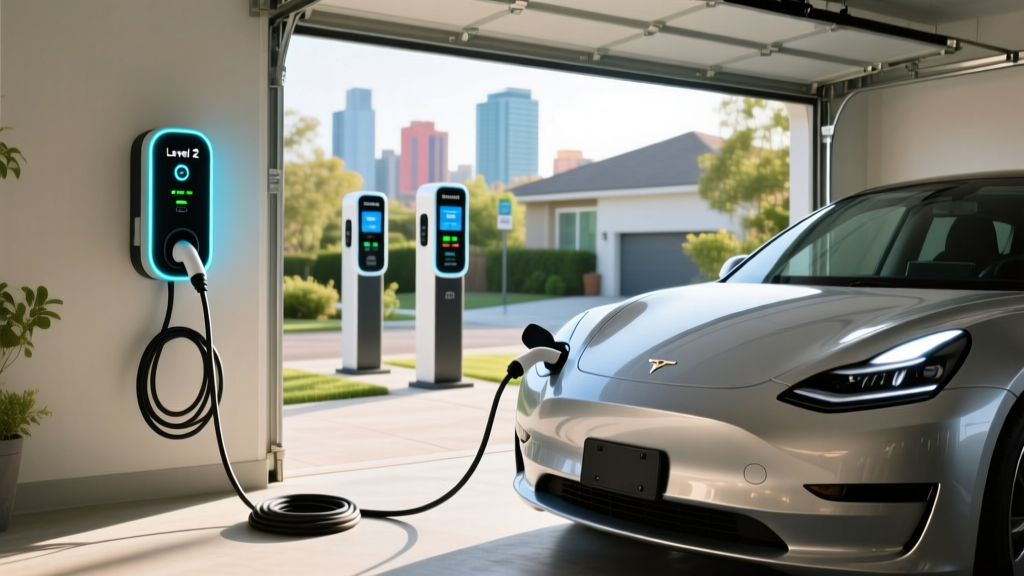
Installing a Level 2 home charger (technically called EVSE — Electric Vehicle Supply Equipment) requires a dedicated 240V circuit, similar to what powers a dryer or oven. Here's what your electrician will evaluate:
- Circuit amperage: Most home EVSE units run on a 40A, 48A, or 60A breaker. A 48A charger delivers ~11.5 kW and requires a 60A breaker (NEC code mandates 125% overhead: 48A × 1.25 = 60A breaker).
- Panel capacity: A typical 100A main panel may not support an additional 60A circuit alongside existing loads (HVAC, dryer, range). Homes with 100A service often need a panel upgrade to 200A, which adds $1,500–$3,000 to your project.
- Wire gauge: A 60A circuit typically requires 6 AWG copper wire (or 4 AWG aluminum). Longer runs from panel to garage may require upsizing to reduce voltage drop.
- Permit and inspection: Most jurisdictions require an electrical permit ($50–$250) and a post-installation inspection to close the permit.
- GFCI protection: NEC 2020 and later require GFCI (Ground Fault Circuit Interrupter) protection for EVSE outlets. Many hardwired EVSE units have built-in GFCI, but receptacle-based installs may need a GFCI breaker ($50–$120 extra).
How Much Does It Cost to Install a Home EV Charger?
| Item | Low Range | High Range | Notes |
|---|---|---|---|
| EVSE Unit (Level 2, 40-48A) | $350 | $750 | Hardwired or NEMA 14-50 plug; smart WiFi models cost more |
| Electrician Labor | $400 | $1,500 | Depends on run length, wall type, conduit needs |
| Electrical Permit | $50 | $250 | Varies by municipality |
| Panel Upgrade (if needed) | $1,500 | $3,500 | 100A → 200A service upgrade; older homes common |
| GFCI Breaker (if required) | $50 | $120 | For receptacle-based installs |
| Total (no panel upgrade) | $800 | $2,600 | Typical garage install near panel |
| Total (with panel upgrade) | $2,300 | $6,100 | Common in pre-1990 homes with 100A service |
Pro tip: Get three quotes. Electrician pricing varies 2–3× for identical work. Ask specifically about load calculation (NEC Article 220), wire run length, and whether the quote includes permit and inspection. The federal §30C Alternative Fuel Vehicle Refueling Property Credit covers up to 30% of home EVSE equipment and installation costs (max $1,000), subject to income and census-tract eligibility — consult a tax professional for your specific situation.
Connector Compatibility: NACS, CCS, and CHAdeMO in 2026
The North American charging connector landscape has consolidated dramatically. Here's where things stand for 2026 model-year vehicles:
| Connector | Brands Using It | Notes |
|---|---|---|
| NACS (North American Charging Standard / Tesla) | Tesla, Ford, GM, Rivian, Volvo, Polestar, Mercedes-Benz, BMW, Hyundai, Kia, Subaru, Lucid, Toyota | Industry standard as of 2025–2026; access to Tesla Supercharger network via adapter or native port |
| CCS1 (Combined Charging System) | VW (ID.4 legacy), some Stellantis models, older non-Tesla EVs | Being phased out; CCS vehicles can use NACS Superchargers with a $200–$300 adapter |
| CHAdeMO | Nissan Leaf (legacy only) | Effectively discontinued for new vehicles; declining public infrastructure |
Which connector does your EV need? If you're buying a 2025–2026 model-year EV from nearly any major manufacturer, it will have a NACS port or ship with a CCS-to-NACS adapter. The J1772 connector (used for Level 1 and Level 2 AC charging on non-Tesla vehicles through 2024) is being replaced by NACS for AC charging as well, though most Level 2 home chargers sold today still use J1772 — and your EV will include a J1772-to-NACS adapter in the box.
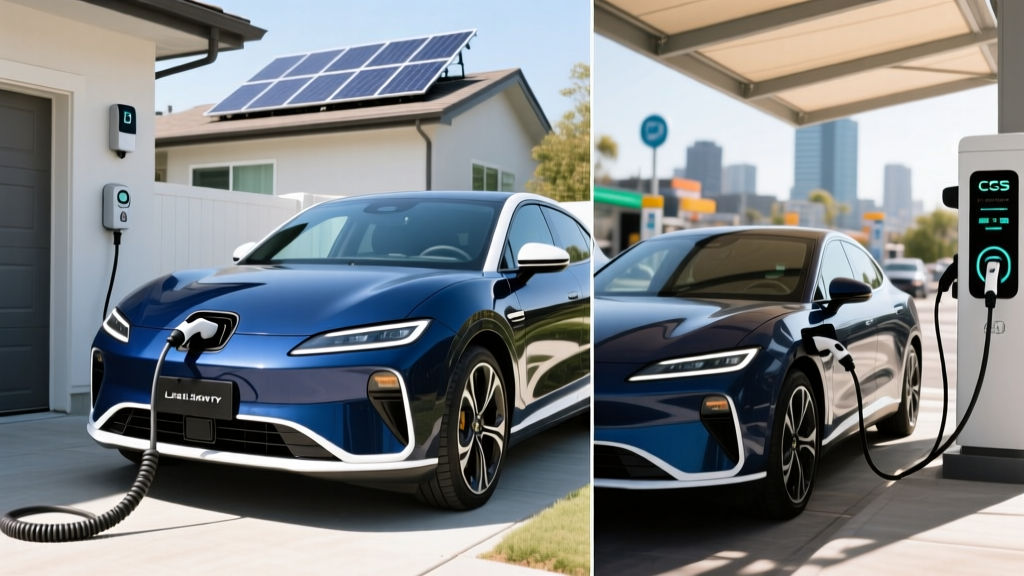
For home Level 2 charging, connector compatibility is straightforward: virtually all home EVSE units use a J1772 plug (or the newer NACS plug on 2026 units), and your vehicle will accept one or both via included adapters. The real connector question matters for public DC fast charging — and NACS dominance means Supercharger access is now available to most EVs.
Cost to Charge vs. Fueling That 6.1L HEMI
Let's put real numbers behind the economics. The 2010 Charger SRT8 with its 6.1L V8 averaged about 15 MPG combined. At $3.50/gallon (a conservative 2026 national average), you're spending roughly $0.233 per mile on fuel.
| Scenario | Cost per kWh | EV Efficiency (kWh/100mi) | Cost Per Mile | Savings vs. SRT8 |
|---|---|---|---|---|
| Home charging (off-peak/utility rate) | $0.13 | 30 kWh/100mi | $0.039 | 83% cheaper |
| Home charging (peak rate) | $0.25 | 30 kWh/100mi | $0.075 | 68% cheaper |
| Public Level 2 (ChargePoint, EVgo) | $0.35 | 30 kWh/100mi | $0.105 | 55% cheaper |
| DC Fast Charging (Electrify America, Tesla) | $0.48 | 30 kWh/100mi | $0.144 | 38% cheaper |
| 2010 Charger SRT8 (gas) | $3.50/gal | 15 MPG | $0.233 | — |
The math: A typical EV using 30 kWh per 100 miles (a mid-size crossover like the Hyundai Ioniq 5 or Tesla Model Y) charged at home at $0.13/kWh costs $3.90 per 100 miles. Your SRT8 at 15 MPG and $3.50/gal costs $23.33 per 100 miles. Over 15,000 annual miles, that's $585 in home-charged electricity vs. $3,500 in gasoline — a $2,915 annual fuel savings.
Even exclusive DC fast charging at highway rates ($0.48/kWh) yields $7.20 per 100 miles — still 69% cheaper than the SRT8. The savings narrow when you rely entirely on public charging, but most EV owners do 80%+ of their charging at home, where rates are lowest.
Charging Time Examples: What to Expect With Common Battery Sizes
Here are realistic 10-80% charging times for popular 2026 EV battery configurations:
- Hyundai Ioniq 5 (84 kWh battery, NMC): 10-80% in ~18 minutes at a 350 kW DC fast charger (sustains ~240 kW peak through 55% SoC, then tapers). Level 2 at 10.9 kW: ~7.5 hours for a full charge.
- Tesla Model Y Long Range (75 kWh, NMC): 10-80% in ~22 minutes at a 250 kW V3 Supercharger. Level 2 at 11.5 kW (48A): ~6.5 hours.
- Ford F-150 Lightning Extended Range (131 kWh, NMC): 10-80% in ~41 minutes at 150 kW (peak rate limited by battery thermal management). Level 2 at 19.2 kW (80A): ~6.8 hours; at 11.5 kW (48A): ~11.4 hours.
- Tesla Model 3 RWD (57.5 kWh, LFP): 10-80% in ~25 minutes at a 170 kW DC fast charger. LFP chemistry accepts charge well but has slightly lower peak C-rate than NMC. Level 2 at 11.5 kW: ~5 hours.
Cold-weather caveat: Below 32°F, expect DC fast charging times to increase 30-50% unless your vehicle has active battery preconditioning (most 2025+ EVs do). The battery management system restricts charge current to protect cold cells from lithium plating. Always use your vehicle's navigation-based preconditioning feature when routing to a DC fast charger — it warms the battery en route.
Recommended Home EVSE Equipment for 2026
ChargePoint Home Flex (NACS or J1772)
- Power Output: Up to 12 kW (50A) on a 60A circuit; adjustable down to 16A for smaller circuits
- Connector: Available in NACS (native) or J1772 (with NACS adapter included)
- Cable Length: 23 feet
- Smart Features: WiFi, app scheduling, energy tracking, Alexa integration, utility demand-response compatible
- Price: ~$599 (unit only)
- Best For: Versatile amperage adjustment, strong app ecosystem, utility program compatibility
Tesla Wall Connector (Gen 4)
- Power Output: Up to 11.5 kW (48A) on a 60A circuit
- Connector: NACS native; J1772 adapter included for non-Tesla EVs
- Cable Length: 24 feet
- Smart Features: WiFi, OTA updates, power sharing (link up to 6 units on one circuit), load management
- Price: ~$450
- Best For: Tesla owners, multi-EV households, budget-conscious buyers wanting premium build quality
Emporia Vue Level 2 EV Charger
- Power Output: Up to 11.5 kW (48A) on a 60A circuit
- Connector: J1772 (NACS adapter included)
- Cable Length: 24 feet
- Smart Features: WiFi, energy monitoring, solar integration (pairs with Emporia Vue home energy monitor), scheduled charging
- Price: ~$399
- Best For: Solar-panel households, budget-focused buyers, energy monitoring enthusiasts
Grizzl-E Smart (United Chargers)
- Power Output: Up to 10 kW (40A) on a 50A circuit
- Connector: J1772 (NACS adapter available separately)
- Cable Length: 24 feet
- Smart Features: WiFi, OCPP protocol (future utility compatibility), adjustable amperage (16/24/32/40A)
- Price: ~$499
- Best For: Cold-climate durability (rated to -40°F), Canadian-made, robust aluminum enclosure
Safety, Code Compliance, and Installation Best Practices
EVSE installation is not a DIY project unless you're a licensed electrician. Here's what proper installation requires per the National Electrical Code (NEC Article 625):
- Dedicated circuit: Your EVSE must be on its own dedicated breaker — no sharing with other outlets or appliances.
- Continuous load derating: EV charging is classified as a "continuous load" (operating 3+ hours). NEC requires the circuit to be rated at 125% of the charger's maximum draw. A 40A charger needs a 50A breaker; a 48A charger needs a 60A breaker.
- Outdoor rating: If mounting outdoors, the EVSE must carry an outdoor/NEMA 4 rating. Most major units (ChargePoint, Tesla, Grizzl-E) are rated for indoor/outdoor use. Ensure the junction box and conduit are weather-sealed.
- GFCI protection: Required for receptacle-based installs (NEMA 14-50 outlet). Hardwired EVSE units with built-in ground-fault protection may not require an additional GFCI breaker — check your unit's documentation.
- Strain relief and cable management: Wall-mounted EVSE units should include a cable holster or retractor to prevent the connector from resting on the ground, which accelerates wear and creates a trip hazard.
Panel upgrade red flags: If your home has a 100A main panel, Federal Pacific or Zinsco breakers (known fire hazards — CPSC has issued warnings), or aluminum branch wiring, address these issues before adding EVSE load. A panel upgrade to 200A service is a significant investment ($1,500–$3,500) but adds long-term home value and enables future loads (heat pumps, second EV).
Frequently Asked Questions
How fast will each charging level add range to my EV?
Level 1 (120V standard outlet): 3–5 miles per hour — adequate for plug-in hybrids with small batteries but impractical for full EVs. Level 2 (240V home station): 12–75 miles per hour depending on amperage (a 48A/11.5 kW station adds roughly 35–45 miles per hour for a typical crossover). DC fast charging: 150–1,000+ miles per hour at peak, which translates to 10-80% sessions of 15–45 minutes depending on battery size, peak kW acceptance, and thermal conditions.
Which connector and charger is compatible with my EV?
For 2025–2026 vehicles: if you own a Tesla, Ford, GM, Rivian, Hyundai, Kia, or most other major-brand EVs, your vehicle uses the NACS connector for DC fast charging. For Level 2 home charging, most vehicles still accept J1772 (via included adapter for NACS-port vehicles). Check your owner's manual or the charge-port door — the connector shape is visually distinct. If you're buying a used CCS-port EV (2022–2024 model year), you'll need a CCS-to-NACS adapter ($200–$300) to access Tesla Superchargers, which now form the largest DC fast-charging network in North America.
How much does charging cost per mile compared to gas?
Charging at home on a standard utility rate ($0.13/kWh) with a typical EV efficiency of 30 kWh/100mi works out to roughly $0.04 per mile. The 2010 Charger SRT8 at 15 MPG and $3.50/gallon costs about $0.23 per mile. That's an 83% reduction in per-mile energy cost. Even public DC fast charging at $0.48/kWh delivers $0.14/mile — still 40% cheaper. Over 15,000 miles annually, home charging saves roughly $2,900 per year compared to the SRT8's fuel bill.
What electrical upgrades might I need before installing a home charger?
The most common upgrade is a panel capacity increase from 100A to 200A service, which costs $1,500–$3,500 and is common in homes built before 1990. You may also need a new dedicated 60A breaker, a conduit run from panel to garage (longer runs increase wire cost), and a GFCI breaker if using a receptacle rather than hardwired install. Homes with outdated breaker panels (Federal Pacific, Zinsco) should replace them regardless of EVSE — these are documented fire hazards. Always have your electrician perform a NEC Article 220 load calculation before adding EVSE to confirm your panel can handle the additional continuous load.
Can I charge my EV with a standard 120V household outlet?
Yes — this is Level 1 charging, and it delivers roughly 1.0–1.9 kW, adding 3–5 miles of range per hour. For a 75 kWh battery going from 20% to 80%, that's approximately 30–40 hours of continuous charging. It's viable for plug-in hybrids (which have 25–45 miles of electric range and smaller batteries) or as an emergency/travel option. For daily EV use, Level 1 is impractical unless your daily driving is under 30 miles and you can charge 12+ hours overnight consistently.