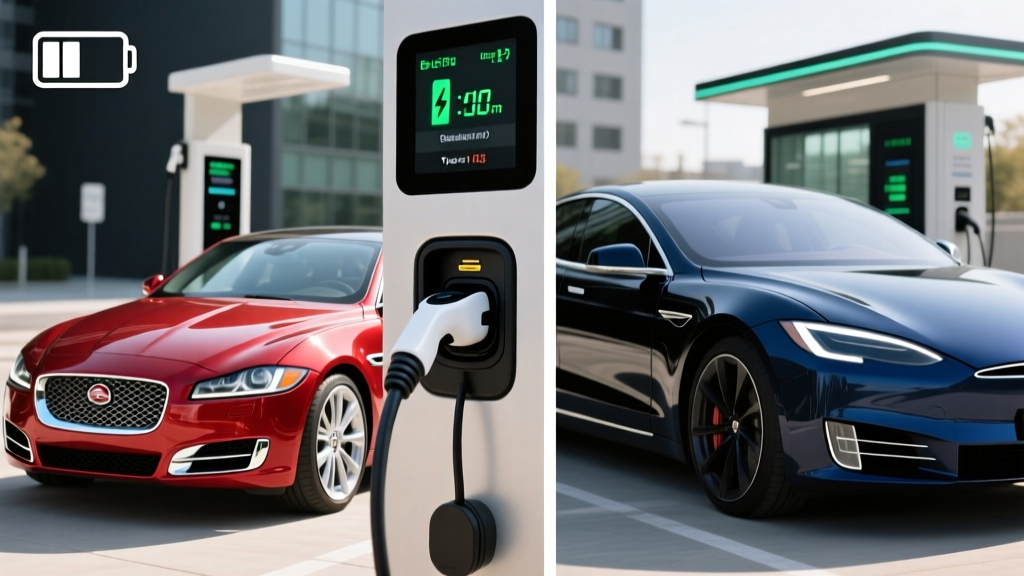
If you've ever searched for a 2010 Jaguar Supercharged — likely the XJ Supercharged or XFR with its 5.0L supercharged V8 producing 470–510 hp — you already know it's a thrilling luxury sedan. But you also know the fuel bills. With EPA ratings around 15 city / 21 highway mpg and a real-world combined closer to 17 mpg, that AJ-V8 gulps premium fuel at a rate that stings in 2026's pricing environment. This guide uses the 2010 Jaguar Supercharged as a baseline to break down exactly what modern EV ownership looks like by comparison: home charging installation, public charging costs, connector compatibility, equipment picks, and the per-mile math that drives the decision.
The 2010 Jaguar Supercharged: A Fuel-Cost Baseline
The 2010 Jaguar XJ Supercharged and XFR share the 5.0L AJ133 supercharged V8. Here's what ownership at the pump looks like in 2026:
- EPA combined: ~18 mpg (XJ Supercharged), ~17 mpg (XFR)
- Fuel required: Premium unleaded (91+ octane)
- 2026 national premium average: ~$4.60/gallon
- Cost per mile (fuel only): ~$0.26/mile
- Annual fuel cost (12,000 miles): ~$3,070
Those numbers set the bar. Let's see what the EV side of the equation actually costs — and what it takes to set up.
Charging Levels Explained: Speeds in kW and Miles Per Hour
The single most important distinction in EV charging is kW (kilowatts) = power (how fast energy flows) versus kWh (kilowatt-hours) = energy (how much the battery holds). Think of kW as the width of the hose and kWh as the size of the bucket. Here's what each level delivers:
| Level | Voltage | Power (kW) | Miles of Range Added Per Hour | Typical Use |
|---|---|---|---|---|
| Level 1 | 120V AC | 1.0–1.4 kW | 3–5 mi/hr | Overnight top-up, PHEVs, emergencies |
| Level 2 (Home/Public) | 240V AC | 3.3–19.2 kW | 12–75 mi/hr | Daily home charging, workplace, destinations |
| DC Fast Charging | 200–800V DC | 50–350 kW | 150–1,200+ mi/hr (peak) | Road trips, rapid top-ups |
A few real-world caveats: DC fast charging speeds are peak rates. Every EV's charge curve tapers significantly above 80% state of charge (SoC) to protect the battery. A vehicle advertising "250 kW peak" may only sustain that rate between 10–40% SoC, then step down to 150 kW, then 80 kW, then 40 kW as it approaches full. That's why we measure fast-charging speed in 10–80% time, not peak kW alone.
Charging Time Examples: What to Expect with Common Battery Sizes
Here's how long common 2025–2026 EVs take to charge at each level, using realistic sustained rates rather than marketing peaks:
| Vehicle | Battery (kWh usable) | Level 2 at 11.5 kW (0–100%) | DC Fast 10–80% | Peak DC Rate |
|---|---|---|---|---|
| Tesla Model Y Long Range | 75 kWh (NMC) | ~7 hours | ~25 min | 250 kW |
| Hyundai Ioniq 5 (Long Range) | 77.4 kWh (NMC) | ~7.5 hours | ~18 min | 240 kW (800V architecture) |
| Ford F-150 Lightning (Extended) | 131 kWh (NMC) | ~12 hours | ~41 min | 150 kW |
| Chevrolet Equinox EV | 85 kWh (NMC) | ~8 hours | ~30 min | 150 kW |
| BMW i4 eDrive40 | 81.5 kWh (NMC) | ~8 hours | ~31 min | 205 kW |
For daily driving, most EV owners use 30–50 miles and plug in at home overnight. A Level 2 charger delivering 11.5 kW adds roughly 40–45 miles per hour of charging — more than enough to replenish a day's driving in 1–2 hours while you sleep.
Home EV Charger Installation: Requirements, Costs, and Panel Upgrades
This is where the rubber meets the road. Installing a Level 2 home charger isn't just buying a wall box — it's an electrical project. Here's the full picture.
Electrical Requirements
A typical Level 2 home charger requires:
- Voltage: 240V (same as your dryer or oven circuit)
- Amperage: 40A circuit for a 32A continuous charger, or 60A circuit for a 48A continuous charger (NEC requires circuits rated at 125% of continuous load)
- Dedicated circuit: The charger must have its own breaker — no sharing with other appliances
- GFCI protection: Required by NEC 2020+ for EV outlets (hardwired units have built-in ground-fault protection)
- Outdoor rating: NEMA 4 or NEMA 4X enclosure if installed outdoors
Panel Upgrade Reality
Many homes built before 2000 have 100A electrical panels. Adding a 40–60A EV circuit may exceed available capacity, especially if you already run electric heat, a dryer, and an oven. A panel upgrade to 200A typically costs $1,500–$3,500. Some utilities offer load-management devices (like the Span smart panel or utility-controlled relays) that let you add an EV circuit without a full upgrade by throttling charger amperage when the house is under heavy load.
| Component | Low End | High End | Notes |
|---|---|---|---|
| Level 2 Charger (Equipment) | $350 | $750 | 32A–48A smart charger, 20–25 ft cable |
| Electrician Labor | $400 | $1,800 | Depends on run length from panel to garage/driveway |
| Permit & Inspection | $50 | $250 | Required in most jurisdictions |
| Panel Upgrade (if needed) | $1,500 | $3,500 | 100A → 200A service upgrade |
| Total (no panel upgrade) | $800 | $2,800 | Most homes with 200A service |
| Total (with panel upgrade) | $2,300 | $6,300 | Older homes with 100A service |
The IRS Residential Clean Energy Credit (IRC §25C) covers up to $1,000 of home charger equipment and installation costs through 2032, subject to income and census-tract eligibility. Always confirm current-year rules with a tax professional.
Connector Compatibility: NACS, CCS1, CHAdeMO, and Adapter Needs
As of 2026, the North American charging connector landscape has consolidated significantly around NACS (the Tesla-designed standard now formalized as SAE J3400), but legacy connectors remain in use. Here's what fits what:
| Connector | Brands Using It (Native) | DC Fast Network Access | Adapter Needed For |
|---|---|---|---|
| NACS (J3400) | Tesla, Ford, GM, Rivian, Volvo, Polestar, Fisker, Lucid (2025+) | Tesla Supercharger, Electrify America (NACS stalls), EVgo | CCS1 public chargers (legacy) |
| CCS1 | Hyundai, Kia, BMW, VW, Mercedes, Stellantis, Honda (2024–2025) | Electrify America, EVgo, ChargePoint, Ionity | Tesla Supercharger (with OEM adapter) |
| CHAdeMO | Nissan Leaf (legacy only, discontinued) | Declining network; some EA/EVgo stalls | No practical NACS/CCS adapter available |
Most 2025–2026 models from Ford, GM, and Rivian ship with NACS ports and include a CCS1 adapter (or offer one as a $150–$250 accessory) for legacy public chargers. Hyundai/Kia's E-GMP vehicles (Ioniq 5/6, EV6/EV9) retain CCS1 but gain Supercharger access via Tesla's CCS-to-NACS adapter. Before buying any EV, verify its native connector and which adapter the manufacturer provides — this directly affects your road-trip charging options.
Cost to Charge: Per-Mile Math vs. the 2010 Jaguar Supercharged
Let's run the numbers that matter: what you actually pay per mile to "fuel" an EV in 2026 versus the 2010 Jaguar Supercharged V8.
| Scenario | Cost per kWh / Gallon | Vehicle Efficiency | Cost Per Mile | Annual Cost (12k mi) |
|---|---|---|---|---|
| 2010 Jaguar XJ Supercharged (Premium Gas) | $4.60/gal | 17 mpg combined | $0.271 | $3,250 |
| Home Charging (Off-Peak TOU Rate) | $0.12/kWh | 3.0 mi/kWh (avg EV) | $0.040 | $480 |
| Home Charging (Standard Residential Rate) | $0.17/kWh | 3.0 mi/kWh | $0.057 | $680 |
| Public Level 2 (ChargePoint, etc.) | $0.30/kWh | 3.0 mi/kWh | $0.100 | $1,200 |
| DC Fast Charging (Electrify America) | $0.48/kWh | 2.8 mi/kWh (highway) | $0.171 | $2,057 |
| Tesla Supercharger (Member Pricing) | $0.30/kWh | 3.2 mi/kWh | $0.094 | $1,125 |
The takeaway is stark: even if you rely entirely on DC fast charging at the most expensive public networks, a modern EV still costs less per mile than the 2010 Jaguar Supercharged on premium fuel. But the real savings come from home charging on off-peak rates — roughly $2,700/year less than the Jaguar. Over five years, that's $13,500 in fuel savings alone, before factoring in the EV's lower maintenance costs (no oil changes, no supercharger belt service, no transmission fluid, regenerative braking saving pad wear).
For authoritative efficiency data on any EV you're considering, the EPA's fueleconomy.gov lists kWh/100mi and MPGe figures for every certified model.
Equipment Recommendations: Best Home Chargers for 2026
Not all Level 2 chargers are equal. Here are proven picks based on reliability, smart features, and value — all NACS-native or available with NACS connectors for 2025–2026 vehicles:
Emporia Vue Level 2 Charger
- Power Output: 48A (11.5 kW on 60A circuit) or 40A (9.6 kW on 50A circuit)
- Connector: NACS (J3400) native; CCS1 adapter available
- Cable Length: 24 feet
- Smart Features: Wi-Fi, energy monitoring, solar integration, scheduling via app, load-sharing with Emporia Vue panel monitor
- Price: ~$400
- Best For: Budget-conscious buyers wanting full smart features and energy tracking
ChargePoint Home Flex (2nd Gen)
- Power Output: Up to 50A (12 kW on 60A circuit); adjustable 16–50A via DIP switches
- Connector: NACS or CCS1 (select at purchase)
- Cable Length: 23 feet
- Smart Features: Wi-Fi, Alexa integration, charge scheduling, detailed session history, flexible amperage for panel-constrained homes
- Price: ~$550
- Best For: Homes with limited panel capacity (set to 32A on a 40A circuit)
Tesla Wall Connector (Gen 4)
- Power Output: 48A (11.5 kW on 60A circuit)
- Connector: NACS native; integrated Magic Dock CCS1 adapter on some units
- Cable Length: 24 feet
- Smart Features: Wi-Fi, OTA updates, power-sharing between multiple Wall Connectors on one circuit, vehicle-specific access control
- Price: ~$475
- Best For: Tesla and NACS-equipped Ford/GM/Rivian owners wanting seamless ecosystem integration
Grizzl-E Smart (United Chargers)
- Power Output: 40A (9.6 kW on 50A circuit)
- Connector: NACS or J1772 (select at purchase)
- Cable Length: 24 feet
- Smart Features: Wi-Fi, OCPP-compatible (works with utility demand-response programs), adjustable amperage, extreme-cold rated (-40°C)
- Price: ~$500
- Best For: Cold-climate installations and utility-program participants
Safety, Code, and Installation Best Practices
EV charging draws sustained high current for hours — this is not the same as plugging in a dryer for 45 minutes. Here's what proper installation looks like:
- Dedicated circuit: Never share the EV circuit with other loads. NEC Article 625 requires dedicated branch circuits for EVSE.
- Hardwired vs. plug-in: Hardwired installations (no plug) eliminate the NEMA 14-50 receptacle as a failure point and don't require GFCI breakers (the EVSE has built-in ground-fault protection). Plug-in 14-50 outlets offer portability but need a GFCI breaker (~$100–$150 extra) and have been linked to thermal events when low-quality receptacles are used. Use only industrial-grade Hubbell or Bryant 14-50 receptacles if going the plug-in route.
- Outdoor rating: All outdoor EVSE must carry a NEMA 4 (weatherproof) rating. The chargers listed above all meet this standard.
- Permit and inspection: Skipping the permit saves $50–$250 but voids insurance coverage for electrical fires and creates liability at home sale. Always pull the permit.
- Cable management: A 24-foot cable drags on the garage floor and collects dirt. Install a simple holster or cable retractor ($25–$50) to keep the connector clean and protected.
Frequently Asked Questions
How much does it cost to install a home EV charger?
A typical Level 2 home charger installation costs $800–$2,800 if your electrical panel has sufficient capacity (200A service with spare breaker slots). If you need a panel upgrade from 100A to 200A, add $1,500–$3,500, bringing the total to $2,300–$6,300. The IRS §25C credit may offset up to $1,000 of this cost depending on your income and census tract.
How fast will each charging level add range?
Level 1 (120V) adds 3–5 miles per hour — adequate for PHEVs with small batteries but impractical for full BEVs. Level 2 (240V, 40–48A) adds 30–45 miles per hour, easily replenishing a day's driving overnight. DC fast charging at 150–350 kW adds 150–1,200+ miles per hour at peak, with 10–80% charges taking 18–41 minutes depending on battery size and architecture.
Which connector/charger is compatible with my EV?
For 2025–2026 models: Tesla, Ford, GM, Rivian, Volvo, and Polestar use NACS (J3400). Hyundai, Kia, BMW, VW, and Mercedes use CCS1. The Nissan Leaf (now discontinued) used CHAdeMO. Check your vehicle's charge port or the manufacturer's spec page before purchasing a home charger — most chargers are available in both NACS and CCS1 configurations.
How much does charging cost per mile vs. gas?
Home charging at off-peak rates (~$0.12/kWh) costs roughly $0.04/mile — about 85% less than the 2010 Jaguar Supercharged on premium gas at $0.27/mile. Even exclusive DC fast charging at $0.48/kWh costs ~$0.17/mile, still 37% less than the Jaguar. Over 12,000 annual miles, home charging saves $2,500–$2,800 versus the supercharged V8.
What electrical upgrades might I need?
If your home has a 100A electrical panel (common in homes built before 2000), you'll likely need a 200A service upgrade to safely add a 40–60A EV circuit. Homes with 200A panels usually have sufficient capacity unless you simultaneously run electric resistance heat, an electric oven, and an electric dryer. A licensed electrician can perform a load calculation per NEC Article 220 to determine your exact capacity. Alternatives include load-management devices or setting a lower-amperage charger (24–32A) that fits within existing panel headroom.
Can I charge a 2010 Jaguar Supercharged at home?
No — the 2010 Jaguar Supercharged (XJ or XFR) is a conventional gasoline vehicle with no electrified powertrain. It has no charge port, no battery beyond the standard 12V starter battery, and relies entirely on its 5.0L supercharged V8 and premium fuel. This article uses it as a fuel-cost comparison baseline against modern EVs.