The 2009 Jaguar XF Supercharged Sedan: A Gasoline Legend Meets the EV Era
If you're researching the 2009 Jaguar XF Supercharged sedan, you're looking at one of the most compelling luxury performance sedans of its era — a 4.2-liter supercharged V8 producing 420 horsepower, paired with a refined ZF 6-speed automatic and Jaguar's iconic aluminum chassis. But here's the hard truth that needs stating upfront: the 2009 Jaguar XF Supercharged is a pure internal-combustion vehicle. It has no battery pack, no charge port, no regenerative braking, and no pathway to plug into any EV charging infrastructure — Level 1, Level 2, or DC fast.
This guide exists because search behavior shows EV-curious owners of legacy luxury sedans often land on charging-related content while researching whether their vehicle can be electrified, or while comparing ownership costs against modern EVs. So we're going to do two things: give you the definitive answer on the XF Supercharged, and deliver a complete, data-driven EV charging guide for anyone evaluating the jump to an electric vehicle in 2026.
Can the 2009 Jaguar XF Supercharged Use an EV Charger?
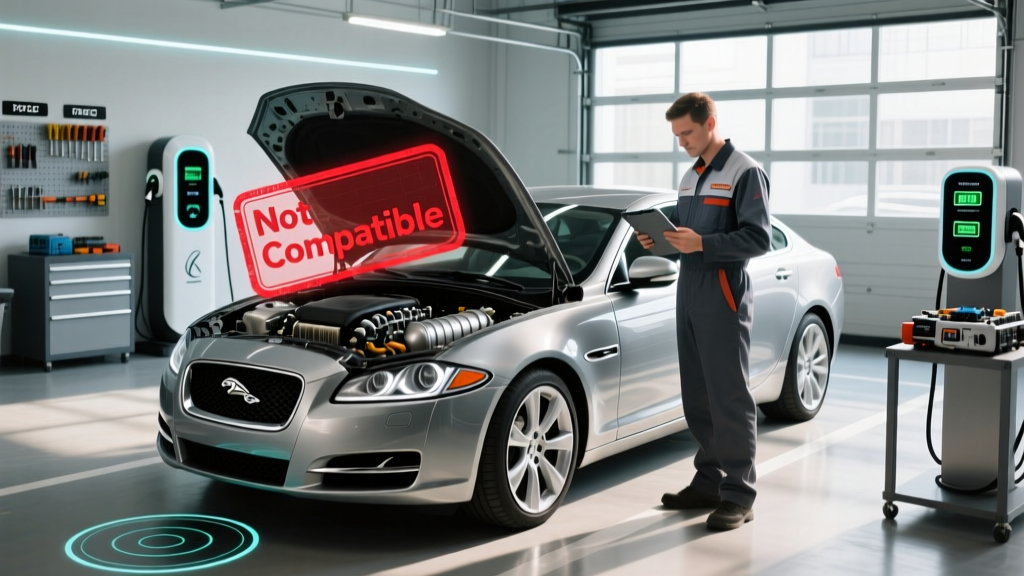
No. The 2009 Jaguar XF Supercharged sedan is powered exclusively by a 4.2L supercharged V8 engine (Jaguar's AJ-V8 Gen III) mated to a conventional torque-converter automatic transmission. It carries a 17.4-gallon gasoline fuel tank and achieves an EPA-rated 15 mpg city / 23 mpg highway. There is no high-voltage traction battery, no onboard charger, no CCS or NACS port, and no aftermarket conversion kit that is commercially viable or legal for road use.
Aftermarket EV conversions of legacy vehicles do exist in the custom-shop world, but they typically cost $40,000–$80,000+, void all original engineering certifications, and are not something any mainstream owner should consider for a daily-driver XF. If you love the XF and want to keep it, you'll fuel it at the pump. If you're exploring EV ownership, you'll be looking at a new or used electric vehicle — and the rest of this guide covers exactly what you need to charge one.
Understanding EV Charging Levels: Speeds in kW and Miles Per Hour
EV charging operates across three tiers. The single most important distinction to internalize: kW (kilowatts) measures power — the rate at which energy flows. kWh (kilowatt-hours) measures energy — the total capacity of the battery. A 250 kW charger fills a 75 kWh battery much faster than an 11.5 kW home charger, just as a fire hose fills a bucket faster than a garden tap.
| Level | Voltage | Power (kW) | Miles of Range Added Per Hour | Typical Use Case | 10–80% Time (75 kWh Battery) |
|---|---|---|---|---|---|
| Level 1 | 120V AC | 1.2–1.9 kW | 3–5 miles/hr | Emergency / overnight trickle | ~45–60 hours (not practical) |
| Level 2 | 240V AC | 7.2–19.2 kW | 20–60 miles/hr | Home daily charging, workplace | ~4–8 hours (overnight) |
| DC Fast (Level 3) | 400–800V DC | 50–350 kW | 150–800+ miles/hr (peak) | Road trips, highway corridors | ~18–40 minutes |
Real-world charging-curve reality: DC fast chargers advertise peak kW, but no EV sustains peak rate from 10% to 80%. Most vehicles hit peak power between 10–40% State of Charge, then taper progressively. A vehicle rated at 250 kW peak might average 140–160 kW across the full 10–80% session. This is why manufacturers quote 10–80% times rather than 0–100% — charging above 80% slows dramatically to protect battery chemistry.
Home EV Charger Installation: Electrical Requirements and Real Costs
Installing a Level 2 home charger is the single most impactful upgrade an EV owner can make. Here's what it actually requires and costs in 2026.
Electrical Requirements
A standard Level 2 home charger requires a 240-volt dedicated circuit, typically rated at 40A to 60A. The charger itself will draw 32A to 48A continuously (NEC code requires circuits rated at 125% of continuous load — so a 40A charger needs a 50A circuit, and a 48A charger needs a 60A circuit). Your home's main electrical panel must have sufficient spare capacity, measured in amps, to accommodate this new load.
Panel Upgrade: The Hidden Cost in Older Homes
Homes built before 2000 often have 100A or 150A main panels. Adding a 50–60A EV circuit to an already-loaded panel may require a panel upgrade to 200A, which is the most expensive variable in any EV charger installation. Newer homes (post-2010) with 200A panels usually have adequate spare capacity. A licensed electrician will perform a load calculation per NEC Article 220 to determine if your panel can handle the circuit.
| Component | Simple Install (Panel Has Capacity) | Complex Install (Panel Upgrade Needed) |
|---|---|---|
| Level 2 Charger (hardware) | $350–$700 | $350–$700 |
| Electrician labor (run 240V circuit, mount unit) | $500–$1,500 | $1,500–$3,000 |
| Electrical panel upgrade (if needed) | $0 | $1,500–$4,000 |
| Permit and inspection | $50–$200 | $50–$200 |
| Conduit, wiring, misc. materials | $100–$400 | $200–$600 |
| Total estimated cost | $1,000–$2,800 | $3,600–$8,500 |
Federal incentive note: The Residential Clean Energy Credit (IRS Form 5695) covers 30% of qualified EV charger hardware and installation costs, up to $1,000 per year. This is separate from the §30D vehicle tax credit. Check current-year IRS guidance, as incentive rules and caps are subject to legislative change.
Connector Compatibility: NACS, CCS1, and CHAdeMO Explained
As of 2026, the North American EV connector landscape has consolidated significantly around the NACS (North American Charging Standard), originally developed by Tesla and now adopted by Ford, GM, Rivian, Hyundai, Kia, Volvo, BMW, and most major automakers. Here's what you need to know:
| Connector Type | Brands Using It (Native) | DC Fast Network Access | Adapter Needed? |
|---|---|---|---|
| NACS (Tesla standard) | Tesla, Ford, GM, Rivian, Hyundai, Kia, Volvo, BMW, Mercedes, Toyota (bZ) | Tesla Supercharger network (17,000+ stalls), plus NACS-equipped EA/ChargePoint stations | None for native NACS vehicles |
| CCS1 (Combo) | Legacy VW ID.4 (pre-2025), some Stellantis models, older BMW iX | Electrify America, EVgo, ChargePoint DC stalls | CCS-to-NACS adapter (~$200) needed for Supercharger access |
| CHAdeMO | Nissan Leaf (discontinued after 2025), Mitsubishi Outlander PHEV (older) | Limited and shrinking network | No viable adapter to NACS/CCS for DC fast charging |
Practical advice for 2026 buyers: If you're purchasing a new EV, prioritize a NACS-equipped vehicle for the widest DC fast-charging access. The Tesla Supercharger network remains the most reliable public charging infrastructure in the U.S., with consistent uptime and plug-and-charge billing. CCS1 vehicles can access Superchargers via a manufacturer-supplied or third-party adapter, but verify your specific model's compatibility before relying on this.
Cost to Charge an EV Per Mile vs. Gasoline (Including the XF Supercharged)
Here's where the economics of EV ownership become starkly clear — and where the 2009 Jaguar XF Supercharged sedan's ownership cost comes into sharp relief.
| Vehicle / Scenario | Energy Source | Cost Per Unit | Efficiency | Cost Per Mile |
|---|---|---|---|---|
| 2009 Jaguar XF Supercharged (420 hp V8) | Premium gasoline | $4.10/gallon (2026 avg premium) | 18 mpg combined (real-world) | $0.228/mile |
| EV — Home Level 2 (off-peak utility rate) | Electricity | $0.13/kWh | 3.0 mi/kWh (typical sedan) | $0.043/mile |
| EV — Home Level 2 (standard rate) | Electricity | $0.18/kWh | 3.0 mi/kWh | $0.060/mile |
| EV — Public Level 2 (network pricing) | Electricity | $0.35/kWh | 3.0 mi/kWh | $0.117/mile |
| EV — DC Fast Charging (highway trip) | Electricity | $0.48/kWh | 2.8 mi/kWh (highway) | $0.171/mile |
The takeaway: Even at the most expensive DC fast-charging rates, a modern EV sedan costs roughly 25% less per mile to fuel than the 2009 XF Supercharged. At home off-peak rates, the EV costs 81% less per mile. Over 15,000 annual miles, the home-charging EV saves approximately $2,775/year in fuel costs versus the XF. Over five years, that's nearly $14,000 — before factoring in the XF's premium maintenance costs (supercharger belt service, transmission fluid, spark plugs, and Jaguar-specific labor rates).
Recommended Level 2 Home Chargers for 2026
Below are three proven Level 2 home chargers across price tiers, each with verified specs. All are hardwired or NEMA 14-50 plug compatible, UL-listed, and rated for indoor/outdoor installation.
ChargePoint Home Flex (2026 Model)
- Power output: Up to 11.5 kW (48A on a 60A circuit)
- Connector: NACS (native), J1772 adapter included
- Cable length: 23 feet
- Smart features: Wi-Fi, app scheduling, utility demand-response integration, Alexa
- Price: ~$599
- Best for: Most EV owners wanting reliable smart scheduling and energy management
Tesla Wall Connector (Gen 4)
- Power output: Up to 11.5 kW (48A on a 60A circuit)
- Connector: NACS native; J1772 adapter available separately (~$50)
- Cable length: 24 feet
- Smart features: Wi-Fi, OTA updates, power-sharing between multiple units, load management
- Price: ~$475
- Best for: Tesla and NACS-native vehicle owners; cleanest integration with Supercharger ecosystem
Emporia Level 2 EV Charger
- Power output: Up to 11.5 kW (48A) or 9.6 kW (40A) configurable
- Connector: J1772 (NACS adapter available)
- Cable length: 24 feet
- Smart features: Wi-Fi, app control, solar integration with Emporia Vue energy monitor, time-of-use scheduling
- Price: ~$399
- Best for: Budget-conscious buyers and homes with solar panels wanting integrated energy tracking
Safety, Code Compliance, and Inspection Requirements
EV charger installation is governed by the National Electrical Code (NEC) and enforced by your local Authority Having Jurisdiction (AHJ — typically your city or county building department). Key requirements include:
- Dedicated circuit: Your Level 2 charger must be on its own dedicated breaker — it cannot share a circuit with other appliances or outlets.
- GFCI protection: NEC 2020 and later require GFCI (Ground Fault Circuit Interrupter) protection for all EV charging outlets. Many modern hardwired chargers have GFCI built into the unit; plug-in units on NEMA 14-50 receptacles require a GFCI breaker.
- Outdoor rating: If your charger is installed outdoors (garage exterior, driveway, carport), the unit must carry a NEMA 4 or IP65 weather-resistance rating. All three chargers recommended above meet this standard.
- Permit and inspection: Virtually all jurisdictions require an electrical permit for a new 240V circuit. The inspection ensures proper wire gauge, breaker sizing, grounding, and GFCI compliance. Do not skip this — unpermitted work can void home insurance claims and create fire risk.
- Wire gauge: A 60A circuit typically requires 6 AWG copper wire (THHN in conduit or NM-B cable where permitted). Your electrician will size this per NEC Table 310.16.
Frequently Asked Questions
Can I convert my 2009 Jaguar XF Supercharged to electric?
Not practically. While custom EV conversions exist, they cost $40,000–$80,000+, require removing the supercharged V8 and transmission, fabricating battery enclosures, and sourcing a motor/controller package. The result would not retain Jaguar engineering integrity, would likely not pass emissions or safety certification in most states, and would cost more than purchasing a new luxury EV outright. The XF is best enjoyed as the gasoline performance sedan it was designed to be.
How much does it cost to install a home EV charger?
A straightforward installation on an existing 200A panel with spare capacity runs $1,000–$2,800 (hardware + electrician + permit). If your home needs a panel upgrade from 100A/150A to 200A, total costs rise to $3,600–$8,500. The 30% federal Residential Clean Energy Credit (up to $1,000) can offset a portion of this — consult a tax professional and review current IRS guidance.
How fast will each charging level add range to a modern EV?
Level 1 (120V): 3–5 miles per hour — adequate only for plug-in hybrids with small batteries or emergency trickle charging. Level 2 (240V, 48A/11.5 kW): 35–45 miles per hour for a typical sedan, fully replenishing daily driving in 2–3 hours. DC Fast (150–350 kW): 150–800+ miles per hour at peak, adding 10–80% in 18–40 minutes depending on the vehicle's charge curve and battery preconditioning.
Which connector do I need for a 2026 EV?
If you're buying new in 2026, nearly all mainstream EVs now use the NACS connector natively, giving you direct access to Tesla Superchargers plus the growing NACS public network. If you own a CCS1-equipped vehicle from 2023–2025, a CCS-to-NACS adapter (~$200) provides Supercharger access. CHAdeMO is effectively legacy — avoid it for new purchases.
How does charging cost compare to fueling the 2009 Jaguar XF Supercharged?
The XF Supercharged sedan averages about 18 mpg combined in real-world driving on premium fuel. At $4.10/gallon, that's roughly $0.23 per mile. A comparable modern EV sedan charged at home on off-peak electricity costs about $0.04–$0.06 per mile — an 80% reduction in per-mile energy cost. Over 15,000 miles/year, that's $2,500–$2,800 in annual fuel savings.
What electrical upgrades might my home need for EV charging?
The most common upgrade is a panel capacity increase. If your main panel is 100A or 150A and already near capacity (central AC, electric range, electric dryer, etc.), adding a 50–60A EV circuit may exceed the panel's rated load. A 200A panel upgrade costs $1,500–$4,000 depending on your utility's service drop and local labor rates. Some utilities offer rebates for panel upgrades tied to EV adoption — check with your local provider. Homes with 200A panels and gas appliances (gas range, gas heat) almost always have sufficient spare capacity.