From 6.1L HEMI to kWh: Why Charger Owners Are Electrifying
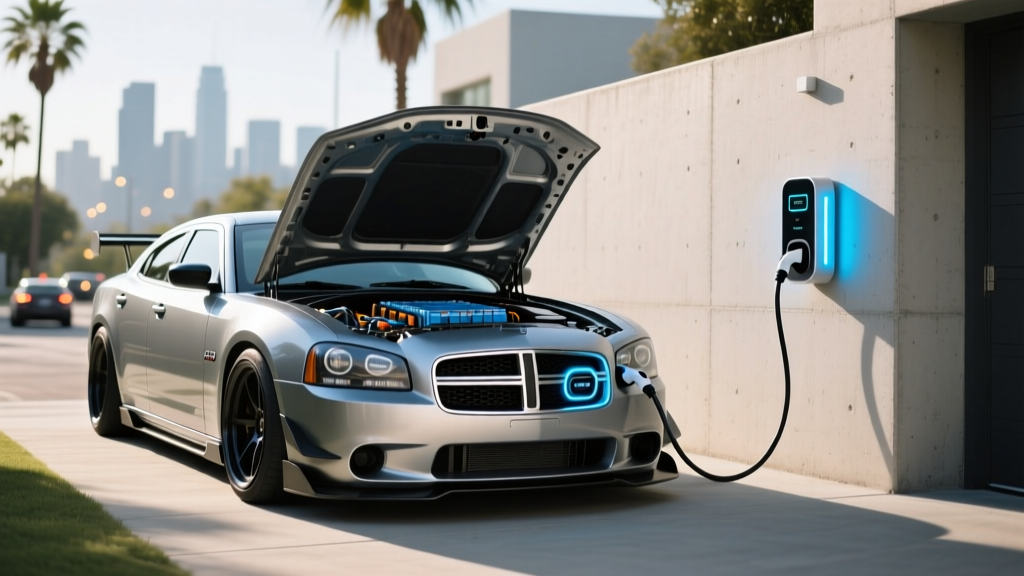
The 2007 Dodge Charger SRT8 is an American muscle icon — a 6.1L HEMI V8 producing 425 horsepower, 420 lb-ft of torque, and roughly 13 MPG combined according to fueleconomy.gov. But with fuel costs climbing and performance EVs proving that instant torque can outmuscle any V8 off the line, a growing niche of Mopar enthusiasts are exploring EV conversions for their LX-platform Chargers.
Whether you're planning a full electric swap or simply researching what charging infrastructure you'd need for a converted SRT8, this guide covers every electrical, financial, and equipment decision you'll face. We'll translate the SRT8's thirst into kWh terms, break down home charger installation costs, and show you exactly which Level 2 equipment makes sense for a high-capacity conversion battery.
Charging Levels Explained: kW, Miles Per Hour, and What Your Conversion Needs
Before selecting equipment, you need to understand the three charging tiers available. The critical distinction: kW (kilowatts) measures power — how fast energy flows into the battery. kWh (kilowatt-hours) measures energy capacity — how much the battery holds. Think of kW as the diameter of a hose and kWh as the size of the bucket you're filling.
| Level | Voltage | Max Power (kW) | Miles of Range Added Per Hour | Best For |
|---|---|---|---|---|
| Level 1 | 120V AC | 1.2–1.9 kW | 3–5 mi/hr | Overnight trickle; PHEVs; emergency top-ups |
| Level 2 | 240V AC | 3.3–19.2 kW | 12–75 mi/hr | Daily home charging; destination charging; conversions |
| DC Fast Charge | 200–800V DC | 50–350 kW | 150–1,000+ mi/hr (peak) | Road trips; 10–80% in 15–40 min |
For a 2007 SRT8 EV conversion, you'll likely install a 60–100 kWh battery pack. At Level 1 (1.4 kW), fully charging an 80 kWh pack takes roughly 57 hours — impractical. At Level 2 with a 48-amp (11.5 kW) charger, that same pack reaches full in about 7 hours. This is why a dedicated Level 2 home station is non-negotiable for a conversion project.
Home Charger Installation: Electrical Requirements, Permits, and Real Costs
Installing a Level 2 charger for your converted Charger SRT8 isn't just about buying a wall box — it's about ensuring your home's electrical panel can handle the load. Here's what the installation actually involves.
Electrical Requirements for a 48-Amp Level 2 Charger
- Circuit: Dedicated 60-amp breaker (NEC requires chargers to run at 80% of circuit capacity, so a 60A breaker supports 48A continuous draw)
- Voltage: 240V, single-phase, split-phase (standard US residential)
- Wire gauge: 6 AWG copper (THHN in conduit) or 4 AWG aluminum for runs over 50 feet
- Outlet vs. hardwired: NEMA 14-60 receptacle for plug-in flexibility, or hardwired for cleaner install and some utility rebate eligibility
- GFCI protection: Required by NEC 2020+ for garage receptacles; many hardwired units have built-in ground-fault protection
The Panel Upgrade Reality for Older Homes
A 2007 Charger SRT8 likely lives in a home built anywhere from the 1960s to the 2000s. If your home has a 100-amp main panel, adding a 60-amp EV circuit may push total calculated load beyond capacity. A panel upgrade to 200 amps typically costs $1,500–$3,500 and requires a utility coordination visit. Homes already on 200-amp service usually have sufficient headroom.
Your electrician will perform a load calculation (NEC Article 220) accounting for existing HVAC, water heater, dryer, range, and the new EV circuit. If the math doesn't work, options include:
- Panel upgrade to 200A or 320A service
- Smart load-management devices (e.g., Emporia Smart Load Center) that throttle charger amperage when other high-draw appliances activate
- Downsizing to a 32-amp charger on a 40-amp breaker (still adds ~25 mi/hr)
| Component | Low End | High End | Notes |
|---|---|---|---|
| Level 2 charger unit (40–48A) | $350 | $750 | Wi-Fi smart chargers cost more |
| Electrician labor (permit, wire, breaker, install) | $500 | $2,000 | Depends on run length, wall type, conduit |
| Permit fee | $50 | $250 | Varies by municipality |
| Panel upgrade (if needed) | $1,500 | $3,500 | 100A → 200A; not always required |
| Total (no panel upgrade) | $900 | $3,000 | Most homes with 200A service |
| Total (with panel upgrade) | $2,400 | $6,500 | Older homes with 100A service |
Connector Compatibility: NACS, CCS1, CHAdeMO, and Your Conversion
If you're building an EV conversion, you choose your charge port. This is a critical decision that affects where you can charge publicly for years to come.
| Connector | Level 2 AC | DC Fast Charge | Adopted By | Adapter Availability |
|---|---|---|---|---|
| NACS (Tesla/J3400) | Yes (J3400 AC) | Yes (Supercharger network) | Tesla, Ford, GM, Rivian, Hyundai, Kia, most OEMs by 2025+ | CCS→NACS adapters ~$200; widely available |
| CCS1 (Combo) | Yes (J1772 upper) | Yes (Electrify America, EVgo, etc.) | Legacy standard; still supported at public stations | NACS→CCS adapters available from Tesla, Lectron |
| CHAdeMO | No (uses J1772 for AC) | Yes (declining network) | Nissan Leaf, Mitsubishi (legacy) | Very limited adapters; network shrinking |
Recommendation for your SRT8 conversion: Install a NACS (J3400) charge port. By 2026, the Tesla Supercharger network has become the de facto national fast-charging standard, with over 25,000 stalls in North America. Most new public chargers include NACS connectors, and legacy CCS stations are adding NACS cables. For a custom conversion, wiring a NACS inlet is straightforward with components from suppliers like EVWest or Thunderstruck Motors.
For home Level 2 charging, all connectors use the same J1772 signaling protocol (or NACS equivalent), so any Level 2 wall unit will work with any EV — the physical plug shape is the only variable, and adapters resolve that.
Charging Cost Per Mile: Converted SRT8 vs. Stock 6.1L HEMI
The 2007 Charger SRT8 with its 6.1L HEMI gets an EPA-rated 13 MPG combined. Let's compare real operating costs across charging scenarios.
| Scenario | Energy Source | Rate | Efficiency | Cost/Mile | Annual Cost |
|---|---|---|---|---|---|
| Stock SRT8 (6.1L HEMI) | Gasoline (premium) | $4.00/gal | 13 MPG | $0.308 | $4,615 |
| EV Conversion — Home (off-peak) | Electricity | $0.11/kWh | 3.0 mi/kWh | $0.037 | $550 |
| EV Conversion — Home (standard rate) | Electricity | $0.16/kWh | 3.0 mi/kWh | $0.053 | $800 |
| EV Conversion — Public Level 2 | Electricity | $0.35/kWh | 3.0 mi/kWh | $0.117 | $1,750 |
| EV Conversion — DC Fast Charge | Electricity | $0.48/kWh | 3.0 mi/kWh | $0.160 | $2,400 |
Key takeaway: Charging at home on off-peak rates costs roughly 8× less per mile than fueling the stock HEMI. Even exclusive DC fast charging saves nearly 50% vs. premium gasoline. A realistic mix — 85% home, 10% public Level 2, 5% DC fast — yields an annual fuel cost of approximately $730, saving over $3,800/year.
Efficiency note: A 4,200-lb Charger SRT8 conversion with a 200–250 kW motor and 80 kWh battery will realistically achieve 2.5–3.5 mi/kWh depending on driving style, tire choice, and climate. Cold weather (below 32°F) reduces range by 15–25% due to battery resistance and cabin heating load. Plan your battery capacity accordingly — an 80 kWh pack yielding ~240 miles in summer may deliver only ~185 miles in a Midwest winter.
Level 2 Equipment Picks: Best Chargers for a Conversion Garage
For an SRT8 conversion, you want a robust 48-amp charger on a 60-amp circuit — this delivers 11.5 kW, fast enough to refill most conversion packs overnight. Here are proven units available in 2026.
Tesla Wall Connector (J3400/NACS)
- Power output: 11.5 kW (48A) on 60A circuit
- Connector: NACS (J3400) native
- Cable length: 24 ft
- Smart features: Wi-Fi, OTA updates, load sharing between units, access control
- Price: ~$425
- Best for: NACS-equipped conversions; cleanest Supercharger-compatible ecosystem
ChargePoint Home Flex (J1772)
- Power output: Up to 12 kW (50A) on 60A circuit; adjustable down to 16A
- Connector: J1772 (use NACS adapter if needed)
- Cable length: 23 ft
- Smart features: Wi-Fi, app scheduling, energy tracking, Alexa integration
- Price: ~$550
- Best for: Flexible amperage; detailed energy monitoring
Emporia Vue Level 2 Charger
- Power output: 11.5 kW (48A) on 60A circuit
- Connector: J1772 (NACS adapter included in some bundles)
- Cable length: 24 ft
- Smart features: Integration with Emporia whole-home energy monitor, solar-aware scheduling, load management
- Price: ~$400
- Best for: Solar homes; budget-conscious buyers wanting smart features
Conversion builder's tip: If your conversion uses a CCS1 inlet (common with salvaged Chevy Bolt or Ford Mach-E charge ports), buy a J1772-to-CCS adapter or simply use the J1772 plug for Level 2 home charging — CCS1's upper section is J1772, so any J1772 station plugs directly in. The DC pins below are only used at fast chargers.
Charging Time Examples: What to Expect With Common Conversion Battery Sizes
EV conversions typically use battery packs between 40 kWh (short-range city car) and 100 kWh (highway cruiser). Here's how long a 10–80% charge takes at each level — the standard measurement because charging slows dramatically above 80% to protect battery chemistry.
| Battery Size | Level 1 (1.4 kW) | Level 2 — 32A (7.7 kW) | Level 2 — 48A (11.5 kW) | DC Fast (50 kW) | DC Fast (150 kW) |
|---|---|---|---|---|---|
| 40 kWh | ~20 hrs | ~3.6 hrs | ~2.4 hrs | ~35 min | ~15 min |
| 60 kWh | ~30 hrs | ~5.5 hrs | ~3.7 hrs | ~52 min | ~22 min |
| 80 kWh (SRT8 sweet spot) | ~40 hrs | ~7.3 hrs | ~4.9 hrs | ~70 min | ~30 min |
| 100 kWh | ~50 hrs | ~9.1 hrs | ~6.1 hrs | ~88 min | ~38 min |
Understanding the charge curve: DC fast charging does not sustain peak kW for the entire session. A battery accepting 150 kW peak at 10% SoC may taper to 80 kW by 50% SoC and 30 kW by 80%. The times above reflect realistic averaged curves, not theoretical minimums. Level 2 home charging is largely linear because the onboard charger (or conversion charger module) limits current consistently.
For conversion builds: your onboard AC charging speed depends on the charger module you install. Popular options like the Elcon PFC 3.3 kW or Gruber Power 6.6 kW module determine your max Level 2 speed. Plan for at least 6.6 kW onboard to make overnight charging practical with an 80 kWh pack.
Safety, Code, and Inspection: What Your Electrician Needs to Know
A 2007 Charger SRT8 EV conversion drawing 48 amps for hours demands a properly engineered home charging setup. Key safety and code requirements:
- Dedicated circuit: The EV charger must have its own breaker — no sharing with outlets, lights, or appliances. NEC 625.40 requires this for circuits over 32A.
- GFCI protection: NEC 2020+ requires ground-fault protection for garage receptacles. Hardwired chargers often include internal GFCI, simplifying compliance.
- Outdoor rating: If your Charger lives in an uncovered driveway or carport, use a NEMA 4-rated (weatherproof) enclosure or a charger rated for outdoor installation (IP65 or higher). The Tesla Wall Connector and ChargePoint Home Flex both carry outdoor ratings.
- Conduit and wire: THHN/THWN-2 copper conductors in EMT or PVC conduit. For runs over 50 feet, increase wire gauge to compensate for voltage drop (aim for <3% drop).
- Permit and inspection: Most jurisdictions require an electrical permit for new 240V circuits. Your electrician pulls the permit, completes the work, and a city/county inspector verifies code compliance. Skipping the permit risks insurance denial in the event of an electrical fire.
- EV-specific load management: If your panel is near capacity, devices like the Sense Flex or Emporia load management module dynamically reduce charger amperage when other circuits draw heavily — avoiding a panel upgrade entirely in some cases.
Frequently Asked Questions: Charging Your Converted SRT8
How much does it cost to install a home EV charger for my conversion project?
Expect $900–$3,000 for a standard installation on an existing 200-amp panel (charger unit + electrician labor + permit). If your home has a 100-amp panel and needs an upgrade to 200 amps, total cost rises to $2,400–$6,500. The federal §25C Residential Clean Energy Credit covers 30% of equipment and installation, up to $1,000 — consult a tax professional for eligibility.
How fast will each charging level add range to my converted Charger?
Assuming your conversion achieves 3.0 miles per kWh: Level 1 (1.4 kW) adds ~4 miles per hour. Level 2 at 48 amps (11.5 kW) adds ~34 miles per hour. DC fast charging at 150 kW can add ~450 miles per hour at peak — but only in short bursts during the 10–80% window, which typically takes 25–35 minutes for an 80 kWh pack.
Which connector should I install on my SRT8 EV conversion?
NACS (J3400) is the strongest choice for a 2026 conversion. It provides access to Tesla's Supercharger network (the largest and most reliable in North America) and is becoming the universal standard for new public chargers. For home Level 2, any J1772 or NACS station works — the AC charging protocol is identical regardless of plug shape.
How much does charging cost per mile compared to the stock HEMI V8?
The stock 2007 SRT8 at 13 MPG on $4.00 premium costs about $0.31 per mile. An EV conversion charged at home on off-peak electricity ($0.11/kWh) at 3.0 mi/kWh costs about $0.037 per mile — roughly 8× cheaper. Even relying exclusively on public DC fast chargers ($0.48/kWh) costs $0.16/mile, still half the cost of gasoline.
What electrical upgrades might my home need before installing a Level 2 charger?
The most common upgrade is a panel replacement from 100A to 200A service ($1,500–$3,500). Homes built after ~2000 usually have 200A panels with sufficient spare capacity. If a panel upgrade isn't feasible, smart load-management devices can dynamically share capacity between the EV charger and other circuits, or you can install a lower-amperage 32A charger on a 40A breaker — still adequate for overnight charging of most conversion packs.
Will my conversion support DC fast charging?
DC fast charging requires a compatible charge port (NACS or CCS1), high-voltage contactors, proper battery management system (BMS) communication with the charger (CAN bus protocol), and battery cells rated for high C-rates (at least 1C, ideally 2C+). Not all conversion builds include DC fast capability — it adds $2,000–$4,000 in components and engineering. If your conversion is strictly for local driving with overnight home charging, Level 2 alone may suffice.