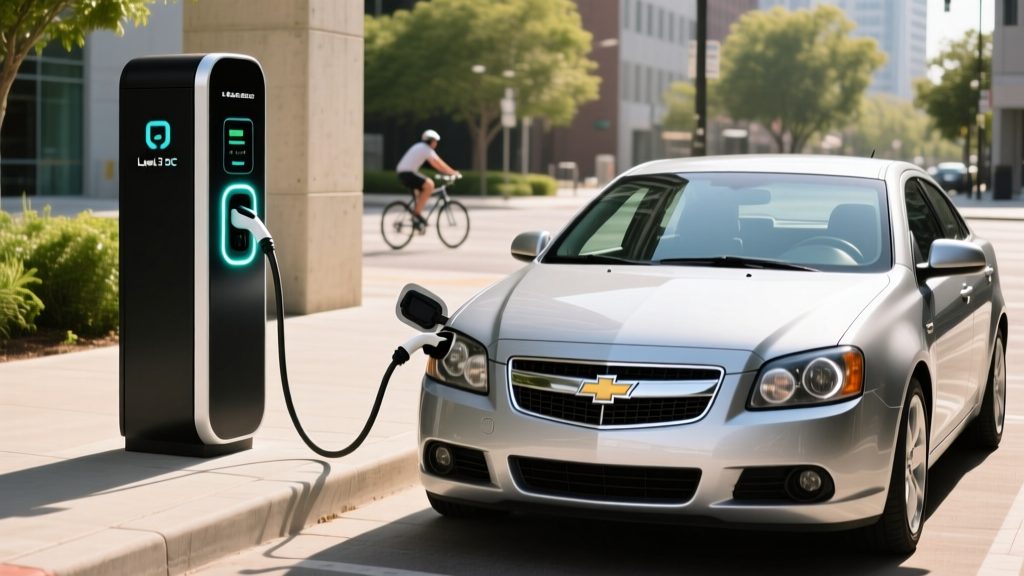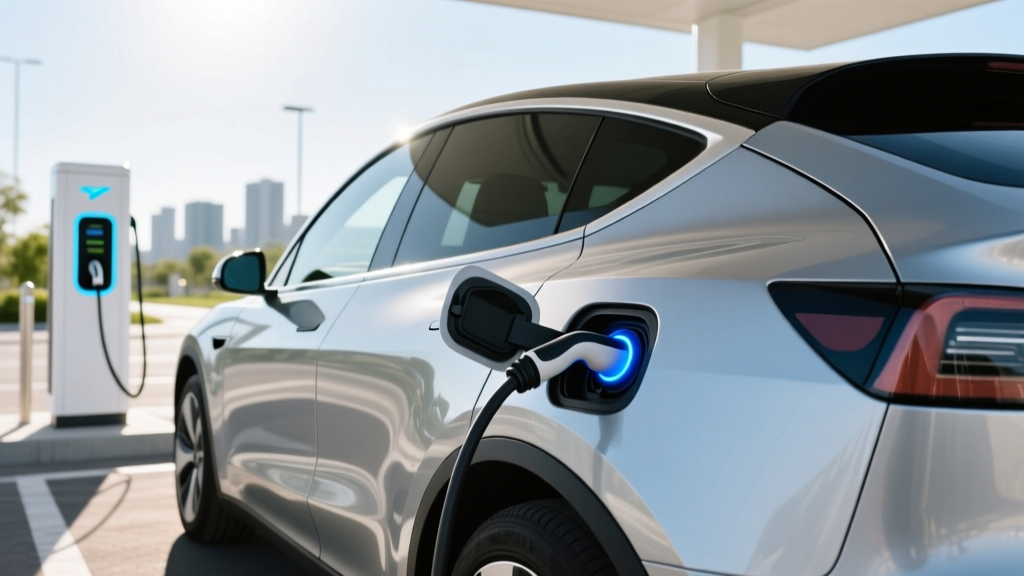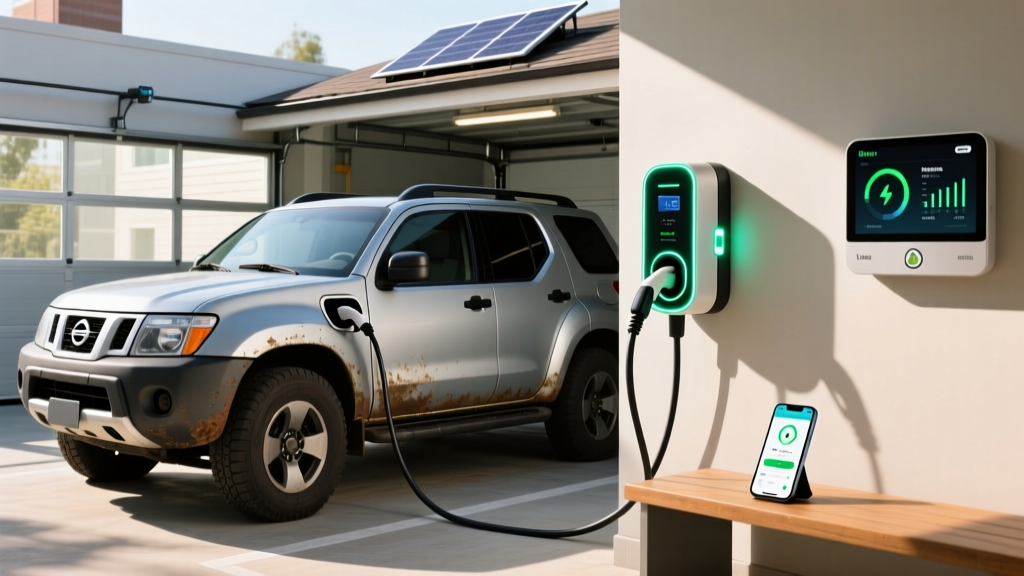
If you've been driving a 2003 Nissan Xterra Supercharged for years — that 3.3L VG33ER V6 putting out 210 hp and averaging a painful 14–16 MPG combined — you've watched fuel bills climb and wondered whether an electric vehicle actually makes sense as a replacement. The short answer: yes, especially if you can charge at home. But the transition from a gas SUV you've owned for two decades to an EV involves a completely new set of logistics: charging levels, electrical panel capacity, connector types, and equipment choices that don't exist in the ICE world.
This guide walks you through everything a former Xterra owner (or any longtime gas-vehicle driver) needs to know about setting up EV charging in 2026 — at home, on the road, and in your budget.
The Three Charging Levels: Speeds, Power, and What They Mean
Before buying a charger or an EV, you need to understand the three charging tiers. The critical distinction: kW (kilowatts) measures power — how fast energy flows into the battery. kWh (kilowatt-hours) measures energy — the battery's total capacity, like gallons in a gas tank. A 75 kWh battery charged at 7.7 kW takes roughly 10 hours from empty; at 150 kW DC fast charging, it can go from 10–80% in about 25 minutes.
| Level | Voltage / Amps | Power (kW) | Miles of Range Added per Hour | Typical Use Case |
|---|---|---|---|---|
| Level 1 | 120V / 12A | 1.4 kW | 3–5 mi/hr | Overnight top-up; PHEVs; emergency |
| Level 2 | 240V / 32–48A | 7.7–11.5 kW | 25–45 mi/hr | Daily home charging; workplace |
| DC Fast Charge | 400–800V DC | 50–350 kW | 150–1,200+ mi/hr (peak) | Road trips; highway corridors |
For context, your 2003 Xterra's 15.8-gallon tank at 15 MPG gave roughly 237 miles of range. A modern EV like the 2026 Hyundai Ioniq 5 (84 kWh battery, EPA 318 miles) replenishes that same distance overnight on Level 2, or in about 18 minutes at a 250+ kW DC fast charger (10–80% SoC).
Home Charger Installation: Electrical Requirements and Real Costs
The single biggest question for new EV buyers: How much does it cost to install a home EV charger? The answer ranges from $0 (if you already have a 240V outlet nearby) to $4,500+ (if your electrical panel needs an upgrade). Most homeowners installing a dedicated Level 2 circuit spend between $800 and $2,500 all-in.
| Component | Low End | Typical | High End |
|---|---|---|---|
| Level 2 charger (equipment) | $250 | $450 | $700 |
| Electrician labor (240V/40–50A circuit) | $400 | $800 | $1,500 |
| Permit and inspection | $50 | $150 | $350 |
| Electrical panel upgrade (100A → 200A) | $0 (not needed) | $0 (not needed) | $2,000–$4,000 |
| Total (no panel upgrade) | $700 | $1,400 | $2,550 |
| Total (with panel upgrade) | $2,700 | $3,400 | $6,550 |
What Electrical Upgrades Might I Need?
Homes built before 1990 — including the era when your Xterra was new — often have 100-amp or even 60-amp service panels. A dedicated 240V/40A circuit for a Level 2 charger draws 9.6 kW continuously. The National Electrical Code (NEC) requires circuits to be rated at 125% of continuous load, so a 40A charger needs a 50A breaker and 6 AWG copper wire (or 4 AWG aluminum).
If your panel is already near capacity (running central AC, electric dryer, electric range, and water heater), adding a 50A EV circuit may push you over the limit. A licensed electrician will perform a load calculation to determine if your panel can handle it. If not, a panel upgrade to 200A service typically costs $2,000–$4,000. Alternatives include:
- Lower-amperage charger: A 32A (7.7 kW) charger on a 40A breaker uses less panel capacity and still adds ~28 miles of range per hour — sufficient for most daily driving.
- Smart load-management devices: Products like the Emporia Smart Load Manager or Tesla Wall Connector with load-sharing can dynamically reduce EV charging when other appliances draw heavy current, avoiding a panel upgrade entirely.
- 120V Level 1 charging: If you drive under 40 miles per day and your EV is a PHEV with a small battery, Level 1 on a standard outlet may suffice — no electrical work needed.
Safety and Code Requirements
Any hardwired Level 2 installation requires:
- A dedicated circuit — no sharing with other appliances
- A GFCI breaker if the charger is installed outdoors (NEC 2023+ requirement for outdoor receptacles; hardwired units often exempt but check local code)
- An NEMA 4-rated enclosure for outdoor installations (weatherproof)
- A local permit and inspection — skipping this can void homeowner's insurance coverage for electrical fires
- Proper wire gauge: 6 AWG copper for 50A circuits, 8 AWG for 40A circuits (verify with your electrician based on run length)
Connector Compatibility: NACS, CCS, and CHAdeMO in 2026
If you're coming from a gas vehicle, the idea of different "fuel nozzles" seems absurd — but the EV industry has three main DC fast-charging connector standards, and picking the right one matters.
| Connector | Brands Using It | Notes |
|---|---|---|
| NACS (Tesla / J3400) | Tesla, Ford, GM, Rivian, Volvo, Polestar, Mercedes-Benz, BMW, Hyundai, Kia, Subaru, Lucid, Toyota | Industry standard by 2026; access to Tesla Supercharger network (17,000+ stalls in North America) |
| CCS1 (Combined Charging System) | VW, Audi, Porsche, Stellantis (Jeep, Dodge, Ram EVs), Honda, Nissan (Ariya), some legacy models | Still widely available at Electrify America, EVgo; adapters to NACS available |
| CHAdeMO | Nissan Leaf (legacy), Mitsubishi Outlander PHEV (older) | Effectively discontinued; new installations rare after 2024 |
The practical takeaway: Nearly every major automaker has adopted NACS for 2025–2026 models. If you're buying a new EV in 2026, it almost certainly has a NACS port. CCS-equipped vehicles (like the VW ID.4 or older Ford Mustang Mach-E) can use NACS-to-CCS adapters ($150–$250) to access Tesla Superchargers. CHAdeMO is a dead end — avoid it unless you're buying a used Nissan Leaf at a steep discount.
For Level 2 home charging, all non-Tesla EVs use the J1772 connector. Tesla vehicles include a J1772-to-NACS adapter in the glovebox. When buying a home charger, choose one with the connector matching your vehicle — or buy a universal unit with a J1772 plug and keep the Tesla adapter handy.
Charging Cost Per Mile vs. Your Xterra's Gas Bill
Your 2003 Nissan Xterra Supercharged averages roughly 15 MPG combined. At $3.50/gallon (a conservative 2026 national average), that's $0.233 per mile just in fuel. Let's compare that to EV charging across different scenarios:
| Scenario | Rate | Cost per Mile | Annual Cost (12,000 mi) |
|---|---|---|---|
| 2003 Xterra (15 MPG, $3.50/gal) | $3.50/gal | $0.233 | $2,796 |
| Home charging — off-peak utility rate | $0.09/kWh | $0.026 | $312 |
| Home charging — standard rate | $0.16/kWh | $0.046 | $552 |
| Public Level 2 (ChargePoint, EVgo) | $0.28/kWh | $0.080 | $960 |
| DC Fast Charging (Electrify America, Tesla) | $0.42/kWh | $0.120 | $1,440 |
Even at the most expensive DC fast-charging rates, an EV costs roughly half per mile compared to the supercharged Xterra. Charge primarily at home on off-peak rates, and your annual "fuel" bill drops from ~$2,800 to ~$312 — a savings of nearly $2,500 per year. Over a typical 5-year ownership period, that's $12,500 back in your pocket, which more than offsets the higher upfront cost of most EVs.
For real-time utility rate data, the U.S. Energy Information Administration publishes state-by-state electricity prices at eia.gov/electricity/state. Many utilities now offer EV-specific time-of-use (TOU) plans with rates as low as $0.05–$0.09/kWh for overnight charging between 10 PM and 6 AM.
Charging Time Examples for Common EV Battery Sizes
How long charging actually takes depends on battery size (kWh), the charger's power output (kW), and the vehicle's charge curve — which tapers significantly above 80% State of Charge to protect battery health. Here are real-world 10–80% times for popular 2026 EVs:
- 2026 Tesla Model Y (75 kWh, NACS): 10–80% in ~17 minutes at a 250 kW Supercharger (V4); ~25 minutes at a 150 kW stall
- 2026 Hyundai Ioniq 5 (84 kWh, NACS): 10–80% in ~18 minutes at a 350 kW charger (sustains ~230 kW peak); ~28 minutes at 150 kW
- 2026 Ford F-150 Lightning (131 kWh extended range, NACS): 10–80% in ~35 minutes at 250 kW; larger battery = longer session
- 2026 Chevrolet Equinox EV (85 kWh, NACS): 10–80% in ~22 minutes at 175 kW
- Level 2 home charging (11.5 kW) for any of the above: 0–100% overnight in 7–12 hours, depending on battery size
The Xterra comparison: filling its 15.8-gallon tank took 4 minutes at a gas station. A DC fast charge to 80% takes 18–35 minutes — longer, yes, but you do it while eating, shopping, or using the restroom. And home charging happens while you sleep, so the "time cost" is effectively zero for daily driving.
Recommended Home Level 2 Chargers (2026 Picks)
Emporia Vue Smart EV Charger
- Power output: 48A / 11.5 kW (on a 60A circuit) or configurable down to 16A
- Connector: J1772 (NACS adapter included for Tesla vehicles)
- Cable length: 24 feet
- Smart features: Wi-Fi, app scheduling, solar integration, load management, energy monitoring
- Price: ~$399
- Best for: Budget-conscious buyers who want smart features and load management without a panel upgrade
Tesla Wall Connector (Gen 4)
- Power output: 48A / 11.5 kW (on a 60A circuit)
- Connector: NACS native (J1772 adapter available separately)
- Cable length: 24 feet
- Smart features: Wi-Fi, OTA updates, power sharing (link two units on one circuit), access control
- Price: ~$475
- Best for: Tesla owners and NACS-equipped EVs; cleanest integration with Tesla vehicles
ChargePoint Home Flex (2nd Gen)
- Power output: Up to 50A / 12 kW (on a 60A circuit); configurable via dip switches
- Connector: J1772 (NACS version available)
- Cable length: 23 feet
- Smart features: Wi-Fi, Alexa/Google Home, app scheduling, charge history, flexible amperage
- Price: ~$599
- Best for: Multi-EV households needing flexible amperage settings; proven reliability track record
Grizzl-E Smart (United Chargers)
- Power output: 40A / 9.6 kW (on a 50A circuit)
- Connector: J1772 (NACS version available for 2025+)
- Cable length: 24 feet
- Smart features: Wi-Fi, OCPP compatibility, adjustable amperage, extreme cold rating (-40°F)
- Price: ~$449
- Best for: Cold-climate owners; Canadian-built with robust build quality and a 3-year warranty
For official safety certification, always verify that any charger you purchase is UL-listed (or ETL-listed to UL standards). The National Highway Traffic Safety Administration (NHTSA) and your local electrical inspector will expect this. Non-certified chargers from overseas marketplaces may be cheaper but carry fire and insurance-liability risks.
Public Charging Networks: What Xterra-to-EV Converters Need to Know
Home charging covers 80–90% of most EV owners' needs. But for road trips — the kind you might have taken in the Xterra to trailheads, campgrounds, or national parks — you'll rely on public DC fast-charging networks. Here's the 2026 landscape:
- Tesla Supercharger network: 17,000+ stalls in North America, now open to NACS-equipped non-Tesla EVs. Consistently the most reliable network (97%+ uptime per JD Power 2025 study). Speeds: 150–350 kW.
- Electrify America: ~4,500 stalls; CCS and NACS connectors. Variable reliability; newer stations (350 kW capable) are faster. Membership plan reduces per-kWh cost.
- EVgo: ~3,800 stalls; mix of CCS and NACS. Strong in urban areas and along highways. Partnership with GM for new 350 kW stalls.
- ChargePoint: Primarily Level 2 (workplace, retail, apartments); limited DC fast-charging footprint.
The EPA's fueleconomy.gov database lets you look up any EV's efficiency in MPGe and kWh/100mi, which helps you estimate charging costs on any network. For example, a 2026 Ioniq 5 AWD rated at 110 MPGe (30 kWh/100mi) would cost $12.60 to add 100 miles at Electrify America's $0.42/kWh rate — still less than the Xterra's $23.30 for 100 miles of gas.
Tax Credits and Incentives for Home Charger Installation
The federal Alternative Fuel Vehicle Refueling Property Credit (IRS §30C) covers 30% of home EV charger equipment and installation costs, up to $1,000. However, this credit is subject to income limitations and must be claimed in the tax year of installation. Check current eligibility on irs.gov before purchasing.
Many states and utilities offer additional rebates — some covering the full cost of a Level 2 charger. California's utility programs, for example, have periodically offered $500–$1,500 rebates for smart charger installations. Contact your local utility to ask about current EV incentive programs in your ZIP code.
Making the Switch: A Practical Decision Framework
Switch to an EV and install a home charger if:
- You have a garage, driveway, or dedicated parking spot with access to your electrical panel
- Your daily driving is under 60 miles (covered easily by overnight Level 2 charging)
- You're spending $2,500+ per year on gas (your Xterra at 15 MPG almost certainly qualifies)
- Your electrical panel has capacity for a 50A circuit — or you're willing to invest in a panel upgrade
Hold off or consider a PHEV if:
- You live in an apartment without charging access and public infrastructure is sparse in your area
- You regularly tow heavy loads (the Xterra's 5,000-lb tow rating is hard to match in current EVs at similar price points — though the F-150 Lightning and Rivian R1T come close)
- Your electrical panel is 60A and a panel upgrade isn't financially feasible right now
Frequently Asked Questions
How much does it cost to install a home EV charger?
Between $700 and $2,550 for a typical Level 2 installation (equipment, electrician, and permit) if your electrical panel has sufficient capacity. If you need a panel upgrade from 100A to 200A service, add $2,000–$4,000. Homes built in the 1990s and earlier — like many that were around when the 2003 Xterra was new — are more likely to need this upgrade.
How fast will each charging level add range?
Level 1 (120V): 3–5 miles per hour. Level 2 (240V): 25–45 miles per hour depending on amperage. DC Fast Charging: 150–1,200+ miles per hour at peak, though charge curves taper above 80% SoC, so real-world sessions deliver ~200 miles in 15–20 minutes on a 250 kW charger.
Which connector/charger is compatible with my EV?
For 2026 models, nearly all new EVs use the NACS (J3400) connector for DC fast charging and J1772 for Level 2. If you buy a Tesla, it uses NACS natively. If you buy a VW ID.4 or other CCS-equipped vehicle, you'll need a CCS-to-NACS adapter ($150–$250) for Supercharger access. CHAdeMO is discontinued for new vehicles.
How much does charging cost per mile vs. gas?
At home on standard rates ($0.16/kWh), a typical EV costs $0.04–$0.05 per mile — about 80% less than a 2003 Xterra Supercharged at $0.23 per mile. Even at premium DC fast-charging rates ($0.42/kWh), EVs cost roughly $0.12 per mile, still half the Xterra's fuel cost.
What electrical upgrades might I need?
A dedicated 240V circuit with a 50A breaker and 6 AWG wire is standard for a 40A Level 2 charger. If your home's electrical panel is at capacity, you may need a panel upgrade (100A to 200A), which costs $2,000–$4,000. Alternatives include installing a lower-amperage charger (32A on a 40A breaker) or using a smart load-management device to avoid the upgrade entirely. Always hire a licensed electrician and pull a permit — it's required by code and protects your insurance coverage.