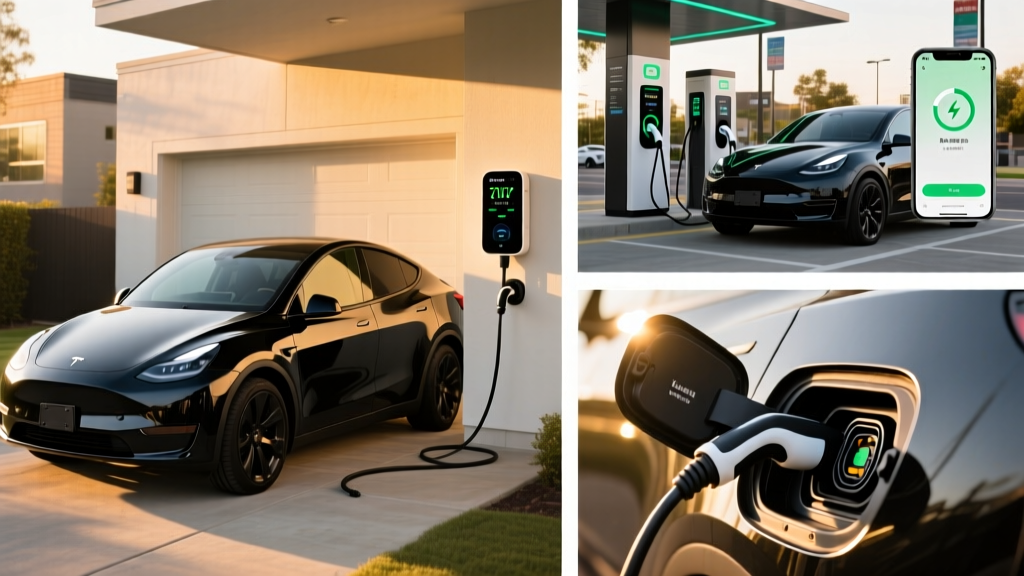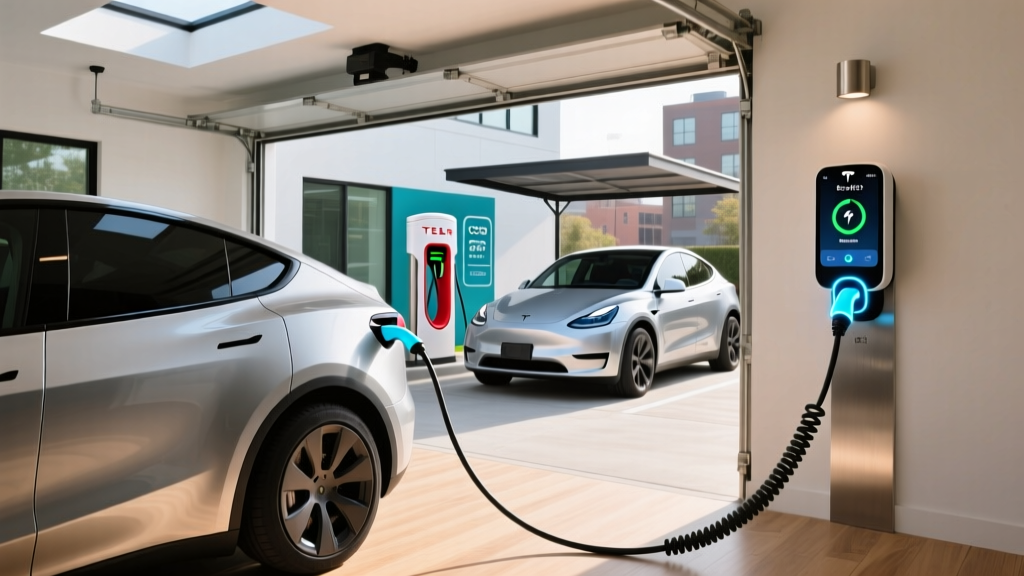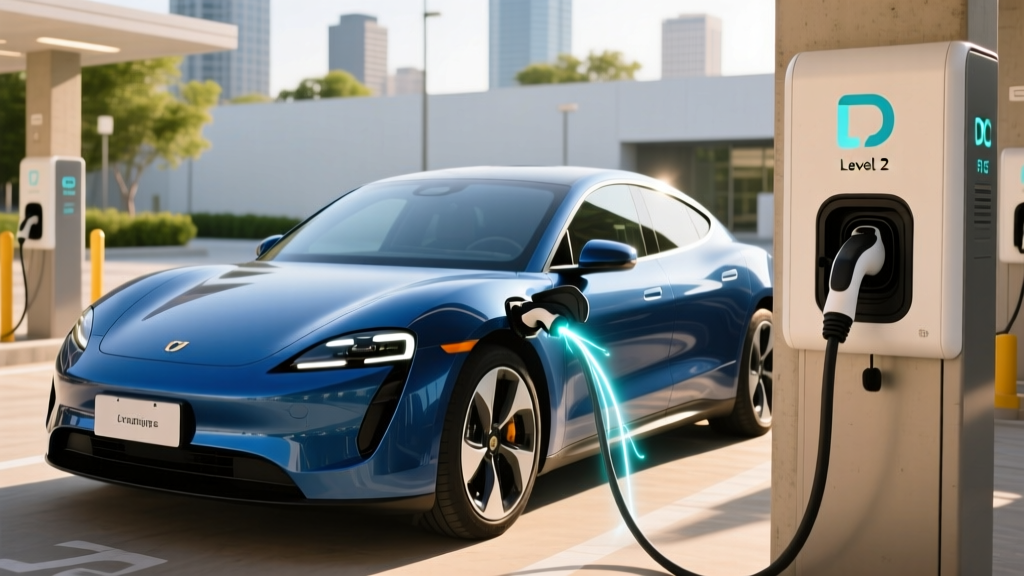
If you've ever owned a 2003 Pontiac Grand Prix GTP Supercharged, you know its 3.8L supercharged V6 delivers a thrilling 240 horsepower — and an EPA-rated 18 MPG city / 28 MPG highway. In 2026, with regular unleaded hovering around $3.30–$3.80 per gallon nationally, that thirst adds up fast. Many GTP owners exploring their next vehicle are asking a practical question: how does the real cost of fueling a supercharged V6 compare to charging a modern electric vehicle?
This guide breaks down EV charging from the ground up — levels, home installation, connectors, equipment, and per-mile costs — using the Grand Prix GTP Supercharged as a gas-car baseline so you can see the numbers side by side.
Charging Levels Explained: Level 1, Level 2, and DC Fast Charging
Before comparing costs, you need to understand the three tiers of EV charging. kW (kilowatts) measures the rate of energy delivery — think of it as how wide the hose is. kWh (kilowatt-hours) measures the total energy stored in the battery — the size of the tank. These are never interchangeable.
| Charging Level | Voltage / Amperage | Power Output (kW) | Miles of Range Added per Hour | Typical Use Case |
|---|---|---|---|---|
| Level 1 (120V) | 120V / 12–16A | 1.4–1.9 kW | 3–5 miles | Overnight trickle; PHEVs or low-mileage drivers |
| Level 2 (240V) | 240V / 32–48A | 7.7–11.5 kW | 25–44 miles | Primary home and workplace charging |
| DC Fast Charging | 400–800V DC | 50–350 kW | 150–1,200+ miles (theoretical) | Road trips; 10–80% in 15–35 minutes |
For context, a modern EV like the 2026 Hyundai Ioniq 5 (84 kWh battery, EPA 310 miles) will charge from 10% to 80% on a 350 kW DC fast charger in roughly 18 minutes, though the charge curve tapers significantly above 80% — peak kW is not sustained kW. On a home Level 2 charger at 11.5 kW, that same 10–80% session takes about 5.5 hours, ideal for overnight replenishment.
Home EV Charger Installation: Electrical Requirements and Real Costs
Most EV owners install a Level 2 home charger on a dedicated 240V circuit. Here's what that involves electrically and financially.
Electrical Requirements
- Circuit: Dedicated 40A or 50A breaker (supports 32A or 40A continuous charging, respectively — NEC requires circuits rated 125% above continuous load)
- Wire: 6 AWG copper (for 50A) or 8 AWG (for 40A), run through conduit where exposed
- Outlet vs. hardwired: NEMA 14-50 outlet offers portability; hardwired units avoid the $75–$150 outlet cost and some jurisdictions waive GFCI requirements for hardwired
- Panel capacity: Your main panel must have physical space for a double-pole breaker AND sufficient amperage headroom. A 200A panel running near capacity may need a load calculation or upgrade
Panel Upgrade Reality
Many older homes — especially those built before 1990 with 100A or 150A service — may need a panel upgrade to 200A to support a Level 2 charger alongside existing loads (HVAC, electric range, dryer). This is a major cost variable that charging guides often gloss over.
| Component | Low Estimate | High Estimate |
|---|---|---|
| Level 2 charger equipment (smart, 40–48A) | $350 | $700 |
| Electrician labor (run circuit, mount, connect) | $400 | $1,500 |
| Permit and inspection | $50 | $250 |
| NEMA 14-50 outlet (if not hardwired) | $75 | $150 |
| Subtotal (no panel upgrade) | $875 | $2,600 |
| Panel upgrade to 200A (if needed) | $1,500 | $3,500 |
| Total with panel upgrade | $2,375 | $6,100 |
The wide range reflects variables like wire run length (a charger 10 feet from the panel costs far less than one 80 feet away in a detached garage), local labor rates, and whether your utility offers rebates. Always hire a licensed electrician and pull a permit — unpermitted work can void homeowner's insurance claims.
Connector Compatibility: NACS, CCS1, and CHAdeMO
As of 2026, the North American charging landscape has consolidated heavily around the NACS (North American Charging Standard) connector pioneered by Tesla. Nearly every major automaker — Ford, GM, Hyundai, Kia, Rivian, Volvo, BMW, and others — has adopted NACS on new vehicles. The legacy CCS1 connector remains on many 2023–2025 models, and CHAdeMO is effectively discontinued outside the used Nissan Leaf market.
| Connector | Vehicles Using It (2026) | DC Fast Network Access | Adapter Needed? |
|---|---|---|---|
| NACS (Tesla standard) | Tesla (all), Ford, GM, Hyundai, Kia, Rivian, BMW, Volvo, others | Tesla Supercharger, Electrify America, EVgo, ChargePoint | CCS-to-NACS adapter (~$200) for older CCS vehicles |
| CCS1 | Legacy 2022–2025 models (VW ID.4, older Bolt, Ioniq 5 pre-2026) | Electrify America, EVgo, ChargePoint (declining CCS stalls) | NACS-to-CCS adapter for Tesla Superchargers |
| CHAdeMO | Nissan Leaf (discontinued), Mitsubishi Outlander PHEV (older) | Limited and shrinking | No practical adapter to NACS for DC fast charging |
If you're buying a new EV in 2026, NACS is the connector to get. If you own a CCS-equipped vehicle, adapters from Tesla, Lectron, and A2Z provide Supercharger access, though at slightly reduced peak charge rates due to the adapter's thermal limits.
Cost Per Mile: Fueling the Grand Prix GTP vs. Charging an EV
This is where the comparison gets concrete. Let's run the numbers on the 2003 Grand Prix GTP Supercharged against a representative 2026 EV.
| Vehicle / Scenario | Energy Source | Cost per Unit | Efficiency | Cost Per Mile |
|---|---|---|---|---|
| 2003 Grand Prix GTP Supercharged | Regular unleaded | $3.50/gallon | 22 MPG combined (real-world) | $0.159 |
| 2026 EV — home charging (off-peak) | Electricity | $0.13/kWh | 3.5 miles/kWh (115 MPGe) | $0.037 |
| 2026 EV — home charging (peak TOU) | Electricity | $0.28/kWh | 3.5 miles/kWh | $0.080 |
| 2026 EV — public Level 2 | Electricity | $0.35/kWh | 3.5 miles/kWh | $0.100 |
| 2026 EV — DC fast charging (road trip) | Electricity | $0.48/kWh | 3.2 miles/kWh (highway) | $0.150 |
Even at the most expensive DC fast charging rates, the EV nearly matches the GTP's per-mile fuel cost. On home off-peak charging — where most daily miles are added — the EV costs roughly 77% less per mile than the supercharged Pontiac. Over 15,000 annual miles, that's a fuel savings of approximately $1,830 per year.
The Grand Prix GTP's supercharger whine and 240 HP are undeniably fun, but the Eaton M90 supercharger also drinks fuel under boost. Real-world combined economy for enthusiastic drivers often drops to 19–20 MPG, widening the gap further.
Charging Time Examples: What to Expect by Battery Size
Charging speed depends on battery capacity (kWh), the vehicle's onboard charger limit (for Level 2), and peak DC charge rate. Here are realistic 10–80% times for common 2026 battery sizes:
- 60 kWh battery (e.g., base Tesla Model 3 RWD): ~5.5 hours on 11.5 kW Level 2; ~20 minutes on 170 kW DC fast charger
- 84 kWh battery (e.g., Hyundai Ioniq 5): ~5.5 hours on 11.5 kW Level 2; ~18 minutes on 350 kW DC fast charger (peak 240 kW, tapering above 80%)
- 100 kWh battery (e.g., Ford F-150 Lightning Extended Range): ~8 hours on 11.5 kW Level 2; ~30 minutes on 350 kW DC fast charger (peak 210 kW)
- 131 kWh battery (e.g., GMC Hummer EV): ~11 hours on 11.5 kW Level 2; ~40+ minutes on 350 kW DC fast charger
A critical detail: DC fast charging follows a curve, not a flat rate. A vehicle rated for 250 kW peak may only sustain that rate between 10–30% State of Charge (SoC), then taper to 150 kW, then 80 kW, then 40 kW as the battery fills. This is why 10–80% time is the industry benchmark rather than 0–100%.
Recommended Home Charging Equipment for 2026
ChargePoint Home Flex (NACS)
- Power: Up to 11.5 kW (48A) on a 60A circuit, or 9.6 kW (40A) on a 50A circuit
- Connector: NACS (native); CCS adapter available
- Cable length: 23 feet
- Smart features: Wi-Fi, scheduled charging, Alexa integration, energy dashboard
- Price: ~$550
- Best for: Most EV owners wanting reliable smart scheduling and utility TOU optimization
Tesla Wall Connector (NACS)
- Power: Up to 11.5 kW (48A) on a 60A circuit
- Connector: NACS (native)
- Cable length: 24 feet
- Smart features: Wi-Fi, OTA updates, Power-Share (load balancing between two units), Tesla app integration
- Price: ~$475
- Best for: Tesla owners or households with multiple NACS vehicles needing load sharing
Emporia Level 2 EV Charger
- Power: Up to 11.5 kW (48A)
- Connector: NACS (2026 model); J1772 on older stock
- Cable length: 24 feet
- Smart features: Wi-Fi, solar integration, real-time energy monitoring, utility demand-response compatible
- Price: ~$400
- Best for: Budget-conscious buyers who want detailed energy tracking and solar pairing
All three units are UL-listed, NEMA 4 rated for outdoor installation, and compatible with the IRS §30D home charging equipment credit (up to $1,000, subject to income and census-tract eligibility — verify current rules at irs.gov).
Safety, Code, and Installation Best Practices
EV charging draws sustained high current for hours — unlike a dryer or oven that cycles on and off. This makes proper installation non-negotiable:
- Dedicated circuit: Your EV charger must have its own breaker — never share a circuit with other appliances
- GFCI protection: NEC 2023 and later require GFCI on 240V receptacles in garages; hardwired installations may be exempt depending on your AHJ (Authority Having Jurisdiction)
- Outdoor rating: If installing outside, ensure the charger is NEMA 4 or IP65 rated. Use an in-use cover for NEMA 14-50 outlets
- Wire sizing: Undersized wire causes voltage drop and heat — always follow NEC ampacity tables and your electrician's load calculation
- Surge protection: Consider a whole-panel surge protective device (SPD), especially in lightning-prone regions; adds $200–$400 installed
- Permit and inspection: Required in virtually all US jurisdictions; unpermitted installs can void insurance and create resale issues
Frequently Asked Questions
How much does it cost to install a home EV charger?
Expect $875–$2,600 for a straightforward Level 2 installation on an existing 200A panel, including equipment, electrician labor, and permits. If your home needs a panel upgrade from 100A or 150A to 200A, add $1,500–$3,500, bringing the total to $2,375–$6,100. Get three quotes and verify your electrician pulls a permit.
How fast will each charging level add range?
Level 1 (120V) adds 3–5 miles per hour — adequate only for PHEVs or drivers covering under 30 miles daily. Level 2 (240V) adds 25–44 miles per hour, fully replenishing most EVs overnight. DC fast charging adds 150–1,200+ miles per hour theoretically, delivering a practical 10–80% charge in 15–35 minutes depending on battery size and peak kW.
Which connector or charger is compatible with my EV?
For 2026 model-year vehicles, NACS is the dominant standard across Tesla, Ford, GM, Hyundai, Kia, BMW, Rivian, and Volvo. CCS1 remains on some 2023–2025 models — adapters are available for Supercharger access. CHAdeMO is effectively obsolete. Check your vehicle's charge port or the manufacturer's spec sheet before purchasing a home charger.
How much does charging cost per mile vs. gas?
Home off-peak EV charging costs roughly $0.037 per mile at $0.13/kWh — about 77% cheaper than fueling a 2003 Grand Prix GTP Supercharged at $0.159/mile (22 MPG combined, $3.50/gallon). Even DC fast charging at $0.48/kWh ($0.150/mile) nearly matches the GTP. The US Department of Energy's fueleconomy.gov provides a detailed calculator for your specific utility rates and vehicle.
What electrical upgrades might I need?
The most common upgrade is a 200A panel replacement for older homes with 100A or 150A service — $1,500–$3,500 depending on your utility and region. You may also need a new meter base, upgraded service drop from the utility, or a sub-panel if your garage is detached. Some utilities offer free or subsidized panel upgrades for EV adopters — check with your provider. A licensed electrician's load calculation will determine exactly what's required.
Trading the supercharger whine of a Grand Prix GTP for the silent torque of an EV is a lifestyle shift — but the math is unambiguous. With home charging, most EV owners spend $400–$600 annually on electricity versus the $2,000–$2,500 the GTP demands in gasoline. Factor in the EV's near-zero drivetrain maintenance (no oil changes, no supercharger belt, no transmission fluid), and the total-cost-of-ownership gap widens further. The upfront investment in a Level 2 home charger typically pays for itself within 18–24 months of fuel savings alone.