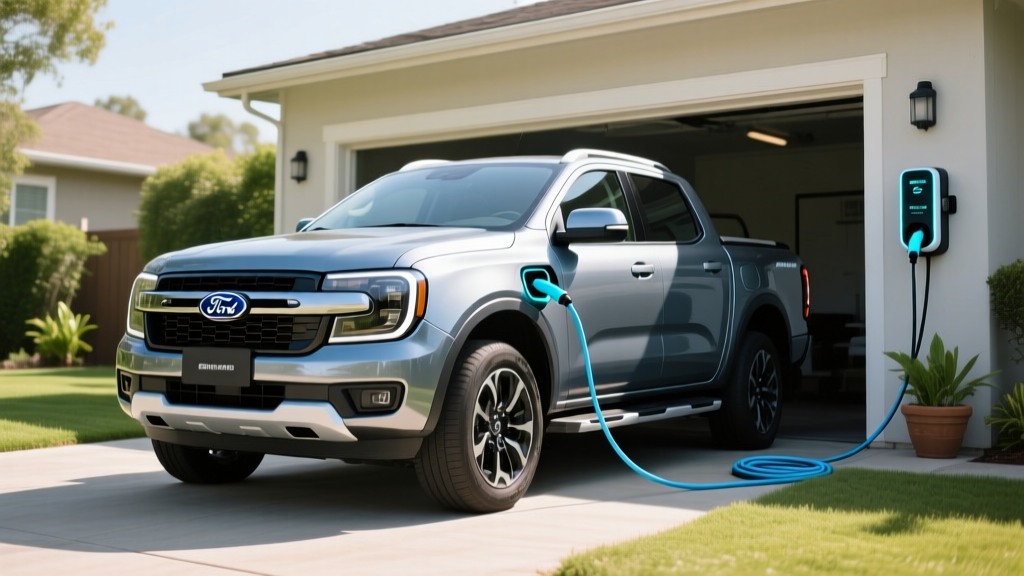
The 2000 Ford Ranger EV is one of the most unusual electric vehicles you can still encounter on American roads. Originally leased in tiny numbers to fleet and government customers in the late 1990s, a handful survived into private hands after Ford discontinued the program. If you own or are considering buying one of these rare electric pickups, understanding how to charge it — and what modern charging infrastructure can (and cannot) do for a vehicle with a 25-year-old electric powertrain — is essential.
This guide covers the Ranger EV's original charging capabilities, how to adapt it for today's charging networks, realistic home installation costs, and what you'll actually spend per mile compared to a gas truck.
Battery: ~27 kWh (nickel-metal hydride, NiMH) | Original EPA range: ~55–70 miles | Onboard charger: 6.6 kW (Level 2, 220V) | Level 1: 1.4 kW (110V) | Connector (original): Avcon inductive paddle (J1773) | DC fast charging: Not supported
Charging Levels Explained: What the Ranger EV Can Accept
Modern EV charging falls into three tiers. The 2000 Ranger EV was designed before today's standards existed, so its compatibility is limited. Here's how each level works and what it means for this specific truck.
| Level | Voltage | Power (kW) | Miles of Range/Hour | Ranger EV Compatible? |
|---|---|---|---|---|
| Level 1 | 120V AC | 1.2–1.4 kW | ~3–4 mi/hr | Yes (original cord) |
| Level 2 | 208–240V AC | 3.3–6.6 kW | ~10–18 mi/hr | Yes (via Avcon paddle or adapter) |
| DC Fast | 400–800V DC | 50–350 kW | 150–600+ mi/hr | No — vehicle lacks DC inlet |
Key distinction: kW (kilowatts) measures power — how fast energy flows into the battery. kWh (kilowatt-hours) measures energy — the total capacity of the battery itself. The Ranger EV's ~27 kWh battery is small by modern standards (a 2026 Ford F-150 Lightning carries a 98–131 kWh pack), which means even slow Level 2 charging fills it relatively quickly.
The Connector Problem: Avcon, J1773, and Modern Adapters
The 2000 Ford Ranger EV predates the modern J1772 connector standard that all non-Tesla EVs in North America use today. Ford equipped the Ranger EV with an Avcon inductive charging paddle — a proprietary system (SAE J1773) that used magnetic induction rather than a physical plug-and-pin connection.
This creates a real-world compatibility challenge:
| Connector Standard | Used By | Works with Ranger EV? |
|---|---|---|
| J1772 (Level 1/2) | All modern non-Tesla EVs | No — requires custom adapter or onboard retrofit |
| NACS (Tesla) | Tesla, 2025+ Ford/GM/Rivian/etc. | No |
| CCS1 (DC Fast) | Most modern non-Tesla EVs | No — Ranger EV has no DC capability |
| CHAdeMO (DC Fast) | Nissan Leaf, Mitsubishi (legacy) | No |
| Avcon J1773 (Inductive) | 1997–2002 Ranger EV, Solectria | Yes — original equipment |
Most surviving Ranger EVs have been retrofitted by their owners with a J1772 inlet — a common modification in the vintage EV community. This involves replacing or bypassing the Avcon paddle receiver with a modern J1772 port wired to the onboard charger. Once converted, the truck can use any standard Level 2 public or home charger.
If the truck still has its original Avcon connector, you'll need to locate the extremely rare remaining Avcon paddles (mostly decommissioned) or commission the J1772 retrofit, typically performed by an EV-savvy electrician or vintage-EV specialist for $500–$1,200.
Home Charging Setup: Electrical Requirements and Install Costs
Because the Ranger EV's onboard charger maxes out at 6.6 kW, you don't need the most powerful home charger available. A standard 32-amp or 40-amp Level 2 station delivers more than enough. Here's what a proper home installation requires.
Electrical Requirements
- Circuit: Dedicated 240V circuit, 40-amp breaker (supports up to 32A continuous draw per NEC 80% rule)
- Wire: 6 AWG copper (or 4 AWG aluminum) from panel to outlet/charger
- Outlet: NEMA 14-50 receptacle (if using a plug-in charger) or hardwired connection
- GFCI protection: Required by NEC 2020+ for EV charging outlets in garages and all outdoor locations
- Permit: Required in virtually all US jurisdictions for new 240V circuits
Panel Upgrade Reality
Homes built before 1980 often have 100-amp electrical panels. Adding a 40-amp EV circuit may push total load beyond safe capacity, triggering a panel upgrade to 200 amps — a $1,500–$3,500 expense on top of the charger install. A licensed electrician will perform a load calculation (NEC Article 220) to determine if your panel can handle the additional circuit. Homes with 200A service usually accommodate a Level 2 charger without an upgrade.
| Component | Typical Cost Range | Notes |
|---|---|---|
| Level 2 charger (hardware) | $300–$700 | 32A–40A, J1772 connector |
| Electrician labor (run 240V circuit) | $400–$1,500 | Depends on panel-to-garage distance |
| Permit and inspection | $50–$250 | Varies by municipality |
| Panel upgrade (if needed) | $1,500–$3,500 | 100A → 200A service upgrade |
| Total (no panel upgrade) | $750–$2,450 | Most homes with 200A service |
| Total (with panel upgrade) | $2,250–$5,950 | Older homes with 100A panels |
The IRS §30D tax credit does not cover home charging equipment for most taxpayers after 2022, though the Residential Clean Energy Credit (25C) may apply in specific circumstances. Some utilities still offer rebates of $250–$500 for Level 2 charger installations — check with your local provider.
Charging Time: What to Expect with a 27 kWh Battery
The Ranger EV's small battery is actually an advantage for home charging speed. Even modest Level 2 equipment can refill it overnight with hours to spare.
- Level 1 (120V, 1.4 kW): 0–100% in approximately 19–22 hours
- Level 2 (240V, 6.6 kW): 0–100% in approximately 4.5–5 hours
- Level 2 (240V, 3.3 kW — if onboard charger limited): 0–100% in approximately 8–9 hours
- DC Fast Charging: Not supported — no DC inlet or protocol
Because the Ranger EV cannot accept DC fast charging, all public fast-charging networks (Electrify America, EVgo, Tesla Superchargers with Magic Dock) are unusable for this vehicle. Your charging strategy is entirely home- and destination-based Level 2.
NiMH battery note: The Ranger EV's nickel-metal hydride pack behaves differently from modern lithium-ion batteries. NiMH cells tolerate full 100% charges better than lithium-ion but are sensitive to deep discharge. Owners report best longevity when keeping state of charge between 20% and 100%, and avoiding letting the truck sit at 0% for extended periods. The pack is now 25+ years old; expect degraded capacity. Real-world range for surviving examples typically falls between 35 and 55 miles depending on cell condition, temperature, and driving style.
Cost Per Mile: Charging the Ranger EV vs. a Gas Truck
Even with a vintage battery, the Ranger EV's operating cost advantage over a gasoline truck is substantial. Here's how it breaks down using 2026 electricity and fuel prices.
| Scenario | Rate | Cost for Full Charge (~27 kWh) | Cost/Mile (est. 45 mi range) |
|---|---|---|---|
| Home (off-peak utility rate) | $0.09/kWh | $2.43 | $0.054/mile |
| Home (national avg. residential) | $0.16/kWh | $4.32 | $0.096/mile |
| Public Level 2 (ChargePoint, etc.) | $0.25–$0.49/kWh | $6.75–$13.23 | $0.15–$0.29/mile |
| Gas truck baseline (20 MPG, $3.50/gal) | — | — | $0.175/mile |
At home off-peak rates, the Ranger EV costs roughly 5 cents per mile to "fuel" — about one-third the cost of a comparable gasoline Ranger. Even at public Level 2 rates, you're paying roughly the same or less per mile than gasoline, though public charging erodes the savings advantage.
Recommended Level 2 Chargers for the Ranger EV
Since the Ranger EV's onboard charger caps at 6.6 kW, any quality 32-amp or 40-amp Level 2 station is sufficient. You're paying for reliability, cable management, and smart features — not raw power. These are the best options assuming a J1772 retrofit has been completed.
Emporia Vue Level 2
- Power output: 40A / 9.6 kW max (Ranger EV will draw 6.6 kW)
- Connector: J1772
- Cable length: 24 ft
- Smart features: Wi-Fi, app scheduling, energy monitoring, load management
- Price: ~$399
- Best for: Budget-conscious owners who want app control and energy tracking
ChargePoint Home Flex
- Power output: Configurable 16A–50A (set to 32A for Ranger EV)
- Connector: J1772
- Cable length: 23 ft
- Smart features: Wi-Fi, Alexa integration, scheduled charging, ChargePoint network access
- Price: ~$549
- Best for: Owners who want flexible amperage and broad public-network familiarity
Grizzl-E Smart
- Power output: 40A / 9.6 kW max
- Connector: J1772
- Cable length: 24 ft
- Smart features: OCPP-compatible, adjustable amperage, extreme-weather rated (-40°F)
- Price: ~$499
- Best for: Outdoor installations in cold climates; built in Canada for harsh conditions
Tesla Universal Wall Connector
- Power output: 48A / 11.5 kW max
- Connector: J1772 (built-in, no adapter needed)
- Cable length: 24 ft
- Smart features: Wi-Fi, Tesla app, power sharing with second unit
- Price: ~$599
- Best for: Multi-EV households that include both Tesla and non-Tesla vehicles
Any of these units will fully charge the Ranger EV's 27 kWh pack in under 5 hours. If you plan to own a modern EV in the future, investing in a 48A-capable unit like the Tesla Universal Wall Connector gives you headroom for vehicles with larger batteries and faster onboard chargers.
Safety, Code, and Practical Considerations
Installing a 240V EV charging circuit is serious electrical work. The National Electrical Code (NEC) and your local building department have specific requirements:
- Dedicated circuit: Your Level 2 charger must be on its own breaker — it cannot share a circuit with other appliances.
- GFCI protection: Since NEC 2020, all EV charging outlets (NEMA 14-50 or similar) require ground-fault circuit interrupter protection. Hardwired chargers have built-in GFCI and may not require an additional breaker-level GFCI.
- Outdoor rating: If your charger is installed outside or in an open carport, the unit must carry a NEMA 4 (weatherproof) rating. All four chargers listed above meet this standard.
- Permit required: Skipping the permit may void your homeowner's insurance coverage for electrical fires. Most jurisdictions charge $50–$250 for an EV circuit permit, with a required inspection after installation.
- Never use an extension cord: Level 2 chargers draw sustained high current. Extension cords — even heavy-duty ones — introduce resistance, heat, and fire risk.
FAQ: Common Questions About Charging the 2000 Ford Ranger EV
How much does it cost to install a home EV charger for the Ranger EV?
Expect $750–$2,450 if your home has a 200-amp electrical panel and the run from panel to garage is under 50 feet. If your home has an older 100-amp panel that needs upgrading, total cost can reach $2,250–$5,950. The charger hardware itself costs $300–$700 for a quality 32A–40A J1772 unit.
How fast will each charging level add range to the Ranger EV?
Level 1 (120V) adds approximately 3–4 miles of range per hour. Level 2 (240V at 6.6 kW) adds approximately 14–18 miles per hour. With the truck's ~45-mile real-world range, a full Level 2 charge takes about 4.5 hours. DC fast charging is not possible on this vehicle.
Which connector is compatible with my Ranger EV?
Originally, the Ranger EV used the Avcon J1773 inductive paddle — a system that no longer exists on any public charging network. Most surviving trucks have been retrofitted with a J1772 inlet, which is compatible with every public Level 2 charger and every modern home charging station in North America (except Tesla-only chargers without a J1772 adapter).
How much does charging cost per mile vs. gas?
At home off-peak rates (~$0.09/kWh), the Ranger EV costs about $0.05 per mile. At the national average residential rate (~$0.16/kWh), it's roughly $0.10 per mile. A comparable gas truck at 20 MPG and $3.50/gallon costs about $0.175 per mile. Home charging saves $0.07–$0.12 per mile.
What electrical upgrades might I need?
If your home has a 200-amp panel with available capacity, you likely need only a new 40-amp double-pole breaker and a 240V circuit run to your garage. If your home has a 100-amp panel (common in pre-1980 construction), a full panel upgrade to 200 amps may be required, adding $1,500–$3,500 to the project. A licensed electrician will perform an NEC Article 220 load calculation to determine your exact needs.
Can I use a Tesla Supercharger or Electrify America station?
No. The 2000 Ford Ranger EV cannot accept DC fast charging under any circumstances — it lacks both the physical inlet and the battery management protocol for DC charging. Your charging options are limited to Level 1 (120V) and Level 2 (240V), making this a home-and-destination charging vehicle only.
Is the NiMH battery safe to charge on modern equipment?
Yes, provided the J1772 retrofit was done correctly. The J1772 protocol includes handshake communication between the charger and the vehicle's onboard charger, which controls the charge rate regardless of battery chemistry. However, given the pack's age (25+ years), have the battery's state of health evaluated by a specialist before committing to regular charging. Replacement NiMH packs are virtually unavailable; some owners have converted to modern lithium-ion cells, a complex and expensive ($5,000–$10,000) project.
Sources: EPA Fuel Economy (historical EV data), IRS Clean Vehicle Credits, National Electrical Code (NEC) Article 625 — Electric Vehicle Charging System Equipment.