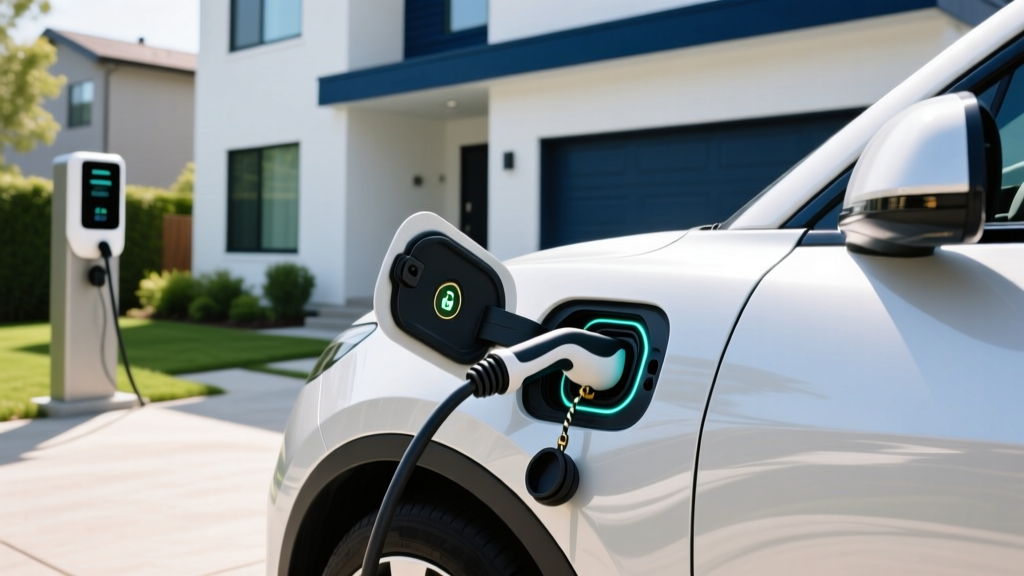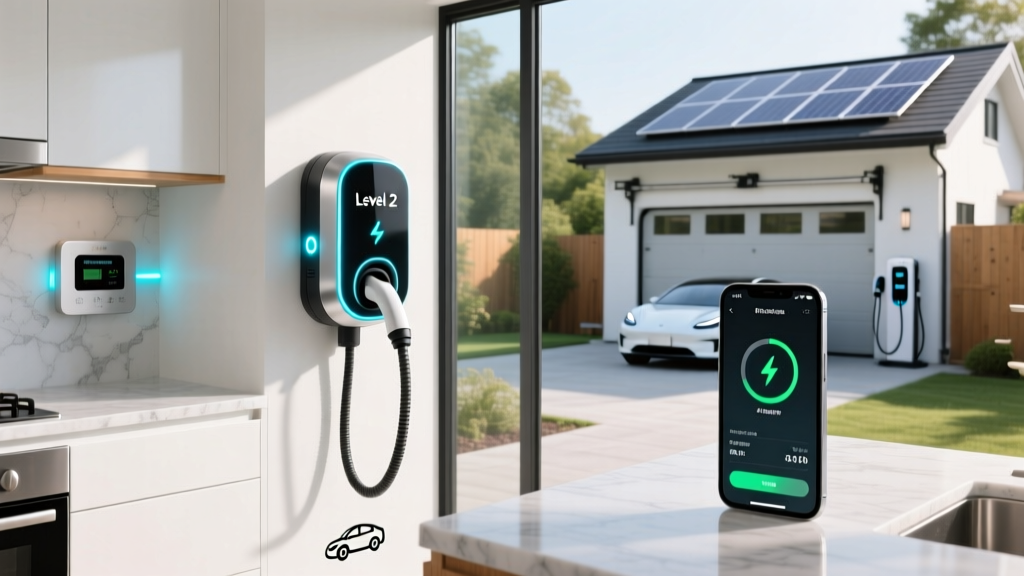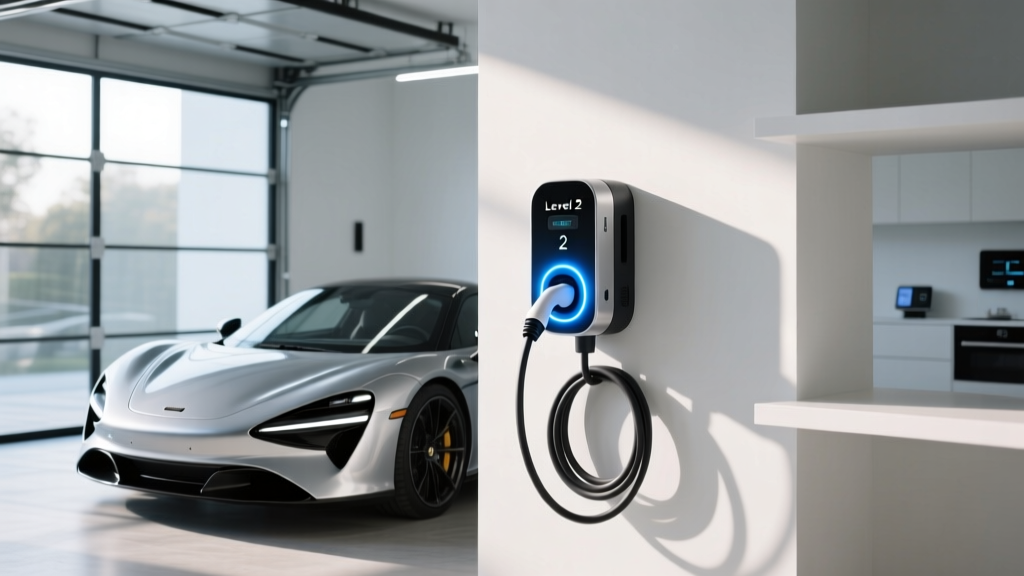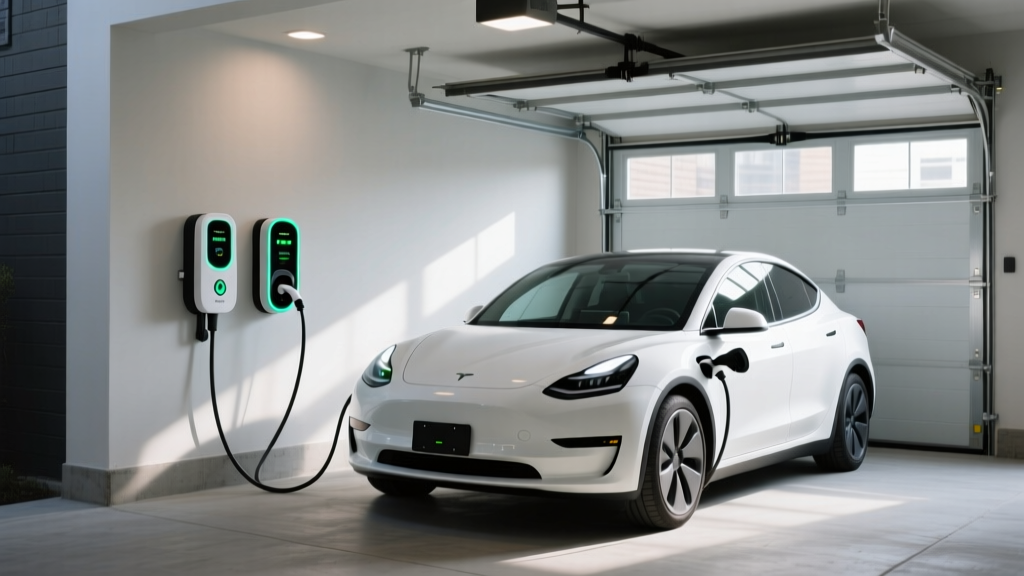
If you own a compact EV or plug-in hybrid and park in a narrow garage, a shared carport, or a two-bay setup where wall space is at a premium, the phrase "2 door charger" takes on real meaning. You need a charging station that fits between vehicles, reaches both parking spots with a single cable, and doesn't require you to squeeze past a wall-mounted unit every time you open your car door. This guide breaks down exactly how to spec, install, and optimize a Level 2 home charger in a tight or dual-vehicle garage — with exact numbers for power, cost, and charging time.
Charging Levels Explained: How Fast Does Each Add Range?
Before picking equipment, you need to understand the three charging tiers available to EV owners. The critical distinction: kW (kilowatts) measures power — how fast energy flows into your car. kWh (kilowatt-hours) measures energy — how much your battery holds. A 60 kWh battery charged at 10 kW takes roughly 6 hours from empty to full.
| Level | Voltage | Power (kW) | Miles of Range Added per Hour | Best For |
|---|---|---|---|---|
| Level 1 | 120V AC | 1.0–1.4 kW | 3–5 mi/hr | PHEVs, overnight trickle, emergency backup |
| Level 2 | 240V AC | 3.3–19.2 kW | 12–70 mi/hr | Daily home charging, 2-car garage setups |
| DC Fast | 400–800V DC | 50–350 kW | 150–1,200 mi/hr | Road trips, public stations |
For a 2 door charger home setup, Level 2 is the target. A 48-amp (11.5 kW) charger adds roughly 40–45 miles of range per hour — enough to refill a 60 kWh battery from 20% to 80% in about 4.5 hours. A 40-amp (9.6 kW) unit, which requires only a 50-amp breaker, is the most common residential choice and still delivers 30–35 miles per hour of charge.
Electrical Requirements for a 2-Car Garage Charger Install
A Level 2 charger needs a dedicated 240-volt circuit. Here's what that means in practice:
- 40-amp charger: Requires a 50-amp breaker and 6 AWG copper wire. This is the sweet spot for most homes — it charges fast enough for daily use and doesn't usually demand a panel upgrade.
- 48-amp charger: Requires a 60-amp breaker and 4 AWG copper wire. Faster, but pushes closer to the limits of older 100-amp or 150-amp service panels.
- 80-amp charger (19.2 kW): Requires a 100-amp breaker and 2 AWG wire. Only practical with a 200-amp or larger panel, and few EVs can accept this rate on AC anyway (the 2026 Tesla Cybertruck and some Lucid models can).
Panel Upgrade Reality Check
Many homes built before 2000 have 100-amp or 150-amp main panels. Adding a 50-amp or 60-amp dedicated circuit may require a panel upgrade to 200 amps, especially if you already run electric heat, a dryer, and an oven. A licensed electrician will perform a load calculation per NEC Article 220 to determine if your panel can handle the additional draw. If an upgrade is needed, budget an additional $1,500–$3,500 on top of the charger install.
Permits and Code Requirements
Most jurisdictions require an electrical permit for a new 240V circuit. The permit fee typically runs $50–$200 depending on your municipality. Your electrician should pull this — never skip it, as it's required for insurance coverage and future home resale. Code also requires:
- A dedicated circuit (no sharing with other appliances)
- GFCI protection on the breaker (required by NEC 2020 and later for EV charging outlets)
- NEMA 14-50 receptacle installed with the ground pin at the top (per manufacturer specs for most hardwired-to-plug adapters)
- Outdoor-rated equipment (NEMA 4 or IP65) if the charger is exposed to weather
Installation Cost Breakdown: What You'll Actually Pay
Home EV charger installation costs vary enormously based on your home's electrical setup, the distance from your panel to the garage, and whether you need a panel upgrade. Here's a realistic 2026 breakdown:
| Component | Simple Install (panel in garage) | Complex Install (long run, panel upgrade) |
|---|---|---|
| Level 2 Charger (hardware) | $350–$700 | $350–$700 |
| Electrician labor (240V circuit) | $300–$800 | $800–$2,000 |
| Wire, conduit, breaker | $100–$300 | $300–$800 |
| Electrical permit | $50–$150 | $50–$200 |
| Panel upgrade (if needed) | $0 | $1,500–$3,500 |
| Total estimated cost | $800–$1,950 | $3,000–$7,200 |
Some utilities offer rebates of $250–$500 for installing a smart Level 2 charger, and certain states provide additional incentives. Check your local utility's EV program before scheduling work.
Connector Compatibility: NACS, CCS, and CHAdeMO in 2026
The connector landscape has consolidated significantly. Here's what fits what in the current model year:
| Connector | Brands Using It (2026 Models) | Home Charger Availability |
|---|---|---|
| NACS (Tesla / SAE J3400) | Tesla, Ford, GM, Rivian, Volvo, Polestar, Hyundai, Kia, BMW, Mercedes-Benz, and most others transitioning | Tesla Wall Connector, ChargePoint Home Flex (NACS), Emporia Level 2 (NACS) |
| CCS1 (Combined Charging System) | Remaining Stellantis models, some legacy VW/Audi vehicles, older Hyundai/Kia | ChargePoint Home Flex, Enel X JuiceBox, Emporia (with CCS cable) |
| CHAdeMO | Nissan Leaf (discontinued after 2025), Mitsubishi Outlander PHEV | Primarily DC public charging; not used for home Level 2 |
For a 2 door charger setup in 2026, NACS is the default choice unless you own a vehicle that still uses CCS1. If you have one NACS car and one CCS car in a two-car garage, buy a NACS charger and keep a NACS-to-CCS adapter (~$200–$250) for the second vehicle. This avoids installing two separate circuits.
Equipment Picks: Best Chargers for a Tight 2-Car Garage
When space between parked vehicles is limited, cable management and charger footprint matter as much as power output. These are the top picks for a 2 door charger configuration:
Tesla Wall Connector (NACS)
- Power: Up to 11.5 kW (48A) on a 60A circuit
- Cable length: 24 feet — reaches across two parking spots in most standard garages
- Smart features: Wi-Fi, OTA updates, Power-Share (two units share one circuit, alternating power to whichever car needs it)
- Price: ~$475
- Best for: Two Tesla or NACS-equipped EVs sharing a single 60A circuit
ChargePoint Home Flex (NACS or CCS1)
- Power: Up to 12 kW (50A) on a 65A circuit, adjustable down to 16A for older panels
- Cable length: 23 feet
- Smart features: Wi-Fi, scheduling, energy tracking, Alexa integration
- Price: ~$599–$649
- Best for: Mixed-fleet garages (NACS + CCS with adapter), flexible amperage settings
Emporia Vue Level 2 Charger (NACS)
- Power: Up to 11.5 kW (48A) on a 60A circuit
- Cable length: 24 feet
- Smart features: Integrates with Emporia Vue energy monitor for whole-home load tracking, solar-aware scheduling
- Price: ~$399
- Best for: Budget-conscious installs, solar homes, energy monitoring enthusiasts
For a tight 2 door charger layout, wall-mount the unit on the wall between the two parking spots (or on the side wall nearest both vehicles) and use a cable management hook or reel to keep the cord off the floor. A 24-foot cable is generally the minimum for reaching both spots comfortably.
Cost to Charge: Home vs. Public vs. Gas Per Mile
Charging at home is dramatically cheaper than public DC fast charging or gasoline. Here's how the math works out in 2026, based on an EV averaging 3.5 miles per kWh (roughly 115 MPGe, typical for a midsize crossover like the Hyundai Ioniq 5 or Tesla Model Y):
| Charging Scenario | Cost per kWh | Cost per Mile | Annual Cost (12,000 mi) |
|---|---|---|---|
| Home, off-peak utility rate | $0.09–$0.14 | $0.026–$0.040 | $310–$480 |
| Home, standard residential rate | $0.15–$0.20 | $0.043–$0.057 | $515–$685 |
| Public Level 2 (ChargePoint, etc.) | $0.25–$0.49 | $0.071–$0.140 | $855–$1,680 |
| DC Fast Charging (Electrify America, Tesla Supercharger) | $0.35–$0.55 | $0.100–$0.157 | $1,200–$1,885 |
| Gasoline (28 MPG combined, $3.40/gal) | — | $0.121 | $1,455 |
The takeaway: home Level 2 charging at off-peak rates cuts fuel costs by 70–80% compared to gasoline. Even at standard residential rates, you'll save $800–$1,100 annually. Public charging erodes those savings significantly, which is why a reliable home setup — including a well-positioned 2 door charger — is the single biggest ownership advantage.
Charging Time Examples: What to Expect with Common Battery Sizes
Real charging times depend on your battery capacity, the charger's kW output, and the vehicle's onboard charger limit. Most EVs in 2026 accept between 7.2 kW and 11.5 kW on Level 2 AC. Here are representative 10%–80% charge times on a 48-amp (11.5 kW) home charger:
- Tesla Model Y (75 kWh usable, 11.5 kW onboard): ~4.5 hours, 10–80%
- Hyundai Ioniq 5 (77.4 kWh usable, 10.9 kW onboard): ~5 hours, 10–80%
- Ford Mustang Mach-E (91 kWh usable, 10.5 kW onboard): ~6 hours, 10–80%
- Chevrolet Equinox EV (85 kWh usable, 11.5 kW onboard): ~5.2 hours, 10–80%
- Toyota RAV4 PHEV (18.1 kWh usable, 6.6 kW onboard): ~2 hours, 10–80%
Note that charging slows above 80% state of charge (SoC) due to battery management — the last 20% can take as long as the first 80%. For daily driving, setting your charge limit to 80% (or 100% for LFP batteries like the Tesla Model 3 RWD) preserves long-term battery health and avoids wasted time.
Safety and Smart Features for Shared Garage Setups
When two vehicles share a charging circuit, safety and coordination matter:
- Load sharing: Tesla's Power-Share feature lets two Wall Connectors split a single 60A circuit. If only one car is plugged in, it gets the full 48A. If both are plugged in, each gets 24A (5.8 kW). This avoids the cost of running a second circuit.
- Scheduled charging: Use your charger's app to stagger charging times — Car 1 charges from 10 PM to 2 AM, Car 2 from 2 AM to 6 AM. This keeps both under the circuit limit and may qualify for off-peak utility rates.
- Cable management: In a tight garage, a loose 24-foot cable is a tripping hazard and can get run over. Install a wall-mounted cable reel or J-hook at chest height between the parking spots.
- Outdoor rating: If your charger is in a carport or exposed bay, ensure it's rated NEMA 4 (splash-resistant) or IP65. All three picks above meet this standard.
Frequently Asked Questions
How much does it cost to install a home EV charger in a 2-car garage?
A straightforward Level 2 install with the electrical panel nearby costs $800–$1,950 including equipment, labor, wire, and permit. If your panel needs upgrading to 200 amps or the wire run exceeds 50 feet through finished walls, expect $3,000–$7,200. Get three quotes from licensed electricians — prices vary widely by region.
Can one Level 2 charger serve two EVs parked side by side?
Yes, with a 24-foot cable and strategic wall placement between the two spots. For simultaneous charging, use a load-sharing system (like Tesla Power-Share) or stagger charging times via the charger's scheduling app. You do not need two separate chargers unless both cars must charge at full speed simultaneously.
Do I need a NACS or CCS charger for my 2026 EV?
Most 2026 model-year EVs from Ford, GM, Rivian, Hyundai, Kia, BMW, and others have adopted the NACS (Tesla) connector. If your vehicle still has a CCS1 port, buy a CCS-compatible charger or use a NACS-to-CCS adapter. CHAdeMO is effectively discontinued for new vehicles.
Will a Level 2 charger overload my 100-amp electrical panel?
Possibly. A 48-amp charger draws 11.5 kW continuously, which is a significant load on a 100-amp service panel that also powers electric heat, a dryer, and an oven. Your electrician will perform an NEC Article 220 load calculation. If the panel is near capacity, you'll either need a panel upgrade ($1,500–$3,500) or a lower-amperage charger (24–32 amps) that draws less.
How much cheaper is home charging than gas per mile?
At off-peak residential electricity rates ($0.09–$0.14/kWh), home charging costs $0.03–$0.04 per mile — roughly 70–75% less than gasoline at $3.40/gallon and 28 MPG. Even at standard rates ($0.15–$0.20/kWh), you'll spend $0.04–$0.06 per mile, still half the cost of gas.