If you're finally retiring a beloved 1997 Buick Riviera Supercharged — that supercharged 3.8L V6 that pushed 240 hp and roughly 18 mpg combined — and stepping into your first battery-electric vehicle, the single biggest ownership shift isn't the lack of an exhaust note. It's fueling. You go from five minutes at a gas station to a fundamentally different energy ecosystem measured in kilowatts, kilowatt-hours, and charge curves. This guide translates everything you need to know about EV charging — home installation, public networks, connectors, and real costs — into the kind of concrete numbers that would have made the engineers behind the Series II 3800 V6 proud.
Why kW vs. kWh Is the First Thing to Learn
Before anything else, lock in this distinction — it's the most common source of confusion for new EV owners and the one mistake that will make every charger spec sheet look like gibberish:
- kW (kilowatt) = power. This is the rate at which electricity flows into your car. Think of it like the diameter of a fuel hose. A 150 kW DC fast charger delivers energy faster than a 50 kW one.
- kWh (kilowatt-hour) = energy. This is the amount of electricity stored in your battery. Think of it as the size of the fuel tank. A 75 kWh battery holds more energy than a 60 kWh one.
A helpful way to internalize it: your 1997 Riviera's 18-gallon fuel tank was analogous to an ~18-gallon capacity; an EV's battery is rated in kWh. The pump's flow rate (gallons per minute) is analogous to a charger's kW rating. You'll see both units in every spec below, and they are never interchangeable.
The Three Charging Levels, in Real Numbers
EV charging breaks into three tiers. The table below shows typical power, connector type, and — most usefully — how many miles of range you actually add per hour of charging, based on an average efficiency of 3.0 mi/kWh (typical for a midsize crossover like the Hyundai Ioniq 5 or Tesla Model Y).
| Level | Voltage | Power (kW) | Connector | Miles of Range Per Hour | Best Use Case |
|---|---|---|---|---|---|
| Level 1 | 120V AC | 1.0 – 1.4 kW | J1772 / NACS | 3 – 5 mi/hr | Overnight top-off for PHEVs or low-mileage drivers |
| Level 2 | 240V AC | 7.2 – 19.2 kW | J1772 / NACS | 22 – 58 mi/hr | Daily home & workplace charging — the workhorse |
| DC Fast (Level 3) | 400–800V DC | 50 – 350 kW | CCS1 / NACS / CHAdeMO | 150 – 1,000+ mi/hr (peak) | Road trips, quick top-ups, commercial fleets |
For context, an average American drives ~37 miles per day (FHWA data). A Level 2 home charger replenishes that in under two hours. Level 1, by contrast, would take 8–12 hours — workable for a PHEV with a 30-mile electric range, but inadequate for a BEV used daily.
Real-World Charging Time Examples (10–80% SoC)
Manufacturers quote 10–80% times because charging slows dramatically above 80% to protect battery health (this is the "charge curve taper" you'll read about in owner forums). Here's what typical battery sizes look like at various charger outputs:
- 60 kWh battery (e.g., base Nissan Leaf, Chevy Bolt successor): ~45 min on a 50 kW DCFC; ~18 min on a 150 kW DCFC; ~8.5 hr on a 7.2 kW Level 2.
- 77 kWh usable battery (e.g., Hyundai Ioniq 5 RWD): ~55 min on 50 kW; ~18 min on a 250–350 kW DCFC (Ioniq 5 peaks at 233 kW); ~10.5 hr on 7.2 kW Level 2.
- 100 kWh battery (e.g., Tesla Model S, Ford F-150 Lightning Extended Range): ~70 min on 50 kW; ~25 min on 250 kW (Tesla V3 Supercharger); ~13 hr on 7.7 kW Level 2.
Home Level 2 Installation: What It Actually Costs
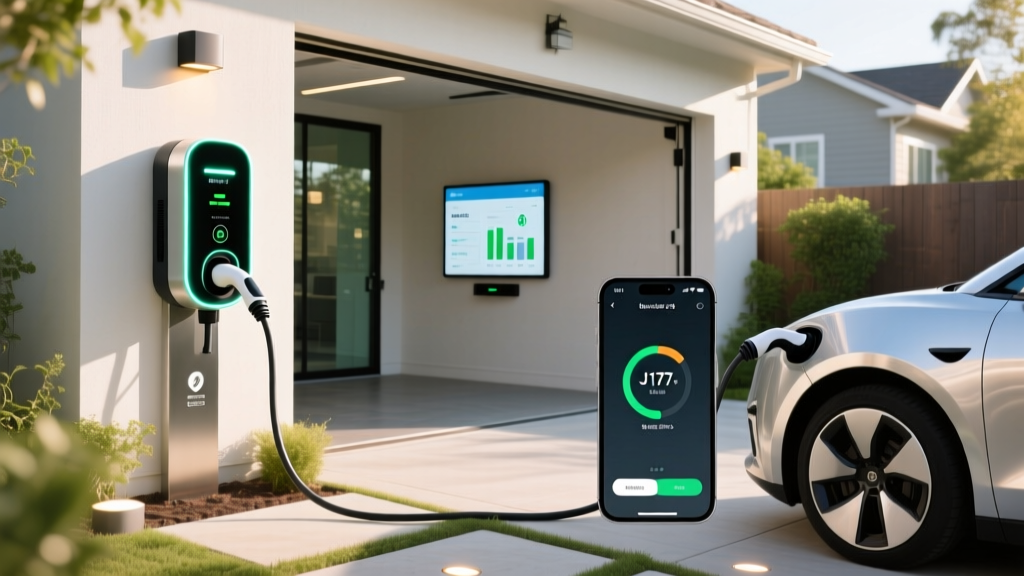
This is where the Riviera-to-EV transition hits your wallet first. A Level 2 home charger requires a dedicated 240V circuit — the same voltage as your electric dryer or oven. The total installed cost depends on three variables: the charger hardware, the complexity of the electrical run, and whether your panel has the capacity.
| Component | Typical Range | Notes |
|---|---|---|
| Level 2 EVSE hardware (smart charger, 32–48A) | $350 – $750 | Emporia, ChargePoint, Wallbox, Tesla Wall Connector |
| Electrician labor (run + termination) | $500 – $1,800 | Depends on distance from panel; garage-mount is cheapest |
| Permit & inspection | $75 – $250 | Required in most jurisdictions; protects warranty & insurance |
| Panel upgrade (if needed: 100A → 200A) | $1,500 – $4,000 | Common in pre-2000 homes — including homes built around the same era as a 1997 Riviera |
| Total (no panel upgrade) | $925 – $2,800 | Most homes with a 200A panel fall here |
| Total (with panel upgrade) | $2,425 – $6,800 | Older or heavily loaded panels |
Panel capacity is the sleeper cost. A 48A Level 2 charger on a 60A breaker draws continuous load that the National Electrical Code treats as 80% of breaker rating. If your home's existing panel is 100A (common in 1970s–1990s construction) and you already have electric heat, an electric water heater, and an electric dryer, an electrician's load calculation may require a panel upgrade. Get this assessed before buying hardware. The U.S. Department of Energy's home charging guide walks through the load-calculation process.
Electrical Requirements at a Glance
- Circuit: Dedicated 2-pole breaker, sized 125% of charger's max continuous draw (e.g., 48A charger → 60A breaker)
- Wire gauge: Typically 6 AWG copper for 48A/60A circuits; 4 AWG for longer runs
- Outlet vs. hardwired: NEMA 14-50 outlet gives flexibility (take charger when you move); hardwired allows 48A+ and avoids GFCI nuisance trips on some breakers
- GFCI protection: NEC 2020+ requires GFCI on 14-50 receptacles in garages — hardwiring sidesteps this cleanly
- Outdoor rating: If your parking spot is outside, the EVSE must be NEMA 4 rated (weatherproof)
Which Connector Does Your EV Need?
Connector standards consolidated significantly between 2023 and 2026. Here's where each major brand landed:
| Connector | Brands Using It (Native) | Adapter Needed? |
|---|---|---|
| NACS (Tesla standard, SAE J3400) | Tesla, Ford, GM, Rivian, Volvo, Polestar, Mercedes, BMW (2025+), Hyundai/Kia (2025+) | CCS→NACS adapters widely available (~$200) |
| CCS1 (Combo) | Legacy VW ID.4, older Hyundai/Kia, older BMW, Stellantis EVs | NACS→CCS adapters available; Tesla Supercharger access requires OEM adapter |
| CHAdeMO | Nissan Leaf (discontinued), Mitsubishi Outlander PHEV | Effectively orphaned for new vehicles |
Practical takeaway for 2026 buyers: NACS has won the standards war. If you're buying new, choose NACS-native unless you have a compelling reason not to. For older CCS vehicles, OEM-supplied NACS adapters unlock Tesla's Supercharger network — the most reliable DC fast-charging footprint in North America.
Cost Per Mile: EV Charging vs. Gasoline
The 1997 Buick Riviera Supercharged returned roughly 18 mpg combined on premium fuel. At $4.00/gal (a reasonable 2026 national premium average), that's 22.2 cents per mile. Let's compare to three realistic EV charging scenarios, assuming an EV efficiency of 3.0 mi/kWh (EPA combined for a typical midsize crossover):
| Scenario | $/kWh | Cost Per Mile | Savings vs. Riviera (per 12,000 mi/yr) |
|---|---|---|---|
| Home, off-peak utility rate | $0.09 | $0.030 | $2,304 |
| Home, average U.S. rate | $0.16 | $0.053 | $2,028 |
| Public Level 2 (ChargePoint, EVgo) | $0.30 | $0.100 | $1,464 |
| DC fast charging (road-trip pricing) | $0.48 | $0.160 | $744 |
| 1997 Riviera Supercharged (premium, 18 mpg) | — | $0.222 | — |
Even in the worst-case scenario — exclusively DC fast charging at road-trip rates — an EV costs less per mile than the supercharged 3800 V6. For the 80%+ of charging that happens at home, the savings are dramatic. A typical driver covering 12,000 miles/year saves $2,000+ annually on energy alone, which goes a long way toward recouping the home charger installation cost within 12–18 months.
Check your utility's time-of-use (TOU) rates. Many offer off-peak EV charging plans in the $0.06–$0.10/kWh range overnight — the single biggest lever for reducing your per-mile cost. Some utilities also offer rebates of $250–$500 toward a smart Level 2 charger, which stacks with the federal Residential Clean Energy Credit (note: the separate EV charger tax credit under §30C was modified under recent legislation — verify current-year eligibility with a tax professional).
Recommended Home Chargers (2026)
These are the chargers we'd actually put on our own garage walls, chosen for reliability, smart features, and value:
Emporia Vue Level 2 (48A, hardwired or 14-50)
- Power: 11.5 kW (48A @ 240V)
- Cable length: 24 ft
- Connector: J1772 (NACS adapter included)
- Smart features: Energy monitoring, solar integration, utility TOU scheduling, load management with other Emporia devices
- Price: ~$399
- Best for: Budget-conscious buyers who want smart load management and solar pairing
Tesla Wall Connector (48A, hardwired)
- Power: 11.5 kW (48A @ 240V)
- Cable length: 24 ft
- Connector: NACS native (J1772 adapter available)
- Smart features: Wi-Fi OTA updates, power sharing between multiple units, vehicle-specific access control
- Price: ~$425
- Best for: Tesla, Ford, GM, and Rivian owners who want native NACS without adapters
ChargePoint Home Flex (up to 50A, 14-50 or hardwired)
- Power: Up to 12 kW (50A @ 240V); dip-switch configurable down to 16A for weaker panels
- Cable length: 23 ft
- Connector: J1772 (NACS pigtail available)
- Smart features: Alexa/Google Home, detailed app scheduling, utility demand-response programs
- Price: ~$699
- Best for: Homes with limited panel capacity — the Flex's adjustable amperage is a genuine differentiator
Wallbox Pulsar Max (48A, hardwired)
- Power: 11.5 kW (48A @ 240V)
- Cable length: 25 ft
- Connector: J1772 or NACS (choose at purchase)
- Smart features: Power Sharing for multi-charger installs, eco-solar mode, compact form factor
- Price: ~$599
- Best for: Two-EV households needing load-balanced dual charging
Public Charging: What to Expect on the Road
Home charging handles ~85% of most EV owners' energy needs. For road trips and apartment dwellers, public infrastructure matters. Here's the current state of play in 2026:
- Tesla Supercharger network: Now open to NACS-equipped Fords, GMs, Rivians, and others. Reliability remains the industry benchmark — roughly 98%+ uptime per third-party audits.
- Electrify America: Largest non-Tesla DCFC network; 350 kW chargers at many sites. Reliability has improved but still trails Tesla; expect ~90% uptime.
- EVgo & ChargePoint: Strong urban/retail presence, mix of 50–350 kW units. Pricing varies widely.
- Ionna (Hyundai/Kia/Mercedes/Stellantis/BMW/GM joint venture): Rolling out high-power highway plazas through 2026–2028, targeting 350 kW chargers with pull-through stalls.
Preconditioning matters. Most modern EVs warm or cool the battery to its optimal charging temperature when you navigate to a DC fast charger. Skipping preconditioning (or arriving at a charger with a cold-soaked battery in winter) can cut peak charge rate by 30–50%. On a 30°F morning, a preconditioned Ioniq 5 will hit its 233 kW peak; an un-preconditioned one may taper at 120 kW until the pack warms up.
Frequently Asked Questions
How much does it cost to install a home EV charger?
Between $925 and $2,800 for a typical installation on a 200A panel with a short conduit run. If your home needs a panel upgrade from 100A to 200A — common in homes built in the 1990s era of vehicles like the 1997 Buick Riviera — add $1,500 to $4,000. Always get a licensed electrician's load calculation before committing to hardware.
How fast will each charging level add range?
Level 1 (120V): 3–5 miles of range per hour. Level 2 (240V, 48A): roughly 35–45 miles per hour depending on vehicle efficiency. DC fast charging: 150–1,000+ miles per hour at peak, but charging tapers significantly above 80% SoC, so real-world road-trip stops are typically 18–30 minutes for a 10–80% fill.
Which connector/charger is compatible with my EV?
For 2026 model-year vehicles, NACS (SAE J3400) is the dominant standard across Tesla, Ford, GM, Rivian, Hyundai/Kia, BMW, Mercedes, Volvo, and Polestar. Older CCS1 vehicles can use OEM-supplied NACS adapters to access Tesla Superchargers. CHAdeMO is effectively discontinued on new vehicles. Check your owner's manual or the EPA's fueleconomy.gov listing for your specific model.
How much does charging cost per mile vs. gas?
At home on the U.S. average electricity rate ($0.16/kWh), a typical EV costs about 5.3 cents per mile. The 1997 Buick Riviera Supercharged, at 18 mpg combined on $4.00/gal premium, costs 22.2 cents per mile. That's a ~$2,000 annual fuel savings for a driver covering 12,000 miles/year.
What electrical upgrades might I need?
The most common upgrade is a panel capacity increase from 100A to 200A, required when an electrician's NEC load calculation shows the existing panel can't safely handle a 60A EV circuit alongside existing loads. Other potential costs: replacing a Federal Pacific or Zinsco panel (known safety hazards, ~$2,500–$4,500), adding a sub-panel in a detached garage, or trenching conduit for an outdoor run. Your electrician should itemize these in a written quote.
Is a smart charger worth the extra cost over a "dumb" unit?
Almost always, yes. Smart chargers ($350–$700) let you schedule charging during off-peak utility hours, monitor energy usage, receive firmware updates, and participate in utility demand-response programs that pay you back. A "dumb" charger ($200–$300) works fine but forfeits $200–$600/year in potential utility savings and rebates.
Can I install a Level 2 charger myself?
Legally and safely, no — unless you're a licensed electrician. A 240V/60A circuit carries lethal fault current and must meet NEC requirements for wire gauge, breaker sizing, torque specs, and GFCI protection. DIY work also voids most EVSE warranties and can complicate homeowner's insurance claims. Budget $500–$1,800 for a licensed install and pull a permit.