Why a 1985 Shelby Charger EV Swap Needs a Charging Plan
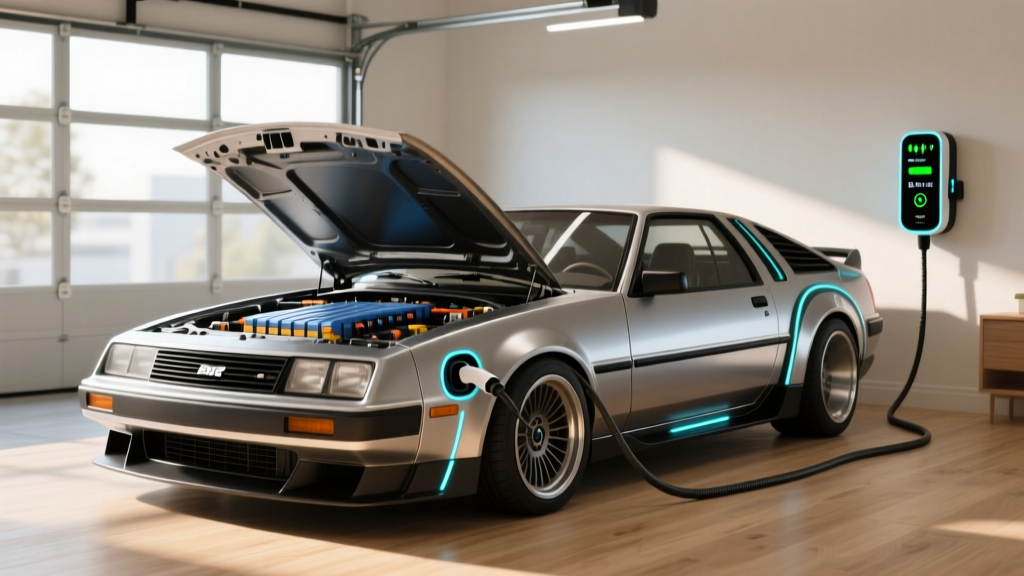
The 1985 Dodge Shelby Charger was a turbocharged, front-wheel-drive icon of the mid-80s — 142 hp from a 2.2L four-cylinder and a five-speed manual. Today, a growing niche of restomod builders and DIY converters are pulling the internal-combustion powertrain out of these lightweight (~2,500 lb) coupes and dropping in electric motors and lithium battery packs. The result: a classic Shelby that runs silent, makes instant torque, and skips the gas station entirely.
But a successful EV conversion isn't just about the motor and batteries — it's about how you'll charge it every day. A converted '85 Shelby Charger typically lands in the 30–50 kWh usable battery range, using salvaged or new LFP/NMC modules. That means home charging infrastructure is essential, and the decisions you make before your first plug-in will determine whether ownership is effortless or frustrating.
This guide covers every charging decision a Shelby Charger EV conversion owner needs to make — from Level 1 trickle charging to a full 240V home station install, connector selection, electrical panel realities, and long-term cost math.
Charging Levels Explained: Speeds, Power, and Miles Per Hour
Before buying equipment, understand the three charging levels and how they translate to actual range added. The key distinction: kW (kilowatts) measures power — the rate of energy delivery. kWh (kilowatt-hours) measures energy — the total capacity of your battery. Think of kW as the flow rate of a hose and kWh as the size of the bucket.
| Level | Voltage | Power (kW) | Miles of Range Added/Hour | Best For |
|---|---|---|---|---|
| Level 1 (120V) | 120V AC | 1.0–1.4 kW | 3–5 mi/hr | Overnight top-ups, low-mileage days |
| Level 2 (240V) | 240V AC | 3.3–19.2 kW | 12–70 mi/hr | Daily home charging, full overnight refill |
| DC Fast Charge | 400–800V DC | 50–350 kW | 150–1,000+ mi/hr | Road trips, rapid top-ups |
Home Charger Installation: Electrical Requirements and Real Costs
Most EV conversion owners install a Level 2 home charging station. This requires a dedicated 240V circuit — the same voltage your electric dryer or oven uses — and a hardwired or plug-in EVSE (Electric Vehicle Supply Equipment). Here's what the electrical reality looks like.
Electrical Panel and Circuit Requirements
- Circuit amperage: A 40A circuit supports a 32A continuous charge (7.7 kW). A 50A circuit supports 40A continuous (9.6 kW). A 60A circuit supports 48A continuous (11.5 kW). EVSE must be derated to 80% of breaker capacity per NEC Article 625.
- Wire gauge: 6 AWG copper for 40A circuits; 4 AWG for 50A; 3 AWG for 60A (THHN in conduit).
- Panel capacity: A 100A panel — common in older homes built in the 1970s–80s — may not have headroom for a 40A EV circuit after accounting for existing loads. A 200A panel is generally sufficient.
- Panel upgrade: If your panel is maxed out, upgrading from 100A to 200A service typically runs $1,500–$3,500 depending on utility requirements and trenching.
Installation Cost Breakdown
| Item | Low End | High End | Notes |
|---|---|---|---|
| EVSE Unit (Level 2 charger) | $300 | $750 | 32A–48A smart chargers |
| Electrician Labor | $400 | $1,500 | Depends on run distance, conduit, panel access |
| Permit & Inspection | $50 | $300 | Varies by municipality |
| Electrical Materials (wire, conduit, breaker) | $100 | $400 | Longer runs = higher cost |
| Panel Upgrade (if needed) | $1,500 | $3,500 | 100A → 200A service upgrade |
| Total (no panel upgrade) | $850 | $2,950 | |
| Total (with panel upgrade) | $2,350 | $6,450 |
Connector Compatibility: NACS, CCS, CHAdeMO, and J1772
Your EV conversion's charge port determines which public chargers you can use and which home EVSE to buy. Most custom conversions use the J1772 connector for Level 1/2 AC charging, since it's the North American standard and virtually every EVSE ships with it. For DC fast charging capability, you'll need to decide between CCS1 or NACS (Tesla's North American Charging Standard, now adopted by most major automakers).
| Connector | Charging Type | Vehicles Using It | Notes for Conversions |
|---|---|---|---|
| J1772 | AC Level 1 & 2 | All non-Tesla EVs (standard) | Easiest to integrate; universal home charging |
| NACS (Tesla) | AC + DC | Tesla; Ford, GM, Rivian, Hyundai, others (2025+) | Access to Supercharger network; compact plug |
| CCS1 | DC Fast (AC via J1772) | Most non-Tesla EVs pre-2025 | Widely available at Electrify America, EVgo |
| CHAdeMO | DC Fast | Nissan Leaf, Mitsubishi (legacy) | Being phased out; not recommended for new builds |
For a 1985 Shelby Charger conversion, the pragmatic approach is a J1772 inlet for home/Level 2 charging and, if DC fast charging matters for road trips, a CCS1 or NACS inlet wired to a compatible charge controller. Some conversion shops use Tesla drive units and charge controllers, which natively support NACS. Adapters (J1772-to-Tesla, CCS-to-NACS) are available from vendors like Lectron and A2Z EV, typically $150–$350.
Charging Time: What to Expect With Common Battery Sizes
Charge time depends on battery size (kWh), charger power (kW), and the charge curve — batteries charge fastest between 10–50% SoC and slow significantly above 80% to protect cell health.
| Battery (usable kWh) |
|---|
Apologies — let me present this table properly:
| Battery (usable kWh) | Level 1 (1.4 kW) | Level 2 (7.7 kW) | Level 2 (11.5 kW) | DC Fast (50 kW, 10–80%) |
|---|---|---|---|---|
| 30 kWh | ~21 hours | ~3.9 hours | ~2.6 hours | ~25 minutes |
| 40 kWh | ~28 hours | ~5.2 hours | ~3.5 hours | ~34 minutes |
| 50 kWh | ~36 hours | ~6.5 hours | ~4.3 hours | ~42 minutes |
| 75 kWh | ~54 hours | ~9.7 hours | ~6.5 hours | ~60 minutes |
Cost to Charge: Home vs. Public vs. Gas Comparison
One of the strongest arguments for converting a classic like the Shelby Charger to electric is the fuel-cost savings. Here's how charging costs compare across scenarios, benchmarked against the original 2.2L turbo engine's ~22 MPG combined.
| Scenario | Cost per kWh | Efficiency | Cost per Mile |
|---|---|---|---|
| Home charging (off-peak utility rate) | $0.08–$0.12/kWh | 3.5 mi/kWh | $0.023–$0.034 |
| Home charging (standard rate) | $0.14–$0.18/kWh | 3.5 mi/kWh | $0.040–$0.051 |
| Public Level 2 (ChargePoint, etc.) | $0.25–$0.40/kWh | 3.5 mi/kWh | $0.071–$0.114 |
| DC Fast Charging (Electrify America) | $0.35–$0.55/kWh | 3.5 mi/kWh | $0.100–$0.157 |
| Gasoline (original 2.2L turbo, 22 MPG) | $3.40/gallon | 22 mi/gallon | $0.155 |
At home off-peak rates, the EV-converted Shelby Charger costs roughly $0.03 per mile to "fuel" — about one-fifth the cost of the original gasoline engine. Even at DC fast-charging rates, the EV conversion is competitive with or cheaper than gas. Over 10,000 miles annually, the savings range from $900 to $1,300 per year depending on your charging mix.
Many utilities offer time-of-use (TOU) plans that drop rates to $0.06–$0.09/kWh between 10 PM and 6 AM. Programming your EVSE to charge during these windows maximizes savings. The U.S. Department of Energy's Alternative Fuels Data Center maintains a state-by-state guide to utility EV rate programs.
Equipment Recommendations: Level 2 Chargers for Your Garage
Here are proven Level 2 EVSE units that work well for conversion vehicles, selected for reliability, connector flexibility, and smart features.
Emporia Vue EV Charger
- Power Output: 48A (11.5 kW on 60A circuit)
- Connector: J1772 (NACS adapter available)
- Cable Length: 24 ft
- Smart Features: Wi-Fi, app scheduling, energy monitoring, solar integration
- Price: ~$400
- Best For: Budget-conscious converters wanting max power and solar pairing
ChargePoint Home Flex
- Power Output: Up to 50A (12 kW on 60A circuit), configurable
- Connector: J1772 (NACS version available)
- Cable Length: 23 ft
- Smart Features: Wi-Fi, Alexa/Google Home, app scheduling, amperage dial
- Price: ~$550–$700
- Best For: Flexible amperage adjustment for older electrical panels
Tesla Wall Connector
- Power Output: 48A (11.5 kW on 60A circuit)
- Connector: NACS (J1772 adapter included for non-Tesla EVs)
- Cable Length: 24 ft
- Smart Features: Wi-Fi, OTA updates, power sharing between units
- Price: ~$475
- Best For: Conversions using Tesla drive units or planning NACS public charging
Grizzl-E Smart
- Power Output: 40A (9.6 kW on 50A circuit)
- Connector: J1772
- Cable Length: 24 ft
- Smart Features: OCPP-compatible, adjustable amperage, -40°F rated
- Price: ~$450
- Best For: Cold-climate garages and outdoor installations; rugged build
Safety, Electrical Code, and Best Practices
EV charging draws sustained high current for hours — more like running a welder than plugging in a phone. Safety isn't optional.
- Dedicated circuit: Your EVSE must be on its own breaker — never shared with other appliances. NEC Article 625 mandates this.
- GFCI protection: Required for outdoor installations and recommended for garages. EVSEs have built-in ground-fault protection, but a GFCI breaker adds a redundant layer.
- NEMA 14-50 vs. hardwired: A NEMA 14-50 outlet allows you to unplug and take your EVSE when moving. Hardwired connections eliminate the outlet as a failure point and are required above 50A. Many inspectors now require GFCI breakers for 14-50 receptacles, adding $50–$100.
- Outdoor rating: If your charger is mounted outside, it must carry a NEMA 4 or IP65 rating for weather resistance. All four units recommended above qualify.
- Permit and inspection: Most jurisdictions require an electrical permit for EVSE installation. Skipping this risks insurance denial if an electrical fire occurs. Inspections typically cost $50–$150 and ensure the work meets NEC standards.
- Cable management: A retractable cord reel or wall hook prevents tripping hazards and cable damage. Don't let the cable rest on the garage floor where it can be run over.
FAQ: 1985 Shelby Charger EV Conversion Charging
How much does it cost to install a home EV charger?
A typical Level 2 home installation runs $850–$2,950 when your electrical panel has capacity. If a panel upgrade from 100A to 200A is needed — common in 1980s-era homes — expect $2,350–$6,450 total including equipment, labor, materials, and permits.
How fast will each charging level add range?
Level 1 (120V) adds 3–5 miles per hour. Level 2 (240V, 7.7 kW) adds roughly 25–28 miles per hour for an efficient conversion. Level 2 at 11.5 kW adds 35–40 miles per hour. DC fast charging at 50 kW can add 100+ miles in 20 minutes.
Which connector and charger is compatible with my EV conversion?
J1772 is the universal AC charging standard and the simplest to integrate into a conversion. If you want DC fast charging on road trips, add a CCS1 or NACS inlet wired to a compatible charge controller. Home chargers from ChargePoint, Emporia, Tesla, and Grizzl-E all work with J1772 or NACS.
How much does charging cost per mile vs. gas?
Home charging at off-peak rates costs roughly $0.03/mile — about 80% less than the original Shelby Charger's gasoline cost of ~$0.15/mile at 22 MPG and $3.40/gallon. Even public DC fast charging at $0.45/kWh costs ~$0.13/mile, still cheaper than gas.
What electrical upgrades might I need?
Homes with 100A panels often need a service upgrade to 200A ($1,500–$3,500) to accommodate a 40–50A EV circuit. You'll also need a dedicated breaker slot, properly sized wire (6 AWG for 40A), and a permit. An electrician's load calculation will determine if your panel has headroom.
Should I charge to 100% every night?
For NMC battery packs (common in conversions using salvaged Tesla or Chevy Bolt modules), daily charging to 80% extends cell life. LFP packs (increasingly popular in conversions for their longevity and thermal stability) tolerate 100% daily charging better and actually benefit from periodic full charges for cell balancing. Set your BMS or EVSE schedule accordingly.
For the latest federal EV incentive rules — including the IRS §30D credit which does not apply to conversions but may apply to donated battery components — consult a tax professional. Conversion-specific incentives vary by state; check the AFDC state law database for current programs.