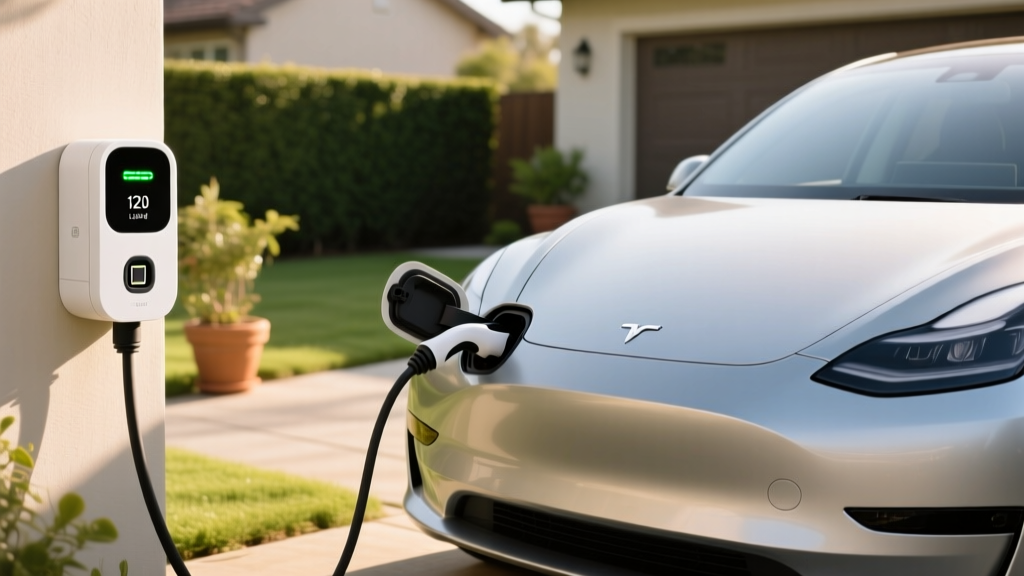
If you just took delivery of a new EV or plug-in hybrid, the charging cord in your trunk is almost certainly a 120V electric car charger — also known as a Level 1 EVSE. Plug it into a standard household outlet, and it will recharge your vehicle overnight. For some drivers, that's genuinely enough. For others, it's a frustrating bottleneck that turns a 20-mile commute refill into an all-night affair.
This guide breaks down exactly what a 120V charger can (and can't) do, how it compares to Level 2 and DC fast charging, what electrical upgrades you might need, and which equipment actually earns your money. Every figure here is grounded in real-world EV ownership — not marketing brochures.
Understanding EV Charging Levels: kW, kWh, and Miles Per Hour
Before evaluating any charger, you need clarity on two units that get confused constantly:
- kW (kilowatt) = the rate of power delivery — think of it as the width of the pipe filling your battery.
- kWh (kilowatt-hour) = the total energy stored in your battery — the size of the tank itself.
A 120V Level 1 charger delivers roughly 1.2 to 1.4 kW. A Level 2 home charger delivers 7.2 to 11.5 kW. A DC fast charger can deliver 50 to 350 kW. The difference in charging speed is enormous.
| Charging Level | Voltage | Max Power (kW) | Miles of Range Per Hour | Typical Use Case |
|---|---|---|---|---|
| Level 1 (120V) | 120V AC | 1.2–1.4 kW | 3–5 miles | Overnight trickle, PHEVs, low-mileage drivers |
| Level 2 (240V) | 240V AC | 7.2–11.5 kW | 20–45 miles | Daily home charging, most EV owners |
| DC Fast Charging | 400–800V DC | 50–350 kW | 150–800+ miles | Road trips, rapid top-ups |
Those "miles per hour" figures assume an average EV efficiency of about 3–4 miles per kWh. A highly efficient vehicle like the Hyundai Ioniq 6 (4.2 mi/kWh) will gain more range per hour than a heavy SUV like the Rivian R1S (2.6 mi/kWh) on the same charger.
How Fast Will a 120V Electric Car Charger Actually Add Range?
Let's put real numbers on the table. At 120V and 12 amps (the maximum most household outlets safely sustain), you'll get about 1.44 kW. Accounting for roughly 85% charging efficiency (energy lost as heat during AC-to-DC conversion), that means approximately 1.2 kWh of actual energy delivered to your battery per hour.
- Tesla Model 3 (75 kWh usable battery): Replenishing 40 miles of driving (roughly 11 kWh) takes about 9–10 hours on a 120V charger.
- Ford F-150 Lightning (131 kWh extended range): The same 40-mile refill takes roughly 14–16 hours — longer than most people sleep.
- Toyota RAV4 Prime PHEV (18.1 kWh battery): A full 0–100% charge takes about 12–14 hours on 120V, but since the battery is small, plugging in every night reliably tops it off for a 42-mile electric-only range.
If your daily driving is under 30 miles and you park for 10+ hours each night, a 120V electric car charger can keep up — especially with a PHEV or a highly efficient sedan. But if you regularly drive 50+ miles, tow, or live in a cold climate where battery efficiency drops 20–30%, Level 1 will leave you short.
120V vs. 240V: When Level 1 Falls Short
Here's the practical decision framework most EV owners work through:
- You drive fewer than 35 miles per day on average
- You own a PHEV with a small battery (under 20 kWh)
- Your garage outlet is a dedicated 15A or 20A circuit with no other loads
- You cannot install a 240V circuit (rental property, HOA restrictions, panel limitations)
- Budget is the top priority — Level 1 equipment costs $0 if your car includes the cord
- You drive 40+ miles daily or have unpredictable driving schedules
- You own a long-range BEV with a 75+ kWh battery
- You want preconditioning support for DC fast charging
- You need full-charge capability for road-trip departures
- You live in a cold climate where efficiency loss makes Level 1 marginal
Home Charger Installation: Electrical Requirements, Costs, and Panel Gotchas
If you decide Level 1 isn't enough, installing a Level 2 charger at home involves electrical work that ranges from straightforward to expensive, depending on your home's panel and wiring.
| Component | Simple Install (panel nearby, capacity available) | Complex Install (panel upgrade, long run) |
|---|---|---|
| Level 2 EVSE equipment | $300–$700 | $300–$700 |
| Electrician labor (240V/40A–50A circuit) | $500–$1,200 | $1,500–$3,500 |
| Electrical permit | $50–$200 | $50–$200 |
| Panel upgrade (100A → 200A, if needed) | N/A | $2,000–$5,000 |
| Conduit/wiring (long runs over 50 ft) | $100–$300 | $500–$1,500 |
| Total estimated cost | $950–$2,400 | $4,350–$10,900 |
What electrical upgrades might I need?
The single biggest variable is your electrical panel. A Level 2 charger on a 40A circuit draws 32A continuous (80% rule per NEC), which requires a 240V breaker. If your home has a 100-amp panel that's already near capacity — common in homes built before 1990 — adding a 40A EV circuit may require a panel upgrade to 200A. That's a $2,000–$5,000 job on its own.
Before hiring an electrician, check your panel's amperage rating (printed on the main breaker) and count your existing breaker loads. Many utility companies offer free or low-cost electrical assessments specifically for EV charging — take advantage of them.
Some utilities and states offer rebates that offset installation costs. The federal residential clean energy credit (IRS Form 5695) may cover up to 30% of charger equipment and installation costs (capped at $1,000) for qualifying homes — but verify current-year eligibility with a tax professional, as rules change.
Connector Compatibility: NACS, CCS, and CHAdeMO Explained
Every EV sold in North America uses one of three connector standards for Level 2 AC charging and DC fast charging. For Level 1 and Level 2 home charging, the vehicle-side connector is what matters:
| Connector Type | Brands Using It (Native) | Adapter Availability |
|---|---|---|
| NACS (Tesla / North American Charging Standard) | Tesla (all models), Ford (2025+), GM (2025+), Rivian (2025+), Hyundai/Kia (2026+), most others transitioning | CCS-to-NACS adapters available from Tesla and third parties (~$150–$250) |
| CCS1 (Combined Charging System) | Legacy models from VW, BMW, older Ford/GM/Hyundai/Kia EVs pre-transition | NACS-to-CCS adapters available; becoming less necessary as networks adopt NACS |
| CHAdeMO | Nissan Leaf (discontinued), Mitsubishi Outlander PHEV (older) | Limited adapter options; CHAdeMO DC infrastructure declining |
For Level 1 (120V) charging, the cord included with your EV will already have the correct connector on one end and a standard NEMA 5-15 or 5-20 household plug on the other. No adapter is needed for Level 1. If you upgrade to a Level 2 wall connector, you'll choose one with the native plug for your vehicle — or buy a universal J1772 unit with an adapter.
Charging Cost Per Mile: 120V Home vs. Public vs. Gas
One of the strongest arguments for home charging — even at 120V — is cost. Electricity rates vary widely, but the math almost always favors home charging over public stations and gasoline.
| Charging Scenario | Rate ($/kWh) | Cost Per Mile (at 3.5 mi/kWh) | Annual Cost (12,000 mi) |
|---|---|---|---|
| Home Level 1 or 2 — off-peak utility rate | $0.08–$0.14 | $0.023–$0.040 | $275–$480 |
| Home Level 1 or 2 — standard residential rate | $0.14–$0.22 | $0.040–$0.063 | $480–$755 |
| Public Level 2 (ChargePoint, EVgo, etc.) | $0.25–$0.49 | $0.071–$0.140 | $855–$1,680 |
| DC Fast Charging (Electrify America, Tesla Supercharger) | $0.32–$0.55 | $0.091–$0.157 | $1,095–$1,885 |
| Gasoline vehicle (30 MPG at $3.40/gal) | N/A | $0.113 | $1,360 |
Even at standard residential rates, home charging on a 120V outlet costs roughly one-third to one-half what gasoline costs per mile. The speed penalty of Level 1 doesn't affect the electricity rate — a kWh costs the same whether delivered at 1.4 kW or 11.5 kW.
Check with your utility about time-of-use (TOU) plans. Many offer off-peak rates below $0.10/kWh for overnight charging, which maximizes savings even on a 120V connection. According to fueleconomy.gov, the average EV costs roughly $0.04–$0.06 per mile to charge at home, compared to $0.10–$0.14 per mile for a comparable gas vehicle.
Recommended 120V and Dual-Voltage Chargers for 2026
Most automakers include a basic 120V charging cord with new EVs, but aftermarket options offer better build quality, longer cables, and smart features. Several units now support both 120V and 240V with plug adapters — ideal for drivers who want flexibility or plan to upgrade later.
Emporia Level 2 + Level 1 Combo
- Power: 12A at 120V (1.4 kW) / 48A at 240V (11.5 kW)
- Connector: J1772 (NACS adapter included)
- Cable length: 24 ft
- Smart features: Wi-Fi, energy monitoring via app, solar integration, TOU scheduling
- Price: ~$399
Tesla Mobile Connector
- Power: 12A at 120V (1.4 kW) / 32A at 240V with NEMA 14-50 adapter (7.7 kW)
- Connector: NACS native
- Cable length: 20 ft
- Smart features: App scheduling, vehicle integration
- Price: ~$200 (included with new Teslas)
ChargePoint Home Flex
- Power: 12A at 120V (1.4 kW) / up to 50A at 240V (12 kW)
- Connector: J1772 (NACS version available)
- Cable length: 18 or 23 ft options
- Smart features: Wi-Fi, Alexa, detailed app analytics, flexible amperage
- Price: ~$699
For a pure 120V-only setup where you can't install 240V, the included OEM cord is usually adequate. But if you want smart scheduling to take advantage of off-peak rates or plan to eventually upgrade to 240V, a dual-voltage unit like the Emporia or ChargePoint Home Flex protects your investment.
Safety, Electrical Code, and Best Practices
Charging an EV on 120V sounds simple — plug into any outlet — but there are safety considerations that matter, especially for sustained overnight loads:
- Dedicated circuit preferred: A 120V charger running for 8–12 hours continuously should ideally be on its own 15A or 20A circuit. Sharing the circuit with a refrigerator, freezer, or space heater risks tripping the breaker or overheating wires.
- Outlet condition: Inspect the receptacle for discoloration, looseness, or warmth after charging. A worn or loose outlet can overheat under sustained 12A draw. Replace with a commercial-grade (spec-grade) outlet rated for continuous loads.
- Avoid extension cords: Most EV manufacturer manuals explicitly warn against extension cords. If absolutely necessary, use a heavy-duty 12-gauge cord no longer than 25 feet — but understand this adds resistance and fire risk.
- GFCI requirements: The 2023 NEC (and most 2026 local adoptions) requires GFCI protection for outdoor receptacles and garages. Ensure your charging outlet is GFCI-protected — either at the breaker or the receptacle itself.
- Outdoor rating: If charging outdoors, use a weatherproof in-use cover rated for the plug size, and ensure the EVSE itself carries a NEMA 4 (outdoor) rating.
For Level 2 installations, the National Electrical Code requires a dedicated circuit, proper wire gauge (6 AWG copper for 50A breakers), and a permit with inspection. Always hire a licensed electrician — unpermitted EV charger work can void homeowner's insurance and create serious fire hazards. Refer to NHTSA's EV safety guidance for additional recommendations.
Frequently Asked Questions
How much does it cost to install a home EV charger?
A Level 1 (120V) charger requires no installation cost — it plugs into an existing outlet. A Level 2 (240V) charger installation ranges from roughly $950–$2,400 for a straightforward setup to $4,350–$10,900 if your home needs a panel upgrade and long wire runs. The equipment itself costs $300–$700; the rest is electrician labor, permits, and potential panel work.
How fast will each charging level add range?
Level 1 (120V) adds 3–5 miles of range per hour. Level 2 (240V) adds 20–45 miles per hour depending on amperage and vehicle efficiency. DC fast charging adds the equivalent of 150–800+ miles per hour at peak rates, though charge curves taper significantly above 80% state of charge.
Which connector/charger is compatible with my EV?
For 2026, most new EVs use the NACS connector (Tesla's standard, now adopted industry-wide). Older non-Tesla EVs may still use CCS1. The Nissan Leaf used CHAdeMO. For Level 1 charging, your included cord will have the correct connector — no adapter needed. For Level 2 wall chargers, choose one matching your vehicle's native port or use an adapter.
How much does charging cost per mile vs. gas?
Home charging at standard residential rates ($0.14–$0.22/kWh) costs roughly $0.04–$0.06 per mile. Gasoline at $3.40/gallon in a 30 MPG vehicle costs about $0.11 per mile. Home EV charging is roughly one-third to one-half the per-mile cost of gasoline. Off-peak utility rates can push EV costs as low as $0.02–$0.03 per mile.
What electrical upgrades might I need?
For 120V Level 1 charging, you likely need nothing beyond a dedicated, well-conditioned 15A or 20A outlet. For Level 2, you'll need a 240V circuit (typically 40A–50A breaker). If your electrical panel is 100A or near capacity, a panel upgrade to 200A may be required — adding $2,000–$5,000 to the project. An electrician can assess your panel's headroom during a site visit.
Can I charge faster on a 120V outlet by using a 20A circuit?
Marginally. A 20A circuit allows 16A continuous draw (80% NEC rule), yielding about 1.9 kW vs. 1.4 kW on a 15A circuit — roughly 30% faster. You'd need an EVSE rated for 16A at 120V and a NEMA 5-20 outlet. The gain is modest: about 5–6 miles per hour instead of 3–5. It helps but doesn't transform Level 1 into a fast solution.
Is 120V charging bad for my EV battery?
No. Level 1 charging is actually gentle on battery cells because the low current generates minimal heat. The main downside isn't battery health — it's convenience. Slow charging also means the battery management system has more time to balance cells, which is mildly beneficial for long-term state of health.