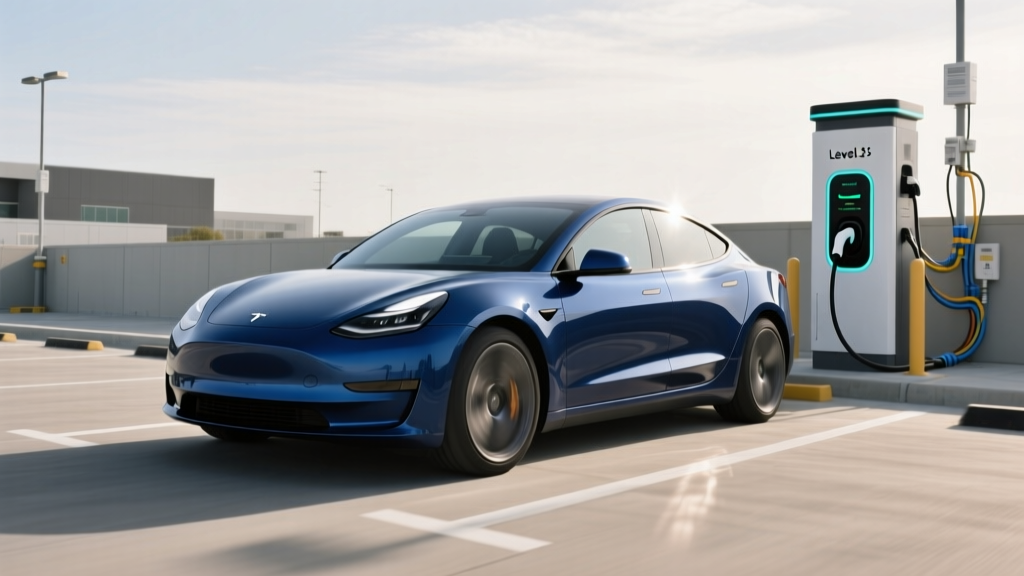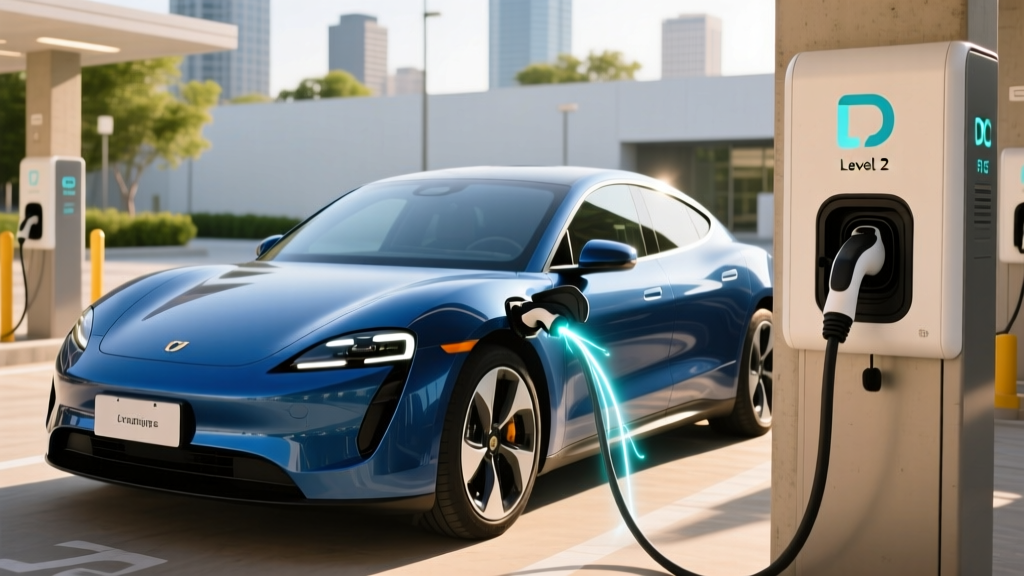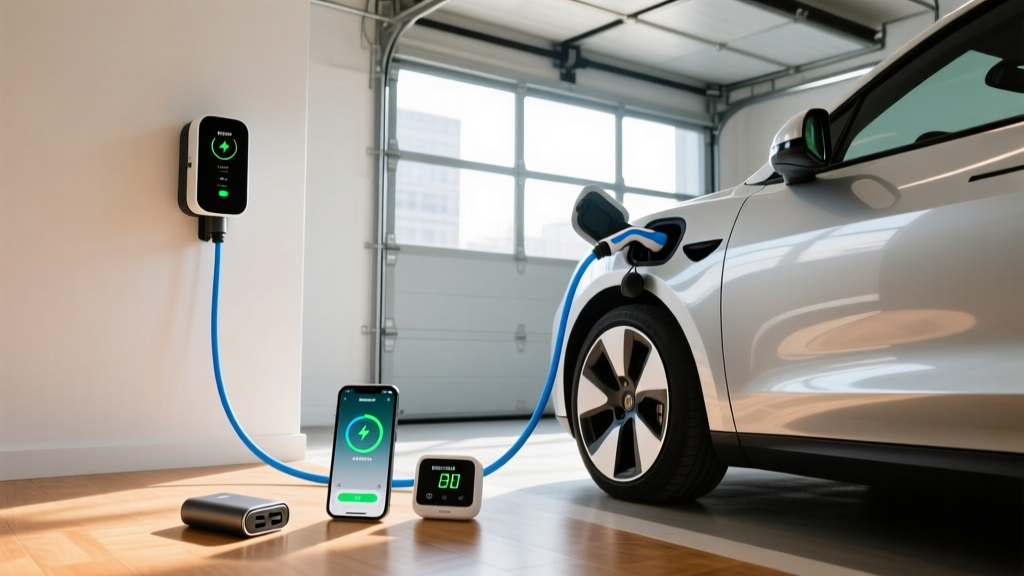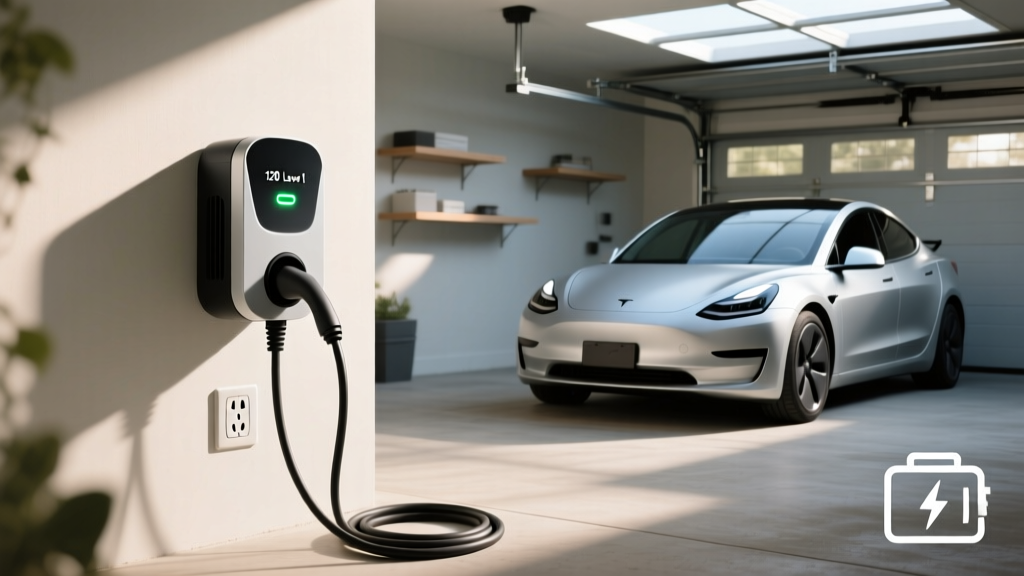
Every electric vehicle sold in the United States ships with a cord that plugs into a standard household outlet. That 120 volt EV charger — technically called Level 1 charging — is the most accessible, least expensive, and most misunderstood way to power an EV. For some owners, it is all they will ever need. For others, it is a frustrating bottleneck that pushes them toward a 240-volt Level 2 installation.
This guide breaks down exactly what a 120 volt EV charger delivers in real-world conditions, what it costs to run and install, how it compares to Level 2 and DC fast charging, and which specific equipment is worth buying in 2026. Whether you are plugging into a garage outlet tonight or weighing a full electrical upgrade, the numbers below will tell you whether Level 1 is enough — or whether you need to call an electrician.
How Fast Does a 120 Volt EV Charger Actually Charge?
A standard US household outlet delivers 120 volts on a 15-amp or 20-amp circuit. Most EV charging cords draw a continuous 12 amps on a 15-amp circuit (the National Electrical Code requires a 20% derating for continuous loads), producing roughly 1.4 kW of charging power. On a 20-amp circuit with a compatible plug (NEMA 5-20), you can pull up to 16 amps continuous, yielding about 1.9 kW.
Here is the critical distinction that trips up new EV owners: kW (kilowatts) measures power — the rate of charging. kWh (kilowatt-hours) measures energy — the total capacity of your battery. A 1.4 kW Level 1 charger running for 10 hours adds 14 kWh of energy to your battery. That is the math that determines whether you wake up with enough range for your commute.
| Level | Voltage | Power (kW) | Miles of Range per Hour | Typical Use |
|---|---|---|---|---|
| Level 1 (120V) | 120V | 1.2–1.9 kW | 3–5 mi/hr | Overnight home, PHEVs, low-mileage drivers |
| Level 2 (240V) | 240V | 3.3–19.2 kW | 12–75 mi/hr | Home garage, workplace, public destination |
| DC Fast Charge | 400–800V DC | 50–350 kW | 150–1,000+ mi/hr | Road trips, highway corridors, quick top-ups |
The miles-per-hour figure varies significantly by vehicle efficiency. A Hyundai Ioniq 5 RWD (EPA-rated at 132 MPGe combined, roughly 3.6 miles per kWh) will gain about 5 miles per hour at 1.4 kW. A Ford F-150 Lightning Extended Range (EPA-rated around 2.1 miles per kWh) will gain closer to 3 miles per hour at the same power level. Chemistry and vehicle mass matter.
Charging Time Examples: How Long Does Level 1 Actually Take?
Let's run the numbers on three common battery sizes to show what a 10% to 80% State of Charge (SoC) session looks like on a 120 volt EV charger at 1.4 kW sustained:
| Battery Size (usable kWh) | Example Vehicles | Energy Needed (10–80%) | Time at 1.4 kW | Time at 1.9 kW |
|---|---|---|---|---|
| 15 kWh | Toyota RAV4 PHEV, Jeep Wrangler 4xe | 10.5 kWh | ~7.5 hours | ~5.5 hours |
| 60 kWh | Chevrolet Equinox EV, base Tesla Model 3 | 42 kWh | ~30 hours | ~22 hours |
| 84 kWh | Tesla Model Y LR, Hyundai Ioniq 5 LR | 58.8 kWh | ~42 hours | ~31 hours |
| 131 kWh | Ford F-150 Lightning Ext. Range | 91.7 kWh | ~66 hours | ~48 hours |
For a plug-in hybrid with a 15 kWh battery, Level 1 is practical: plug in when you get home at 6 PM, and you are fully charged by bedtime. For a 60 kWh BEV, Level 1 can work if your daily driving is under 30 miles — you will recover that usage in about 8–10 hours of overnight charging. For an 84 kWh or larger battery, Level 1 is best understood as a maintenance and trickle option, not a primary refueling strategy — unless you drive very little or can leave the car plugged in for extended periods.
How Much Does It Cost to Charge on 120 Volts?
One of the strongest arguments for a 120 volt EV charger is operating cost. Residential electricity rates vary widely by state — from roughly $0.11/kWh in Louisiana to $0.35/kWh in California — but Level 1 charging at home almost always undercuts gasoline on a per-mile basis. Level 1 also avoids the demand charges and session fees common at public DC fast chargers.
Here is how the cost per mile breaks down across common charging scenarios, using a mid-efficiency EV consuming 3.5 miles per kWh (approximately 28.6 kWh per 100 miles, similar to a 2026 Tesla Model Y Long Range):
| Scenario | Rate | Cost per kWh | Cost per Mile | Cost for 300 mi |
|---|---|---|---|---|
| Home Level 1 (national avg.) | $0.17/kWh | $0.17 | $0.049 | $14.57 |
| Home Level 1 (off-peak TOU) | $0.09/kWh | $0.09 | $0.026 | $7.71 |
| Home Level 2 (same rate) | $0.17/kWh | $0.17 | $0.049 | $14.57 |
| Public Level 2 (ChargePoint, etc.) | $0.25–$0.49/kWh | $0.37 avg. | $0.106 | $31.71 |
| DC Fast (Electrify America) | $0.35–$0.56/kWh | $0.48 avg. | $0.137 | $41.14 |
| Tesla Supercharger (avg.) | $0.30/kWh | $0.30 | $0.086 | $25.71 |
| Gasoline (25 MPG, $3.40/gal) | $3.40/gal | — | $0.136 | $40.80 |
The key insight: the cost per mile of Level 1 and Level 2 charging at home is identical — it is determined by your electricity rate, not the charger speed. Level 2 charges faster but does not cost more per kWh. The economic advantage of Level 1 is purely in installation: a 120 volt outlet already exists in your garage, so the setup cost is zero if you use the included mobile cord.
Equipment Recommendations: Best 120 Volt EV Chargers in 2026
Most EVs include a basic Level 1 mobile connector in the trunk. However, many owners choose to buy a dedicated or upgraded 120 volt EV charger for better durability, longer cables, smart scheduling, or the ability to use the same unit on both 120V and 240V outlets. Below are well-regarded options available in 2026:
Emporia Level 2 EV Charger (with 120V adapter)
- Power output: 1.4 kW on 120V (12A); up to 11.5 kW on 240V (48A)
- Connector: J1772 (NACS adapter included with newer Tesla-compatible versions)
- Cable length: 24 feet
- Smart features: Wi-Fi, Emporia app scheduling, solar integration, energy monitoring
- Price: ~$399 (plus optional 120V adapter pigtail ~$30)
- Why it stands out: Dual-voltage capability means you start on 120V today and move to 240V later without buying a new unit.
ChargePoint Home Flex (NACS or J1772)
- Power output: 1.4 kW on 120V (12A); up to 12 kW on 240V (50A)
- Connector: Available in J1772 or native NACS (Tesla-standard) versions
- Cable length: 23 feet
- Smart features: Wi-Fi, app-based scheduling, Alexa integration, charge stats
- Price: ~$649
- Why it stands out: UL-listed, widely compatible, and the NACS version plugs directly into newer Tesla-standard vehicles without an adapter.
Tesla Mobile Connector (Gen 2)
- Power output: 1.3 kW on 120V (12A); up to 7.2 kW on 240V with NEMA 14-50 adapter (32A)
- Connector: NACS (Tesla native); J1772 adapter sold separately (~$45)
- Cable length: 20 feet
- Smart features: Basic — no Wi-Fi or scheduling; relies on vehicle-side scheduling via the Tesla app
- Price: ~$200 (included with some Tesla vehicles)
- Why it stands out: Inexpensive and lightweight. Best used as a backup or travel cord rather than a primary daily charger.
Lectron V-Box Pro (Dual Voltage)
- Power output: 1.44 kW on 120V (12A); up to 11.52 kW on 240V (48A)
- Connector: J1772 (NACS adapter available)
- Cable length: 21 feet
- Smart features: LCD display, basic scheduling, no Wi-Fi
- Price: ~$329
- Why it stands out: Budget-friendly dual-voltage option with a clear display showing real-time kW draw and session cost.
Connector Compatibility: Will a 120 Volt EV Charger Fit My Car?
All Level 1 EV chargers sold in the US use the SAE J1772 connector standard — except for Tesla vehicles, which use the proprietary NACS (North American Charging Standard) connector. However, the North American EV market is rapidly consolidating around NACS. As of 2025–2026, Ford, GM, Rivian, Hyundai, Kia, BMW, and most other major automakers have switched to NACS ports on new vehicles. If you drive a 2025+ model from these brands, your car likely has a NACS port.
| Connector | Brands / Models | Adapter Needed for Level 1? |
|---|---|---|
| NACS (Tesla standard) | Tesla (all), Ford (2025+), GM/Cadillac (2025+), Rivian (2025+), Hyundai/Kia (2026+), BMW (2025+) | No — use NACS mobile cord or J1772-to-NACS adapter (~$45–$90) |
| J1772 | Older EVs (pre-2025): Chevy Bolt, Nissan Leaf, VW ID.4 (pre-2025), most PHEVs | No — J1772 is the universal Level 1/2 standard for non-Tesla |
| CHAdeMO | Nissan Leaf (DC fast only); not used for Level 1 | N/A — CHAdeMO is DC-only; Leaf uses J1772 for Level 1/2 |
| CCS1 | Phasing out on new vehicles; present on 2022–2024 models from VW, Hyundai, Kia, Ford | N/A — CCS1 is DC-only; these vehicles use J1772 for Level 1/2 |
Key takeaway: For Level 1 (120V) charging, you only need to worry about J1772 vs. NACS. CCS1 and CHAdeMO are DC fast-charge-only connectors and are irrelevant to your 120 volt EV charger setup. If you own a newer NACS-equipped vehicle and buy a J1772 charger, a simple J1772-to-NACS adapter solves the problem.
Installation and Electrical Requirements: What You Need for 120V Charging
The best-case scenario for a 120 volt EV charger is that you already have a standard NEMA 5-15 outlet in your garage or carport on a dedicated 15-amp or 20-amp circuit. In that case, installation cost is $0 — plug in and charge. However, several electrical considerations can affect safety, code compliance, and whether you should upgrade.
Dedicated Circuit Requirement
The NEC (National Electrical Code) recommends that EV charging occur on a dedicated circuit — meaning the outlet is not shared with other high-draw appliances (refrigerators, freezers, sump pumps). If your garage outlet shares a circuit with other loads, you risk tripping the breaker during a long charging session. A licensed electrician can verify your circuit layout for roughly $100–$150 for a service call.
GFCI Protection
The 2020 NEC (and subsequent editions adopted by most jurisdictions by 2026) requires GFCI (Ground Fault Circuit Interrupter) protection for all 120V, 15A and 20A receptacles in garages. If your garage outlet is older and lacks GFCI protection, an electrician will need to install a GFCI breaker or GFCI outlet — adding approximately $50–$150 to your cost. Some EV mobile connectors have built-in GFCI protection, but local inspectors may still require a GFCI receptacle or breaker.
Outdoor Rating
If you charge outdoors (carport, driveway), your outlet must be in a weatherproof enclosure ("in-use" bubble cover) rated for wet locations (NEMA 3R or 4). The EV charger cord itself should carry an outdoor rating — most quality units are rated for -22°F to 122°F operation.
| Item | Scenario | Cost Range |
|---|---|---|
| Existing garage outlet (dedicated, GFCI) | Plug in included mobile cord | $0 |
| New dedicated 15A/20A circuit | Electrician runs new line from panel | $200–$600 |
| GFCI outlet/breaker upgrade | Retrofit older garage outlet | $50–$150 |
| Weatherproof outdoor enclosure | Carport or driveway install | $30–$80 (materials) |
| Upgraded dual-voltage EV charger | Equipment purchase (e.g., Emporia, ChargePoint) | $330–$650 |
| Electrical permit | Required in most jurisdictions for new circuits | $50–$150 |
When to Consider a Panel Upgrade
Most homes with a 100-amp or 200-amp electrical panel will have no issue adding a 120V, 15-amp circuit for Level 1 charging. However, if your home has an older 60-amp service panel (common in pre-1970s construction), or if your panel is already near capacity with existing loads (electric range, dryer, HVAC, water heater), an electrician may recommend a panel upgrade. A 200-amp panel upgrade typically costs $1,500–$3,500 — a significant expense, but one that also future-proofs your home for a Level 2 charger, heat pump, or solar installation. Always have a licensed electrician perform a load calculation before adding circuits. Final specifications should come from a professional on-site assessment.
Level 1 vs. Level 2: When Is 120V Enough?
Whether a 120 volt EV charger is sufficient depends entirely on your daily driving pattern and vehicle battery size. Here is a practical decision framework:
- You drive fewer than 30–40 miles per day on average
- You own a PHEV with a battery under 20 kWh (Level 1 fully recharges overnight)
- Your vehicle is parked 10+ hours per day in a location with outlet access
- Your electrical panel cannot accommodate a 240V circuit without an expensive upgrade
- You are a secondary/weekend EV driver with low annual mileage
- You drive 40+ miles daily and need reliable overnight recovery
- You own a BEV with a 60+ kWh battery and want full flexibility
- You frequently need to charge from low SoC (below 20%) overnight
- You live in a cold climate where battery preconditioning and cabin heating reduce efficiency
- You want to precondition your battery for DC fast charging before road trips
For context, a Level 2 charger at 7.7 kW (32A on 240V) adds roughly 28 miles of range per hour for an efficient EV — about 7 times faster than Level 1. A Level 2 charger at 11.5 kW (48A) adds roughly 42 miles per hour. That means an 84 kWh battery going from 10% to 80% takes approximately 8 hours at 7.7 kW — achievable in a single overnight session — versus 42 hours on Level 1.
Safety, Code, and Best Practices for 120V EV Charging
Level 1 charging is safe when done correctly, but the sustained high-current draw on a standard household circuit warrants some precautions:
- Inspect the outlet: Look for discoloration, warmth, or a loose fit when you insert the plug. A worn receptacle under continuous 12-amp load for 8+ hours can overheat. Replace any outlet that shows signs of thermal stress.
- Use a quality extension cord only if absolutely necessary: Most EV charger manufacturers explicitly warn against extension cords. If you must use one, it should be a 12-gauge (or thicker) cord rated for outdoor/continuous use, no longer than 25 feet. Never use a 16-gauge household extension cord.
- Do not use a multi-outlet power strip or splitter: Your EV charger should be the only load on the circuit during charging.
- Schedule charging during off-peak hours: Many utilities offer time-of-use (TOU) rates that drop electricity costs to $0.07–$0.10/kWh between 10 PM and 6 AM. Use your vehicle's built-in charge scheduling (Tesla, Ford, Hyundai all offer this) or a smart charger's app to automate off-peak charging.
- Check for the IRS §30C Alternative Fuel Vehicle Refueling Property Credit: If you install a new dedicated circuit for EV charging, you may qualify for a tax credit covering up to 30% of the cost (capped at $1,000 for residential). Eligibility depends on your census tract and income — consult a tax professional.
Frequently Asked Questions
How much does it cost to install a home 120 volt EV charger?
If you already have a dedicated 120V outlet in your garage with GFCI protection, the installation cost is $0 — simply plug in your vehicle's included mobile connector. If you need a new dedicated circuit run from your electrical panel, expect to pay $200–$600 for the electrician's work plus $50–$150 for a permit. An upgraded dual-voltage charger unit adds $330–$650.
How fast will a 120 volt EV charger add range?
A 120V charger delivers 1.2–1.9 kW depending on the circuit amperage. For a typical mid-size EV, that translates to 3–5 miles of range per hour of charging. Over a 10-hour overnight session, expect roughly 30–50 miles of recovered range — enough for most commutes but insufficient to fully recharge a large BEV battery from empty.
Which connector do I need for my EV?
If your vehicle is a Tesla or a 2025+ model from Ford, GM, Rivian, Hyundai, Kia, or BMW, it likely has a NACS (Tesla-standard) port. Use a NACS mobile cord or a J1772-to-NACS adapter. Older EVs and most PHEVs use the J1772 connector, which is the universal standard for Level 1 and Level 2 charging. CCS1 and CHAdeMO connectors are only used for DC fast charging and do not apply to 120V Level 1 setups.
How much does charging cost per mile compared to gas?
At the US average residential electricity rate of $0.17/kWh, a mid-efficiency EV costs roughly $0.049 per mile to charge at home on Level 1 — about one-third the cost of a 25 MPG gasoline vehicle at $3.40 per gallon ($0.136 per mile). With off-peak TOU rates around $0.09/kWh, the cost drops to $0.026 per mile, roughly one-fifth the cost of gasoline. Source: fueleconomy.gov.
What electrical upgrades might I need for 120V charging?
Most homes need no upgrades at all for Level 1. The most common needs are: a GFCI outlet or breaker retrofit ($50–$150), a new dedicated 15A or 20A circuit ($200–$600), or a weatherproof outdoor enclosure ($30–$80). A full electrical panel upgrade ($1,500–$3,500) is rarely needed for 120V charging but may be required if your home has an older 60-amp service. Always have a licensed electrician perform a load calculation before proceeding.
Can I use an extension cord with my 120 volt EV charger?
Most manufacturers advise against it, and it voids some warranties. If you have no alternative, use only a heavy-duty 12-gauge or 10-gauge cord rated for continuous outdoor use, no longer than 25 feet. Never daisy-chain extension cords or use a standard 16-gauge household cord, which can overheat under sustained 12-amp draw.
Is Level 1 charging bad for my EV battery?
No. In fact, slower charging generates less heat, which is gentler on lithium-ion cells over the long term. Level 1 charging will not accelerate battery degradation compared to Level 2. The primary drawback is convenience (time), not battery health.