Tesla achieved a major dry electrode lithium battery manufacturing breakthrough that could reshape how the industry builds battery cells — and ultimately what EV buyers pay for range, longevity, and charging speed. But what does a manufacturing innovation at the cell level actually mean for your next EV purchase? This guide translates the engineering into buyer-relevant reality: the chemistry choices (LFP vs NMC/NCA) that determine your daily driving experience, the degradation curves that define long-term ownership, and the warranty and replacement economics that should inform every electrified purchase decision in 2026.
Why Tesla's Dry Electrode Process Matters for EV Buyers
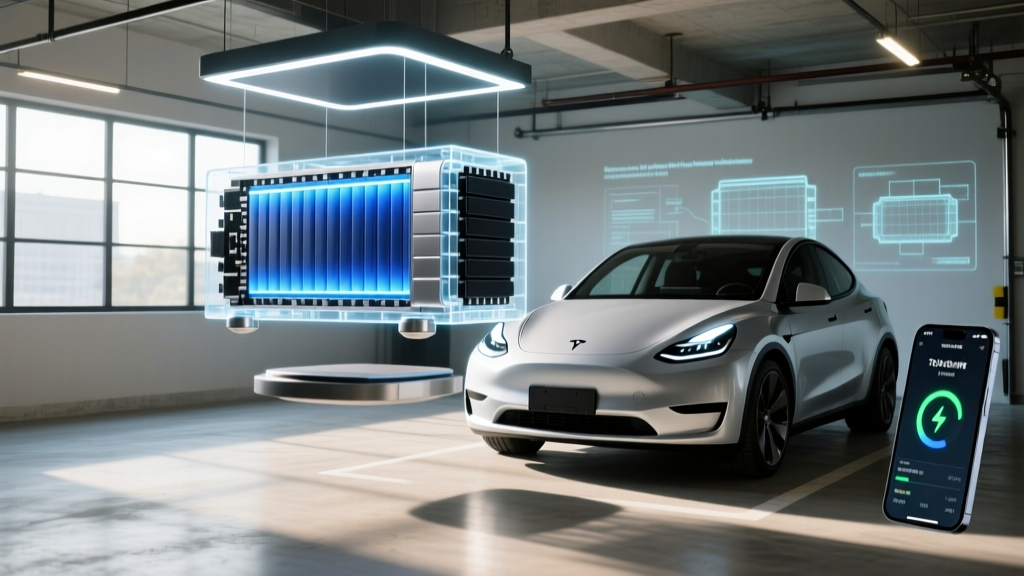
Dry electrode manufacturing eliminates the toxic solvent (NMP) traditionally used to coat battery electrodes, replacing it with a dry powder-and-binder process that Tesla has been scaling at its 4680 cell lines in Texas. The payoff: lower factory energy use (no solvent-recovery ovens), higher energy-density electrodes, and a pathway to thicker cathodes that store more energy per kilogram. According to Tesla's official engineering updates, the process is now running in production for anode-side 4680 cells and is being extended to cathodes — a step that unlocks both cost reduction and performance gains.
For buyers, the downstream effects show up as three things: (1) cheaper cells that compress entry-level EV pricing, (2) denser packs that push EPA ranges past 350 miles without adding weight, and (3) more structurally integrated battery packs that improve crash safety and chassis stiffness. None of this changes how you charge or maintain a battery today — but it accelerates the shift toward larger, longer-lived packs across the market.
Chemistry 101: LFP vs NMC/NCA and the Trade-Offs That Matter
Regardless of how the electrode is manufactured, the cathode chemistry still dictates the battery's personality. Tesla's dry electrode breakthrough is chemistry-agnostic — it improves manufacturing of both LFP and nickel-based chemistries — so understanding which chemistry is under your floor remains the single most important battery decision you'll make.
| Attribute | LFP (Lithium Iron Phosphate) | NMC/NCA (Nickel-based) |
|---|---|---|
| Energy density | ~160 Wh/kg (lower) | ~250-290 Wh/kg (higher) |
| Cycle life | 3,000-5,000 cycles | 1,500-2,500 cycles |
| Cold-weather range loss | Greater (~30-40% at 20°F) | Moderate (~20-30% at 20°F) |
| Cost per kWh | Lower (no nickel/cobalt) | Higher (commodity-sensitive) |
| Recommended SoC habit | 100% daily OK | 80% daily, 100% only for trips |
| Typical use in 2026 | Tesla Model 3 RWD, Model Y RWD, BYD, Ford standard-range | Long-range/performance trims, Rivian, Hyundai Ioniq 5 LR |
Which is better? For commuters who can charge at home and don't need 320+ miles of EPA range, LFP is the pragmatic 2026 pick — cheaper, longer cycle life, and tolerant of 100% SoC. For road-trippers, towing, or cold-climate drivers, NMC/NCA still wins on energy density and winter performance. Dry electrode manufacturing narrows the cost gap between the two, making NMC packs more affordable than they were in 2023.
How Long Do EV Batteries Actually Last? Real Degradation Data
The persistent myth — that EV batteries need replacing like phone batteries every few years — does not match the data. Modern liquid-cooled packs routinely outlast the vehicles they're installed in.
Typical degradation trajectory (liquid-cooled NMC/NCA packs, aggregated fleet data):
- Year 1 / 15,000 mi: ~2-4% capacity loss (initial formation)
- Year 3 / 45,000 mi: ~6-8% total loss
- Year 5 / 75,000 mi: ~9-11% total loss
- Year 8 / 120,000 mi: ~12-15% total loss
- Year 10 / 150,000 mi: ~15-20% total loss (still above most warranty thresholds)
LFP packs often show slower fade past year 3, with many fleet samples retaining 90%+ capacity at 100,000 miles. Recurrent's public fleet studies and fueleconomy.gov data corroborate that most 2020-era packs retain 85-90% State of Health (SoH) at the 8-year warranty mark.
The critical nuance: degradation is not linear. Most loss occurs in the first 12-24 months as the solid-electrolyte interphase (SEI) layer stabilizes, then slows dramatically. A 2023 Tesla Model 3 LR at 60,000 miles typically holds ~92% SoH — translating to ~295 real-world miles versus the original EPA 341, not a bricked vehicle.
Battery Warranty Terms: What's Actually Covered in 2026
Federal regulation mandates a minimum 8-year/100,000-mile warranty on EV battery packs (10 years/150,000 miles in CARB states), but the retention threshold — the SoH level at which a manufacturer must replace or repair — varies and matters more than the headline term.
| Manufacturer | Term | Capacity Retention Threshold | Notes |
|---|---|---|---|
| Tesla (Model 3/Y) | 8 yr / 120,000 mi (LR/AWD) | 70% | Transfers to second owner |
| Hyundai / Kia | 10 yr / 100,000 mi | 70% | First-owner; 10/100 in CARB |
| Ford (Mustang Mach-E, F-150 Lightning) | 8 yr / 100,000 mi | 70% | Module-level repair preferred |
| Rivian | 8 yr / 175,000 mi | 70% | Longest mileage cap in class |
| GM (Ultium-based) | 8 yr / 100,000 mi | 70% | Blended L2 + DCFC coverage |
Read the fine print: warranties cover defects and abnormal degradation, not gradual capacity loss above the threshold. A pack at 72% SoH at year 7 is functioning within spec, even if range feels noticeably reduced. Keep service records and SoH screenshots — they're essential for claims and resale.
EV Battery Replacement Cost: When and How Much
Full pack replacement is rare before 150,000 miles, but it's the number one buyer fear — so let's price it honestly. Most 2026 replacements are module-level repairs, not full swaps, because modern packs are serviceable in sections.
| Vehicle Class | Battery Size | Full Pack Replacement | Module Repair (typical) |
|---|---|---|---|
| Compact (Chevy Bolt, Nissan Leaf) | 60-65 kWh | $13,000 - $17,000 | $2,500 - $5,000 |
| Midsize sedan (Tesla Model 3, Ioniq 6) | 75-82 kWh | $16,000 - $22,000 | $3,500 - $7,000 |
| Crossover/SUV (Model Y, Mach-E) | 75-90 kWh | $18,000 - $25,000 | $4,000 - $8,000 |
| Truck / Large SUV (F-150 Lightning, Rivian) | 100-135 kWh | $25,000 - $35,000 | $6,000 - $12,000 |
Context that matters: the vast majority of EVs sold in 2020-2026 will be scrapped or resold before needing a full pack replacement. Independent shops are increasingly performing module-level repairs at 20-30% of OEM pack cost. And dry electrode manufacturing is driving cell-level costs down — Tesla's stated target is sub-$100/kWh at the cell level, which would compress a future Model Y pack replacement toward $12,000-$15,000 by the early 2030s.
What Actually Kills (or Preserves) EV Battery Life
Chemistry and manufacturing set the ceiling; your habits determine where you land on the curve. Based on aggregated fleet telemetry and NREL battery research, these are the dominant factors:
- State of charge habits: Daily 20-80% SoC for NMC/NCA; LFP tolerates 100% but benefits from occasional 20% minimums. Avoid parking at 100% or below 10% for days.
- DC fast charging frequency: Occasional 150-250 kW sessions are fine; daily DCFC accelerates degradation by ~1-2% per year versus L2-only charging. Precondition the pack (navigate to a Supercharger/charger) to protect the cells.
- Extreme temperatures: Sustained heat (above 95°F ambient with pack above 80% SoC) is more damaging than cold. Garage parking in hot climates adds measurable SoH life. Cold doesn't degrade — it just temporarily reduces available capacity.
- Thermal preconditioning: Always enable scheduled departure or preconditioning. A warmed or cooled pack accepts charge with far less stress.
- Depth of discharge: Shallow cycles (40-70%) beat deep cycles (10-100%) for long-term SoH, especially on NMC packs.
- Storage: If storing 30+ days, target 50% SoC and temperate ambient. Never store at 100%.
Monitoring State of Health: How Owners Check Battery Life in 2026
Most 2026 EVs surface SoH through the vehicle's native app or service menu. Tesla's in-car service mode shows calculated capacity vs. nameplate; Hyundai's Bluelink and FordPass expose similar metrics. Third-party tools like TeslaFi, Scan My Tesla, or OBD-II readers (for non-Tesla EVs) pull BMS-reported capacity figures over time.
Best practice: log SoH quarterly at a consistent SoC (ideally 100% for LFP, 80% for NMC after a rest period) and plot the trend. A sudden 3-5% drop in a single quarter — rather than the expected ~1% annual fade — signals a module imbalance worth diagnosing under warranty.
Beyond Dry Electrode: Solid-State, Silicon Anode, and Realistic Timelines
Tesla's dry electrode process is a manufacturing evolution, not a chemistry revolution. The next true leaps — solid-state electrolytes and silicon-dominant anodes — promise 30-50% energy density gains and dramatically faster charging, but they remain forward-looking.
Realistic timelines (2026 perspective):
- Silicon-anode cells: Already in limited production (GM/Sila Nanotechnologies, Mercedes EQG). Expect broader availability in premium trims by 2027-2028.
- Semi-solid-state (gel electrolyte): NIO and WeLion shipping 150 kWh packs in China; US-market availability remains narrow and expensive.
- True solid-state: Toyota and Samsung SDI target 2028-2030 pilot production. Volume production at mainstream pricing is unlikely before 2031-2032.
For a buyer shopping in 2026, the practical takeaway: don't defer an EV purchase waiting for solid-state. Today's liquid-electrolyte packs with dry-electrode manufacturing already deliver 15+ year usable life in most use cases.
Frequently Asked Questions
How long do EV batteries last in years and miles?
Modern liquid-cooled EV batteries typically retain 80-85% of original capacity at 150,000 miles / 10 years, based on fleet data from Tesla, Hyundai, and third-party analysts like Recurrent. Many packs outlast the vehicle's structural and cosmetic life.
How much does an EV battery cost to replace in 2026?
Full pack replacement ranges from $13,000 (compact EVs) to $35,000 (large trucks), but most out-of-warranty repairs are module-level at $2,500-$12,000. Full replacements before 150,000 miles are uncommon.
What does the EV battery warranty actually cover?
Federally mandated 8yr/100k-mi minimum (10yr/150k in CARB states), covering defects and degradation below a stated threshold — typically 70% of original capacity. Gradual fade above that threshold is considered normal wear.
How do I check and maximize my EV battery's health?
Check SoH via the vehicle's app, service mode, or OBD-II tools quarterly. Maximize life by keeping NMC packs between 20-80% SoC daily, preconditioning before DCFC, avoiding prolonged 100% parking, and minimizing daily fast-charging.
LFP vs NMC — which is better for me?
LFP wins on cost, cycle life, and daily-charge convenience (100% OK). NMC/NCA wins on energy density, cold-weather range retention, and long-trip usability. Dry electrode manufacturing is narrowing the cost gap, but the use-case split remains.
Does Tesla's dry electrode breakthrough change what I should buy today?
Indirectly, yes — it accelerates cost reduction and density improvements across 4680-based packs (Cybertruck, future Model Y refreshes). For a 2026 purchase, prioritize chemistry and pack size for your use case; the manufacturing process is a long-term tailwind, not a reason to wait.