The Silicon Anode Revolution: Breaking the Graphite Ceiling
For over three decades, the lithium-ion battery industry has relied almost exclusively on graphite for the anode. While graphite is stable, cheap, and reliable, it has a hard theoretical limit. Graphite can only store about 372 milliamp-hours per gram (mAh/g) of energy. As electric vehicle (EV) manufacturers push for 400-mile ranges and 10-minute fast-charging capabilities, graphite is becoming the bottleneck. Enter silicon: a material that boasts a theoretical capacity of over 4,200 mAh/g—more than ten times that of graphite. However, silicon comes with a massive engineering catch. When lithium ions enter a silicon anode during charging, the material swells by up to 300%. This extreme volume expansion causes the silicon particles to pulverize, destroying the battery from the inside out and destabilizing the Solid Electrolyte Interphase (SEI) layer.
Solving this swelling problem has been the holy grail of modern battery chemistry. Today, two dominant startups have cracked the code and are racing toward mass commercialization: Sila Nanotechnologies and Group14 Technologies. Both are backed by automotive giants, both are building massive manufacturing facilities in the United States, and both promise to fundamentally alter the EV landscape by 2025. In this head-to-head showdown, we break down the technology, the manufacturing strategies, and the commercialization timelines of these two battery titans.
Contender 1: Sila Nanotechnologies and Titan Silicon
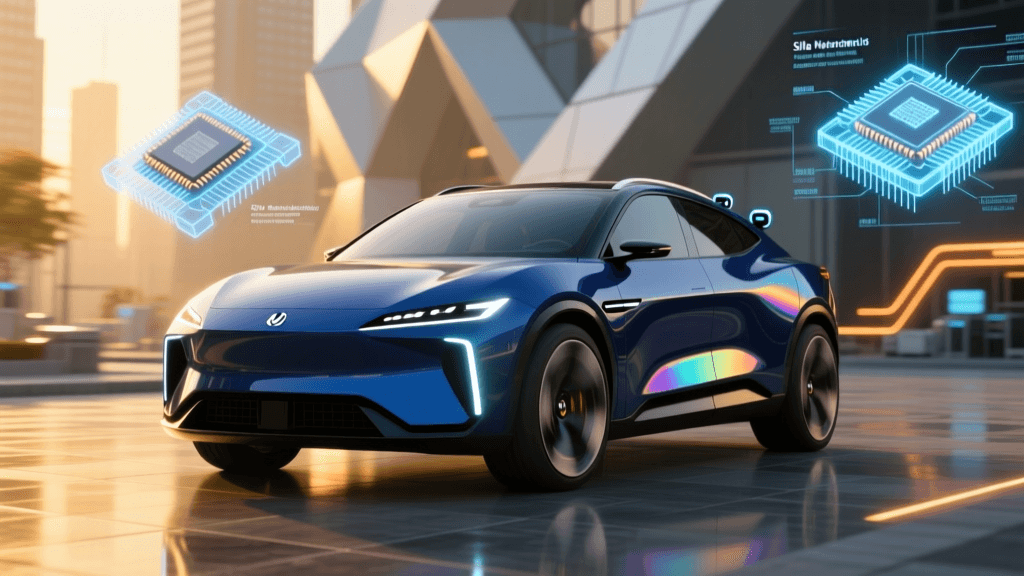
Founded by Gene Berdichevsky, the seventh employee at Tesla and a key architect of the original Roadster's battery pack, Sila Nanotechnologies has been a pioneer in silicon anode research. Their flagship automotive product, Titan Silicon, utilizes a proprietary 'yolk-shell' nanoparticle architecture. Instead of using solid silicon particles, Sila creates a porous, nanostructured scaffold. The silicon is housed inside a protective shell with intentionally designed empty space. When lithium ions enter the silicon during charging, the material expands into this pre-existing void rather than pushing outward. This prevents the electrode from swelling at the macro level and stops the SEI layer from repeatedly cracking and reforming, which is the primary cause of capacity fade in early silicon batteries.
Sila's commercialization strategy is heavily anchored by a high-profile partnership with Mercedes-Benz and Panasonic. The upcoming all-electric Mercedes-Benz G-Class will be one of the first vehicles to feature Sila's silicon-dominant anode technology, promising a 20% to 40% increase in energy density without increasing the physical footprint of the battery pack. To meet demand, Sila is constructing a massive, $600 million manufacturing facility in Moses Lake, Washington, aiming to produce enough anode material for hundreds of thousands of EVs annually by the late 2020s.
Contender 2: Group14 Technologies and SCC55
Group14 Technologies takes a slightly different, yet equally innovative, approach to the silicon swelling problem. Backed heavily by Porsche and venture capital giant SoftBank, Group14's flagship product is SCC55 (Silicon Carbon Composite). Rather than a yolk-shell nanoparticle, SCC55 is a highly engineered, porous hard-carbon scaffold. Silicon is deposited directly inside the microscopic pores of the carbon matrix. Because the silicon is entirely contained within the rigid carbon structure, the overall volume of the composite particle does not change during lithiation. The carbon matrix acts as both a structural cage and a highly conductive pathway for electrons.
Group14's commercialization path is incredibly aggressive. They have already established their 'Woodland' factory in Washington state and are currently building a second, massive facility dubbed the 'Bamberg' factory. Group14's key partnerships include Porsche, Farasis Energy, and Amperex Technology Limited (ATL). Porsche is integrating Group14's silicon anode technology into its high-performance EVs, aiming for unprecedented charging speeds and range retention. Furthermore, Group14's SCC55 is designed as a 'drop-in' solution, meaning existing battery manufacturers can blend it with graphite using their current slurry-mixing equipment without requiring billions in new capital expenditure for entirely new manufacturing lines.
Head-to-Head Comparison: Sila vs. Group14
| Feature | Sila Nanotechnologies (Titan Silicon) | Group14 Technologies (SCC55) |
|---|---|---|
| Core Architecture | Yolk-shell nanoparticles with porous scaffolds | Porous hard-carbon matrix with silicon in pores |
| Key Auto Partners | Mercedes-Benz, Panasonic | Porsche, Farasis Energy, ATL |
| Manufacturing Base | Moses Lake, Washington (Gigafactory) | Woodland & Bamberg, Washington |
| Integration Strategy | Specialized anode manufacturing processes | Drop-in replacement for existing graphite lines |
| Target Energy Density | Up to 40% increase at the cell level | Up to 50% increase at the cell level |
| First Major EV Rollout | 2025 (Mercedes G-Class) | 2024/2025 (Porsche EV lineup) |
The Swelling Challenge and SEI Dynamics
To understand why these two companies are poised to dominate, we must look at the electrochemistry of the Solid Electrolyte Interphase (SEI). As noted by researchers at the Argonne National Laboratory, the SEI is a protective layer that forms on the anode during the first few charge cycles. In traditional graphite batteries, this layer is relatively stable. In raw silicon batteries, the 300% expansion tears the SEI apart. When the SEI cracks, the liquid electrolyte rushes in to react with the newly exposed silicon, creating a thicker, more resistive SEI layer. This parasitic reaction consumes lithium inventory and increases internal resistance, leading to rapid battery death.
Both Sila and Group14 solve this, but through different mechanical philosophies. Sila's yolk-shell design allows the silicon to breathe and expand inward, keeping the outer shell—and the SEI layer formed upon it—completely undisturbed. Group14's SCC55 relies on the rigidity of the hard-carbon matrix. Because the silicon never expands beyond the boundaries of the carbon cage, the external surface of the particle remains dimensionally stable. Both methods successfully achieve the high cycle life required for automotive warranties (typically 1,000 to 1,500 full charge cycles), but Group14's drop-in capability gives it a slight edge in immediate scalability across legacy battery gigafactories.
Fast Charging: The Hidden Advantage of Silicon
While range gets the headlines, charging speed is the true barrier to mass EV adoption. Graphite anodes struggle with extreme fast charging (XFC). When lithium ions are forced into a graphite anode too quickly, they can pile up on the surface and form metallic lithium dendrites—a dangerous phenomenon known as lithium plating, which can cause short circuits and thermal runaway. Silicon, however, has a higher lithium insertion potential and superior ion acceptance rates. According to data tracked by the U.S. Department of Energy Vehicle Technologies Office, integrating silicon into the anode significantly reduces the risk of lithium plating at high C-rates.
This means that EVs equipped with Sila or Group14 anode materials will not only drive further but will charge drastically faster. We expect the first generation of silicon-enhanced EVs to achieve 10% to 80% state-of-charge in under 12 minutes when paired with 800-volt architectures and 350 kW+ DC fast chargers. This brings the EV refueling experience tantalizingly close to the five-minute convenience of a traditional gas station stop.
Supply Chain Security and Geopolitics
Beyond performance, the shift to silicon is a matter of national security and supply chain resilience. The global graphite supply chain is overwhelmingly dominated by China, which controls the vast majority of natural graphite mining and synthetic graphite processing. As highlighted by supply chain analyses from the National Renewable Energy Laboratory (NREL), reliance on foreign-processed graphite poses a significant risk to Western EV manufacturing goals. Silicon, on the other hand, is one of the most abundant elements on Earth, primarily sourced from quartz sand. By building domestic gigafactories in Washington state, both Sila and Group14 are helping automakers localize their battery supply chains, bypassing geopolitical bottlenecks and qualifying for critical North American sourcing requirements under the Inflation Reduction Act (IRA).
Actionable Advice for EV Buyers and Enthusiasts
What does this technological showdown mean for you, the consumer, as you plan your next vehicle purchase? Here is our practical guide to navigating the silicon anode rollout:
- Do Not Expect 100% Silicon Immediately: The first wave of commercial EVs (2024-2026) will not use pure silicon anodes. They will use blends, typically replacing 5% to 15% of the graphite with Sila or Group14 materials. This hybrid approach yields a 10% to 20% boost in range and significantly improves fast-charging times without requiring a complete redesign of the battery cell.
- Target Premium and Performance Models First: Because silicon anode materials currently carry a cost premium over commodity graphite, they will debut in high-margin, luxury, and performance vehicles. Look for the Mercedes G-Class, Porsche Macan/Cayenne EVs, and high-end luxury sedans to feature this tech first. Mass-market economy EVs will likely not see silicon blends until 2028 or later.
- Check the Charging Curve Specs: When reviewing new EV spec sheets, look beyond the total range. Pay close attention to the 10-80% charging time and the peak kW charging rate. Vehicles advertising silicon-enhanced batteries will sustain peak charging speeds for a much longer portion of the charging curve compared to traditional graphite LFP or NMC batteries.
- Monitor Battery Degradation Warranties: Early silicon batteries suffered from rapid degradation. However, the nanostructured solutions from Sila and Group14 have largely solved this. Still, when purchasing an early-adopter silicon-anode EV, ensure the manufacturer offers a robust battery capacity warranty (e.g., 70% retention at 100,000 miles) to protect your investment.
The Verdict: Who Wins the Showdown?
The battle between Sila Nanotechnologies and Group14 Technologies is not a zero-sum game; it is a dual-front war against the limitations of graphite. Sila's Titan Silicon offers a masterclass in nano-engineering, providing a highly optimized, purpose-built solution for next-generation battery cells designed from the ground up. Their partnership with Mercedes-Benz guarantees a high-visibility, premium debut. Conversely, Group14's SCC55 is the ultimate pragmatist's dream. By offering a drop-in solution that requires minimal retooling for existing battery manufacturers, Group14 is positioned to capture a massive share of the mid-market and high-volume manufacturing sector in the near term.
Ultimately, the consumer is the true winner of this showdown. As both companies scale production and drive down the cost of silicon-carbon composites, the era of the 400-mile, 10-minute-charging EV is no longer a distant theoretical concept. It is rolling off the assembly line, powered by the very sand beneath our feet.