The Great EV Battery Waste Myth: Why Landfills Aren't the Destination
As electric vehicle (EV) adoption accelerates globally, a persistent and damaging myth continues to circulate among skeptics and concerned consumers alike: the idea that millions of 'dead' EV batteries will soon form toxic mountains in landfills. This apocalyptic vision is not only factually incorrect, but it also fundamentally misunderstands the economics of modern battery chemistry and the rapid innovations in the recycling sector. In reality, end-of-life EV batteries are not waste; they are highly valuable 'urban mines' packed with critical minerals like lithium, nickel, cobalt, and manganese.
According to the International Energy Agency (IEA) Global EV Outlook, the demand for critical minerals will skyrocket in the coming decades, making battery recycling a strategic imperative for national security and supply chain resilience, not just an environmental afterthought. In this deep dive, we will bust the most common myths surrounding EV battery recycling, profile the industry titans leading the charge, and provide actionable advice for consumers and fleet managers on navigating end-of-life battery logistics.
Myth 1: 'Dead EV Batteries End Up in Landfills'
The Myth: Once an EV battery drops below 80% of its original capacity and is replaced, it is thrown into a municipal landfill, leaching toxic chemicals into the soil.
The Fact: The economics of battery materials make landfilling financially irrational, and strict environmental regulations make it legally perilous. An EV battery pack contains hundreds of dollars worth of recoverable metals. Recycling companies actively purchase these scrap packs from automakers, dismantlers, and salvage yards. Furthermore, the emerging regulatory landscape, particularly in the European Union and increasingly in the United States, mandates extended producer responsibility (EPR), forcing automakers to account for the end-of-life disposal of their products.
Common Mistake: Consumers often assume their local municipal recycling center can handle a damaged or degraded EV battery. Actionable Advice: Never attempt to dispose of a high-voltage EV battery through standard municipal waste channels. If you are an independent owner dealing with a salvaged EV, contact certified automotive dismantlers or specialized battery logistics companies (like Call2Recycle) who have the hazmat certifications required to transport and sell the pack to a recycler.
Myth 2: 'Recycling Destroys the Battery's Value'
The Myth: The recycling process is so energy-intensive and destructive that it negates the environmental benefits of driving an EV in the first place.
The Fact: This myth stems from a misunderstanding of legacy recycling methods. Historically, lithium-ion batteries were recycled using pyrometallurgy (smelting), which involves burning the battery at extreme temperatures. This process recovers cobalt and nickel but burns off the lithium, aluminum, and organic electrolytes, resulting in a low overall recovery rate and high carbon emissions.
Today, the industry has shifted toward hydrometallurgy and direct recycling, which boast vastly superior environmental and economic profiles. The Argonne National Laboratory's ReCell Center has been instrumental in advancing these direct recycling technologies, proving that we can recover battery-grade materials with a fraction of the carbon footprint compared to virgin mining.
Comparison: EV Battery Recycling Technologies
| Recycling Method | Process Overview | Material Recovery Rate | Key Industry Players |
|---|---|---|---|
| Pyrometallurgy (Smelting) | Burns organic materials and plastics at high heat to extract metal alloys. | 50-60% (Loses Lithium, Aluminum, and Electrolytes) | Legacy Metal Smelters |
| Hydrometallurgy (Leaching) | Shreds batteries into 'black mass' and uses aqueous chemical solutions to dissolve and separate metals. | 95%+ (Recovers Ni, Co, Li, Mn, and Cu) | Li-Cycle, Redwood Materials, Cirba Solutions |
| Direct Recycling | Preserves the cathode's crystal structure by relithiating the material without breaking it down to base elements. | 90%+ (Retains structural manufacturing value) | Ascend Elements, ReCell Center, OnTo Technology |
Company Profiles: The Titans of Hydrometallurgy
To understand where the industry is heading, we must look at the companies scaling hydrometallurgical and closed-loop recycling technologies.
Redwood Materials: The Closed-Loop Pioneer
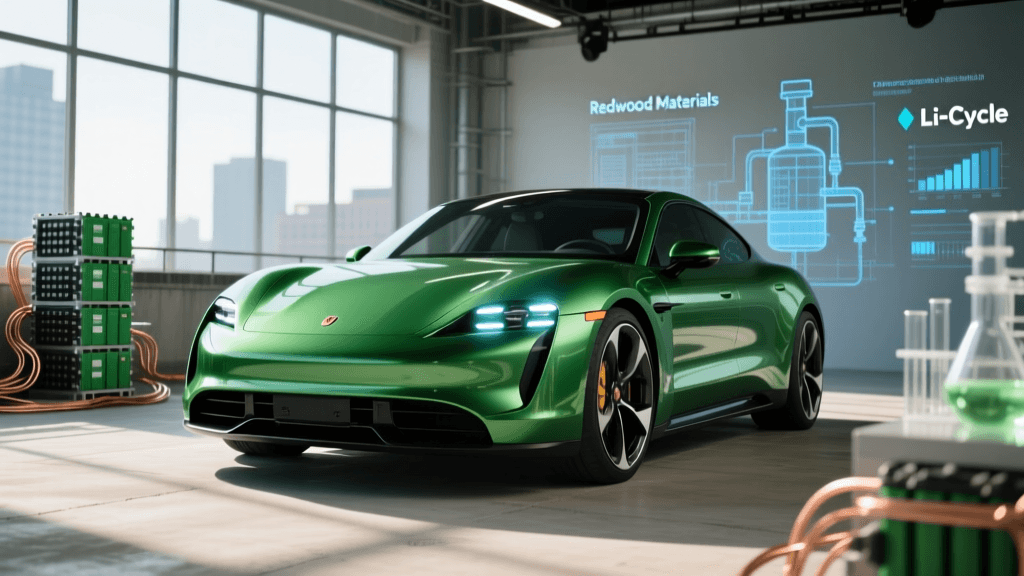
Founded by Tesla co-founder JB Straubel, Redwood Materials is arguably the most prominent battery recycler in North America. Unlike traditional recyclers that simply sell recovered metal salts back to the market, Redwood is vertically integrated. They collect end-of-life batteries and manufacturing scrap, extract the critical metals via hydrometallurgy, and then remanufacture those metals directly into new anode and cathode active materials. By producing battery components domestically in Nevada and South Carolina, Redwood is effectively short-circuiting the global supply chain, reducing the reliance on overseas refining, and cutting the carbon footprint of battery production by up to 50%.
Li-Cycle: The Spoke and Hub Model
Li-Cycle has pioneered a unique 'Spoke & Hub' logistics and processing model. Because transporting damaged or degraded lithium-ion batteries is hazardous and expensive, Li-Cycle builds 'Spokes'—smaller, localized shredding facilities situated near EV manufacturing hubs or dense urban centers. At the Spokes, batteries are safely shredded under an inert liquid solution to prevent fires, producing a safe, stable powder known as 'black mass.' This black mass is then shipped to Li-Cycle's massive 'Hub' facilities (like their Rochester, NY plant), where advanced hydrometallurgical processes extract battery-grade lithium, nickel, and cobalt with recovery rates exceeding 95%.
The LFP Complication: A Blind Spot for Fleet Managers
A common mistake made by commercial fleet managers and cost-conscious consumers is ignoring the chemistry of their batteries when planning for end-of-life. The rapid rise of Lithium Iron Phosphate (LFP) batteries—championed by Tesla, Ford, and BYD for their lower cost and high durability—has introduced a new economic hurdle for recyclers.
Unlike Nickel Manganese Cobalt (NMC) or Nickel Cobalt Aluminum (NCA) chemistries, LFP batteries contain no cobalt or nickel, which are the high-value metals that traditionally subsidized the cost of recycling. Because iron and phosphate are incredibly cheap, the 'black mass' derived from LFP batteries is significantly less valuable.
Actionable Advice for Fleets: If your commercial fleet utilizes LFP battery packs (common in standard-range delivery vans and light-duty trucks), do not assume recyclers will pay you for your scrap. You may actually have to pay a processing fee for LFP end-of-life management. When negotiating fleet purchase agreements with OEMs, include a contractual clause for guaranteed end-of-life buy-back or subsidized recycling for LFP packs to protect your total cost of ownership (TCO) projections.
Practical Guide: What to Do When Your EV Battery Fails
Whether you are an individual owner with a severely degraded pack or a fleet manager retiring a dozen EVs, follow these steps to ensure your battery enters the legitimate recycling stream:
- Verify the State of Health (SOH): Use an OBD-II scanner or a dealership diagnostic tool to get a precise SOH percentage. Batteries between 70-80% SOH still hold immense value for 'second-life' applications, such as stationary solar energy storage, which pays out more than raw material recycling.
- Seek Certified Dismantlers: Look for dismantlers certified by the Automotive Recyclers Association (ARA) or those partnered directly with OEMs. They have the high-voltage safety training required to depower and extract the pack without damaging the cooling plates or busbars, preserving its resale value.
- Request a Chain of Custody Document: For corporate ESG (Environmental, Social, and Governance) reporting, request a certificate of recycling or a chain of custody document from the recycler. Companies like Redwood Materials and Li-Cycle provide documentation proving the materials were recovered domestically and did not end up in a landfill or exported to unregulated overseas smelters.
Conclusion: The Future is Circular
The narrative of the 'unrecyclable EV battery' is a relic of the past, rooted in outdated pyrometallurgical processes and a lack of supply chain transparency. With innovations from companies like Redwood Materials and Li-Cycle, and the ongoing research into direct recycling from institutions like Argonne's ReCell Center, the EV industry is rapidly moving toward a truly circular economy. By understanding the realities of battery chemistry and partnering with certified recycling networks, consumers and fleets can ensure that today's EVs become the raw materials for tomorrow's clean energy revolution.