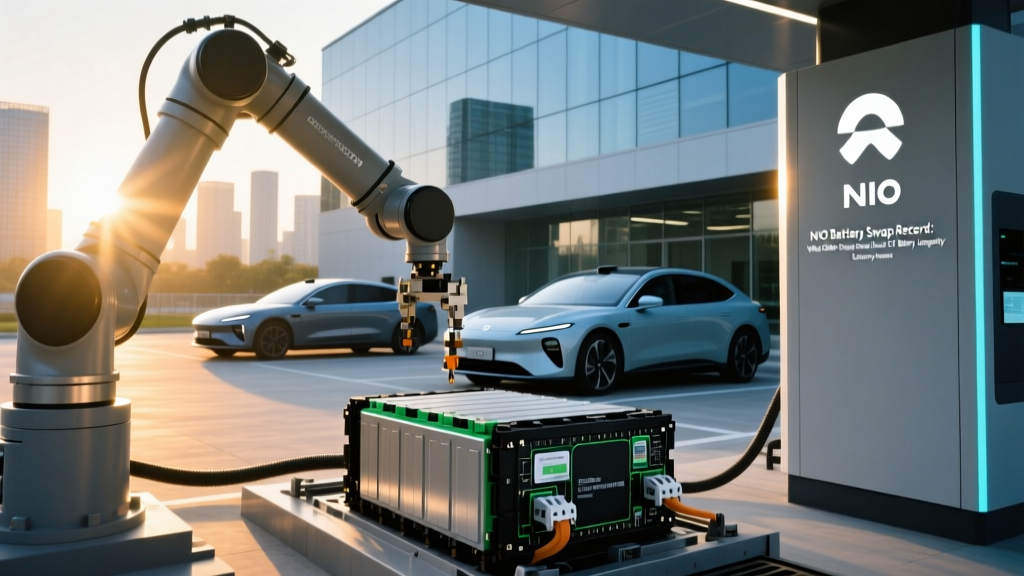
NIO recently crossed a milestone that no other automaker can claim: over 100 million cumulative battery swaps across its global fleet. That nio battery swap record isn't just a PR figure — it represents one of the largest real-world datasets on EV battery durability ever assembled. Every swap captures State of Health (SoH) telemetry, cycle counts, and thermal history for batteries that have endured Chinese winters, Scandinavian cold, and Middle Eastern heat.
For the broader EV market, NIO's swap data offers a rare window into a question every buyer asks: how long do EV batteries actually last? Most manufacturers publish warranty terms, but few have millions of batteries cycling through diagnostic stations weekly. This guide uses NIO's swap-driven longevity insights as a springboard to cover everything you need to know about EV battery technology in 2026 — from LFP versus NMC chemistry to real degradation curves, replacement costs, and the solid-state batteries still on the horizon.
What NIO's Battery Swap Record Actually Tells Us
NIO's Power Swap network operates over 2,800 stations globally as of early 2026, with the highest-volume stations completing over 400 swaps per day. Each swap takes roughly three minutes and includes an automated diagnostic scan that logs the battery's SoH, internal resistance, cell voltage delta, and thermal management history.
The key insight from this data: batteries swapped and managed under NIO's BaaS (Battery as a Service) model show average degradation of roughly 8-12% over 200,000 km (~124,000 miles), depending on chemistry and climate. That's consistent with broader industry findings but benefits from NIO's active thermal management and the fact that swap stations keep batteries at optimal storage SoC (typically 40-60%) when not in use — a condition that significantly slows calendar aging.
NIO's approach also sidesteps the replacement-cost anxiety that haunts other EV owners. Because the battery is leased rather than owned outright under BaaS, a degraded pack is simply swapped for a healthier one at the station — no five-figure repair bill. For non-NIO owners, understanding degradation still matters enormously, which is why the rest of this guide focuses on universal battery knowledge.
LFP vs NMC/NCA: The Chemistry Trade-Off Explained
The two dominant lithium-ion chemistries in 2026 EVs are LFP (lithium iron phosphate) and NMC/NCA (nickel manganese cobalt / nickel cobalt aluminum). NIO offers both: a 75 kWh LFP pack and 100 kWh / 150 kWh NMC packs. Here's how they compare across the metrics that matter:
| Factor | LFP (Lithium Iron Phosphate) | NMC/NCA (Nickel-Based) |
|---|---|---|
| Energy Density | Lower (~160-180 Wh/kg cell-level) | Higher (~220-300 Wh/kg cell-level) |
| Cycle Life | 3,000-5,000+ cycles to 80% SoH | 1,000-2,000 cycles to 80% SoH |
| Cold-Weather Performance | Weaker below -10°C; greater range loss | Better low-temp conductivity |
| Cost (per kWh) | Lower — no cobalt or nickel | Higher — commodity-linked metals |
| Thermal Stability | Excellent — less prone to thermal runaway | Good but requires robust BMS |
| Typical Use Case | Standard-range, daily-commuter EVs | Long-range, performance, cold-climate |
| SoC Recommendation | Can charge to 100% regularly | Best kept at 80-90% daily; 100% for trips |
Which is better? There is no universal winner. LFP is the pragmatic choice for buyers who prioritize longevity and cost — Tesla's Model 3 RWD, BYD's lineup, and NIO's 75 kWh pack all use LFP. NMC/NCA delivers the range and cold-weather resilience that long-distance drivers and northern-climate owners need. NIO's swap data shows LFP packs retaining ~90% SoH after 200,000 km, while NMC packs in the same mileage band average ~85-88% SoH — a meaningful but not alarming difference.
How Long Do EV Batteries Actually Last?
The short answer: most modern EV batteries outlast the vehicles they're installed in. The long answer requires distinguishing between cycle life (charge-discharge events) and calendar aging (time-based degradation regardless of use).
Typical Degradation Curve (Industry-Wide Data):
- Year 1 / 15,000 mi: ~2-4% capacity loss (initial formation settling)
- Year 3 / 45,000 mi: ~6-9% cumulative loss
- Year 5 / 75,000 mi: ~8-12% cumulative loss
- Year 8 / 120,000 mi: ~12-18% cumulative loss
- Year 10 / 150,000 mi: ~15-22% cumulative loss (varies heavily by climate and charging habits)
Sources: Geotab fleet data study, NIO BaaS telemetry, Recurrent Auto battery reports.
NIO's swap data aligns closely with these figures. The company has reported that fewer than 1.5% of batteries in its swap network have required retirement (SoH below 70%) within the first five years — and those are predominantly packs that experienced repeated deep discharge or extreme thermal stress.
For context, a battery at 78% SoH still provides usable daily range. A 300-mile EPA-rated EV at 78% SoH delivers roughly 234 miles — still adequate for most commutes and road trips with brief DC fast-charging stops.
Battery Warranty Terms: What's Actually Covered
Every EV sold in the U.S. includes a high-voltage traction battery warranty mandated at minimum by federal standards, but most automakers exceed those minimums. Here's how major brands compare in 2026:
| Automaker | Battery Warranty | Capacity Threshold | Notes |
|---|---|---|---|
| Tesla (Model 3/Y LFP) | 8 years / 120,000 mi | 70% retention | LFP packs; RWD trims |
| Tesla (Model 3/Y NMC) | 8 years / 120,000 mi (Long Range: 120k; Plaid: 150k mi) | 70% retention | Varies by trim |
| Hyundai / Kia | 10 years / 100,000 mi | 70% retention | Among the longest coverage |
| Ford (Mustang Mach-E, F-150 Lightning) | 8 years / 100,000 mi | 70% retention | Standard across EV lineup |
| GM (Ultium-based) | 8 years / 100,000 mi | 70% retention (60% for commercial) | Varies by model |
| BMW | 8 years / 100,000 mi | 70% retention | i4, iX, i7 lineup |
| NIO (BaaS) | N/A — battery is leased | Swapped if SoH drops | No owner replacement liability |
Key takeaway: The 70% capacity retention threshold over 8 years / 100,000 miles is the industry standard. If your battery degrades below that threshold within the warranty period, the manufacturer replaces or repairs it at no cost. According to fueleconomy.gov, the vast majority of EV batteries never trigger a warranty claim — most remain above 80% SoH well past the warranty window.
EV Battery Replacement Cost: What to Budget (and When)
Battery replacement is the single biggest fear among prospective EV buyers. Here's the reality in 2026:
| Battery Size / Type | Replacement Cost Range | Typical Models |
|---|---|---|
| 50-60 kWh (LFP) | $8,000 - $12,000 | Tesla Model 3 RWD, BYD Dolphin |
| 75-85 kWh (NMC) | $12,000 - $18,000 | Tesla Model Y LR, Hyundai Ioniq 5, Ford Mach-E |
| 100+ kWh (NMC/NCA) | $16,000 - $25,000 | Tesla Model S/X, GMC Hummer EV, NIO 100 kWh |
| 150 kWh (semi-solid-state, NIO) | $25,000+ (estimated) | NIO ET7 150 kWh pack |
When is replacement typically needed? For most owners, it isn't. Battery replacement outside of warranty is exceedingly rare before 150,000-200,000 miles. The more common scenario is partial module replacement — many modern packs (especially GM's Ultium and Hyundai's E-GMP architecture) allow individual module swaps rather than full-pack replacement, cutting costs by 60-70%.
NIO's swap model eliminates this concern entirely for BaaS subscribers, but it's only available in markets where NIO operates (China, parts of Europe, and limited expansion). For everyone else, the warranty coverage above is your primary safety net.
Factors That Accelerate (or Slow) Battery Degradation
Not all miles are equal when it comes to battery wear. NIO's swap telemetry — combined with broader fleet studies — points to five primary degradation accelerators:
Battery Care Best Practices:
- Limit DC fast charging to road trips. Frequent 150+ kW DC sessions raise cell temperatures and accelerate electrolyte decomposition. Occasional fast charging is fine; daily fast charging adds ~2-4% extra degradation over 5 years.
- Avoid sustained 100% SoC. For NMC packs, store at 40-80% SoC. LFP packs tolerate 100% better — Tesla and BYD actually recommend periodic full charges for LFP to support BMS calibration.
- Precondition in cold weather. Charging a frozen battery without preconditioning causes lithium plating on the anode — permanent damage. Always use scheduled departure preconditioning.
- Minimize deep discharges. Regularly driving below 10% SoC stresses cell chemistry. Set charge limits to arrive home at 20%+ when possible.
- Park in shade or garages during extreme heat. Sustained 95°F+ ambient temperatures with high SoC is the worst combination for calendar aging. A garage drops peak battery temperature by 10-15°F.
- Use Level 2 home charging as your daily routine. 7-11 kW Level 2 charging generates far less heat than DC fast charging and is the single best habit for long-term SoH.
NIO's swap data shows that batteries predominantly used in moderate climates with regular Level 2 charging retain ~92% SoH at 100,000 km, versus ~85% for packs frequently DC-fast-charged in hot climates. That 7-point gap translates to roughly 20 additional miles of usable range.
How to Check and Monitor Battery Health (SoH)
State of Health (SoH) is expressed as a percentage: a new battery is 100% SoH, and a battery that has lost 15% of its original capacity is at 85% SoH. Here's how to check it:
In-vehicle methods:
- Tesla: The Service menu (hold the model badge on the About screen for ~3 seconds on newer software) shows battery health. Third-party apps like Tessie or TeslaFi pull more granular SoH data via the API.
- Hyundai/Kia: The EV dashboard in the infotainment system shows estimated range trends. For precise SoH, a dealer diagnostic scan is required.
- NIO: The NIO app displays real-time SoH for your current pack — and because of the swap model, you can see the health history of every battery assigned to your vehicle.
- OBD-II scanners: Devices like the OBDeleven or Carly adapter can read battery SoH from the BMS (Battery Management System) on most European and Korean EVs.
What to watch for: A sudden drop in SoH (more than 3-4% in a single month) or a growing cell voltage delta (visible in apps like Scan My Tesla) can indicate a failing module. Address it under warranty before the threshold expires.
Emerging Battery Tech: Solid-State and Silicon Anodes
NIO's 150 kWh semi-solid-state battery — developed with WeLion New Energy Technology — entered limited service in 2024 and is available through swap stations for the ET7 sedan. It delivers an EPA-equivalent range of roughly 575 miles using a hybrid solid-liquid electrolyte. However, it remains low-volume and premium-priced.
Realistic timelines for next-gen batteries:
- True solid-state batteries (Toyota, Samsung SDI): Expected in limited production vehicles by 2027-2028. Promise 2x energy density and faster charging, but manufacturing costs remain 3-4x current NMC cells.
- Silicon-anode batteries (Sila Nanotechnologies, Group14): Already in limited use (Mercedes G580 EQG). Offer ~20% energy density improvement over graphite anodes. Broader adoption expected 2026-2028.
- Sodium-ion batteries (CATL): Lower cost and excellent cold performance, but ~40% lower energy density. Best suited for budget city EVs and stationary storage. Entering Chinese-market vehicles in 2025-2026.
For buyers shopping today, current LFP and NMC chemistries are mature, well-understood, and backed by substantial warranty coverage. The next-generation technologies will arrive incrementally — not as a single breakthrough that makes today's EVs obsolete.
Frequently Asked Questions
How long do EV batteries last in years and miles?
Most modern EV batteries retain 80-85% of original capacity after 8-10 years or 150,000 miles under normal use. NIO's swap data and fleet studies from Geotab and Recurrent Auto consistently support this range. Many batteries remain functional well beyond 200,000 miles, albeit with reduced range.
How much does an EV battery cost to replace in 2026?
Replacement costs range from roughly $8,000 for smaller LFP packs to $25,000+ for 100+ kWh NMC packs. However, full replacement is rarely needed — most degradation issues are addressed under the 8-year/100,000-mile warranty, and partial module repairs cost 60-70% less than full-pack swaps.
What does the EV battery warranty actually cover?
Standard warranties guarantee that the battery will retain at least 70% of its original capacity for 8 years or 100,000 miles (whichever comes first). If SoH drops below 70% within that window, the manufacturer repairs or replaces the battery at no cost. Some brands, like Hyundai and Kia, extend coverage to 10 years / 100,000 miles.
How do I check my EV's battery health?
Methods vary by brand: Tesla offers in-app diagnostics and API-based third-party tools; Hyundai/Kia require dealer scans for precise SoH; NIO displays SoH in its app. OBD-II adapters with EV-specific software can read BMS data on many models. Monitor for sudden capacity drops or increasing cell voltage imbalances.
LFP vs NMC — which chemistry should I choose?
Choose LFP if you prioritize cycle life, lower cost, and can charge to 100% regularly (ideal for daily commuters with home charging). Choose NMC if you need maximum range, better cold-weather performance, or tow frequently. Both chemistries are proven to last well beyond 150,000 miles with proper care.
Does NIO's battery swap model affect battery longevity?
Yes — positively. Swap stations store batteries at optimal SoC (40-60%) and controlled temperatures when idle, which reduces calendar aging. The diagnostic scan at each swap also catches degradation issues earlier than typical owner monitoring. NIO's nio battery swap record of 100M+ swaps provides the largest real-world validation of this approach.