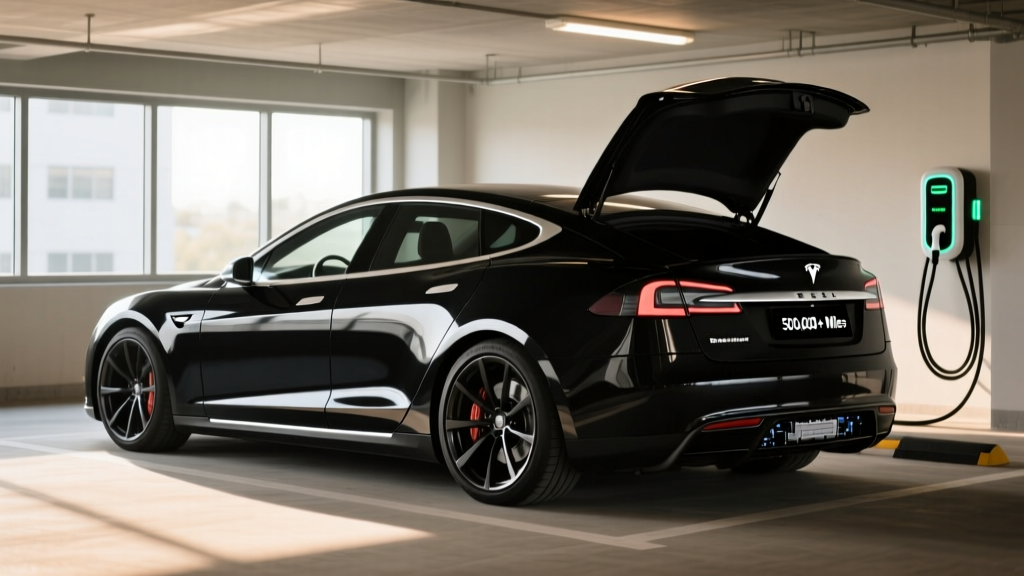
Search forums and owner groups long enough, and you will find Tesla Model S and Model 3 owners crossing 300,000, 400,000, and even 500,000 miles on their original high-voltage traction battery packs. These outlier cases fuel a legitimate question for prospective EV buyers: how long do electric car batteries actually last, and what separates a pack that dies at 120,000 miles from one that survives half a million?
The answer lies in battery chemistry, thermal management design, charging habits, and a bit of manufacturing lottery. This guide examines real degradation data, compares LFP and NMC/NCA chemistries, breaks down warranty coverage and replacement costs, and explains how to monitor and maximize your battery's State of Health (SoH) over a decade or more of ownership.
The Highest Mileage Teslas on Original Batteries: What the Data Shows
The most-documented high-mileage Tesla on an original battery is a 2014 Model S P85 owned by Hansjörg von Gemmingen-Hornberg in Germany, which surpassed 1,000,000 miles (1.6 million km) — though that vehicle did require motor replacements along the way. In the US, multiple Model S owners have reported crossing 400,000–500,000 miles on original packs, and a handful of Model 3 Long Range owners have exceeded 300,000 miles with under 15% degradation.
These are statistical outliers, not expectations. But they demonstrate that lithium-ion traction batteries are not inherently fragile. The median experience is more modest but still encouraging: according to data aggregated by Tesla in its 2023 Impact Report, Model S and Model X batteries retain approximately 88% of original capacity at 200,000 miles. Model 3 and Model Y rear-wheel-drive variants equipped with LFP (lithium iron phosphate) cells show even slower degradation curves, with many owners reporting 92–95% retention at 100,000 miles.
LFP vs NMC/NCA: Which Chemistry Lasts Longer?
Tesla uses two primary cathode chemistries across its 2025–2026 lineup, and the choice has significant implications for longevity, range, and charging behavior.
| Attribute | LFP (Lithium Iron Phosphate) | NMC/NCA (Nickel Manganese Cobalt / Nickel Cobalt Aluminum) |
|---|---|---|
| Models using it (2026) | Model 3 RWD, Model Y RWD | Model 3 Long Range, Model Y Long Range/Performance, Model S, Model X, Cybertruck |
| Energy density | Lower (~160 Wh/kg cell-level) | Higher (~250–270 Wh/kg cell-level) |
| Cycle life | 3,000–5,000+ full cycles | 1,000–2,000 full cycles |
| Cold-weather performance | Weaker; more range loss below 32°F | Better low-temp discharge capability |
| Recommended daily SoC | 100% (Tesla recommends charging to full regularly) | 80% daily; 100% only for trips |
| Cost per kWh | Lower (no cobalt or nickel) | Higher (commodity-sensitive) |
| Longevity advantage | Significantly longer calendar and cycle life | Higher range per charge offsets fewer total cycles |
The trade-off in plain terms: LFP batteries last substantially longer in terms of charge cycles and calendar years, but they deliver less range per kWh and suffer more in freezing temperatures. NMC/NCA packs give you more range in a lighter package and handle cold better, but they degrade faster if routinely charged to 100% or exposed to high heat. If longevity is your top priority and you can accept 260–272 miles of EPA range, the Model 3 RWD with LFP is arguably the longest-lasting battery Tesla currently sells.
EV Battery Degradation: Real Data by Miles and Years
Battery degradation follows a nonlinear curve: the steepest loss occurs in the first 10,000–20,000 miles (typically 2–5%), after which the rate flattens considerably. This "bathtub curve" means that early degradation is not predictive of long-term health.
| Milestone | Average Capacity Retained (NMC/NCA) | Average Capacity Retained (LFP) |
|---|---|---|
| 20,000 miles / 1 year | 95–97% | 97–99% |
| 50,000 miles / 3 years | 90–94% | 94–97% |
| 100,000 miles / 5 years | 86–92% | 91–96% |
| 150,000 miles / 8 years | 80–88% | 88–94% |
| 200,000 miles / 10+ years | 75–85% | 84–92% |
These figures represent fleet averages. Individual results vary based on climate, charging patterns, and manufacturing variance. Tesla's own published fleet data shows Model S/X packs retaining ~88% at 200,000 miles, while independent analyses from sources like Recurrent Auto corroborate that most modern EV batteries retain well above 80% capacity through the warranty period.
Calendar aging also matters: a garage-kept Tesla driven 5,000 miles per year will still lose capacity over time due to electrolyte decomposition and solid-electrolyte interphase (SEI) layer growth. Storing at 50% SoC in moderate temperatures minimizes this effect.
Tesla Battery Warranty: What Is Actually Covered?
Tesla's high-voltage battery warranty is one of the longest in the industry, but it covers defects and excessive degradation — not normal wear below the threshold.
| Model | Warranty Duration | Mileage Limit | Minimum Capacity Retention |
|---|---|---|---|
| Model 3 RWD (LFP) | 8 years | 100,000 miles | 70% |
| Model 3 Long Range / Performance | 8 years | 120,000 miles | 70% |
| Model Y (all trims) | 8 years | 120,000 miles | 70% |
| Model S / Model X | 8 years | 150,000 miles | 70% |
| Cybertruck | 8 years | 150,000 miles | 70% |
If your battery drops below 70% capacity within the warranty window, Tesla will replace or refurbish it at no cost. The replacement pack will have at least 70% capacity — it will not necessarily be brand-new. In practice, warranty claims are rare: most Tesla batteries remain above 80% well past the warranty mileage limit. According to Tesla's impact report, fewer than 1% of vehicles require battery replacement under warranty.
How Much Does a Tesla Battery Replacement Cost?
Out-of-warranty battery replacement is the scenario that generates the most anxiety. Here are current estimated costs as of 2025–2026, based on service center quotes and owner reports:
| Model | Battery Size (usable kWh) | Estimated Replacement Cost |
|---|---|---|
| Model 3 RWD (LFP) | ~57.5 kWh | $10,000–$13,000 |
| Model 3 Long Range | ~75 kWh | $13,000–$16,000 |
| Model Y Long Range | ~75 kWh | $13,000–$16,000 |
| Model S (2023+) | ~95 kWh | $18,000–$22,000 |
| Model X (2023+) | ~95 kWh | $18,000–$22,000 |
| Cybertruck AWD/Cyberbeast | ~123 kWh | $20,000–$25,000 (estimated) |
These costs include the pack, labor, and diagnostics. However, context matters: full battery replacements outside warranty are uncommon. More often, Tesla service centers can identify and replace individual modules within the pack for $3,000–$7,000, restoring most of the lost capacity. The vast majority of Tesla owners will sell or trade their vehicle before needing a full out-of-pocket replacement.
Factors That Accelerate (or Slow) Battery Degradation
Not all miles are equal. The highest mileage Teslas on original batteries share common habits that minimize stress on the cells:
- Daily charge limit: Set to 80% for NMC/NCA; 100% is fine for LFP (Tesla recommends periodic full charges for LFP calibration).
- Avoid frequent DC fast charging: Occasional Supercharging is fine, but daily 250 kW sessions accelerate degradation. Prioritize Level 2 home charging.
- Minimize extreme SoC storage: Never leave the car at 100% or below 10% for days. Aim for 50% if storing for weeks.
- Precondition in cold weather: Use scheduled departure or navigate to a Supercharger to warm the pack before fast charging — cold lithium plating causes permanent damage.
- Park in shade or a garage: Sustained high battery temperatures (above 104°F / 40°C) accelerate calendar aging.
- Use regenerative braking moderately: Heavy regen in cold weather can stress cells; Tesla limits regen when the pack is cold for this reason.
- Keep software updated: Tesla pushes BMS (Battery Management System) refinements via OTA updates that optimize cell balancing and thermal strategies.
The single biggest degradation accelerant is sustained high SoC at elevated temperatures. A Model S parked at 100% charge in an Arizona summer for weeks will lose more capacity than one driven hard but charged to 80% and kept in a moderate climate.
How to Check Your Tesla's Battery Health (State of Health)
Tesla does not expose a direct SoH percentage in the vehicle UI, but owners have several methods to estimate it:
- Range at 100% charge: Compare your displayed range at 100% SoC against the original EPA rating. A Model 3 Long Range originally rated at 341 miles that now shows 305 miles at 100% has roughly 89% SoH (accounting for the fact that Tesla's displayed range uses a fixed energy-per-mile factor, not real-time conditions).
- Third-party apps: Tools like Tessie, Stats (iOS), or TeslaFi log charge data over time and calculate estimated degradation curves based on energy added versus SoC change.
- Service center diagnostic: Tesla service can run a full battery health report. Request this before purchasing a used Tesla out of warranty.
- OBD-II dongles: Devices like the OBDLink SX paired with apps such as Scan My Tesla can read pack voltage, cell imbalance, and energy counters directly from the CAN bus.
For buyers evaluating a used Tesla, the most practical check is charging to 100% and recording the displayed range. Cross-reference with the vehicle's odometer and the original EPA figure from fueleconomy.gov to estimate remaining capacity.
Emerging Battery Technology: Solid-State and Silicon Anodes
Next-generation battery technologies promise step-change improvements in energy density and longevity, but timelines remain extended:
- Solid-state batteries: Companies like QuantumScape and Toyota have demonstrated prototype cells with 800+ mile range potential and 10-minute charging. However, manufacturing scale-up remains the bottleneck. Realistic availability in production vehicles: 2028–2030 at the earliest, likely debuting in limited luxury models before reaching mainstream pricing.
- Silicon-dominant anodes: Startups including Sila Nanotechnologies and Group14 are replacing graphite anodes with silicon composites, boosting energy density by 20–40%. These are entering production in 2025–2026 in limited applications (Porsche has signaled adoption). Expect gradual rollout rather than a single launch event.
- LMFP (lithium manganese iron phosphate): A near-term evolution of LFP that adds manganese for higher voltage and energy density while retaining LFP's cycle-life advantages. CATL and BYD are scaling production; Tesla has not confirmed adoption but is a likely customer given its LFP supply chain.
These technologies are announced and in various stages of validation — none are available in a Tesla you can order today. For current buyers, the practical takeaway is that today's NMC and LFP chemistries are mature, well-understood, and demonstrably capable of 200,000+ miles with proper care.
Frequently Asked Questions
How long do Tesla batteries last in years and miles?
Most Tesla batteries retain 80–90% capacity at 150,000–200,000 miles and 8–10 years. LFP-equipped Model 3 and Model Y vehicles tend toward the higher end of that range. Complete failure is rare; degradation is gradual, and a pack at 75% capacity is still functional — just with reduced range.
What is the highest mileage Tesla on its original battery?
The most widely documented case is a 2014 Model S P85 in Germany that exceeded 1,000,000 miles on its original battery pack. In the US, multiple owners have reported 400,000–500,000 miles with 15–25% degradation. These are outliers; median longevity is lower but still exceeds 200,000 miles for most owners.
Is LFP or NMC better for battery longevity?
LFP chemistry offers significantly longer cycle life (3,000–5,000 cycles vs. 1,000–2,000 for NMC) and tolerates daily 100% charging without accelerated wear. The trade-off is lower energy density (less range) and weaker cold-weather performance. If you plan to keep a vehicle 10+ years and can accept moderate range, LFP is the longevity winner.
How much does it cost to replace a Tesla battery out of warranty?
Full pack replacement ranges from approximately $10,000 (Model 3 RWD) to $22,000+ (Model S/X). Module-level repairs are often possible for $3,000–$7,000. Most owners never face this cost, as batteries typically outlast the vehicle's economic life.
Does frequent Supercharging damage the battery?
DC fast charging generates heat and stresses cells more than Level 2 charging. Occasional Supercharging on road trips has minimal impact, but daily fast charging can accelerate degradation by 1–3% over the pack's lifetime compared to exclusive Level 2 charging. Tesla's thermal management system mitigates much of this, but physics favors slower, cooler charging.
Does the Tesla battery warranty cover normal degradation?
The warranty covers degradation below 70% capacity within 8 years and 100,000–150,000 miles (depending on model). If your battery remains above 70%, it is considered normal wear. In practice, very few Tesla batteries fall below this threshold within the warranty window.