If you search for a 2009 Cadillac CTS battery, you will find 12-volt lead-acid replacements in the $150–$250 range — a maintenance item every 3 to 5 years that cranks a 3.6L V6 engine. But that search query has become an accidental gateway for a much larger question in 2026: how do modern high-voltage EV traction batteries actually hold up over a decade or more of real-world use?
The answer, backed by millions of fleet miles and long-term owner data, is that EV battery longevity has far outpaced early skepticism. This guide dissects the chemistry, degradation curves, warranty protections, and replacement economics that determine whether an EV battery will outlast the car it powers.
What a "2009 Cadillac CTS Battery" Has to Do With EV Ownership
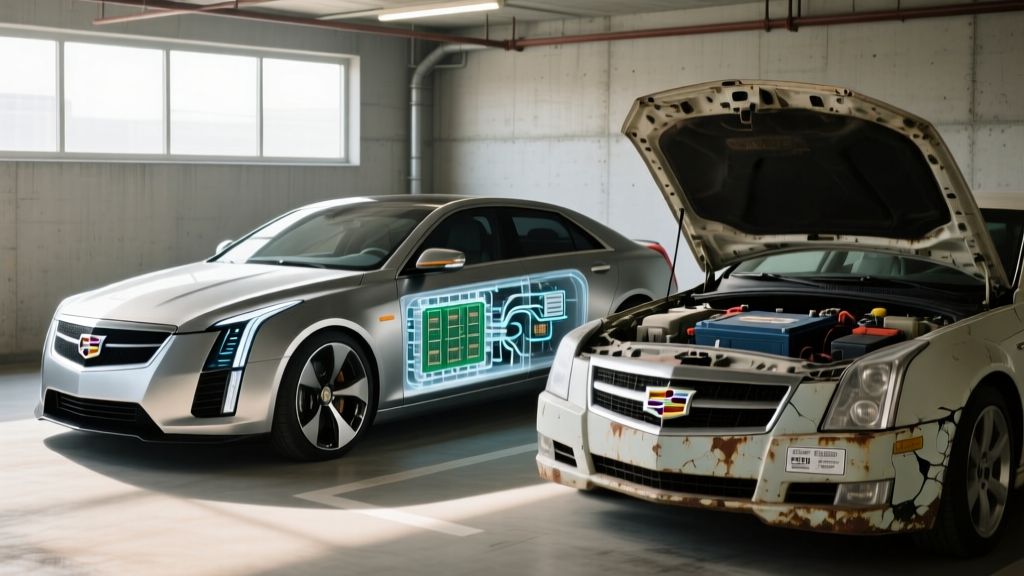
The 2009 Cadillac CTS used a standard Group 48 12V lead-acid battery — roughly 0.7 kWh of energy storage designed for engine cranking and accessory power. It weighed about 35 lbs, cost under $200, and needed replacement every few years as sulfation degraded its plates.
A modern EV traction battery, by contrast, stores between 60 and 130+ kWh of usable energy, weighs 800 to 1,500 lbs, and costs $8,000 to $22,000+ to replace. The comparison seems absurd — until you realize that the question behind both searches is the same: how long will my battery last, and what will it cost me when it doesn't?
The critical distinction: a 12V auxiliary battery (still present in most EVs for accessory systems) is a cheap, routine maintenance item. The high-voltage traction battery that propels the vehicle is a fundamentally different component with a fundamentally different lifespan profile. Most 2026 EV traction batteries are engineered to outlast 200,000 miles with meaningful capacity remaining.
LFP vs. NMC/NCA: The Chemistry Trade-Offs That Matter
Not all EV batteries are built from the same materials. In 2026, two dominant lithium-ion chemistries power the vast majority of EVs sold in North America, and understanding the difference directly affects your ownership experience.
| Attribute | LFP (Lithium Iron Phosphate) | NMC / NCA (Nickel Manganese Cobalt / Nickel Cobalt Aluminum) |
|---|---|---|
| Energy Density | Lower (~160–180 Wh/kg cell-level) | Higher (~220–300 Wh/kg cell-level) |
| Cycle Life | 3,000–5,000+ full cycles | 1,000–2,500 full cycles |
| Cold-Weather Performance | Weaker — greater range loss below freezing; slower DC fast charging in cold | Better cold tolerance; preconditioning mitigates most losses |
| Cost per kWh | Lower (~$80–$100/kWh pack-level in 2026) | Higher (~$110–$140/kWh pack-level in 2026) |
| State-of-Charge Recommendation | Can be charged to 100% daily without significant degradation | Best kept 20–80% daily; 100% reserved for trips |
| Cobalt Content | None | Contains cobalt (supply chain and ethical sourcing considerations) |
| Typical 2026 Applications | Tesla Model 3/Y RWD, Ford Mustang Mach-E Select (LFP trims), BYD models, Rivian Standard | Tesla Long Range/Performance, Hyundai Ioniq 5/6, BMW iX, most premium/long-range trims |
Which is better? It depends on your use case. If you charge at home nightly and want a battery that tolerates daily 100% fills with minimal degradation over 15+ years, LFP is the stronger longevity play. If you need maximum range per charge and regularly drive in sub-freezing climates, NMC/NCA delivers better energy density and cold-weather performance — but demands more disciplined charging habits (staying in the 20–80% window for daily use).
According to IEA Global EV Outlook data, LFP market share in global EV battery production surpassed 40% by 2025, driven by cost advantages and longevity. In the U.S. market, LFP adoption continues to grow as manufacturers offer it in base and standard-range trims.
How Long Do EV Batteries Actually Last? Degradation Data
EV batteries do not suddenly "die." They gradually lose capacity — measured as State of Health (SoH) — over time and charge cycles. A battery at 80% SoH still functions; it simply delivers 80% of its original range.
Typical Degradation Curve (NMC/NCA, liquid-cooled, moderate climate):
- Year 1 / 15,000 mi: ~2–4% capacity loss (initial formation loss)
- Year 3 / 45,000 mi: ~6–9% total loss
- Year 5 / 75,000 mi: ~9–12% total loss
- Year 8 / 120,000 mi: ~12–17% total loss
- Year 10 / 150,000 mi: ~15–20% total loss
LFP batteries typically show slower degradation in years 3–10, often retaining 85–90% SoH at 150,000 miles under normal use conditions.
Real-world fleet data supports these figures. Tesla's 2025 Impact Report documented that Model 3/Y batteries retained an average of ~88% capacity at 150,000 miles. Recurrent Auto's long-term fleet analysis of over 15,000 EVs showed median degradation of approximately 12% at 100,000 miles across multiple brands. Early-generation EVs (2011–2015 Nissan Leaf with passive air cooling) degraded significantly faster — sometimes 25–35% over 8 years — highlighting how thermal management system quality directly impacts longevity.
For context, a 2026 Hyundai Ioniq 5 with a 77.4 kWh (usable) NMC battery and an EPA range of 305 miles would, at 85% SoH after roughly 120,000 miles, still deliver approximately 259 miles of EPA-equivalent range — entirely practical for most daily driving and road trips with DC fast charging.
Battery Warranties: What's Covered and for How Long
Federal law mandates that EV batteries carry a minimum warranty of 8 years / 100,000 miles (10 years / 150,000 miles in CARB states including California, New York, Massachusetts, and others). Most manufacturers exceed these minimums with capacity-retention guarantees.
| Manufacturer (2026 Models) | Warranty Period | Capacity Retention Threshold | Notes |
|---|---|---|---|
| Tesla (Model 3/Y LWD) | 8 yr / 100,000 mi | 70% | LFP battery; covers defects + capacity below threshold |
| Tesla (Model 3/Y LR & Performance) | 8 yr / 120,000 mi | 70% | NMC battery |
| Hyundai / Kia (Ioniq 5/6, EV6) | 10 yr / 100,000 mi | 70% | Among the longest coverage periods |
| Ford (Mustang Mach-E, F-150 Lightning) | 8 yr / 100,000 mi | 70% | Covers battery components + capacity |
| BMW (i4, iX, i7) | 8 yr / 100,000 mi | 70% | Includes thermal management system |
| Rivian (R1T, R1S) | 8 yr / 175,000 mi | 70% | Highest mileage threshold in segment |
| GM (Ultium-platform: Equinox EV, Blazer EV, Silverado EV) | 8 yr / 100,000 mi | 70% | Ultium battery + propulsion components |
What the warranty covers: Manufacturing defects, premature cell failure, thermal management system failures, and capacity dropping below the stated threshold (typically 70%). If your 77.4 kWh battery degrades to below 54.2 kWh within the warranty period, the manufacturer must repair or replace it at no cost.
What it typically does not cover: Damage from accidents, flooding, unauthorized modifications, or neglect (such as ignoring coolant service intervals). Gradual capacity loss above the threshold is considered normal wear.
EV Battery Replacement Costs: The Real Numbers
This is the question that generates the most anxiety — and the most misinformation. Here are actual replacement cost ranges based on 2026 manufacturer service data and independent EV repair networks:
| Battery Size / Vehicle Class | Replacement Cost Range (Parts + Labor) | Typical When Needed |
|---|---|---|
| 40–60 kWh (Compact / Standard Range — e.g., Chevy Bolt, base Model 3) | $8,000 – $13,000 | Rarely before 200,000+ mi; often outlasts vehicle |
| 70–90 kWh (Mid-size / Long Range — e.g., Ioniq 5, Model Y LR, Mach-E ER) | $12,000 – $18,000 | Rarely before 180,000+ mi |
| 100–135 kWh (Large / Truck / Luxury — e.g., F-150 Lightning ER, Rivian R1T, BMW iX) | $16,000 – $25,000+ | Rarely before 170,000+ mi |
Several critical context points:
- Full replacements are rare. Most out-of-warranty battery issues involve individual module or cell-group failures, which can be repaired for $1,500–$4,000 by qualified EV technicians without replacing the entire pack.
- Costs are declining. Pack-level battery prices fell below $120/kWh in 2025 according to BloombergNEF, down from over $400/kWh in 2015. Replacement costs continue to trend downward.
- Most EV batteries outlive the vehicle. Data from Recurrent Auto shows that fewer than 2% of EVs in their 15,000+ vehicle study required full battery replacement outside of warranty recalls.
- The 2009 Cadillac CTS comparison: Over 15 years, that CTS would need 3–5 lead-acid battery replacements ($600–$1,200 total), plus thousands in engine maintenance (timing chains, water pumps, transmission service, oil changes). An EV's "expensive" battery, in most cases, requires zero scheduled maintenance and lasts the life of the car.
Factors That Accelerate (or Preserve) Battery Life
Battery degradation is not purely a function of time. Your habits and environment significantly influence how quickly capacity declines.
Practices that accelerate degradation:
- Frequent DC fast charging above 150 kW without preconditioning: High charge rates on a cold battery cause lithium plating on the anode. Always use your vehicle's navigation-based preconditioning (e.g., Tesla's "navigate to Supercharger" feature, Hyundai's battery preconditioning setting) to warm the pack before fast charging.
- Sustained 100% state of charge (NMC/NCA): Storing an NMC battery at 100% SoC for days or weeks accelerates electrolyte decomposition. Charge to 100% only when departing for a trip.
- Deep discharges to 0%: Regularly driving the battery to near-empty stresses cell chemistry. Keep a 10–15% buffer when possible.
- Prolonged exposure to extreme heat: Parking in direct sun in 110°F+ climates without thermal management active increases calendar degradation. Garage parking helps.
- Ignoring coolant system service: Liquid-cooled battery packs require periodic coolant flushes per the manufacturer schedule (typically every 5 years / 60,000–100,000 miles). Neglected coolant degrades thermal management performance.
Practices that maximize longevity:
- Home Level 2 charging at 7–11 kW: Slow, steady charging generates minimal heat and is the gentlest method for long-term battery health.
- 20–80% daily SoC window (NMC/NCA): Set your charge limit to 80% for daily use. Most EV apps let you schedule this.
- 100% SoC is fine for LFP: LFP chemistry benefits from periodic full charges for cell balancing. Charge to 100% at least once per week if your vehicle recommends it.
- Precondition before fast charging: Always use the vehicle's built-in preconditioning route or manual preconditioning feature.
- Drive it normally: Moderate regenerative braking settings and avoiding repeated hard launches reduce thermal stress on cells.
How to Check and Monitor Battery Health (SoH)
State of Health (SoH) is the percentage of original capacity your battery retains. A new battery is 100% SoH; a battery that has degraded to hold 85% of its original kWh is at 85% SoH. Here is how owners can monitor it in 2026:
- In-vehicle displays: Tesla, Hyundai/Kia, BMW, and GM offer varying levels of battery health information through the infotainment or service menus. Some display SoH directly; others show estimated range compared to original.
- OBD-II diagnostic tools: Third-party tools like OBDeleven, LeafSpy (for Nissan), and EV-specific OBD readers can pull SoH data from the battery management system (BMS). These typically cost $30–$100 for the hardware plus a compatible app.
- Telematics and fleet services: Services like Recurrent Auto (free for individual owners) connect to your vehicle's telematics API and track SoH over time, comparing your degradation curve to similar vehicles in your climate zone.
- Dealer diagnostic reports: During service visits, dealerships can run a full BMS diagnostic and print a capacity report. Request this if you are approaching a warranty threshold and want documentation.
- Manual calculation: Track your kWh used (from the trip computer or charging app) versus miles driven over a full charge cycle. Compare your observed efficiency (kWh/100mi) and total range to the original EPA figures. A sustained 15% drop in range under similar conditions suggests ~85% SoH.
For buyers evaluating a used EV, a pre-purchase battery health check is essential. Services like fueleconomy.gov list original EPA range figures for comparison, and third-party battery reports from services like Altelium or AVILOO provide independent SoH certification.
Emerging Battery Technology: Solid-State, Silicon Anode, and What's Next
Next-generation battery technologies promise step-changes in energy density, charge speed, and longevity — but timelines remain measured. Here is the realistic 2026 outlook:
Solid-state batteries: Toyota, Samsung SDI, and QuantumScape have demonstrated prototype solid-state cells with 500+ Wh/L energy density and 10-minute fast-charge capability. Toyota has announced limited production in select 2027–2028 models, but widespread commercial availability at scale is not expected before 2029–2030. Cost per kWh remains substantially higher than current liquid-electrolyte lithium-ion.
Silicon-dominant anodes: Companies like Sila Nanotechnologies and Group14 are replacing graphite anodes with silicon composites, boosting energy density by 20–40%. These are beginning to appear in limited production applications (e.g., Mercedes-Benz G-Class EV variants) and are expected to scale through 2027–2028. They improve range without fundamentally changing charging behavior.
Sodium-ion batteries: CATL and BYD have begun producing sodium-ion cells for lower-cost, shorter-range EVs. These offer lower energy density than LFP but eliminate lithium and cobalt entirely, potentially reducing costs below $60/kWh. U.S. market availability remains limited as of 2026, primarily in commercial fleet and urban EV applications.
Semi-solid-state / condensed-matter batteries: CATL's condensed-matter battery (announced 2023, entering limited production 2025–2026) bridges the gap between conventional lithium-ion and full solid-state, offering improved safety and energy density. Expect initial deployment in premium and aviation-adjacent applications before reaching mainstream EVs.
All of these technologies are forward-looking. If you are buying an EV in 2026, today's LFP and NMC chemistries — with proven degradation data, robust warranties, and declining replacement costs — represent mature, reliable technology. Waiting for solid-state means waiting at least 3–5 years for meaningful market availability.
Frequently Asked Questions
How long do EV batteries last in years and miles?
Most modern liquid-cooled EV batteries (2020 and newer) are designed to retain 70–85% of original capacity at 150,000–200,000 miles, which typically corresponds to 10–15 years of average driving (12,000–15,000 miles/year). LFP chemistries often exceed this. The vehicle is more likely to be retired for body, suspension, or economic reasons before the battery fails catastrophically.
How much does an EV battery cost to replace?
Full pack replacement ranges from approximately $8,000 for a compact standard-range battery to $25,000+ for a large truck or luxury SUV pack, including labor. However, full replacements are rare — most battery issues involve repairable module-level failures costing $1,500–$4,000. Costs continue to decline as pack-level prices fall. For comparison, a 2009 Cadillac CTS battery replacement costs $150–$250, but that vehicle's engine and transmission maintenance over 15 years often exceeds $5,000–$8,000.
What does the EV battery warranty actually cover?
Federal law requires a minimum of 8 years / 100,000 miles (10/150,000 in CARB states). Coverage includes manufacturing defects and capacity loss below a defined threshold (typically 70% of original capacity). It does not cover accident damage, flood damage, or unauthorized modifications. Review your specific manufacturer's warranty booklet for exact terms, as thresholds and mileage limits vary by brand and trim.
How do I check my EV's battery health?
Use your vehicle's built-in battery health display (if available), connect an OBD-II EV diagnostic tool, or enroll in a telematics service like Recurrent Auto for ongoing SoH tracking. For used-EV purchases, request a dealer BMS diagnostic report or use a third-party certification service. Compare your real-world range to the original EPA figures on fueleconomy.gov as a baseline check.
LFP vs NMC — which battery chemistry is better for me?
Choose LFP if you charge primarily at home, want to charge to 100% daily without worry, prioritize maximum cycle life (3,000–5,000+ cycles), and live in a moderate climate. Choose NMC/NCA if you need maximum EPA range per charge, regularly drive in sub-freezing temperatures, or frequently take long road trips where energy density matters. Both chemistries are proven to last well beyond 150,000 miles with proper care.
Does fast charging damage my EV battery?
Occasional DC fast charging (1–3 times per week) has minimal impact on modern liquid-cooled batteries. The risk comes from exclusive fast charging without preconditioning, particularly in cold weather, which can cause lithium plating. For optimal longevity, make Level 2 home charging (7–11 kW) your primary method and use DC fast charging for road trips. Always precondition the battery before fast charging when the feature is available.
Is it worth buying a used EV with an older battery?
Yes, provided you verify the State of Health before purchase. A 4-year-old EV at 85% SoH still offers substantial usable range and may have 4+ years of warranty coverage remaining. Avoid used EVs with passive air-cooled batteries (early Nissan Leaf, early Fiat 500e) unless the SoH is verified above 80% and the price reflects degradation risk. Request documentation from a BMS diagnostic or telematics report.
Whether you arrived here searching for a 2009 Cadillac CTS battery or researching your first EV purchase, the data is clear: modern EV traction batteries are among the most durable and well-warranted components in any vehicle on the road today. The chemistry is proven, the degradation is slow and predictable, and the economics of ownership — when factoring in fuel savings, maintenance reduction, and warranty protection — overwhelmingly favor electrification over the lifespan of the vehicle.