If you've spent any time browsing EV forums, you've seen the dread: a post from an owner staring down a $20,000 battery replacement bill. It's the single biggest fear holding buyers back from going electric. But what does the actual ev battery life driving research show when we look at fleet data, manufacturer reports, and long-term owner logs rather than outlier anecdotes?
The short answer: modern EV traction batteries are outlasting most expectations. Geotab's analysis of over 10,000 EVs found average annual degradation of roughly 1.8%, meaning a typical pack retains about 82% of its original capacity after a decade. Recurrent Auto's real-world fleet data, covering over 15,000 vehicles, paints a similar picture. Most EV batteries will never need replacement during the vehicle's usable life — but the details matter enormously depending on which chemistry your car uses, where you live, and how you charge.
This guide breaks down the data behind EV battery longevity, the chemistry trade-offs between LFP and NMC, what warranties actually cover, realistic replacement costs, and the daily habits that meaningfully extend — or shorten — your pack's life.
How Long Do EV Batteries Actually Last?
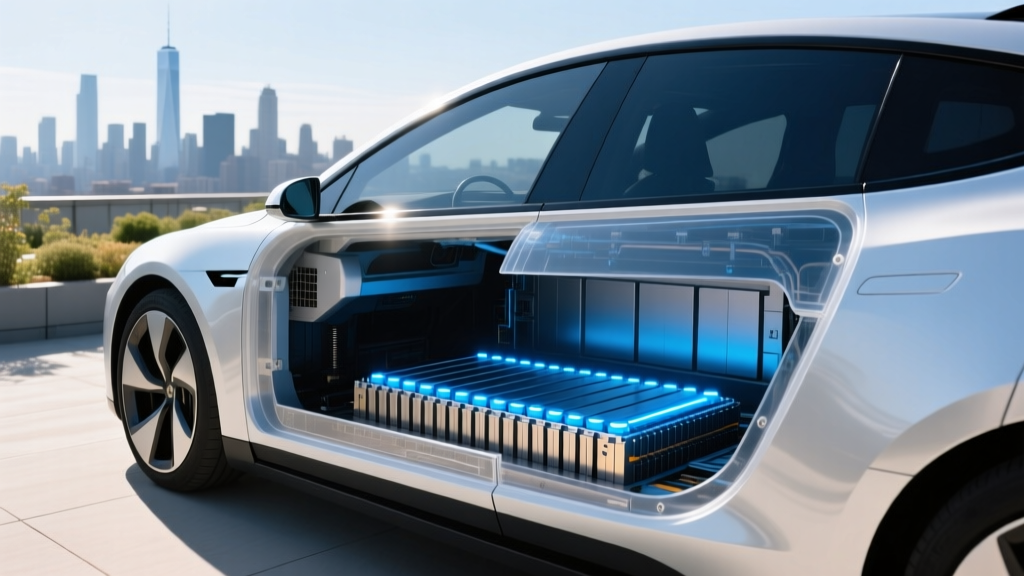
The high-voltage traction battery in a modern EV is engineered for a fundamentally different duty cycle than a phone or laptop battery. Where consumer electronics prioritize energy density above all else, automotive packs balance capacity, charge rate, thermal management, and cycle life over a target lifespan of 150,000 to 200,000+ miles.
Here's what large-scale driving research actually shows:
- Geotab fleet study (10,000+ EVs): Average degradation of ~1.8% per year, ~82% State of Health (SoH) retained at 10 years.
- Recurrent Auto fleet data (15,000+ EVs): Most vehicles show 5-10% range loss at 100,000 miles; Tesla Model 3 and Model Y clusters show ~5% loss at 100k miles on average.
- Tesla 2023 Impact Report: Model 3/Y batteries retain ~88% capacity at 200,000 miles on average.
- Nissan Leaf (early air-cooled packs): Higher degradation — some 2011-2017 Leafs lost 20-30% capacity over 8 years, a cautionary tale about thermal management.
Sources: Geotab EV Battery Health Study, Recurrent Auto Battery Research
The critical takeaway: degradation is not linear. Most packs experience a steeper drop in the first 1-2 years (roughly 2-5% as the battery "settles"), then flatten to a slow, steady decline of ~1% per year for the remainder of their life. A battery reaching 70% State of Health — the threshold most warranties use — doesn't mean the car is unusable. It means your 300-mile EPA-rated EV now delivers roughly 210 miles of range, still perfectly functional for daily driving.
LFP vs. NMC: The Chemistry That Defines Your Battery's Life
Not all EV batteries are created equal. The two dominant chemistries in 2026 passenger vehicles — Lithium Iron Phosphate (LFP) and Nickel Manganese Cobalt (NMC) — have fundamentally different aging profiles, energy densities, and cost structures. Which one is "better" depends entirely on your use case.
| Attribute | LFP (LiFePO4) | NMC / NCA |
|---|---|---|
| Energy Density | Lower (~160 Wh/kg cell-level) | Higher (~250-300 Wh/kg cell-level) |
| Cycle Life | 3,000-5,000+ cycles to 80% SoH | 1,000-2,000 cycles to 80% SoH |
| Cost | ~20-30% cheaper per kWh | Higher due to nickel/cobalt |
| Cold Performance | Weaker — more range loss below 32°F | Better low-temp performance |
| Charge to 100% Daily? | Yes — recommended for calibration | No — 80% daily limit advised |
| Typical Use | Standard-range models (Tesla Model 3 RWD, base Model Y, some BYD, Ford Mustang Mach-E Select) | Long-range & performance models (Tesla LR/Performance, Hyundai Ioniq 5/6, Rivian, BMW iX) |
| Thermal Stability | Excellent — lower runaway risk | Good — requires more active cooling |
The practical upshot: If you're a commuter who can charge at home nightly and doesn't need maximum range, an LFP-equipped vehicle offers superior longevity and lower cost. You can charge to 100% daily without guilt — in fact, LFP batteries need periodic 100% charges so the Battery Management System (BMS) can accurately calibrate State of Charge. If you need maximum range for road trips or live in a cold climate, NMC delivers more miles per kWh but demands more careful charging habits (keeping SoC between 20-80% for daily use).
What Battery Warranties Actually Cover
Federal law mandates a minimum 8-year/100,000-mile warranty on EV battery packs for emissions-related components, and most manufacturers exceed this baseline. But the fine print matters: warranties cover defects and excessive degradation — not normal wear that stays above the retention threshold.
| Manufacturer | Warranty Period | Mileage Cap | Capacity Retention Threshold |
|---|---|---|---|
| Tesla (Model 3/Y LFP) | 8 years | 100,000 mi | 70% |
| Tesla (Model 3/Y LR NMC) | 8 years | 120,000 mi | 70% |
| Hyundai / Kia (E-GMP) | 10 years | 100,000 mi | 70% |
| Ford (Mach-E, F-150 Lightning) | 8 years | 100,000 mi | 70% |
| GM (Ultium platform) | 8 years | 100,000 mi | 70% |
| Rivian | 8 years | 175,000 mi (R1T/R1S) | 70% |
| BMW (i4/iX) | 8 years | 100,000 mi | 70% |
Key nuances most buyers miss:
- The 70% threshold is a floor, not an expectation. If your battery degrades to 69% within the warranty period, the manufacturer replaces or repairs it. Most packs never reach this threshold under normal use.
- "Repair" may mean module replacement, not a full new pack. Many modern packs are modular — a technician can swap degraded modules rather than the entire assembly, which is how warranty claims are typically resolved.
- Warranty does not cover damage. Road debris strikes, flood submersion, or aftermarket modifications that damage the pack void coverage.
- Transferability varies. Some warranties transfer to second owners automatically; others require registration. Check before buying used.
EV Battery Replacement Cost: What the Numbers Say
This is where the fear lives — and where context is most needed. Yes, a full battery pack replacement is expensive. But the vast majority of EVs will never need one during their first 150,000+ miles, and costs are declining as manufacturing scales and module-level repairs become more common.
| Vehicle | Battery Size | Chemistry | Full Pack Replacement (parts + labor) | Module Repair (typical) |
|---|---|---|---|---|
| Tesla Model 3 (Standard Range) | ~60 kWh | LFP | $12,000 - $16,000 | $2,000 - $5,000 |
| Tesla Model Y (Long Range) | ~82 kWh | NMC | $16,000 - $22,000 | $3,000 - $7,000 |
| Hyundai Ioniq 5 | 77.4 kWh | NMC | $18,000 - $24,000 | $3,500 - $8,000 |
| Ford F-150 Lightning (Extended) | ~131 kWh | NMC | $25,000 - $35,000 | $4,000 - $10,000 |
| Chevrolet Equinox EV | ~85 kWh | NMC (Ultium) | $16,000 - $22,000 | $3,000 - $7,000 |
| Nissan Leaf (40 kWh) | 40 kWh | NMC | $8,000 - $12,000 | $2,000 - $4,500 |
When is replacement actually needed? Almost never during the warranty period for modern liquid-cooled packs. The scenarios that trigger out-of-warranty replacement are typically: vehicles with 200,000+ miles showing significant range loss, early-generation air-cooled packs (pre-2018 Nissan Leaf) that degraded faster, or physical damage from collisions or flooding. For a 2026-model EV with liquid thermal management, a full pack replacement is a low-probability event within the first decade of ownership.
What Actually Degrades an EV Battery (And What Doesn't)
Battery degradation is driven by electrochemical stress. Understanding the specific mechanisms lets you make informed daily decisions — and avoid unnecessary worry about things that don't meaningfully matter.
High-Impact Factors
- Extreme State of Charge exposure: Sitting at 100% SoC (or below 5%) for extended periods accelerates electrolyte decomposition and lithium plating, especially in NMC cells. This is why daily charging to 80% is recommended for NMC packs.
- High temperatures: Sustained battery temperatures above 95°F (35°C) — from hot climates, repeated DC fast charging without adequate cooling, or parking in direct sun at high SoC — are the single largest degradation accelerant. This is why early air-cooled Leafs degraded faster than liquid-cooled competitors.
- DC fast charging frequency: Exclusive reliance on DC fast charging (especially at rates above 1C) generates more heat and stress than Level 2 home charging. Research from Idaho National Laboratory showed packs charged exclusively via DCFC degraded ~0.3% more per year than those charged primarily on Level 2 — meaningful but not catastrophic.
Low-Impact Factors (Common Myths)
- Occasional 100% charges: Charging to 100% for a road trip, then driving down promptly, causes negligible harm. The problem is sitting at 100% for days.
- Regenerative braking: Regen does cycle the battery, but at low C-rates well within design limits. It does not meaningfully accelerate degradation.
- Cold weather use: Cold temperatures temporarily reduce range (often 20-30% loss at 20°F), but this is reversible capacity reduction, not permanent degradation. Preconditioning the battery before driving actually protects it.
- ☐ Set daily charge limit to 80% (NMC) or 100% (LFP) via vehicle app
- ☐ Use Level 2 home charging as your primary method
- ☐ Enable battery preconditioning before DC fast charging (most EVs do this automatically when a charger is set as your navigation destination)
- ☐ Avoid leaving the car at 100% SoC for more than a few hours
- ☐ In hot climates, park in shade or a garage when possible
- ☐ Don't let the battery sit below 10% SoC for extended periods (a week+)
- ☐ Use scheduled charging to finish charging right before you leave — minimizes time at high SoC
How to Check Your Battery's State of Health
State of Health (SoH) is the percentage of original capacity your battery currently holds. A new pack is 100% SoH; a pack that held 75 kWh when new and now holds 67.5 kWh is at 90% SoH. Monitoring this number gives you an early warning of unusual degradation and is critical when buying or selling a used EV.
In-Vehicle Methods
- Tesla: Navigate to Service mode (hold the "Software" label on the car screen for 3 seconds, enter "service" as the code) → Battery Health test. This runs a controlled discharge cycle and reports SoH percentage. Tesla also displays a "Battery Health" card in the app for newer software versions.
- Hyundai/Kia (E-GMP): The infotainment system's EV diagnostics menu displays battery SoH directly. Some model years show it under Settings → EV → Battery.
- GM (Ultium): OnStar diagnostics can report battery health metrics; the myChevrolet/myCadillac app shows basic battery status.
- Most other brands: The instrument cluster or EV info screen shows estimated range at full charge. Compare this to the original EPA rating — a 310-mile car now showing 280 miles at 100% SoC suggests roughly 90% health (accounting for the fact that EPA range already includes a buffer).
Third-Party Tools
OBD-II dongles paired with apps like OBDeleven, LeafSpy (for Nissan Leaf), or manufacturer-specific diagnostic tools can pull granular SoH data, individual cell voltage readings, and battery temperature history. For pre-purchase inspections on used EVs, a dealer diagnostic report showing SoH percentage is worth requesting — it's the EV equivalent of a compression test on a gas car.
Emerging Battery Technology: What's Real and What's Not Yet
Headlines about solid-state batteries and silicon anodes are constant, but separating laboratory promise from production reality is essential for purchase decisions today.
Solid-state batteries replace the liquid electrolyte with a solid material, promising higher energy density, faster charging, and improved safety. Toyota has announced a solid-state EV for 2027-2028 with a claimed 466-mile range and 10-minute 10-80% charge. Samsung SDI and QuantumScape are targeting similar timelines. However, these are announced timelines for limited production — mass-market availability at competitive pricing is realistically a 2029-2031 prospect. No solid-state EV is currently available for purchase.
Silicon-dominant anodes (replacing graphite) offer roughly 20-40% energy density improvement and are closer to market. Sila Nanotechnologies and Group14 Technologies have production contracts with major automakers for 2026-2028 vehicles. Expect incremental range gains rather than a step-change revolution.
Sodium-ion batteries are entering production for lower-cost, shorter-range vehicles — CATL has begun shipping sodium-ion packs in Chinese-market EVs. These trade range for dramatically lower cost and better cold performance, but are unlikely to appear in US-market long-range vehicles before 2028 at the earliest.
For buyers in 2026: today's LFP and NMC chemistries are mature, well-understood, and backed by extensive real-world data. Waiting for next-generation tech means waiting years — and current packs are already lasting the life of the vehicle for most owners.
Frequently Asked Questions
How long do EV batteries last in years and miles?
Based on fleet driving research from Geotab and Recurrent Auto, modern liquid-cooled EV batteries retain approximately 80-88% of their original capacity at 10 years or 150,000-200,000 miles. LFP chemistries tend toward the higher end of this range. Most EV batteries will outlast the vehicle's body, suspension, and interior before reaching a point of functional obsolescence.
How much does an EV battery cost to replace?
Full pack replacement ranges from roughly $8,000 for a small pack (Nissan Leaf 40 kWh) to $25,000-$35,000 for a large pack (Ford F-150 Lightning Extended Range 131 kWh). However, module-level repairs — which resolve most degradation issues — typically cost $2,000-$10,000. The vast majority of 2026-model EVs will never need either during their first decade of ownership, as the warranty covers defects and degradation below 70% capacity for 8 years / 100,000+ miles.
What does the battery warranty actually cover?
EV battery warranties (typically 8 years / 100,000 miles, with some manufacturers like Hyundai/Kia offering 10 years) cover manufacturing defects and capacity loss below a defined threshold — usually 70% of original capacity. They do not cover physical damage from accidents, flooding, or road debris, nor do they cover "normal" degradation that stays above the 70% floor. If your battery falls below the threshold within the warranty period, the manufacturer will repair or replace it at no cost.
How do I check and maximize my EV battery health?
Check State of Health via your vehicle's built-in diagnostics (Tesla Service Mode, Hyundai/Kia EV menu) or an OBD-II diagnostic tool. Maximize longevity by: using Level 2 home charging as your primary method, setting daily charge limits to 80% for NMC or 100% for LFP, enabling preconditioning before DC fast charging, avoiding leaving the car at extreme SoC (above 90% or below 10%) for extended periods, and parking in shade in hot climates.
LFP vs. NMC — which battery chemistry is better?
Neither is universally better — they serve different needs. LFP (Lithium Iron Phosphate) offers longer cycle life (3,000-5,000 cycles), lower cost, the ability to charge to 100% daily, and superior thermal stability, but has lower energy density and weaker cold-weather performance. NMC (Nickel Manganese Cobalt) delivers higher energy density for longer range and better cold performance, but requires 80% daily charge limits and has shorter cycle life (1,000-2,000 cycles). For commuters with home charging who don't need maximum range, LFP is the longevity winner. For road-trippers and cold-climate drivers, NMC's range advantage matters more.