The Strategic Pivot: Why Automakers are Ditching Cobalt
The electric vehicle industry is undergoing a massive chemical transformation. For the better part of a decade, Nickel Manganese Cobalt (NMC) and Nickel Cobalt Aluminum (NCA) chemistries dominated the EV landscape due to their superior energy density. However, the geopolitical, ethical, and financial vulnerabilities associated with cobalt mining have forced automakers to aggressively pivot toward cobalt-free alternatives. According to the International Energy Agency (IEA), cobalt supply chains are highly concentrated, with the Democratic Republic of Congo accounting for over 70% of global production. This bottleneck creates severe price volatility and supply security risks.
To mitigate these risks, the industry has heavily invested in Lithium Iron Phosphate (LFP) and, more recently, Lithium Manganese Iron Phosphate (LMFP) and Sodium-ion technologies. This data-driven analysis breaks down the current state of cobalt-free battery development, compares the hard performance metrics of leading chemistries, and outlines the strategic manufacturing plans of major EV and battery giants for 2024 and beyond.
Data-Driven Chemistry Comparison: NMC vs. LFP vs. LMFP
Understanding the shift requires looking at the raw data. While NMC remains the king of volumetric and gravimetric energy density, the gap is rapidly closing thanks to innovations in cell packaging (like Cell-to-Pack and Cell-to-Chassis designs) and new manganese-blended chemistries. Below is a comparative analysis of the dominant battery chemistries currently in production or late-stage development.
| Chemistry | Cobalt Content | Gravimetric Density (Wh/kg) | Volumetric Density (Wh/L) | Avg Cost ($/kWh) | Average Cycle Life |
|---|---|---|---|---|---|
| NMC 811 | ~10% | 250 - 300 | 650 - 750 | $110 - $130 | 1,000 - 1,500 |
| LFP (Standard) | 0% | 160 - 180 | 400 - 450 | $80 - $95 | 3,000 - 5,000 |
| LMFP (M3P/Next-Gen) | 0% | 200 - 230 | 500 - 550 | $90 - $105 | 2,000 - 3,000 |
| Sodium-Ion | 0% (No Lithium) | 120 - 150 | 300 - 350 | $50 - $70 | 3,000+ |
As the data illustrates, LFP offers a massive advantage in cycle life and cost, making it ideal for standard-range vehicles and grid storage. However, its lower energy density limits its use in long-range or heavy-duty applications. This is where LMFP enters the picture. By adding manganese to the LFP cathode, manufacturers can boost the voltage plateau from 3.2V to 4.1V, yielding a 15% to 20% increase in energy density without introducing a single gram of cobalt or nickel.
2024 Manufacturer Plans and Capacity Expansion
The transition to cobalt-free chemistries is no longer a theoretical exercise; it is the foundation of current gigafactory expansions. Here is a data-backed look at how the major players are executing their cobalt-free strategies.
Tesla: Scaling LFP and Exploring Next-Gen Dry Electrodes
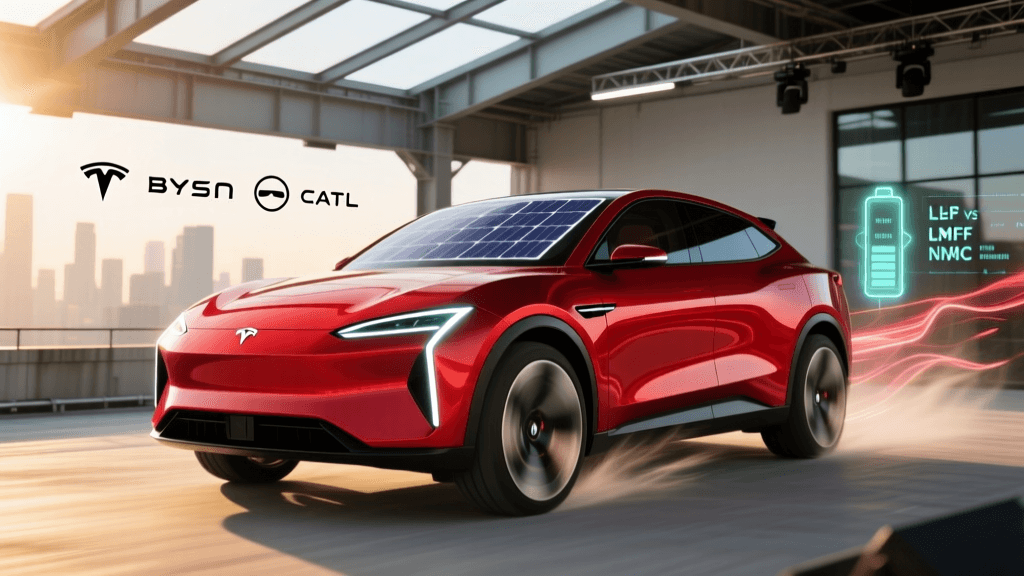
Tesla has been the most vocal proponent of LFP for its standard-range vehicles. Currently, all rear-wheel-drive Model 3 and Model Y units produced in the US and globally utilize cobalt-free LFP prismatic cells, primarily sourced from CATL and BYD. Tesla's 2024 roadmap indicates a continuation of this trend, with LFP expected to account for over 50% of their total battery volume. Furthermore, Tesla's ongoing research into dry electrode manufacturing for its 4680 cells aims to eventually produce a cobalt-free, high-energy-density cell that could challenge NMC in long-range applications, though commercial scale for this specific chemistry remains in the 2025-2026 window.
BYD: The Blade Battery and LMFP Rollout
BYD has entirely abandoned cobalt in its passenger EV lineup. Their proprietary Blade Battery (an LFP variant with a unique long, thin prismatic design that acts as a structural beam) has revolutionized pack-level energy density. For 2024, BYD is actively commercializing its second-generation Blade Battery, which incorporates LMFP chemistry. This upgrade is projected to push pack-level energy density past 180 Wh/kg, allowing BYD to offer 400+ miles of range in mid-size sedans without relying on nickel or cobalt.
CATL: Shenxing Superfast Charging and M3P
CATL, the world's largest battery manufacturer, has introduced two major cobalt-free innovations. First, the 'Shenxing' LFP battery, which utilizes a superfast-charging anode and advanced electrolyte to achieve 4C charging rates (adding 250 miles of range in 10 minutes) at a lower cost than NMC. Second, CATL is mass-producing its 'M3P' battery, an LMFP-based chemistry that has already been integrated into updated versions of the Tesla Model 3 and various Chinese domestic market EVs. CATL's 2024 capacity expansion plans dedicate over 60% of new gigafactory lines to these cobalt-free variants.
Ford and the BlueOval Battery Park
Ford is attempting to localize LFP production to reduce reliance on Chinese imports. The BlueOval Battery Park in Michigan, utilizing CATL's licensed LFP technology, is slated to produce 20 GWh of cobalt-free cells annually starting in 2026. This move is specifically designed to secure a domestic, cobalt-free supply chain for Ford's lower-cost EV platforms.
The Rise of Sodium-Ion: The Ultimate Cobalt and Lithium Alternative
While LMFP solves the cobalt problem, it still relies heavily on lithium, a resource facing its own supply constraints. Sodium-ion (Na-ion) batteries represent the next frontier in cobalt-free, lithium-free development. According to research highlighted by the Argonne National Laboratory, sodium is thousands of times more abundant than lithium and can be extracted from seawater or soda ash. In 2024, CATL and HiNa Battery have begun integrating Na-ion cells into entry-level EVs and micro-mobility vehicles. While Na-ion's energy density (120-150 Wh/kg) currently restricts it to city cars and energy storage, its unparalleled cold-weather performance (retaining over 90% capacity at -20°C) makes it a highly attractive, low-cost alternative for specific market segments.
Actionable Advice for EV Buyers: Navigating the Cobalt-Free Market
As cobalt-free batteries become the standard for standard-range and mid-tier EVs, consumers must adjust their ownership habits to maximize battery health and performance. Based on the electrochemical properties of LFP and LMFP, here is practical advice for current and prospective EV buyers:
- Charge to 100% Regularly: Unlike NMC batteries, which degrade faster when held at 100% state of charge (SoC), LFP and LMFP batteries have a very flat voltage discharge curve. This makes it difficult for the Battery Management System (BMS) to accurately guess the remaining range. Manufacturers explicitly recommend charging LFP vehicles to 100% at least once a week to calibrate the BMS and prevent 'range ghosting'.
- Mandatory Winter Preconditioning: The primary weakness of cobalt-free LFP chemistry is its poor ionic conductivity in freezing temperatures. If you live in a climate that regularly drops below freezing, you must use your vehicle's scheduled departure feature to precondition the battery while it is still plugged in. Fast-charging an unheated LFP battery in winter will severely throttle charging speeds to protect the anode from lithium plating.
- Right-Size Your Battery Purchase: Do not automatically pay the $5,000 to $8,000 premium for a long-range NMC battery if your daily commute is under 60 miles. The cycle life of an LFP battery (up to 5,000 cycles) means the battery will likely outlast the physical chassis of the car. Buying a standard-range, cobalt-free LFP model offers a better total cost of ownership and reduces the environmental impact of mining critical minerals.
- Check the Charging Curve Specs: When shopping for a cobalt-free EV, look for models featuring advanced thermal management and 4C charging capabilities (like the CATL Shenxing LFP). Older LFP packs tapered charging speeds drastically after 80%, but newer cobalt-free architectures maintain high kW inputs up to 90%, drastically reducing road-trip downtime.
The transition away from cobalt is not just a supply chain maneuver; it is a fundamental improvement in battery safety, longevity, and cost-efficiency. As LMFP and Sodium-ion technologies mature through 2025, the performance gap between cobalt-free and traditional chemistries will effectively vanish, cementing LFP and its derivatives as the undisputed standard for the mass-market electric vehicle.