The All-Iron Flow Battery Breakthrough: Hype or the Next EV Chemistry?
Headlines about an all-iron flow battery breakthrough have caught the attention of EV owners and shoppers alike. The promise — abundant iron, no cobalt, tens of thousands of cycles — sounds like a revolution. But flow batteries are fundamentally different from the lithium-ion cells packed under your EV's floor, and understanding that gap is essential before you change your buying plans.
This guide walks through the chemistries that actually power today's EVs — LFP and NMC/NCA — with hard degradation data, warranty terms, replacement costs, and care practices. Then we'll place the all-iron flow battery in its proper context: a potentially transformative grid-storage technology with a long, uncertain road to passenger-vehicle adoption.
LFP vs NMC/NCA: The Chemistries Powering Today's EVs
Every mainstream EV sold in the US in 2026 uses one of two lithium-ion cathode families:
- LFP (Lithium Iron Phosphate): Used in the Tesla Model 3/Y Standard Range, Ford Mustang Mach-E Select (LFP variants), and several BYD models. Iron-phosphate cathodes, no nickel or cobalt.
- NMC (Nickel Manganese Cobalt) / NCA (Nickel Cobalt Aluminum): Used in most long-range and performance trims — Tesla Model S/X, Hyundai Ioniq 5/6 Long Range, Chevrolet Silverado EV, Rivian R1T/R1S, and the BMW iX.
| Attribute | LFP | NMC / NCA |
|---|---|---|
| Energy Density (cell-level) | ~160–180 Wh/kg | ~220–300 Wh/kg |
| Typical Cycle Life | 3,000–6,000+ cycles | 1,000–2,500 cycles |
| Calendar Life | Excellent (15–20+ yr) | Good (12–15+ yr) |
| Cold-Weather Performance | Weaker — larger range loss below 32°F | Better — smaller range penalty in cold |
| Thermal Stability | Superior — higher runaway threshold | Good with active BMS/cooling |
| Raw-Material Cost | Lower — iron/phosphate abundant | Higher — nickel/cobalt price exposure |
| State-of-Charge Estimation | Harder — flat voltage curve | Easier — sloped voltage curve |
| Recommended Daily SoC | 100% OK (periodic calibration) | 80% daily; 100% for trips only |
The bottom line: LFP wins on longevity, cost, and safety; NMC/NCA wins on range-per-kilogram and cold-weather usability. For a commuter who can charge at home nightly, LFP is often the smarter pick. For road-trippers in Minnesota, NMC's cold-weather edge matters.
How Long Do EV Batteries Last? Real Degradation Data
The fear of a dead battery at 80,000 miles persists — but the data tells a different story. Modern lithium-ion packs, when paired with active liquid thermal management, degrade far more slowly than early Nissan Leaf or first-gen Chevy Bolt cells.
Observed degradation benchmarks (fleet and owner-reported data):
- Tesla Model 3/Y (NMC and LFP): ~5–8% capacity loss at 100,000 miles, per Tesla's 2024 Impact Report and aggregated Tesla fleet data.
- Hyundai Ioniq 5 (NMC, 77.4 kWh usable): ~4–6% loss at 60,000 miles in owner forums and Recurrent fleet analyses.
- Chevrolet Bolt EV/EUV (NMC, 65 kWh): ~6–10% at 80,000 miles — slightly higher due to older cell generation but still within warranty thresholds.
- Tesla Model S/X (NCA, 100 kWh): ~10–12% at 150,000 miles — higher-mileage fleet data, still above 70% retention.
The pattern is consistent: most modern packs lose 1–2% per year in the first few years, then plateau. A 10–15% total loss over 150,000 miles and 10 years is typical, not catastrophic. The vast majority of EV batteries outlast the vehicle they're installed in.
What Does the Battery Warranty Actually Cover?
Federal law (via EPA/CARB emissions-related component rules) pushes automakers toward generous high-voltage battery coverage. Here's what the major brands offer on 2026 models:
| Automaker | Duration | Mileage | Capacity Retention Threshold |
|---|---|---|---|
| Tesla (Model 3/Y LFP) | 8 years | 100,000 mi | 70% |
| Tesla (Model 3/Y LR, S, X) | 8 years | 120,000–150,000 mi | 70% |
| Hyundai / Kia (Ioniq 5/6, EV6/EV9) | 10 years | 100,000 mi | 70% |
| GM (Ultium-based: Silverado EV, Blazer EV, Equinox EV) | 8 years | 100,000 mi | 70% |
| Ford (Mach-E, F-150 Lightning) | 8 years | 100,000 mi | 70% |
| Rivian (R1T / R1S) | 8 years | 175,000 mi | 70% |
| BMW (iX, i4, i7) | 8 years | 100,000 mi | 70% |
Key nuances: The warranty covers capacity below the threshold or defect-related failure. It does not cover damage from accidents, flooding, or unauthorized modifications. If your 77.4 kWh Ioniq 5 measures at 52 kWh usable (67% SoH) at year 7, Hyundai owes you a remedy — repair, module replacement, or full pack swap. Always request a certified SoH report before a warranty claim.
EV Battery Replacement Cost: What You'll Actually Pay
Out-of-warranty replacements are rare but real — usually from collision damage, manufacturing defects discovered late, or extreme high-mileage use (think 250,000+ mile fleet vehicles). Here's the current cost landscape:
| Vehicle | Battery Size | Chemistry | Replacement Cost Range |
|---|---|---|---|
| Tesla Model 3 Standard Range | ~60 kWh | LFP | $10,000–$14,000 |
| Tesla Model Y Long Range | ~75 kWh | NMC | $13,000–$18,000 |
| Hyundai Ioniq 5 | 77.4 kWh | NMC | $14,000–$20,000 |
| Ford F-150 Lightning Extended | ~131 kWh | NMC | $22,000–$32,000 |
| Chevrolet Silverado EV | ~200 kWh | NMC (Ultium) | $30,000–$42,000 |
| Rivian R1T (Max Pack) | ~149 kWh | NMC | $25,000–$35,000 |
Important context: these figures include the pack and labor but vary by region and service center. Module-level repairs (replacing a few bad modules rather than the whole pack) are increasingly available and can cut costs by 50–70%. Independent EV shops like Electrified Garage and Gruber Motor Company now offer third-party options. For the overwhelming majority of owners, the battery will never need replacement — it will outlive the car's economic life.
Factors That Accelerate Battery Degradation
Not all miles age a battery equally. The variables that matter most:
- DC fast-charging frequency: Occasional Supercharging or Electrify America stops are fine. Daily 150–350 kW DC charging adds ~1–2% extra degradation over 100k miles versus Level 2 only. Heat is the mechanism — sustained high-C-rate charging raises cell temperature.
- Extreme temperatures: Sustained operation above 95°F or below 10°F without preconditioning accelerates calendar aging. Park in shade or a garage when possible.
- State-of-charge habits: For NMC/NCA, holding 100% SoC for days at a time stresses cathode structure. Charge to 80% daily; 100% only before trips. LFP tolerates 100% well — Tesla recommends periodic full charges to calibrate the BMS.
- Storage at high SoC: Leaving an NMC vehicle at 100% for a two-week vacation causes more calendar degradation than a year of normal use. Store at 50–60%.
- Deep discharges: Regularly running below 10% stresses the anode. Set your low-SoC alert at 15–20%.
- Thermal management quality: Actively liquid-cooled packs (Tesla, GM Ultium, Hyundai E-GMP, Rivian) degrade significantly less than passively cooled packs in hot climates.
How to Check and Maximize Your Battery's State of Health
State of Health (SoH) is the percentage of original usable capacity your pack still holds. A new 77.4 kWh Ioniq 5 at 95% SoH has ~73.5 kWh usable.
Checking SoH:
- In-vehicle diagnostics: Tesla shows battery health via the service menu; Hyundai/Kia provide SoH at dealer scan; GM's Ultium vehicles display it in the myChevrolet/myCadillac app.
- OBD-II tools: Apps like Scan My Tesla, ABRP's OBD dongle, or Leaf Spy (for Nissan) read cell-level data directly from the BMS.
- Third-party reports: Services like Recurrent and Geotab offer fleet-grade SoH reports useful for resale or warranty claims.
- Dealer certification: Before a CPO purchase or warranty claim, request a printout of the official SoH test — this is the document that matters.
Maximizing longevity: Use Level 2 (7–11.5 kW) for daily charging. Precondition the battery before DC fast charging (the car does this automatically if you navigate to a charger in Tesla/Hyundai/GM). Avoid letting the car sit above 90% or below 10% for more than a few hours. In summer, use scheduled departure to time charging completion just before you leave.
Beyond Lithium-Ion: Solid-State, Silicon Anodes, and the All-Iron Flow Question
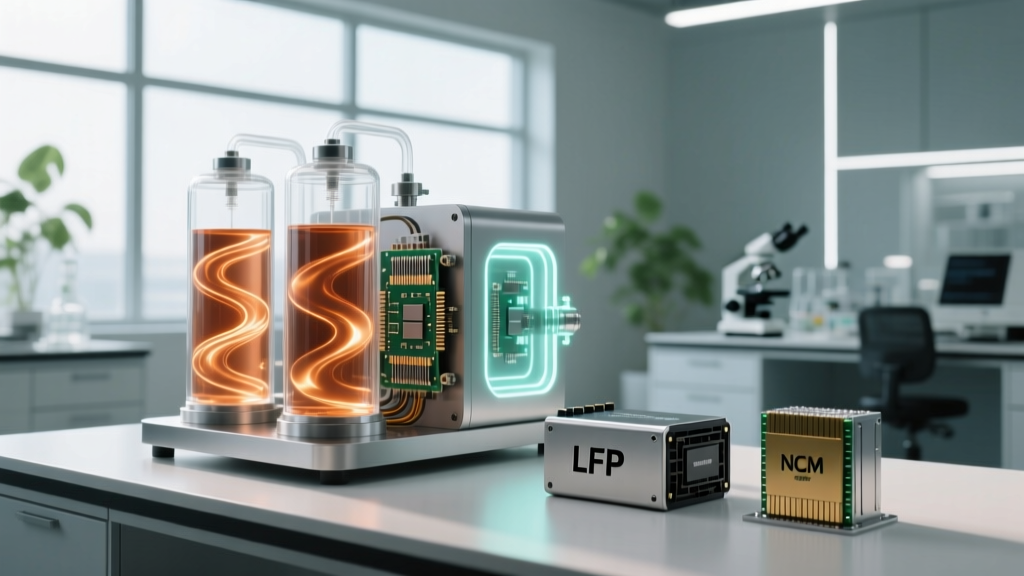
The all-iron flow battery breakthrough generating headlines (notably from companies like ESS Inc.) is real engineering — but it solves a different problem than your EV commute. Flow batteries store energy in liquid electrolyte tanks that are physically separate from the power-conversion stack. This makes them:
- Infinitely scalable in energy: bigger tanks = more kWh, without changing the power stack.
- Extremely long-lived: 20,000+ cycles with near-zero degradation, since the iron electrolyte doesn't structurally fatigue.
- Abundant-material: iron, salt water, no lithium, cobalt, or nickel.
The catch for vehicles: flow batteries have very low energy density — roughly 15–25 Wh/kg at the system level, compared to 160–300 Wh/kg for lithium-ion. A 75 kWh flow pack would weigh over 3,000 kg (6,600 lb), making it physically impossible to fit in a passenger car. Their sweet spot is 4-to-12-hour grid storage for solar and wind — exactly where lithium-ion's cycle life and cost are weakest.
Forward-looking technologies with more direct EV relevance:
- Solid-state batteries: Toyota, Samsung SDI, and QuantumScape target 2027–2030 production. Promised benefits: 350–500 Wh/kg cell-level, 10-minute 10–80% charges, improved safety. Still pre-commercial in vehicles; expect limited luxury-model deployment first.
- Silicon-dominant anodes: Sila Nanotechnologies and Group14 are shipping silicon-carbon anodes now in limited applications (Mercedes G-Class EV, certain consumer electronics). Benefit: 10–20% energy density improvement over graphite anodes. Timeline: incremental rollout 2025–2028.
- Sodium-ion batteries: CATL and BYD have begun production for low-cost, short-range Chinese-market EVs. Lower energy density than LFP but cheaper and cobalt-free. US availability uncertain.
None of these are available in a 2026 US-market EV you can buy today. Treat manufacturer announcements as preliminary until vehicles are in customer hands with EPA-certified range figures.
Frequently Asked Questions
How long do EV batteries last in years and miles?
Modern liquid-cooled lithium-ion packs (LFP or NMC) typically retain 85–90% capacity at 100,000 miles and 80–85% at 150,000 miles over 10–12 years. Most will outlast the vehicle's economic life. Early passive-cooled packs (2011–2017 Leaf, early Bolt) degraded faster, but that generation is no longer in production.
How much does it cost to replace an EV battery out of warranty?
Between $10,000 and $42,000 depending on pack size and chemistry, with most mid-size crossovers (75–80 kWh) falling in the $13,000–$20,000 range. Module-level repairs can cut this substantially. In practice, fewer than 1–2% of EVs require out-of-warranty pack replacement.
What does the battery warranty cover?
Capacity loss below a defined threshold (typically 70% over 8 years / 100,000 miles, or 10 years / 100,000 miles for Hyundai/Kia) and manufacturing defects. It does not cover collision damage, flooding, unauthorized modifications, or normal cosmetic range reduction above the threshold.
How do I check my EV's battery health?
Through the manufacturer's app (Tesla, GM Ultium vehicles), dealer scan tool (Hyundai, Kia, BMW), or OBD-II reader with EV-compatible software. Request a certified SoH report for resale or warranty claims.
LFP or NMC — which should I choose?
Choose LFP if you charge at home daily, want maximum cycle life, prioritize lower cost, and live in a moderate climate. Choose NMC/NCA if you need maximum EPA range per charge, regularly drive in sub-freezing weather, or take frequent long road trips where energy density translates to fewer charging stops.
Will the all-iron flow battery ever power an EV?
Not in any foreseeable passenger vehicle. System-level energy density (~15–25 Wh/kg) is roughly 10× too low for automotive use. Its market is multi-hour grid storage paired with solar and wind, where its 20,000+ cycle life and iron-based chemistry are decisive advantages over lithium-ion.
Does frequent DC fast charging ruin my battery?
No, but it adds measurable wear. Daily 150–350 kW charging versus exclusive Level 2 adds roughly 1–2% extra degradation over 100,000 miles. The effect is manageable — preconditioning, avoiding back-to-back fast charges in hot weather, and staying below 80% SoC on most DC sessions keeps it minor.
For current federal incentive rules affecting EV purchases, including the §30D credit's battery-sourcing requirements that intersect with chemistry choices, consult the IRS clean vehicle credit page or a qualified tax professional. Rules around critical-mineral sourcing have direct implications for which chemistries qualify.