When most EV buyers think about battery chemistry, the conversation stops at lithium-ion. But as raw material costs fluctuate and supply chains strain, alternative chemistries like the zinc bromine battery are generating serious research interest. Zinc-bromine (ZnBr₂) flow batteries have been used in stationary grid storage for years — so could they ever make it into an electric vehicle?
The short answer: not anytime soon for passenger EVs. But understanding why requires a deep look at how zinc bromine stacks up against the two dominant EV chemistries today — LFP (lithium iron phosphate) and NMC (nickel manganese cobalt) — and what actually matters for battery longevity, cost, and real-world driving.
This guide covers every chemistry trade-off, degradation data point, warranty term, and replacement cost you need to make an informed decision about EV battery technology in 2026.
What Is a Zinc Bromine Battery and How Does It Work?
A zinc bromine battery is a type of flow battery that stores energy in liquid electrolyte tanks containing zinc and bromine compounds. During discharge, zinc is oxidized at the anode while bromine is reduced at the cathode. During charging, the process reverses — zinc plates back onto the anode and bromine regenerates at the cathode.
The key architectural difference from lithium-ion cells: in a flow battery, energy capacity is determined by the size of the electrolyte tanks, while power output is determined by the stack (the electrochemical reaction chamber). This decoupling makes flow batteries excellent for long-duration stationary storage — you can scale energy cheaply by adding bigger tanks.
However, that same architecture creates fundamental problems for vehicles:
- Low energy density: Zinc-bromine flow batteries achieve roughly 35–75 Wh/kg at the system level, compared to 150–250+ Wh/kg for modern lithium-ion packs. An EV needing 80 kWh of usable capacity would require a ZnBr₂ system weighing well over 1,000 kg — impractical for a passenger car.
- Moving parts: Pumps circulate electrolyte through the stack, adding complexity, weight, parasitic loss, and failure points that solid-state lithium cells simply don't have.
- Bromine handling: Elemental bromine is corrosive and toxic, requiring robust containment that adds further weight and safety engineering overhead.
- Charge/discharge power limits: Flow batteries typically cannot sustain the high C-rates needed for EV acceleration (3C–4C bursts) or DC fast charging (150–350 kW sustained).
Companies like Redflow (Australia) and several Chinese manufacturers have deployed zinc-bromine systems for telecom backup and grid-scale storage, where weight is irrelevant and long cycle life matters. But for automotive traction batteries, the physics simply don't favor this chemistry today.
LFP vs. NMC vs. Zinc Bromine: Chemistry Trade-Offs Compared
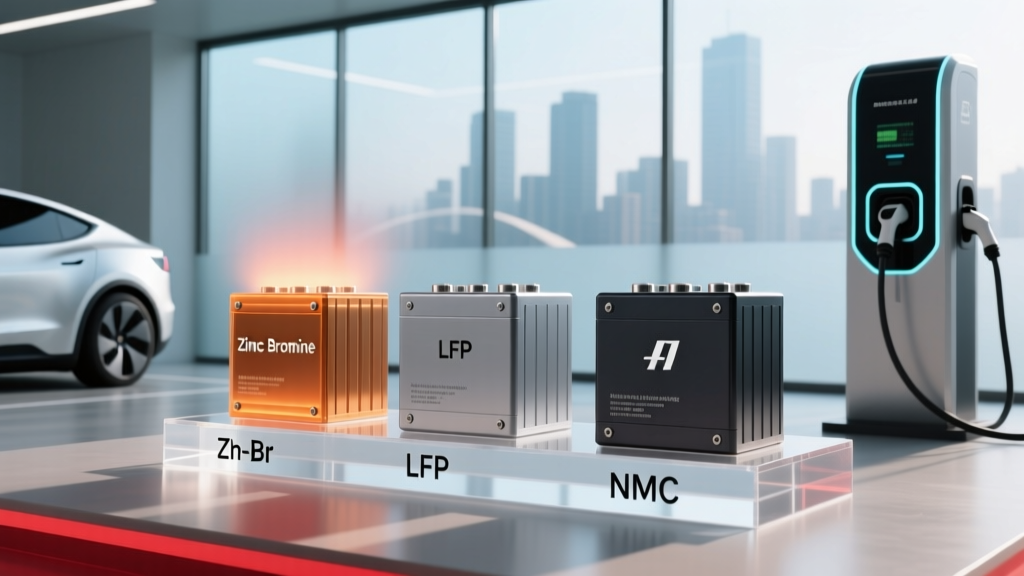
To understand where zinc bromine fits — or doesn't — you need to see it alongside the chemistries that actually power the EVs you can buy right now. Here's a direct comparison:
| Attribute | LFP (LiFePO₄) | NMC / NCA | Zinc Bromine (Flow) |
|---|---|---|---|
| Cell energy density | 140–180 Wh/kg | 200–300 Wh/kg | 35–75 Wh/kg (system) |
| Typical EV use | Standard-range models (Tesla Model 3 RWD, BYD, base Ford Mustang Mach-E) | Long-range / performance models (Model 3 LR, Ioniq 5, Rivian) | Grid storage only — no production EVs |
| Cycle life | 3,000–6,000+ cycles to 80% SoH | 1,000–2,500 cycles to 80% SoH | 5,000–10,000+ cycles (stationary) |
| Cost per kWh (pack level) | ~$90–$115 | ~$120–$155 | ~$200–$350 (flow system) |
| Cold-weather performance | Moderate loss; slower charging below 32°F; heat pump helps | Better low-temp conductivity; preconditioning still needed | Electrolyte can gel/freeze; not rated for automotive temp ranges |
| Thermal runaway risk | Very low — most stable Li-ion chemistry | Low with modern BMS; higher than LFP | No thermal runaway; bromine containment is the safety concern |
| Critical mineral exposure | No cobalt, no nickel — iron and phosphate abundant | Requires nickel, cobalt, manganese — supply chain risk | Zinc and bromine are abundant and cheap |
| Fast-charge capability | Typically 170–250 kW peak; good charge curve | 200–350 kW peak; excellent charge curve | Not applicable — flow architecture limits power density |
The takeaway: zinc bromine excels at cycle life and raw material cost for stationary applications, but its energy density is roughly one-third to one-fifth of what an EV needs. LFP and NMC remain the only chemistries viable for passenger vehicles in 2026.
How Long Do EV Batteries Actually Last?
The most persistent EV myth is that batteries need frequent replacement, like a laptop that dies after two years. Real-world data tells a very different story.
Typical EV battery degradation curve (based on aggregated fleet data):
- Year 1: ~2–3% capacity loss (initial formation loss, normal)
- Years 2–4: ~0.5–1% per year (slow, linear degradation)
- Years 5–8: ~0.5–1.5% per year depending on usage patterns
- Year 8 average SoH: ~88–92% for NMC; ~92–95% for LFP
- Year 10 projected SoH: ~84–90% for NMC; ~89–93% for LFP
- Year 15 projected SoH: ~78–85% for NMC; ~84–90% for LFP
Sources: Geotab fleet analysis, Recurrent Auto battery health reports, manufacturer warranty data.
For context, a Tesla Model 3 Long Range with an NMC pack rated at 341 miles EPA would realistically retain roughly 300–310 miles of range at the 8-year mark — still well above what most daily commutes require. LFP packs in the Model 3 RWD degrade even more slowly thanks to the chemistry's inherent stability.
According to data aggregated by Recurrent Auto, the average EV battery in their study of over 15,000 vehicles showed roughly 92% State of Health at 100,000 miles — far exceeding early pessimistic projections.
Most EV batteries will outlast the vehicle they're installed in. The question isn't whether the battery will "die" — it's whether you'll keep the car long enough to see it drop below 80% capacity.
What Does the EV Battery Warranty Actually Cover?
Federal law in the United States mandates that EV batteries carry a minimum warranty of 8 years or 100,000 miles (whichever comes first). In California and states that follow CARB standards, that extends to 10 years or 150,000 miles. Most manufacturers exceed these minimums.
| Manufacturer | Warranty Period | Mileage Cap | Capacity Retention Threshold |
|---|---|---|---|
| Tesla (Model 3/Y LFP) | 8 years | 100,000 mi | 70% |
| Tesla (Model 3/Y LR NMC) | 8 years | 120,000 mi | 70% |
| Hyundai / Kia | 10 years | 100,000 mi | 70% |
| Ford (Mach-E, F-150 Lightning) | 8 years | 100,000 mi | 70% |
| GM (Ultium-based) | 8 years | 100,000 mi | 70% |
| Rivian | 8 years | 175,000 mi | 70% |
| BMW (i4, iX) | 8 years | 100,000 mi | 70% |
The critical detail: these warranties cover capacity loss below the stated threshold, not total failure alone. If your battery drops to 68% of original capacity at year 6 and 80,000 miles, the manufacturer is obligated to repair or replace it to bring it back above the threshold. In practice, very few owners ever file these claims — the degradation curves above show why.
Warranties typically exclude damage from collisions, flooding, improper modifications, or use of non-approved charging equipment. They also do not cover gradual, normal degradation that stays above the threshold.
How Much Does an EV Battery Replacement Cost?
If your battery does fall below warranty coverage — or you're buying a used EV out of warranty — replacement cost is a legitimate consideration. Here's what the numbers look like in 2026:
| Vehicle / Pack Size | Battery Capacity | Chemistry | Estimated Replacement Cost (Parts + Labor) |
|---|---|---|---|
| Tesla Model 3 RWD | ~60 kWh | LFP | $8,000–$12,000 |
| Tesla Model Y Long Range | ~75 kWh | NMC | $12,000–$16,000 |
| Hyundai Ioniq 5 | 77.4 kWh | NMC | $11,000–$15,000 |
| Ford F-150 Lightning (Extended) | ~131 kWh | NMC | $18,000–$25,000 |
| Chevrolet Bolt EV (2023–2025) | 65 kWh | NMC | $9,000–$14,000 |
| Rivian R1T (Max Pack) | ~149 kWh | NMC | $20,000–$28,000 |
Several important caveats:
- Module-level repair is increasingly common. Many shops can replace individual modules rather than the full pack, cutting costs by 50–70%. A single module replacement might cost $1,500–$4,000.
- Refurbished packs are becoming available from third-party suppliers at 40–60% of new-pack pricing.
- Pack costs continue to decline. According to BloombergNEF, average lithium-ion pack prices fell below $130/kWh in 2025 and are projected to reach $100/kWh by 2027–2028, which would push a 75 kWh replacement to roughly $7,500 at the pack level.
- Most original batteries never need replacement. Data from fueleconomy.gov and fleet operators confirms that the vast majority of EV batteries outlive the useful life of the vehicle itself.
Factors That Accelerate Battery Degradation
Not all miles are equal when it comes to battery health. Here are the primary factors that influence how quickly your pack loses capacity:
1. DC Fast Charging Frequency
Occasional DC fast charging (150–350 kW) has minimal long-term impact. But daily reliance on high-power DC charging — especially without battery preconditioning — accelerates degradation. Studies suggest that vehicles DC-fast-charged more than 3 times per week show roughly 1–3% additional capacity loss over 5 years compared to vehicles primarily charged on Level 2 (7–19 kW). Modern thermal management systems mitigate this significantly, but heat remains the enemy of lithium-ion longevity.
2. Extreme Temperatures
Both sustained heat and extreme cold stress battery chemistry. Operating in ambient temperatures above 95°F (35°C) regularly can add 0.5–1% per year to degradation rates. Cold weather doesn't degrade the battery permanently in the same way, but charging a cold battery without preconditioning can cause lithium plating on the anode — a permanent capacity loss mechanism. Always precondition before DC fast charging in cold weather.
3. State of Charge Habits
For NMC batteries, keeping the pack between 20–80% State of Charge for daily use significantly extends lifespan. Storing or operating at 100% SoC for extended periods accelerates calendar degradation. For LFP batteries, the guidance is different: manufacturers like Tesla and BYD recommend periodically charging to 100% because LFP's voltage curve is so flat that the Battery Management System (BMS) needs full-charge calibration to accurately estimate remaining capacity.
4. Depth of Discharge
Shallow cycles (using 20–40% of the pack per day and recharging) are gentler than deep cycles (draining from 90% to 10% regularly). This is one reason PHEVs with smaller batteries — which cycle more deeply relative to capacity — sometimes show faster relative degradation, even though absolute capacity loss is small.
Battery Care Checklist for Maximum Longevity
- ☑ Charge to 80% daily for NMC; 100% periodically for LFP (per manufacturer guidance)
- ☑ Use Level 2 home charging as your primary method
- ☑ Precondition the battery before DC fast charging, especially in cold weather
- ☑ Avoid leaving the vehicle at 100% SoC for more than 24–48 hours
- ☑ Minimize DC fast charging to 1–2 sessions per week when possible
- ☑ Park in shade or a garage during hot summer months
- ☑ Keep tire pressure optimized — reduces energy draw and heat generation
- ☑ Use the manufacturer's app to monitor State of Health trends over time
How to Check Your EV Battery's State of Health
State of Health (SoH) is expressed as a percentage of the battery's original usable capacity. A new battery is at 100% SoH; one that holds 85 kWh out of an original 100 kWh is at 85% SoH.
Here's how to monitor it:
- OEM apps: Tesla, Hyundai, Ford, and others display estimated range and sometimes direct SoH percentages in their companion apps. Tesla's service menu shows a "Battery Health" test result.
- OBD-II readers with EV support: Devices like the OBDLink SX paired with apps such as EV Health or LeafSpy (for Nissan) can pull real SoH data from the BMS.
- Third-party services: Companies like Recurrent Auto offer free battery health reports by connecting to your vehicle's telematics data. Their reports compare your pack against a fleet of identical vehicles.
- Manual calculation: Charge to 100%, note the displayed range, and compare it to the original EPA rating adjusted for your driving style. This is imprecise but gives a rough estimate.
For used-EV buyers, a pre-purchase battery health check is essential. Request a SoH report or have a dealer run a diagnostic before purchase. A pack at 90%+ SoH with 50,000 miles has plenty of life remaining.
Emerging Battery Tech: What's Next After LFP and NMC?
While zinc bromine remains a stationary-storage technology, several next-generation chemistries are targeting EV applications:
- Solid-state batteries: Toyota, Samsung SDI, and QuantumScape are targeting 2027–2029 production timelines. Solid-state cells promise 300–500 Wh/kg energy density, faster charging, and reduced fire risk. However, manufacturing scale-up and cost remain significant hurdles. Expect initial deployment in premium vehicles at high MSRPs before any mainstream adoption.
- Silicon-dominant anodes: Companies like Sila Nanotechnologies and Group14 are replacing graphite anodes with silicon composites, boosting energy density by 20–40%. These are beginning to appear in 2025–2026 model-year vehicles and represent an incremental but meaningful improvement to existing NMC and NCA cells.
- Sodium-ion batteries: CATL and BYD are producing sodium-ion cells for low-cost, short-range EVs — primarily in China. Energy density (~120–160 Wh/kg) limits them to city cars and micro-EVs, but the cost advantage is substantial. U.S. availability is not expected before 2028.
- Lithium-sulfur: Still in lab and early prototype stages. Theoretical energy density is exceptional (500+ Wh/kg), but cycle life remains far too low for automotive use. Realistic timeline: 2030+ at the earliest.
None of these technologies are currently available in production EVs sold in the U.S. market. Any vehicle marketed with "solid-state" or "next-gen" battery claims should be treated as announced/preliminary until independent EPA range and charging data confirm performance.
Frequently Asked Questions
Will a zinc bromine battery ever be used in an EV?
It's extremely unlikely for passenger vehicles. Zinc-bromine flow batteries have energy densities of 35–75 Wh/kg — roughly one-fifth of modern lithium-ion. That would require a pack weighing over 1,000 kg to achieve 80 kWh of usable capacity. The chemistry is well-suited to stationary grid storage where weight doesn't matter and cycle life (5,000–10,000+ cycles) is the priority. For EVs, LFP and NMC remain the practical choices, with solid-state as the most promising future alternative.
How long do EV batteries last in real-world use?
Based on aggregated fleet data from Geotab and Recurrent Auto, most modern EV batteries retain 88–95% of their original capacity at the 8-year mark, depending on chemistry (LFP degrades more slowly than NMC). At 200,000 miles, most packs still hold 80%+ capacity. With proper care, an EV battery should last 15–20 years before dropping below 70% SoH — at which point the vehicle itself is likely at end-of-life.
How much does it cost to replace an EV battery in 2026?
Full-pack replacement costs range from roughly $8,000 for a 60 kWh LFP pack (Tesla Model 3 RWD) to $25,000+ for a 130+ kWh NMC pack (F-150 Lightning Extended Range). However, module-level repairs can reduce costs to $1,500–$4,000, and the vast majority of EV batteries never require replacement during the vehicle's useful life. Pack prices continue to decline, with $100/kWh expected by 2027–2028.
Is LFP better than NMC for daily driving?
For most daily drivers, LFP is the better choice: longer cycle life (3,000–6,000+ cycles), lower cost, no cobalt, and superior thermal stability. The trade-off is lower energy density (roughly 15–25% less range for the same pack weight) and reduced cold-weather fast-charging performance. If you need maximum range for road trips or live in a cold climate, NMC still has an edge. For commuting and city driving, LFP is hard to beat.
Does fast charging damage my EV battery?
Occasional DC fast charging has negligible long-term impact. However, frequent daily DC fast charging (3+ times per week) without battery preconditioning can add 1–3% additional capacity loss over 5 years. Modern EVs have active thermal management that preconditions the pack before fast charging — always ensure this feature is enabled. For daily charging, Level 2 at home (7–19 kW) is the gentler, more economical option.
How do I know if my battery warranty applies?
Federal law mandates 8 years/100,000 miles minimum battery coverage (10 years/150,000 miles in CARB states). The warranty covers capacity loss below the manufacturer's threshold (typically 70% of original capacity). If your battery drops below this threshold within the warranty period, contact the manufacturer or an authorized dealer for a diagnostic. Keep records of your charging habits, as extreme abuse (e.g., repeated 0% storage, unauthorized modifications) can void coverage.