The Short Answer: EV Batteries Outlast Most Expectations
The single biggest fear among prospective EV buyers isn't range or charging speed — it's the battery. Specifically: what happens to electric car batteries after 5, 10, or 15 years of use? The data from millions of vehicles on the road tells a clear story: modern lithium-ion traction batteries degrade slowly, predictably, and in most cases will outlast the useful life of the vehicle itself.
That said, degradation is real, measurable, and influenced by how you charge and drive. This guide breaks down the chemistry, the numbers, the costs, and the habits that determine how your EV's battery ages — with exact figures, not marketing promises.
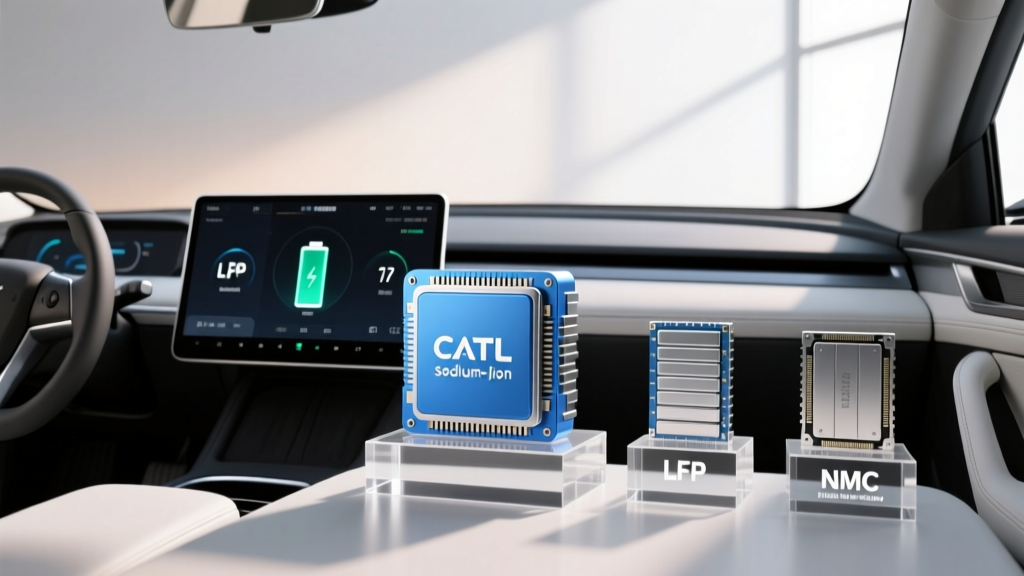
LFP vs NMC/NCA: The Chemistry That Defines Your Battery's Life
Not all EV batteries are built the same. The two dominant cathode chemistries in 2026 passenger EVs are NMC/NCA (nickel manganese cobalt / nickel cobalt aluminum) and LFP (lithium iron phosphate). The chemistry in your car determines its energy density, cycle life, cold-weather behavior, and cost.
| Attribute | LFP (Lithium Iron Phosphate) | NMC/NCA (Nickel-based) |
|---|---|---|
| Energy density | Lower (~160–180 Wh/kg cell-level) | Higher (~220–300 Wh/kg cell-level) |
| Typical cycle life | 3,000–5,000+ cycles to 80% SoH | 1,000–2,500 cycles to 80% SoH |
| Cold-weather performance | More range loss below freezing (~30–40%) | Better cold performance (~20–30% loss) |
| Cost per kWh | Lower — no cobalt or nickel | Higher — commodity-sensitive |
| Optimal daily SoC | Can charge to 100% regularly | Best kept at 80–90% daily; 100% for trips |
| Common in | Tesla Model 3/Y RWD, Ford Mustang Mach-E Select (2025+), BYD models | Most long-range/AWD trims, Hyundai Ioniq 5/6, Rivian, GM Ultium vehicles |
The trade-off in plain terms: NMC/NCA gives you more range in a lighter, smaller pack — ideal for long-range and performance trims. LFP sacrifices some energy density for dramatically longer cycle life, lower cost, and simpler daily charging habits. If your commute is under 60 miles round-trip and you want a battery that could theoretically last 15+ years with minimal degradation, LFP is the stronger longevity play. If you need maximum range and cold-weather capability, NMC/NCA is the pragmatic choice.
How Long Do EV Batteries Actually Last?
Based on aggregated fleet data from Tesla, real-world studies by Recurrent Auto, and manufacturer testing, here is what degradation looks like across time and mileage for a typical liquid-cooled lithium-ion EV battery:
| Timeframe / Mileage | Typical Capacity Retained (SoH) | What That Means in Practice |
|---|---|---|
| Year 1 / ~12,000 mi | 96–98% | Initial calibration loss; barely noticeable |
| Year 3 / ~36,000 mi | 93–96% | Slight range reduction; ~10–15 mi less on a 300-mi EPA car |
| Year 5 / ~60,000 mi | 90–94% | Measurable but manageable; ~18–30 mi less |
| Year 8 / ~100,000 mi | 85–92% | Noticeable on long trips; still well within warranty threshold |
| Year 10 / ~120,000 mi | 82–90% | A 300-mi car now delivers ~246–270 mi usable range |
| Year 15 / ~180,000 mi | 75–88% | Approaching or at warranty threshold; replacement may be considered |
A few critical nuances:
- The degradation curve is not linear. Most capacity loss occurs in the first 12–18 months (the "break-in" phase), then the curve flattens significantly. A battery at 94% SoH at year 3 will likely still be at 88–90% at year 8.
- LFP batteries degrade more slowly in terms of cycle count, but their lower starting energy density means absolute range loss feels similar in the early years.
- Liquid thermal management matters. Vehicles with active liquid cooling (Tesla, Hyundai E-GMP, GM Ultium, Rivian) consistently outperform passively cooled packs (older Nissan Leaf) in long-term degradation data.
According to data published by the National Renewable Energy Laboratory (NREL), a modern EV battery is expected to retain approximately 85–90% of its original capacity after 100,000 miles under typical use conditions.
What Does the EV Battery Warranty Actually Cover?
Federal law in the United States mandates that EV batteries carry a minimum warranty of 8 years or 100,000 miles (whichever comes first). In California Air Resources Board (CARB) states, that extends to 10 years or 150,000 miles. Most manufacturers meet or exceed these minimums. Here is how the major warranties compare for 2026 model-year vehicles:
| Manufacturer | Battery Warranty | Capacity Retention Threshold |
|---|---|---|
| Tesla (Model 3/Y) | 8 yr / 100,000 mi (LFP RWD); 8 yr / 120,000 mi (Long Range) | 70% |
| Hyundai / Kia (E-GMP) | 10 yr / 100,000 mi | 70% |
| GM (Ultium-based) | 8 yr / 100,000 mi | 70% |
| Ford (Mach-E, F-150 Lightning) | 8 yr / 100,000 mi | 70% |
| Rivian (R1T, R1S) | 8 yr / 175,000 mi | 70% |
| BMW (iX, i4) | 8 yr / 100,000 mi | 70% |
What "70% capacity retention" means: If your 82 kWh (usable) battery drops below 57.4 kWh of usable capacity within the warranty period, the manufacturer must repair or replace it at no cost. In practice, very few batteries fall below this threshold under normal use — it represents a worst-case contractual floor, not a typical outcome.
What's NOT covered: Gradual degradation above the threshold (e.g., losing 15% capacity over 7 years is considered normal), damage from accidents, flooding, improper charging equipment, or unauthorized modifications. Always read the specific warranty booklet for your model.
How Much Does an EV Battery Replacement Cost?
This is the question that generates the most anxiety — and the most misinformation. Let's put real numbers to it.
| Vehicle / Pack Size | Approximate Replacement Cost (Parts + Labor) | Typical Replacement Timeline |
|---|---|---|
| Tesla Model 3 RWD (~60 kWh LFP) | $12,000–$16,000 | Rarely needed within 15 years |
| Tesla Model Y LR (~82 kWh NMC) | $14,000–$20,000 | Rarely needed within 15 years |
| Hyundai Ioniq 5 (~77.4 kWh) | $14,000–$18,000 | Rarely needed within 12–15 years |
| Ford F-150 Lightning Ext. Range (~131 kWh) | $22,000–$32,000 | Rarely needed within 12–15 years |
| Chevrolet Equinox EV (~85 kWh) | $13,000–$17,000 | Rarely needed within 12–15 years |
| Rivian R1T Max Pack (~149 kWh) | $25,000–$35,000 | Rarely needed within 12–15 years |
The critical context most coverage omits: Battery replacement at full cost is exceedingly rare. The vast majority of EV batteries will retain 75–90% of their capacity over the vehicle's practical lifespan (10–15 years / 150,000–200,000 miles). When batteries do fail prematurely, it is typically a single module or cell group — not the entire pack — and many shops now offer module-level repair for $2,000–$5,000 rather than full replacement.
Battery prices have also dropped roughly 80% since 2013 (from ~$700/kWh to under $130/kWh at the cell level in 2025–2026, per BloombergNEF data). If you do need a replacement in 2035, it will almost certainly cost less than today's estimates.
What Accelerates Battery Degradation (and What Doesn't)
Based on fleet data and electrochemistry fundamentals, here are the factors that genuinely impact long-term battery health:
Habits That Preserve Battery Health
- Daily charging to 80% (NMC/NCA) or 100% (LFP): Storing an NMC battery at 100% SoC for extended periods accelerates electrolyte decomposition. LFP chemistry tolerates full charges far better.
- Use Level 2 home charging as your primary method: Slow, steady charging generates less heat stress than repeated DC fast charging.
- Precondition the battery before fast charging: Most modern EVs do this automatically when you navigate to a charger. A cold battery charged at high power suffers lithium plating — a permanent degradation mechanism.
- Park in shade or a garage during extreme heat: Sustained battery temperatures above 95°F (35°C) accelerate calendar aging even when the car is off.
- Drive the car regularly: Batteries that sit at low SoC for months without use can suffer from copper dissolution in the anode current collector.
Factors With Less Impact Than Commonly Believed
- Occasional DC fast charging: A few road-trip fast charges per month are fine. The degradation concern applies to daily DCFC use as a primary charging method. Modern BMS (battery management systems) actively manage charge rates to protect the pack.
- Regenerative braking: Regen currents are well within safe C-rate limits and do not meaningfully accelerate degradation.
- Cold weather range loss: This is temporary — range recovers when temperatures rise. Cold does not permanently damage the battery unless you fast-charge a frozen pack without preconditioning.
How to Monitor Your Battery's State of Health
State of Health (SoH) is the metric that tells you how much capacity your battery retains compared to its original specification. Here is how to check it:
- In-vehicle displays: Tesla shows a battery health estimate in the service menu (or via the app). Hyundai/Kia provides a battery health readout in the EV settings. GM's Ultium vehicles display estimated battery capacity in the driver information center.
- OBD-II dongles + apps: Tools like OBDLink SX/MX+ paired with apps such as EVNotify, LeafSpy (Nissan), or manufacturer-specific scan tools can read the BMS-reported SoH directly. This is the most accurate consumer method.
- Third-party services: Recurrent offers a free battery health report that compares your degradation curve against a fleet of identical vehicles, giving you a clear percentile ranking.
- Dealer diagnostic: Any authorized service center can pull a full battery health report during routine service. Request this before purchasing a used EV.
What to watch for: A sudden drop in SoH (e.g., 3–5% in a single month) is abnormal and may indicate a failing module — this is a warranty claim scenario. Gradual, linear decline of 1–3% per year is expected and healthy.
What's Next: Solid-State and Silicon-Anode Batteries
Next-generation battery technologies are in active development, but it is important to separate announcements from production reality:
- Solid-state batteries: Toyota, Samsung SDI, and QuantumScape have demonstrated prototypes with 500+ mile range potential and faster charging. Toyota has announced a target for limited commercial production around 2027–2028, initially in low-volume luxury models. Mass-market availability is not expected before 2030. These should be considered forward-looking and are not available in any production vehicle as of 2026.
- Silicon-anode batteries: Companies like Sila Nanotechnologies and Group14 are shipping silicon-dominant anode materials that boost energy density by 20–40% over graphite. These are beginning to appear in limited applications (e.g., Mercedes G-Class 580e in select markets) and will scale through the late 2020s.
- Sodium-ion batteries: CATL and BYD are producing sodium-ion cells for lower-cost, shorter-range applications. These offer excellent cycle life and cold performance but lower energy density — likely destined for city cars and fleet vehicles rather than long-range models.
For buyers in 2026: today's NMC and LFP batteries are mature, well-understood technologies with extensive real-world track records. Waiting for solid-state is not a practical strategy for anyone who needs a vehicle in the next 1–3 years.
Frequently Asked Questions
How long do electric car batteries last in years and miles?
Based on fleet data, most modern EV batteries retain 82–90% of their original capacity after 10 years or 120,000 miles. The battery will typically outlast the vehicle's practical service life of 15–20 years. Complete failure requiring full replacement before 150,000 miles is rare with liquid-cooled packs.
How much does it cost to replace an EV battery?
Full replacement costs range from approximately $12,000 for a smaller pack (Tesla Model 3 RWD, ~60 kWh) to $32,000+ for large packs (F-150 Lightning Extended Range, ~131 kWh). However, most batteries never need replacement, and module-level repairs cost $2,000–$5,000 when needed. Battery cell prices continue to decline year over year.
What does the EV battery warranty cover?
Federal law requires a minimum 8-year/100,000-mile warranty (10 years/150,000 miles in CARB states). Coverage applies if the battery drops below a specified capacity threshold — typically 70% of original capacity. The warranty covers defects and abnormal degradation but not gradual loss above the threshold or damage from misuse.
Is LFP or NMC better for battery longevity?
LFP chemistry offers significantly longer cycle life (3,000–5,000+ cycles vs. 1,000–2,500 for NMC) and tolerates daily 100% charging. However, LFP has lower energy density (less range per kWh) and worse cold-weather performance. For maximum longevity in moderate climates with shorter commutes, LFP wins. For long-range needs and cold climates, NMC is the better fit.
Does fast charging damage my EV battery?
Occasional DC fast charging (a few times per month on road trips) has minimal impact on battery health. The concern is using DCFC as your primary daily charging method, which increases cumulative heat stress. Modern battery management systems throttle charge rates to protect the pack. For daily use, Level 2 home charging at 7–11 kW is ideal.
Can I check my EV battery health myself?
Yes. Many EVs display battery health estimates in-vehicle or via the manufacturer app. For more precise readings, use an OBD-II scanner with EV-compatible software, or sign up for a free report from services like Recurrent Auto. Always request a battery health report before buying a used EV.