Headlines about Toyota's solid-state battery breakthroughs surface every few months, promising 750-mile ranges and 10-minute charge times. But for buyers shopping for an EV today, the relevant question is simpler: How do current lithium-ion batteries actually perform over a decade of real-world use, and what will it cost if something goes wrong?
This guide breaks down the chemistry, degradation data, warranty coverage, and replacement economics of the batteries powering today's EVs — and explains exactly where Toyota's solid-state ambitions fit into the timeline.
Today's EV Battery Chemistries: LFP vs. NMC Explained
Every battery-electric vehicle on the road in 2026 uses one of two dominant lithium-ion chemistries in its high-voltage traction pack: NMC (nickel manganese cobalt, sometimes NCA — nickel cobalt aluminum) or LFP (lithium iron phosphate). The chemistry choice affects range, longevity, cold-weather performance, and cost.
| Attribute | LFP (Lithium Iron Phosphate) | NMC / NCA |
|---|---|---|
| Energy Density | Lower (~160 Wh/kg cell-level) | Higher (~230–260 Wh/kg cell-level) |
| Typical Use | Standard-range / lower-cost trims (Tesla Model 3 RWD, base Model Y) | Long-range / performance trims, most premium EVs |
| Cycle Life | 3,000–5,000+ full cycles before 80% capacity | 1,000–2,000 full cycles before 80% capacity |
| Cold-Weather Performance | More range loss in freezing temps (~30–40%) | Better cold performance (~20–30% loss) |
| Charging to 100% | Manufacturer recommends regular 100% charges for SoC calibration | Best kept at 80% daily; 100% only for trips |
| Cost | ~20–30% cheaper per kWh (no cobalt or nickel) | Higher raw-material cost |
| Thermal Stability | Excellent — less prone to thermal runaway | Good with active thermal management |
Which is better? Neither is universally superior. If you prioritize maximum range per charge and don't mind managing state-of-charge habits, NMC delivers more miles in a smaller, lighter pack. If you want a battery that tolerates daily 100% charging, lasts longer in total cycle count, and costs less upfront, LFP is the pragmatic pick — especially for commuters with home charging who rarely need the last 15% of range.
How Long Do EV Batteries Actually Last?
High-voltage traction batteries in modern EVs are designed to outlast the vehicle itself for most owners. The data supports this.
According to long-term fleet analyses, including data referenced by the National Renewable Energy Laboratory (NREL), typical lithium-ion EV packs lose roughly 1–2% of total capacity per year under normal use. That translates to:
- Year 1–2: ~2–4% capacity loss (steepest initial drop, then levels off)
- Year 5: ~8–12% total loss (so a 300-mile EPA pack delivers ~265–275 real-world miles)
- Year 8: ~12–18% total loss (still above most warranty thresholds)
- Year 10–12: ~18–25% total loss for NMC; ~10–15% for LFP in favorable conditions
- Year 15+: Many packs still functional at 70–80% capacity — usable but noticeably reduced range
Real-world examples reinforce the lab data. Tesla's 2025 Impact Report noted that Model S/X vehicles at 150,000 miles retained an average of ~88% of original battery capacity. Hyundai-Kia's E-GMP platform vehicles (Ioniq 5, EV6) have shown similarly modest degradation in owner-reported data, typically 5–8% loss over the first 60,000 miles.
The critical point: most EV batteries are not replaced during the vehicle's normal ownership life. Catastrophic failure (sudden, total battery death) is rare and usually covered under warranty. Gradual degradation simply means less range over time — not a stranded vehicle.
What Does the Battery Warranty Actually Cover?
Federal law mandates a minimum EV battery warranty of 8 years / 100,000 miles (10 years / 150,000 miles in California and states adopting CARB emissions standards). But the details vary significantly by manufacturer.
| Manufacturer | Warranty Term | Capacity Retention Threshold | Notes |
|---|---|---|---|
| Tesla (Model 3/Y LFP) | 8 yr / 120,000 mi | 70% | Longer mileage for LFP trims |
| Tesla (Model S/X) | 8 yr / 150,000 mi | 70% | Premium-tier coverage |
| Hyundai / Kia | 10 yr / 100,000 mi | 70% | Among the longest terms |
| Ford (Mustang Mach-E, F-150 Lightning) | 8 yr / 100,000 mi | 70% | Standard federal minimum+ |
| GM (Ultium platform) | 8 yr / 100,000 mi | 70% | Includes battery pack and components |
| Toyota (bZ4X) | 10 yr / 100,000 mi | 70% | Extended EV battery coverage |
| Volkswagen (ID.4) | 8 yr / 100,000 mi | 70% | Standard coverage |
The 70% capacity retention threshold is the industry standard trigger: if your battery degrades below 70% of its original capacity within the warranty period, the manufacturer must repair or replace it at no cost. In practice, very few vehicles hit this threshold under normal use — which is precisely why manufacturers are comfortable offering it.
Important caveat: warranties typically exclude damage from accidents, improper charging equipment, modifications, or operating the vehicle outside specified temperature ranges. Read the fine print in your owner's manual.
EV Battery Replacement Cost: What to Expect
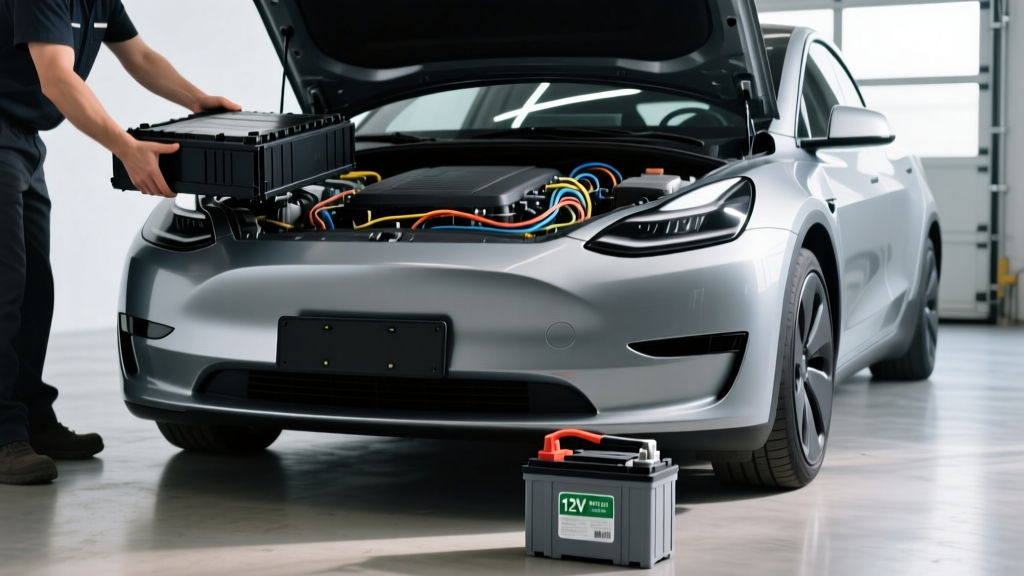
If a battery does fail outside warranty — or if you're buying a used EV and want to budget for a worst-case scenario — here's what replacement looks like in 2026.
| Vehicle / Pack Size | Battery Capacity | Replacement Cost (Parts + Labor) | When Typically Needed |
|---|---|---|---|
| Tesla Model 3 RWD (LFP) | ~60 kWh | $10,000–$13,000 | Rare before 200,000+ mi |
| Tesla Model Y LR (NMC) | ~75 kWh | $13,000–$16,000 | Rare before 200,000+ mi |
| Hyundai Ioniq 5 | ~77.4 kWh | $14,000–$18,000 | Rare before 150,000+ mi |
| Ford F-150 Lightning Ext. Range | ~131 kWh | $22,000–$30,000 | Large pack = higher cost |
| Chevrolet Bolt EV/EUV | ~65 kWh | $14,000–$16,000 | Post-recall packs are improved |
| Toyota bZ4X | ~71.4 kWh | $13,000–$17,000 | Limited long-term data; expected 150,000+ mi |
These figures represent full pack replacement at a dealership. Independent EV shops and refurbished/remanufactured packs can reduce costs by 20–40%. Also note that module-level replacement (swapping only the degraded or failed cell modules rather than the entire pack) is increasingly available for some platforms, bringing costs down to $3,000–$7,000 in some cases.
Context matters: the average American drives ~13,500 miles per year (FHWA data). At that rate, reaching 150,000 miles takes over 11 years — by which point most owners have already moved to a new vehicle.
Factors That Accelerate (or Preserve) Battery Life
Not all miles are equal when it comes to battery wear. These factors have the largest measurable impact on long-term State of Health (SoH):
What Hurts Battery Longevity
- Frequent DC fast charging above 150 kW — occasional road-trip use is fine, but daily DCFC sessions accelerate degradation by generating sustained high heat in cells
- Regularly sitting at 100% SoC — especially for NMC packs; high voltage stresses cathode material over time
- Deep discharges to 0% — letting the pack fully deplete (not just low-battery warning, but actual 0%) damages cell chemistry
- Prolonged exposure to extreme heat — parking in 110°F+ desert sun for weeks without thermal management active
- Aggressive driving with high regen — constant high-C-rate charge/discharge cycles generate more heat than moderate driving
What Preserves Battery Longevity
- Daily charging to 80% (NMC) or 100% (LFP, as recommended by the manufacturer)
- Level 2 home charging as the primary method — slower charge rates produce less heat
- Preconditioning the battery before fast charging (most EVs do this automatically when you navigate to a charger)
- Keeping SoC between 20–80% for daily use on NMC packs
- Garage parking in extreme climates — keeps the pack within its thermal comfort zone
- Software updates — OEMs regularly refine battery management algorithms to reduce wear
How to Check Your Battery's State of Health (SoH)
State of Health is the percentage of original capacity your battery can still hold. A new EV has 100% SoH; a battery at 85% SoH holds 85% of its original kWh.
Most modern EVs provide SoH visibility through:
- In-vehicle menus: Tesla, Hyundai, and BMW include battery health readouts in the service or energy menus. Toyota's bZ4X displays a battery health indicator in the multi-information display.
- OEM apps: The FordPass, myChevrolet, and Tesla apps show estimated range trends that indirectly reflect SoH over time.
- OBD-II diagnostic tools: Third-party apps like Leaf Spy (Nissan), Scan My Tesla, or ABRP OBD can read detailed cell-level data including individual module voltage variance, which is a more precise health indicator than a single SoH percentage.
- Dealer diagnostic reports: Any authorized service center can pull a full battery health report — request this during routine service or before purchasing a used EV.
For used-EV buyers: Always request a battery health report before purchase. A 5-year-old EV showing 90%+ SoH with consistent Level 2 charging history is a strong indicator of careful ownership. Below 80% SoH on a vehicle still under warranty should trigger a warranty claim.
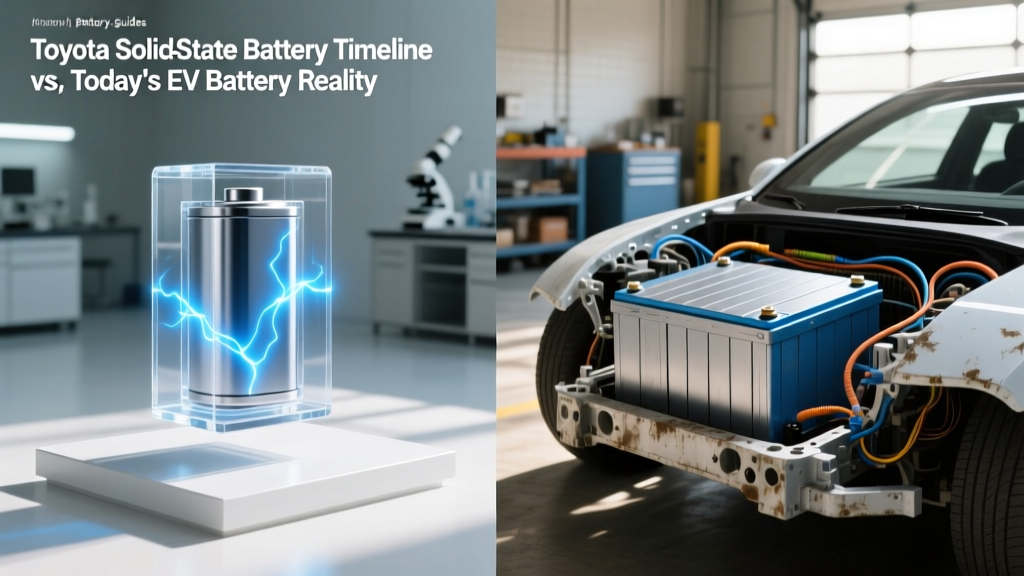
Toyota's Solid-State Battery: What's Real and What's Not (Yet)
Toyota has announced a phased rollout of solid-state battery technology, with the company's most recent timeline targeting commercial production beginning around 2027–2028 for limited-model deployment. Toyota's stated goals for solid-state cells include:
- Energy density roughly 2× current NMC cells, enabling 450–750 miles of range in a mid-size sedan
- DC fast charging from 10–80% in approximately 10 minutes
- Improved safety (solid electrolyte is non-flammable, unlike liquid electrolyte in current Li-ion cells)
- Longer cycle life with less degradation
These are announced targets for future vehicles — no Toyota solid-state EV is available for purchase in 2026. Toyota has also acknowledged that initial production volumes will be limited and costs will be high, likely restricting early solid-state packs to premium models or the Lexus lineup.
Toyota's current EV battery strategy relies on conventional lithium-ion technology in the bZ4X (71.4 kWh NMC pack, EPA range up to 252 miles) and the bZ series. The company's hybrid vehicles (Prius, RAV4 Hybrid, Camry Hybrid) use smaller NiMH or lithium-ion packs that are not comparable in size or function to full EV traction batteries.
Realistic timeline assessment: Solid-state batteries represent genuine engineering progress, but scaling from lab prototypes to millions of affordable vehicle packs is a multi-year manufacturing challenge. Industry analysts broadly expect solid-state EVs to reach meaningful volume (5%+ of global EV sales) no earlier than 2030–2032. For buyers making a purchase decision in 2026, today's LFP and NMC batteries — with their proven degradation curves, established warranty coverage, and declining costs — are the practical choice.
Frequently Asked Questions
How long do EV batteries last in years and miles?
Based on fleet data and manufacturer reports, most modern EV batteries retain 70–85% of original capacity at 150,000 miles (roughly 10–12 years of average driving). LFP chemistries tend to degrade more slowly than NMC. Catastrophic failure is rare; gradual range loss is the norm.
How much does it cost to replace an EV battery?
Full pack replacement ranges from roughly $10,000 for a 60 kWh pack (Tesla Model 3 RWD) to $30,000 for a 131 kWh pack (F-150 Lightning Extended Range). Module-level repairs can cost $3,000–$7,000. Most batteries are not replaced during normal ownership — they outlast the vehicle's economic life.
What does the EV battery warranty cover?
Federal minimum is 8 years / 100,000 miles (10 years / 150,000 miles in CARB states). Coverage triggers if capacity drops below ~70% of original. This covers defects and abnormal degradation, not accident damage, misuse, or improper charging equipment.
Is LFP or NMC better for daily driving?
For daily commuting with home charging, LFP offers longer cycle life, tolerance for regular 100% charges, lower cost, and better thermal stability — at the trade-off of lower energy density (less range per pound) and worse cold-weather performance. NMC is better if you need maximum range or live in cold climates. Neither is universally superior.
Does frequent DC fast charging damage the battery?
Occasional DC fast charging (road trips, a few times per month) has minimal measurable impact. Daily DCFC at high power (150 kW+) does accelerate degradation due to sustained heat generation. For daily charging, Level 2 at home (7–11.5 kW) is the optimal balance of speed and battery preservation.
When will Toyota's solid-state battery be available?
Toyota has announced a target of 2027–2028 for initial commercial production, with limited availability likely in premium models first. Meaningful volume production across affordable models is not expected before 2030+. No Toyota solid-state EV is currently available for purchase.
Should I wait for solid-state batteries before buying an EV?
If you need a vehicle in 2026, waiting for solid-state is not practical — the technology is years from affordable, high-volume availability. Today's batteries offer proven reliability, 8–10 year warranties, and declining costs. The EV you buy now will likely be replaced before solid-state packs reach mainstream pricing.