Toyota's repeated promises about solid-state batteries have generated more headlines than any other EV battery technology story in the last three years. The claims are tantalizing: 750+ km of range, 10-minute fast charges, and a lifespan that could outlast two vehicle generations. But with Toyota's first solid-state-equipped vehicles still not available to consumers as of 2026, the practical question for buyers is more grounded: how do these projected solid-state lifespans compare to the batteries powering EVs you can actually buy today?
This guide dissects what we know about Toyota's solid-state battery timeline alongside hard data on current lithium-ion EV batteries — degradation curves, warranty terms, replacement costs, and the chemistry choices (LFP vs. NMC) that define how long your pack will actually last.
Toyota Solid-State Battery: Promised Lifespan vs. Reality
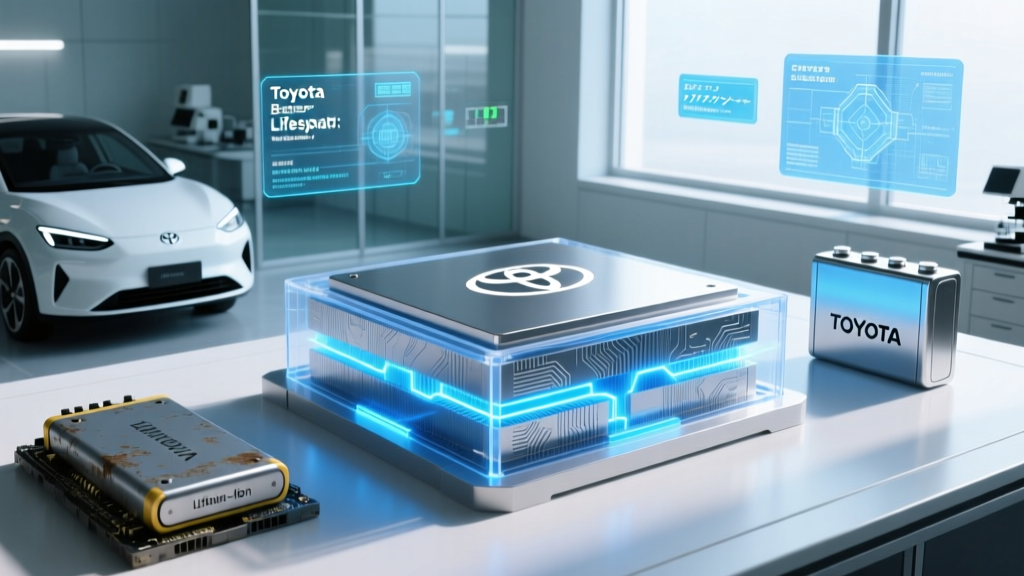
Toyota's solid-state battery program, developed in partnership with Idemitsu Kosan, targets a battery that can sustain over 80% capacity retention after 1,000 full charge cycles — roughly equivalent to 200,000+ miles of driving. Toyota has stated in technical briefings that its sulfide-based solid electrolyte design aims for degradation rates lower than current liquid-electrolyte lithium-ion cells, partly because solid electrolytes resist the dendrite formation and electrolyte decomposition that drive conventional battery aging.
However, critical context is required:
- Availability: Toyota has announced limited production beginning around 2027–2028, initially in small volumes for select models. Mass production is targeted for 2030 and beyond.
- No independent validation: Because no consumer vehicle with Toyota's solid-state pack has been delivered, there are zero real-world, third-party degradation datasets available. All lifespan figures are manufacturer projections.
- Cost barrier: Toyota has acknowledged that early solid-state packs will be expensive, likely reserved for premium or performance trims before economies of scale bring costs down.
How Long Do Current EV Batteries Actually Last?
For the batteries you can buy today, the data is robust. Modern EV traction batteries (not the 12V auxiliary battery that runs accessories) are lasting significantly longer than early-generation packs from the 2011–2015 era.
According to data aggregated from fleet studies and manufacturer reports, the average modern EV battery loses approximately 5–8% of its original capacity over the first 100,000 miles, with the degradation curve flattening considerably after the initial 20,000–30,000 miles. A 2024 study by Recurrent Auto, analyzing data from over 15,000 EVs, found that most packs retain 90–95% of their original capacity at the 5-year mark under normal use conditions.
- Year 1 / 15,000 mi: 2–4% capacity loss (initial settling)
- Year 3 / 45,000 mi: 5–7% cumulative loss
- Year 5 / 75,000 mi: 7–10% cumulative loss
- Year 8 / 120,000 mi: 10–15% cumulative loss
- Year 10+ / 150,000+ mi: 15–20% cumulative loss (many packs still functional)
Source: Recurrent Auto fleet data, manufacturer warranty thresholds, and independent testing by Argonne National Laboratory.
Several high-mileage examples reinforce this. Tesla Model S and Model 3 fleets have produced numerous reports of packs exceeding 200,000 miles with 80%+ capacity retention. The Chevrolet Bolt EV, despite its recall for manufacturing defects in early models, has shown strong longevity in unaffected units. Nissan Leaf owners with the larger 62 kWh pack report 85–90% capacity at 80,000 miles, a marked improvement over the early 24 kWh Leaf packs that degraded rapidly in hot climates.
Battery Chemistry: LFP vs. NMC vs. NCA — What Lasts Longer?
The chemistry inside your battery pack is the single biggest determinant of lifespan, cost, and performance characteristics. Two dominant chemistries power the current EV market:
| Attribute | LFP (Lithium Iron Phosphate) | NMC/NCA (Nickel Manganese Cobalt / Nickel Cobalt Aluminum) |
|---|---|---|
| Cycle Life | 3,000–5,000+ cycles to 80% SoH | 1,000–2,000 cycles to 80% SoH |
| Energy Density | Lower (~160 Wh/kg cell-level) | Higher (~250–300 Wh/kg cell-level) |
| Cold Performance | Weaker — more range loss below 32°F | Better low-temp discharge capability |
| Cost | Lower — no cobalt or nickel | Higher — commodity metals exposure |
| Charging to 100% | Tolerates daily 100% SoC well | Best kept 20–80% daily; 100% for trips only |
| Thermal Stability | Excellent — very resistant to thermal runaway | Good with active thermal management |
| Common Applications | Tesla Model 3/Y RWD, Ford Mustang Mach-E Select, BYD models | Tesla Long Range/Performance, Hyundai Ioniq 5/6, most premium EVs |
The practical takeaway: If longevity is your top priority and you live in a moderate climate, LFP offers a meaningful cycle-life advantage. You can charge LFP to 100% daily without accelerating degradation, and the cells are projected to outlast the vehicle itself in most cases. NMC/NCA sacrifices some cycle life for greater range per kilogram — the trade-off that makes sense for long-range trims and cold-climate drivers.
EV Battery Warranty Terms: What Manufacturers Actually Cover
Federal law mandates that EV batteries carry a minimum warranty of 8 years or 100,000 miles (whichever comes first). In California Air Resources Board (CARB) states, that extends to 10 years or 150,000 miles. But the capacity retention threshold — the point at which the manufacturer considers the battery "failed" — varies by brand.
| Manufacturer | Warranty Period | Capacity Threshold | Notes |
|---|---|---|---|
| Tesla | 8 yr / 100,000–120,000 mi (varies by model) | 70% retention | Model 3/Y RWD: 100k mi; Long Range: 120k mi |
| Hyundai / Kia | 10 yr / 100,000 mi | 70% retention | Among the longest standard coverage |
| Ford | 8 yr / 100,000 mi | 70% retention | Covers battery and hybrid/EV components |
| Chevrolet / GM | 8 yr / 100,000 mi | 60–70% retention (model-dependent) | Bolt EV/EUV: 70%; Ultium platform: 70% |
| Toyota (bZ4X) | 8 yr / 100,000 mi (10 yr / 150,000 mi in CARB states) | 70% retention | Hybrid battery: 10 yr / 150,000 mi nationwide |
| BMW | 8 yr / 100,000 mi | 70% retention | Includes i4, i5, iX, i7 |
What triggers a warranty claim: The battery must fall below the stated retention threshold as measured by the manufacturer's diagnostic tools. Normal gradual degradation above that threshold is not covered. Damage from accidents, flooding, improper charging equipment, or unauthorized modifications voids coverage.
EV Battery Replacement Cost: When and How Much?
The fear of a $20,000 battery replacement is the most persistent anxiety among prospective EV buyers. Let's put it in perspective with actual numbers.
| Vehicle | Battery Size | Estimated Replacement Cost | When Typically Needed |
|---|---|---|---|
| Tesla Model 3 RWD (LFP) | ~60 kWh | $12,000–$16,000 | Rarely — LFP packs project 300,000+ mi |
| Tesla Model Y Long Range (NMC) | ~75 kWh | $14,000–$20,000 | 200,000+ mi under normal conditions |
| Hyundai Ioniq 5 (NMC) | 77.4 kWh | $15,000–$22,000 | 200,000+ mi projected |
| Ford F-150 Lightning (NMC) | 98–131 kWh | $20,000–$32,000 | 200,000+ mi projected |
| Chevrolet Bolt EV | 65 kWh | $14,000–$16,000 | 200,000+ mi (post-recall replacement packs) |
| Toyota bZ4X | 71.4 kWh | $15,000–$20,000 (estimated) | 200,000+ mi projected |
The critical context most coverage omits: According to data from Recurrent Auto and warranty claim rates published by several manufacturers, the percentage of EV batteries that actually require out-of-warranty replacement is well under 5%. The vast majority of packs outlast the vehicle's useful economic life. Battery replacement is statistically far less common than transmission replacement in ICE vehicles.
Costs are also trending downward. Battery pack prices fell from over $1,200/kWh in 2010 to approximately $115–$130/kWh at the pack level in 2025, per BloombergNEF. Continued declines in manufacturing cost, combined with a growing supply of refurbished and remanufactured packs, mean that a replacement in 2035 will likely cost significantly less than today's estimates.
Factors That Accelerate (or Preserve) Battery Lifespan
Battery degradation isn't purely a function of time or mileage — how you use and charge the pack matters enormously. Here are the factors with the strongest evidence behind them:
- Avoid sustained high State of Charge (SoC): For NMC/NCA batteries, keeping daily SoC between 20–80% significantly slows degradation. LFP batteries tolerate 100% daily charging and actually benefit from periodic full charges for cell balancing.
- Minimize DC fast charging frequency: Occasional road-trip fast charging is fine. But daily reliance on 150+ kW DC fast charging accelerates electrolyte breakdown. A DOE/EPA analysis suggests limiting DCFC to once or twice per week when Level 2 home charging is available.
- Manage extreme temperatures: Lithium-ion batteries degrade faster when regularly exposed to ambient temperatures above 95°F or below 10°F, especially at high SoC. Use your vehicle's preconditioning feature to thermally condition the battery before fast charging in cold weather.
- Don't store at 100% or 0% SoC: If leaving the vehicle for more than a week, set the charge limit to 50–60% for NMC/NCA or 50–70% for LFP.
- Use regenerative braking wisely: Moderate regen settings generate less heat in the battery than aggressive one-pedal driving in hot weather. Some vehicles (like the Hyundai Ioniq 5) allow you to adjust regen intensity — use lower settings in summer.
- Keep the vehicle plugged in during extreme cold: Even without charging, a plugged-in EV can use grid power to maintain battery temperature, preventing cold-induced degradation.
The fast-charging nuance: The peak kW number that manufacturers advertise (e.g., "250 kW max charge rate") is not sustained throughout the session. Charging follows a curve — peak rate holds from roughly 10–50% SoC, then tapers progressively. This taper is partly a battery-protection mechanism. Batteries with active liquid thermal management (Tesla, Hyundai E-GMP, GM Ultium) handle repeated fast charging better than passively cooled packs (early Nissan Leaf), which is why degradation data for the Leaf showed more variability in hot climates.
How to Monitor Your EV Battery's State of Health (SoH)
State of Health (SoH) is the metric that tells you what percentage of original capacity your battery retains. A new battery is 100% SoH; a battery that can only hold 65 kWh of its original 75 kWh capacity is at approximately 87% SoH.
How to check SoH:
- In-vehicle displays: Some manufacturers (Tesla, Hyundai/Kia, BMW) provide a battery health indicator in the vehicle settings menu, though granularity varies. Tesla's service mode (accessible on most 2021+ vehicles) shows a nominal-full-charge kWh figure that can be compared to the pack's original rated capacity.
- OBD-II diagnostic tools: Third-party apps like Leaf Spy (Nissan), TeslaFi, and ABRP (A Better Route Planner) with OBD dongle can read battery management system (BMS) data including SoH, cell voltage variance, and degradation estimates.
- Dealer diagnostics: Any authorized service center can run a full battery health report. Request this during routine service visits, especially as you approach the warranty mileage threshold — having documented SoH readings creates a paper trail for any future warranty claim.
- Charging data analysis: If your vehicle or charger tracks kWh delivered during a full charge, compare that to the battery's original usable capacity. A 77 kWh pack that accepts only 68 kWh from 0–100% (accounting for ~5% charging loss) is showing approximately 85–88% SoH.
Solid-State and Silicon Anode: The Next Generation of EV Batteries
Toyota's solid-state program is the highest-profile, but it's not the only next-generation battery technology in development. Here's where the landscape stands as of 2026:
Solid-state batteries replace the liquid electrolyte in conventional lithium-ion cells with a solid material (sulfide, oxide, or polymer-based). The theoretical advantages are substantial:
- Higher energy density (potentially 400–500 Wh/kg at the cell level, vs. ~250–300 for current NMC)
- Faster charging capability (Toyota targets 10% to 80% in approximately 10 minutes)
- Improved safety (no flammable liquid electrolyte)
- Potentially longer cycle life due to reduced dendrite growth
Realistic timeline: Toyota, Samsung SDI, and Nissan have all targeted 2027–2029 for initial production volumes, with mass-market availability projected for 2030+. QuantumScape, backed by Volkswagen, has been shipping prototype cells to automotive partners but has not yet announced a commercial vehicle integration. Cost remains the primary barrier — solid-state cells are currently estimated at 4–8x the per-kWh cost of mature lithium-ion production.
Silicon anode batteries represent a nearer-term evolution. By replacing some or all of the graphite anode with silicon, manufacturers can increase energy density by 20–40% without a full chemistry overhaul. Sila Nanotechnologies (partnered with Mercedes-Benz and Panasonic) and Group14 (partnered with SK On) have announced commercial production timelines in the 2026–2028 window. These cells will likely appear first in premium vehicles before reaching mainstream price points.
For today's buyer: Neither technology changes the purchase decision in 2026. Current lithium-ion batteries — whether LFP or NMC — already deliver lifespans that exceed most ownership periods, backed by 8–10 year warranties. Waiting for solid-state means waiting at minimum 2–4 years for limited availability at premium pricing.
Frequently Asked Questions
How long do EV batteries last in years and miles?
Modern EV batteries (2020+ production) typically retain 85–92% of their original capacity at 100,000 miles and 5–7 years of use. Based on current degradation data, most packs will deliver 200,000+ miles of usable service before falling below 70% capacity — the typical warranty threshold. LFP chemistry packs project even longer lifespans, with cycle-life ratings of 3,000–5,000 cycles suggesting potential for 300,000+ miles.
How much does it cost to replace an EV battery?
Replacement costs range from approximately $12,000 for a smaller pack (Tesla Model 3 RWD, ~60 kWh) to $32,000 for a large truck battery (Ford F-150 Lightning Extended Range, 131 kWh). However, fewer than 5% of EV batteries actually require replacement outside of warranty, and costs are declining annually as pack-level prices continue to fall.
What does the EV battery warranty actually cover?
Federal law requires a minimum 8-year/100,000-mile battery warranty. The warranty covers capacity loss below a specified threshold (typically 70% of original capacity) and defects in materials or manufacturing. It does not cover gradual degradation above the threshold, damage from accidents or improper use, or modifications. In CARB states (California and adopting states), coverage extends to 10 years/150,000 miles.
How do I check and maximize my EV battery's health?
Monitor SoH through your vehicle's built-in diagnostics, third-party OBD-II apps, or dealer service reports. To maximize lifespan: keep NMC/NCA batteries between 20–80% SoC for daily use (LFP can be charged to 100%), limit DC fast charging to a few times per week, precondition the battery in cold weather, and avoid storing the vehicle at extreme SoC levels for extended periods.
LFP vs. NMC — which battery chemistry is better?
Neither is universally "better" — they serve different priorities. LFP wins on cycle life (3,000–5,000 cycles vs. 1,000–2,000), cost, thermal safety, and tolerance for daily 100% charging. NMC wins on energy density (more range in a smaller, lighter pack) and cold-weather performance. Choose LFP if you want maximum longevity and plan to keep the vehicle 10+ years. Choose NMC if you need maximum range or live in a consistently cold climate.
Is Toyota's solid-state battery available to buy?
No. As of 2026, Toyota has not released any vehicle with a solid-state battery for consumer purchase. The company targets limited production beginning around 2027–2028, with broader availability projected for 2030+. All lifespan and performance claims remain manufacturer projections without independent real-world validation.