Why Toyota's Solid-State Battery Matters — and Why You're Still Waiting
Toyota has been teasing a solid-state battery electric vehicle for years, and as of 2026, the technology remains in limited production rather than sitting on dealer lots. The promise is compelling: a battery that could deliver over 600 miles of range, charge from 10% to 80% in under 10 minutes, and resist the degradation that gradually robs today's lithium-ion cells of capacity. But understanding where this technology actually stands requires separating Toyota's press releases from physics, manufacturing reality, and the batteries you can buy today.
This guide breaks down what Toyota's solid-state battery program means for buyers, how it compares to the LFP and NMC chemistries already powering hundreds of thousands of EVs on U.S. roads, and what you should actually expect from an EV battery — whether it's solid-state or the proven liquid-electrolyte cells in a Model Y, Ioniq 5, or bZ4X.
Current EV Battery Chemistry: LFP vs. NMC Explained
Before evaluating solid-state technology, you need to understand the two dominant chemistries in today's EV market. Both use lithium-ion principles, but their cathode materials create fundamentally different trade-offs.
NMC (Nickel Manganese Cobalt) and the closely related NCA (Nickel Cobalt Aluminum) chemistries dominate the premium and long-range segment. Tesla's Model 3 Long Range, Hyundai Ioniq 5, Ford Mustang Mach-E Extended Range, and Toyota's own bZ4X all use NMC or NCA cells. These batteries pack more energy per kilogram, enabling 300+ mile ranges without excessive weight.
LFP (Lithium Iron Phosphate) has surged in popularity for standard-range and more affordable models. Tesla's Model 3 Rear-Wheel Drive, the base Model Y, and several Chinese-market EVs use LFP. The chemistry sacrifices energy density but gains dramatically in cycle life, thermal stability, and cost.
| Attribute | LFP (Lithium Iron Phosphate) | NMC / NCA |
|---|---|---|
| Energy Density | ~160–180 Wh/kg (lower) | ~220–300 Wh/kg (higher) |
| Typical Cycle Life | 3,000–5,000+ cycles | 1,000–2,000 cycles |
| Cold-Weather Performance | Reduced; slower charging below 32°F | Better low-temp charge acceptance |
| Thermal Stability | Excellent; very resistant to thermal runaway | Good; requires robust BMS and cooling |
| Cost (per kWh, cell-level) | ~$70–90/kWh | ~$100–130/kWh |
| Recommended Charge Habit | Can charge to 100% daily | Best kept 20–80% daily; 100% for trips |
| Common Applications | Standard-range models, fleet, budget EVs | Long-range, performance, AWD models |
The practical implication: if you commute 40 miles round-trip and charge at home, an LFP vehicle charged to 100% nightly will likely outlast the car itself. If you need 320+ miles of range for road trips, NMC is still the better choice — just don't habitually charge it to 100% unless you're leaving on a drive.
Toyota's Solid-State Battery: Timeline, Specs, and Reality Check
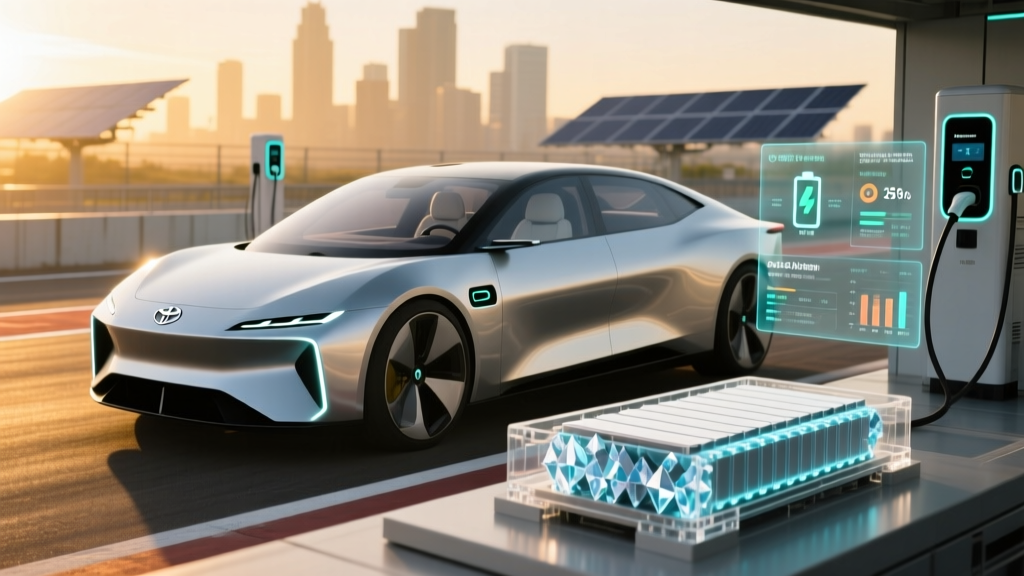
Toyota announced in mid-2023 that it would commercialize solid-state batteries by 2027–2028, initially in limited-run vehicles. As of early 2026, the company has confirmed that a Toyota solid-state battery electric vehicle will debut in a low-volume model — widely expected to be a premium Lexus or a next-generation sports car — before scaling to mainstream models potentially by 2030.
Here is what Toyota has publicly stated about its first-generation solid-state cells:
- Projected range: Up to 621 miles (1,000 km) on the WLTP cycle, which translates to roughly 500–540 miles EPA — a critical distinction, as WLTP is more generous than the U.S. EPA testing standard.
- Charge speed: 10% to 80% State of Charge (SoC) in approximately 10 minutes, implying peak DC fast-charge rates potentially exceeding 350 kW.
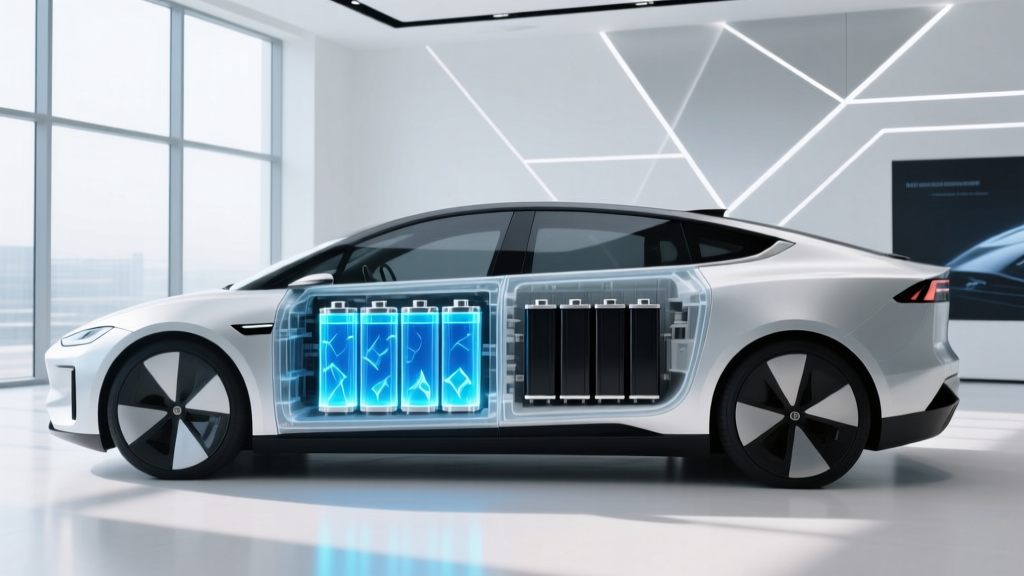
- Energy density: Estimated at roughly 2× current NMC cells, potentially 450–500 Wh/kg at the cell level.
- Safety: Solid electrolytes are non-flammable, eliminating the thermal runaway risk inherent to liquid electrolytes.
The manufacturing challenge is substantial. Solid-state cells require entirely new production lines, and the solid electrolyte material (often a sulfide-based compound) is sensitive to moisture and difficult to manufacture at scale. Toyota's partner, Idemitsu Kosan, is building a pilot plant to produce the solid electrolyte material, but scaling from kilograms to thousands of tons is a multi-year industrial challenge — not a software update.
Toyota isn't alone. Nissan has announced a solid-state pilot line for 2025 with production targeted for 2028. Samsung SDI aims for 2027 production. QuantumScape, backed by Volkswagen, continues prototype testing. None of these are in consumer vehicles today.
How Long Do EV Batteries Actually Last? Degradation Data
The most common question from prospective EV buyers is battery longevity. The data from millions of miles of real-world operation is reassuring: modern EV batteries are lasting far longer than early skeptics predicted.
According to data aggregated by Recurrent Auto, which tracks over 15,000 EVs in its fleet monitoring platform, the average EV battery retains approximately 90–95% of its original capacity after 5 years and 75,000 miles. Degradation follows a curve: the steepest loss occurs in the first 1–2 years (roughly 3–5%), after which the rate flattens significantly.
- Year 1 / 15,000 mi: ~95–97% State of Health (SoH)
- Year 3 / 45,000 mi: ~91–94% SoH
- Year 5 / 75,000 mi: ~89–93% SoH
- Year 8 / 120,000 mi: ~85–90% SoH
- Year 10 / 150,000 mi: ~82–88% SoH (projected)
LFP batteries show even slower degradation in many datasets, with some Tesla Model 3 Standard Range owners reporting 95%+ SoH at 100,000 miles. This is consistent with LFP's rated cycle life of 3,000–5,000+ cycles — meaning a 60 kWh LFP pack could theoretically cycle through 180,000 to 300,000 miles of total energy throughput before reaching 80% capacity.
Toyota's current EV, the bZ4X, uses a 71.4 kWh NMC battery and Toyota has stated it targets 90% capacity retention after 10 years — an ambitious goal that reflects the company's conservative battery management strategy (larger buffers, lower peak charge limits).
Battery Warranties: What's Covered and for How Long
Federal law mandates that EV batteries carry a minimum warranty of 8 years / 100,000 miles in most states, and 10 years / 150,000 miles in California Air Resources Board (CARB) states including California, New York, Massachusetts, and others. Most automakers exceed the federal minimum voluntarily.
| Manufacturer | Warranty Term | Capacity Retention Threshold |
|---|---|---|
| Tesla (Model 3/Y NMC) | 8 yr / 120,000 mi | 70% minimum SoH |
| Tesla (Model 3 RWD LFP) | 8 yr / 100,000 mi | 70% minimum SoH |
| Hyundai / Kia (E-GMP) | 10 yr / 100,000 mi | 70% minimum SoH |
| Ford (Mach-E, F-150 Lightning) | 8 yr / 100,000 mi | 70% minimum SoH |
| Toyota (bZ4X) | 8 yr / 100,000 mi (10 yr/150k in CARB states) | 70% minimum SoH |
| GM (Ultium platform) | 8 yr / 100,000 mi | 70% minimum SoH |
| Rivian | 8 yr / 175,000 mi | 70% minimum SoH |
The critical detail is the capacity retention threshold. Most warranties guarantee the battery will retain at least 70% of its original capacity during the warranty period. If your 84 kWh pack drops below 58.8 kWh of usable capacity within 8 years, the manufacturer must repair or replace it — typically with a refurbished unit that meets the threshold, not necessarily a brand-new pack.
Warranties cover defects and abnormal degradation. They generally do not cover damage from collisions, flooding, improper charging equipment, or modifications. Read your specific warranty booklet — the details matter.
EV Battery Replacement Costs: What the Data Shows
Battery replacement is the single biggest fear for EV shoppers. The numbers are large, but context matters enormously: the vast majority of EV batteries never need replacement during the vehicle's useful life.
Out-of-warranty replacement costs depend on battery size, chemistry, and the manufacturer's parts pricing. Here's what the data shows for current-generation replacements:
| Vehicle / Pack Size | Battery Chemistry | Estimated Replacement Cost |
|---|---|---|
| Tesla Model 3 RWD (~60 kWh) | LFP | $10,000 – $14,000 |
| Tesla Model Y Long Range (~82 kWh) | NMC | $14,000 – $18,000 |
| Hyundai Ioniq 5 (~77.4 kWh) | NMC | $13,000 – $17,000 |
| Ford F-150 Lightning Ext. Range (~131 kWh) | NMC | $20,000 – $28,000 |
| Chevrolet Bolt EV (~65 kWh) | NMC | $10,000 – $14,000 |
| Toyota bZ4X (~71.4 kWh) | NMC | $12,000 – $16,000 |
These figures include the battery pack and labor but can vary by region and dealer. Several factors are pushing costs downward: cell prices have fallen from over $1,000/kWh in 2010 to roughly $100–130/kWh for NMC in 2025 (BloombergNEF data), and the growing supply of refurbished packs from salvaged EVs provides a lower-cost alternative for older vehicles.
When is replacement actually needed? Most data suggests that fewer than 2–3% of EV batteries require replacement outside of collision damage, and the majority of those are covered under warranty. A battery at 70% SoH still provides substantial range — a 300-mile EPA vehicle at 70% capacity still delivers ~210 miles, which exceeds most daily driving needs.
How to Maximize EV Battery Health and Monitor SoH
Battery degradation is inevitable but manageable. The factors that accelerate wear are well understood, and most can be controlled through daily habits.
- Avoid sustained 100% SoC (NMC/NCA): Charge to 80% for daily use; reserve 100% for road trips. LFP owners can charge to 100% regularly — in fact, periodic full charges help the BMS calibrate.
- Minimize DC fast charging when possible: Occasional road-trip fast charging is fine. Daily reliance on 150+ kW DC charging accelerates degradation by ~1–2% over the battery's life compared to Level 2 home charging.
- Precondition before fast charging: Most EVs automatically warm the battery when you navigate to a charger. If yours doesn't, drive for 15–20 minutes before a DC session in cold weather to protect the cells and improve charge speed.
- Avoid extreme SoC in extreme heat: A battery sitting at 100% SoC in 105°F ambient heat degrades faster than one at 50% SoC. If you park outside in summer, set your charge limit to 80%.
- Don't baby it too much: The difference between obsessive care and reasonable care is small — maybe 2–3% SoH over 10 years. Drive the car.
How to Check Your Battery's State of Health
State of Health (SoH) represents your battery's current maximum capacity as a percentage of its original capacity. Here's how to check it:
- In-vehicle display: Some EVs (notably the Nissan Leaf, and newer Hyundai/Kia models) show SoH directly in the instrument cluster or infotainment system.
- Manufacturer app: Tesla, Ford, and BMW provide battery health data through their mobile apps, though the level of detail varies.
- OBD-II diagnostic tools: Devices like the OBDLink SX paired with apps such as LeafSpy (Nissan) or ABRP can read SoH from the battery management system (BMS) directly.
- Dealer diagnostic: Any authorized service center can run a full battery health report, typically for $50–100 if not covered under a service visit.
- Third-party services: Companies like Recurrent offer free battery monitoring that tracks your SoH over time and compares it to fleet averages for your specific model.
Silicon Anodes and Other Near-Term Battery Advances
While solid-state batteries grab headlines, incremental improvements to current lithium-ion technology are delivering meaningful gains right now. The most significant near-term advance is the silicon anode.
Traditional lithium-ion cells use graphite anodes. Replacing some or all of the graphite with silicon can increase energy density by 20–40%, because silicon can store roughly 10× more lithium ions per unit mass. Companies like Sila Nanotechnologies (partnered with Mercedes-Benz for the G-Class EV) and Group14 (backed by Porsche) are bringing silicon-dominant anodes to production vehicles in 2025–2026.
Other advances include:
- Manganese-rich NMC (NMx): GM's Ultium cells use a higher manganese ratio to reduce cobalt content and cost while maintaining energy density.
- Sodium-ion batteries: CATL and BYD are deploying sodium-ion cells in Chinese-market EVs. These sacrifice energy density (~140 Wh/kg) but eliminate lithium entirely, offering a low-cost option for city cars. U.S. availability is unlikely before 2028.
- Improved thermal management: Heat pumps (standard on the Ioniq 5, Model Y, and bZ4X) and more sophisticated liquid cooling loops reduce the thermal stress that drives degradation.
For a buyer evaluating a Toyota solid-state battery electric vehicle against today's options, the honest assessment is this: solid-state technology will likely arrive in limited, expensive models first (think $80,000+ Lexus), with mainstream affordability a decade away. Today's NMC and LFP batteries, properly cared for, will reliably deliver 150,000+ miles with 85%+ capacity retention — and they're available now.
Frequently Asked Questions
How long do EV batteries last in years and miles?
Based on fleet data from Recurrent Auto and manufacturer reports, modern EV batteries typically retain 85–90% of their original capacity after 10 years or 150,000 miles. Many will outlast the vehicle itself. LFP chemistries tend to degrade even more slowly than NMC. The federal warranty minimum is 8 years/100,000 miles, and most manufacturers guarantee at least 70% capacity retention over that period.
How much does it cost to replace an EV battery?
Out-of-warranty replacement costs range from approximately $10,000 for a ~60 kWh pack (Tesla Model 3 RWD, Chevy Bolt) to $20,000–$28,000 for a large pack like the F-150 Lightning's 131 kWh unit. However, fewer than 3% of EV batteries require replacement outside of accident damage, and most failures occur within the warranty period. Cell prices continue to decline, and refurbished packs are increasingly available at 40–60% of new-pack cost.
What does the EV battery warranty actually cover?
Battery warranties cover defects in materials and workmanship, plus abnormal degradation below a specified threshold — typically 70% of original capacity. The standard term is 8 years/100,000 miles (10 years/150,000 miles in CARB states). Warranties do not cover damage from accidents, flooding, unauthorized modifications, or use of non-compliant charging equipment. If your battery falls below the threshold, the manufacturer will repair or replace it with a unit that meets the minimum capacity standard.
LFP vs. NMC — which battery chemistry should I choose?
Choose LFP if you want maximum longevity, can charge at home daily, don't need more than ~270 miles of range, and want the freedom to charge to 100% without worry. Choose NMC/NCA if you need 300+ miles of range, frequently road-trip, live in a very cold climate where LFP's charge acceptance suffers, or want the lightest possible vehicle. Both chemistries are proven and will reliably serve the life of the vehicle.
When will Toyota's solid-state battery EV be available to buy?
Toyota has targeted 2027–2028 for initial commercialization, likely in a limited-production or premium model. Mainstream, affordable Toyota solid-state battery electric vehicles are not expected before 2030 at the earliest. Toyota has revised this timeline multiple times, and manufacturing scale-up challenges remain significant. Buyers should not postpone a current EV purchase in anticipation of this technology.
Does frequent DC fast charging damage the battery?
Occasional DC fast charging (road trips, a few times per month) has a negligible effect on battery health. Daily DC fast charging at 150+ kW can accelerate degradation by roughly 1–2% over the battery's lifetime compared to exclusive Level 2 home charging. The bigger risk is fast charging in extreme heat without preconditioning — always let the vehicle's thermal management system prepare the battery before a high-power session.