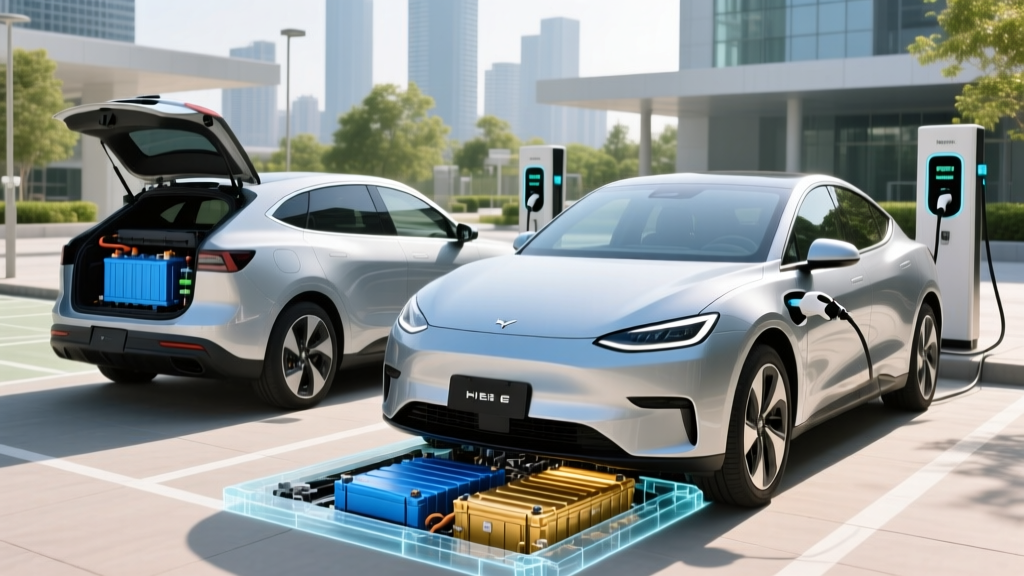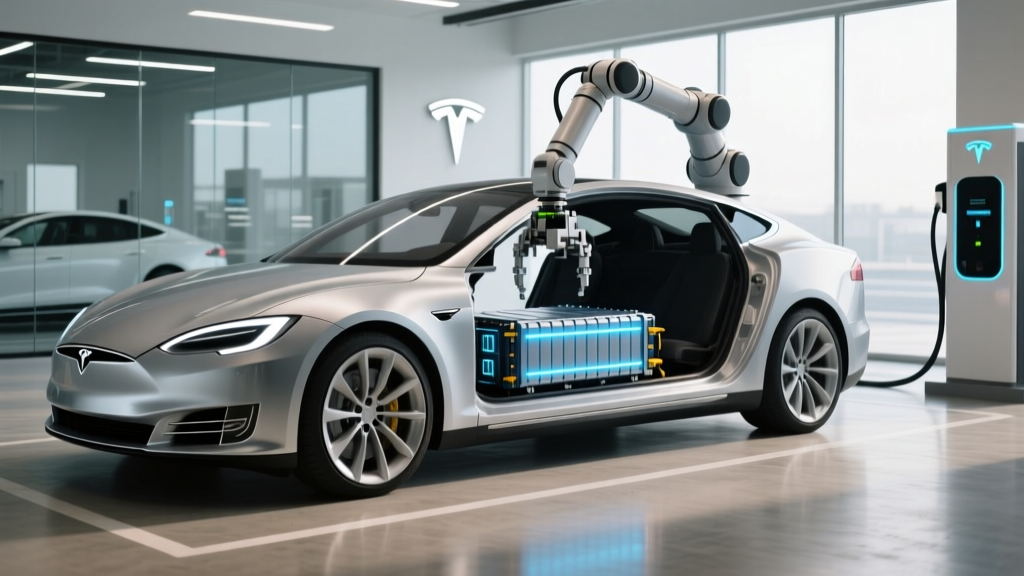
If you've spent any time in EV forums, you've likely seen the phrase "Tesla swappable battery" pop up. The idea sounds simple: pull into a station, swap your depleted pack for a fully charged one in minutes, and drive away. But in 2026, Tesla does not offer a consumer swappable battery program. The company briefly experimented with the concept at a single Harris Ranch, California station around 2013 before quietly abandoning it in favor of scaling its Supercharger network.
What "swappable" actually means for Tesla owners today is battery replacement—a service-center procedure where a degraded or failed high-voltage traction pack is removed and a refurbished or new unit is installed. It's not something you'll ever do at a drive-through kiosk, and it's not something most owners will ever need. But understanding the economics, the chemistry, and the long-term degradation curve is essential for anyone buying a Tesla—or any EV—with an eye on the decade ahead.
This guide covers exactly how long Tesla batteries last, what replacement costs look like across the lineup, how LFP and NMC/NCA chemistries compare, and the daily habits that meaningfully extend pack life.
Tesla's Battery Swap Experiment: What Happened and Why It Ended
In June 2013, Elon Musk demonstrated a 90-second battery swap for the Model S at a pilot station in Harris Ranch. The pitch was compelling: faster than filling a gas tank, no waiting for a charge. Tesla priced the swap at roughly $60–$80, comparable to a tank of gasoline at the time.
But adoption was near zero. Owners preferred to charge at home or use Superchargers (which were free for many early Model S buyers). The logistics of inventorying, inspecting, and rebalancing hundreds of 85 kWh packs at each station proved costly. By 2015, the program was effectively dead. Tesla pivoted hard into Supercharger V2 and later V3/V4 architecture instead.
Today, companies like NIO in China operate successful battery-swap networks with thousands of stations—but Tesla is not among them. For Tesla owners, "swappable" is a service-center conversation, not a business model.
LFP vs NMC/NCA: Tesla's Two Chemistry Paths
Tesla currently uses two distinct battery chemistries across its lineup, and the choice affects range, longevity, charging behavior, and cold-weather performance. Understanding the difference is the single most important battery decision you'll make at purchase time.
| Attribute | LFP (Lithium Iron Phosphate) | NMC / NCA (Nickel-based) |
|---|---|---|
| Models using it | Model 3 RWD, Model Y RWD (Standard Range) | Model 3/Y Long Range & Performance, Model S, Model X, Cybertruck |
| Energy density | Lower (~160 Wh/kg cell-level) | Higher (~250–270 Wh/kg cell-level) |
| Typical usable capacity | 57–60 kWh | 75–100 kWh depending on pack |
| Cycle life | 3,000–5,000+ cycles to 80% SoH | 1,500–2,500 cycles to 80% SoH |
| Cold-weather range loss | Greater (~30–40% at 20°F) | Moderate (~20–30% at 20°F) |
| Recommended daily charge | 100% (Tesla recommends periodic full charges) | 80% daily; 100% only for trips |
| Cost per kWh (pack-level) | Lower (~$100–$120) | Higher (~$130–$160) |
| Cobalt content | Zero | Low (NCA) to moderate (NMC) |
The practical takeaway: If you buy a Standard Range Model 3 or Model Y, you're getting an LFP pack. It's cheaper, lasts more charge cycles, and you can (and should) charge it to 100% regularly to keep the battery management system calibrated. If you step up to Long Range or Performance, you get an NMC/NCA pack with more range and better cold performance—but you should keep daily charging at 80% and only go to 100% before road trips.
How Long Do Tesla Batteries Actually Last?
Tesla's own 2024 Impact Report (the most recent with granular fleet data) showed that Model 3 and Model Y batteries retain approximately 85% of original capacity after 200,000 miles. That's a meaningful data point: the average American drives ~13,500 miles per year, meaning a Tesla battery would reach 200k miles at roughly 15 years of average use.
Typical Tesla Battery Degradation Curve (Fleet-Average Data):
- Year 1 / 15,000 mi: ~3–5% loss (initial formation loss, steepest part of the curve)
- Year 3 / 45,000 mi: ~7–9% total loss
- Year 5 / 75,000 mi: ~9–11% total loss
- Year 8 / 120,000 mi: ~12–15% total loss
- Year 12 / 180,000 mi: ~15–18% total loss
Source: Tesla Impact Reports, aggregated fleet telemetry. Individual results vary based on charging habits, climate, and chemistry.
The degradation curve is nonlinear: you lose the most in the first year, then it flattens significantly. LFP packs tend to show slightly more early degradation but hold a higher floor over thousands of cycles. NMC packs degrade more gradually but are more sensitive to sustained high states of charge.
Real-world outlier: several Tesla owners have documented packs surpassing 300,000 miles with 70–75% remaining capacity. These are not typical, but they demonstrate that catastrophic failure is rare—gradual capacity loss is the norm.
Tesla Battery Warranty: What's Covered and What's Not
Tesla's battery warranty is one of the stronger guarantees in the industry, but the details matter. Here's what each model gets for the high-voltage traction battery:
| Model | Warranty Period | Mileage Limit | Minimum Capacity Retention |
|---|---|---|---|
| Model 3 RWD (LFP) | 8 years | 100,000 miles | 70% |
| Model 3 Long Range / Performance | 8 years | 120,000 miles | 70% |
| Model Y (all trims) | 8 years | 120,000 miles | 70% |
| Model S / Model X | 8 years | 150,000 miles | 70% |
| Cybertruck | 8 years | 120,000 miles | 70% |
What the warranty covers: Battery failure (defect, malfunction) and capacity degradation below the 70% threshold within the warranty period. Tesla will replace or refurbish the pack to bring it above the retention threshold.
What it does not cover: Damage from accidents, flooding, fire, unauthorized modifications, or using the vehicle as a stationary power source beyond specified V2L/V2H features. Cosmetic issues and 12V auxiliary battery failures are handled separately.
The 70% threshold is key: if your 82 kWh Long Range pack drops to 57 kWh usable capacity within 8 years or 120,000 miles, Tesla replaces it. Based on fleet data, very few owners hit this threshold under normal use.
Tesla Battery Replacement Cost: 2026 Pricing by Model
If your battery degrades beyond the warranty threshold or fails outside the warranty window, you're looking at an out-of-pocket replacement. These costs come from service-center invoices shared by owners and industry estimates as of early 2026:
| Model | Pack Size (Usable) | Chemistry | Estimated Replacement Cost |
|---|---|---|---|
| Model 3 RWD | ~57 kWh | LFP | $8,000–$12,000 |
| Model 3 Long Range | ~79 kWh | NMC/NCA | $12,000–$16,000 |
| Model Y Long Range | ~79 kWh | NMC/NCA | $13,000–$17,000 |
| Model S (current gen) | ~95 kWh | NMC/NCA | $16,000–$22,000 |
| Model X (current gen) | ~95 kWh | NMC/NCA | $17,000–$23,000 |
| Cybertruck AWD/Cyberbeast | ~123 kWh | NMC (4680 cells) | $20,000–$30,000 |
Important context: These figures include the pack and labor but can vary by region and service-center pricing. Tesla increasingly uses refurbished packs for out-of-warranty replacements, which lowers cost. Also, pack prices have been declining steadily—lithium-ion pack-level costs fell from ~$140/kWh in 2023 to roughly $105–$115/kWh by late 2025, according to BloombergNEF data.
Most Tesla owners will never need a replacement. The battery is designed to outlast the vehicle's economic life. But for high-mileage drivers (rideshare, commercial, 30k+ miles/year), budgeting for a potential replacement in years 12–15 is prudent.
Factors That Accelerate Battery Degradation
Not all miles are created equal. A Tesla battery's lifespan depends heavily on how it's used. Here are the primary degradation accelerators, ranked by impact:
- Sustained high state of charge (NMC/NCA only): Keeping an NMC pack at 100% for days or weeks causes electrolyte oxidation and cathode stress. Set daily charge to 80% and only charge to 100% within a few hours of departure on road trips.
- Frequent DC fast charging: Occasional Supercharging is fine—Tesla's thermal management is excellent. But daily DC fast charging at 250 kW generates sustained high temperatures. If you can charge at home on Level 2 (7–11 kW), do so for daily use.
- Extreme heat exposure: Parking in direct sun in 100°F+ climates for extended periods accelerates calendar degradation. Tesla's battery preconditioning and active cooling mitigate this, but shaded or garage parking helps.
- Deep discharges (below 10% SoC): Frequently draining the pack to near-zero stresses the anode. Try to keep the floor at 10–15% for daily driving.
- Cold-weather fast charging without preconditioning: Charging a cold battery at high power can cause lithium plating on the anode. Always use the Tesla app to precondition (or navigate to a Supercharger, which triggers automatic preconditioning) before fast charging in cold weather.
Conversely, the gentlest usage pattern is: Level 2 home charging, 20–80% SoC window for NMC (or regular 100% for LFP), moderate climates, and occasional fast charging. Owners following this pattern consistently report the lowest degradation rates in fleet data.
How to Check Your Tesla's Battery Health (SoH)
Tesla doesn't surface a direct "State of Health" percentage in the vehicle UI the way some competitors do. But you can estimate it with reasonable accuracy:
Method 1: Range comparison. Charge to 100% (or your normal max for NMC) and note the displayed range. Compare it to the original EPA-rated range for your model. For example, if your 2023 Model 3 Long Range originally showed 341 miles at 100% and now shows 305 miles, you're at roughly 89% SoH. Note that displayed range is affected by driving style and temperature—do this comparison in moderate weather.
Method 2: Third-party apps. Tools like TeslaFi, Tessie, or Stats (iOS) log detailed battery telemetry via Tesla's API. They track energy added vs. rated range gained over multiple charge cycles, giving a more accurate SoH estimate than a single data point.
Method 3: Service center diagnostic. If you suspect abnormal degradation (e.g., sudden range drops, large cell-imbalance warnings), Tesla service can run a full pack diagnostic that reads individual module voltages, internal resistance, and precise capacity. This is the gold standard but requires a service appointment.
For most owners, Method 1 checked semi-annually is sufficient. Track it in a spreadsheet and look for trends rather than reacting to single readings.
What's Next: Solid-State Batteries and Tesla's 4680 Cells
The battery landscape is shifting, but timelines matter. Here's a realistic look at what's coming and when:
Tesla 4680 cells (available now): Tesla's larger-format cylindrical cells, produced at the Austin Gigafactory, are currently in the Cybertruck and some Model Y vehicles built at Giga Texas. They offer modest energy-density improvements (~10–15% over 2170 cells) and are designed for structural integration (the battery is part of the vehicle's chassis). Cost-per-kWh reductions are the primary goal, not range breakthroughs.
Silicon-dominant anodes (2026–2028): Companies like Sila Nanotechnologies and Group14 are supplying silicon-composite anode materials that can boost energy density 20–40%. Tesla has not confirmed adoption timelines, but the industry expects gradual integration into premium cells by 2027–2028.
Solid-state batteries (2028–2032, realistically): Toyota, Samsung SDI, and QuantumScape are the most advanced in solid-state development. These promise 2x energy density, faster charging, and improved safety. But manufacturing scale and cost remain enormous hurdles. Expect limited premium-vehicle deployment around 2028–2030 at the earliest, with mainstream adoption not before 2032. Tesla has not announced a solid-state timeline.
The practical advice: don't delay an EV purchase waiting for solid-state. Current lithium-ion technology is mature, well-understood, and backed by eight-year warranties. The improvements coming are incremental cost and density gains, not paradigm shifts that obsolete today's vehicles.
Tesla Battery FAQ
Does Tesla offer a swappable battery program in 2026?
No. Tesla discontinued its battery swap pilot in 2015. Battery replacement is handled exclusively through Tesla Service Centers. The company invested in its Supercharger network instead, which now includes over 60,000 connectors globally.
How much does it cost to replace a Tesla battery out of warranty?
Between $8,000 and $30,000 depending on the model and pack size. A Model 3 RWD with an LFP pack is on the lower end (~$8k–$12k), while a Cybertruck's 123 kWh 4680 pack is on the higher end (~$20k–$30k). Costs have been declining as cell prices drop.
What does Tesla's battery warranty cover?
Eight years with a mileage limit (100k–150k miles depending on model) and a guaranteed minimum of 70% capacity retention. If your battery drops below 70% within that window, Tesla replaces or refurbishes it at no cost. Defects and malfunctions are also covered.
Should I charge my Tesla to 100% every day?
It depends on the chemistry. If you have an LFP pack (Model 3 RWD, Model Y RWD), yes—Tesla recommends charging to 100% at least weekly for BMS calibration. If you have an NMC/NCA pack (Long Range, Performance), set the daily limit to 80% and charge to 100% only before long trips.
Does frequent Supercharging damage the battery?
Occasional Supercharging has negligible impact thanks to Tesla's active thermal management. However, exclusive reliance on DC fast charging (daily, over years) can accelerate degradation slightly due to sustained high temperatures. Most fleet data shows a 1–3% additional capacity loss over 100k miles for heavy fast-charging users vs. primarily Level 2 charging.
LFP vs NMC: which Tesla battery is better?
Neither is universally better—they serve different needs. LFP offers longer cycle life, lower cost, and zero cobalt, but has lower energy density and worse cold-weather performance. NMC provides more range per kWh and better cold performance but costs more and degrades faster if held at high SoC. Choose LFP for affordability and commuting; choose NMC for maximum range and cold-climate driving.
Can I upgrade my Tesla to a larger battery after purchase?
Not through Tesla. Unlike the original swap concept, Tesla does not offer post-purchase battery upgrades. The pack you buy is the pack you keep. Some third-party shops have attempted upgrades on older Model S vehicles, but this voids the warranty and is not recommended.