Why the Tesla Semi Battery Is an Engineering Outlier
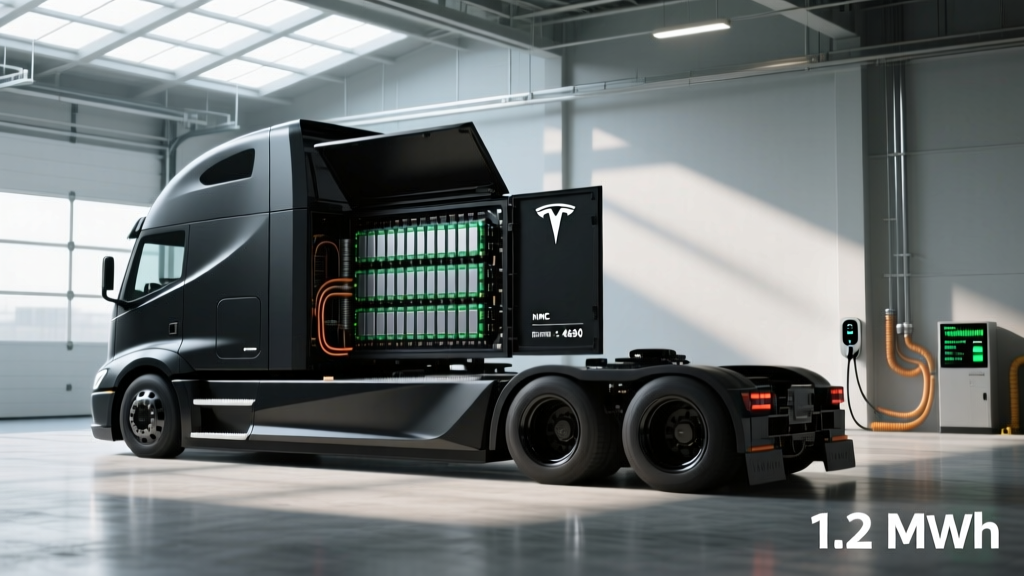
When Tesla began delivering the Semi to PepsiCo and other fleet operators in late 2022, it forced a fundamental question onto the commercial-vehicle industry: can a battery-electric Class 8 tractor genuinely replace a diesel rig on regional and even long-haul routes? The answer hinges almost entirely on one component — the high-voltage traction battery pack. At an estimated ~900 kWh of usable capacity, the Tesla Semi's battery is roughly 10 to 12 times larger than the pack in a Model Y, and it operates under thermal, mechanical, and economic stresses that passenger EVs rarely encounter.
This guide breaks down what is publicly known and reasonably estimated about the Tesla Semi battery in 2026, then broadens into the battery-technology principles every EV buyer — whether you're spec'ing a fleet of Semis or choosing between LFP and NMC in a Model 3 — needs to understand. We'll cover chemistry trade-offs, real degradation data, warranty structures, replacement costs, and the emerging technologies that may reshape the next generation of packs.
- Usable capacity: ~900 kWh (estimated; Tesla has not published an official figure)
- Chemistry: Likely NMC/NCA cathode (nickel-rich for energy density)
- EPA-claimed range: 500 miles fully loaded (80,000 lb GCW)
- Energy consumption: ~1.7 kWh/mile under load (Tesla claim) → implies ~850 kWh used for 500 mi
- Megacharger peak rate: ~1 MW (1,000 kW); 400 miles in ~30 min claimed
- Base MSRP: $250,000 (300-mi range) / $290,000 (500-mi range)
Battery Chemistry Explained: NMC/NCA vs. LFP
Every lithium-ion cell has a cathode chemistry that defines its personality. The two dominant families in 2026 are nickel-based cathodes (NMC — nickel manganese cobalt; NCA — nickel cobalt aluminum) and LFP (lithium iron phosphate). Understanding the trade-offs is essential whether you're evaluating the Tesla Semi battery or deciding on a passenger-car trim.
| Attribute | NMC / NCA (Nickel-Based) | LFP (Lithium Iron Phosphate) |
|---|---|---|
| Energy density (cell-level) | 250–300 Wh/kg | 160–200 Wh/kg |
| Cycle life (to 80% SoH) | 1,000–2,000 cycles | 3,000–6,000+ cycles |
| Cold-weather performance | Better low-temp discharge; heat pump helps | Reduced power & range below 32°F; slower charging |
| Cost per kWh (2026 est.) | $110–$140 | $75–$100 |
| Thermal stability | Good; requires robust BMS/cooling | Excellent; higher runaway threshold |
| Typical use case | Long-range, performance, heavy-duty (e.g., Tesla Semi) | Standard-range, cost-sensitive, high-cycle fleets |
| Cobalt content | Some (declining in newer NMC 811/9½½) | None |
Why the Tesla Semi Almost Certainly Uses NMC/NCA
A 500-mile range at 80,000 pounds gross combination weight demands maximum energy density. LFP cells, while cheaper and longer-lasting, are roughly 30–40% heavier per kWh. A 900 kWh LFP pack could weigh over 5,500 kg at the cell level alone, severely cutting into payload capacity — a non-starter for freight operators who earn revenue per ton-mile. Nickel-rich NMC or NCA cells pack more energy into less mass, which is why Tesla's 4680-format cells (used in the Semi and Cybertruck) employ a nickel-based chemistry with a silicon-enhanced anode.
For passenger vehicles, the calculus is different. Tesla's standard-range Model 3 and Model Y use LFP batteries sourced from CATL, trading some range for lower cost and dramatically longer cycle life. If you drive 12,000 miles per year and charge at home, an LFP pack could theoretically outlast the vehicle's structural lifespan.
How Long Do EV Batteries Actually Last?
The short answer: far longer than most first-time EV buyers assume. The long answer depends on chemistry, thermal management, charging habits, and climate.
Passenger EVs (NMC/NCA): Data aggregated from Tesla's 2024 Impact Report and independent fleet analyses show that Model 3 and Model Y packs retain approximately 85–90% of original capacity after 150,000 miles. Degradation is steepest in the first 20,000–30,000 miles (roughly 3–5% loss), then flattens into a slow linear decline. At 200,000 miles, most packs sit between 80–88% State of Health (SoH).
Passenger EVs (LFP): CATL-supplied LFP packs in standard-range Teslas show even slower fade. Real-world fleet data from ride-hail operators indicate 92–95% SoH at 100,000 miles, with projections of 85%+ at 300,000 miles under normal use.
Tesla Semi (projected): The Semi's battery faces a harder life — daily deep cycles, 1 MW Megacharging sessions that generate significant heat, and 600,000+ mile service targets. Tesla has claimed the Semi's drivetrain is designed for a 1-million-mile lifespan. If the pack retains 70% SoH at that mileage, the Semi would still deliver ~350 miles of loaded range — viable for many regional routes. Independent verification at this scale is still limited as of 2026, since the earliest production Semis (delivered late 2022) have roughly 2–3 years of operational data.
EV battery degradation is not linear. Expect a 3–5% capacity drop in year one, then ~1–2% per year under normal conditions. Factors that accelerate fade: frequent DC fast charging above 150 kW, routinely charging to 100% on NMC packs, sustained operation above 104°F (40°C), and deep discharges below 10% SoC. LFP packs tolerate 100% charges better and actually benefit from periodic full charges for cell balancing.
Tesla Battery Warranty Terms: What's Covered
Tesla's battery warranty structure sets the industry baseline. Here's how coverage breaks down across the lineup as of 2026:
| Model | Warranty Period | Mileage Cap | Minimum Capacity Retention |
|---|---|---|---|
| Model 3 / Model Y (RWD, LFP) | 8 years | 100,000 miles | 70% |
| Model 3 / Model Y (Long Range / Performance) | 8 years | 120,000 miles | 70% |
| Model S / Model X | 8 years | 150,000 miles | 70% |
| Cybertruck | 8 years | 120,000 miles | 70% |
| Tesla Semi (estimated/announced) | 8 years | 500,000–1,000,000 miles (unconfirmed) | ~70% (expected) |
The warranty covers defects in materials or workmanship AND capacity loss below the stated threshold. If your Model Y Long Range battery drops to 68% SoH at 90,000 miles, Tesla will repair or replace it at no cost. Critically, the warranty does not cover gradual degradation above the 70% floor — that's considered normal wear. For the Semi, Tesla has publicly stated confidence in a million-mile drivetrain, but the exact warranty terms for fleet operators may differ from consumer-vehicle structures and are typically negotiated as part of purchase agreements.
EV Battery Replacement Cost: What Owners Actually Pay
Out-of-warranty battery replacement is the single biggest fear among prospective EV buyers. Let's put real numbers to it.
| Vehicle / Pack Size | Battery Capacity | Estimated Replacement Cost | Typical Replacement Trigger |
|---|---|---|---|
| Tesla Model 3 RWD (LFP) | ~60 kWh | $10,000–$14,000 | Rarely needed within vehicle life |
| Tesla Model Y LR (NMC) | ~75 kWh | $13,000–$18,000 | Post-warranty, 150k+ miles |
| Tesla Model S / X | ~95–100 kWh | $18,000–$25,000 | Higher-mileage units, 150k+ mi |
| Tesla Semi (est.) | ~900 kWh | $80,000–$130,000 (est.) | Projected 600k–1M mi; fleet economics |
| Ford F-150 Lightning (Ext. Range) | ~131 kWh | $20,000–$30,000 | Post-warranty, high-mileage use |
Context matters enormously here. According to data from fueleconomy.gov and industry analyses, the vast majority of EV batteries never need replacement during the original owner's tenure. The average American keeps a new vehicle for 6.5 years and drives roughly 84,000 miles in that span — well within warranty coverage. For the Tesla Semi, the calculus shifts: a $100,000+ battery replacement on a $290,000 tractor sounds alarming, but fleet operators amortize that cost over 600,000+ revenue-generating miles, where diesel fuel savings of $0.20–$0.30 per mile can offset the replacement many times over.
Factors That Accelerate (or Extend) Battery Life
Battery longevity is not random — it's a function of how you treat the cells. Here's what the data shows:
- Daily charge limit (NMC/NCA): Set to 80% for routine use; charge to 100% only before road trips.
- Daily charge limit (LFP): Tesla recommends charging to 100% at least once per week for accurate BMS calibration.
- DC fast charging: Minimize sessions above 150 kW when possible. Occasional Supercharging is fine; daily 250 kW sessions accelerate cathode wear.
- Avoid extreme SoC storage: Don't leave the vehicle at 100% or below 10% for extended periods (weeks). Aim for 50% if storing.
- Thermal preconditioning: Use scheduled departure or preconditioning before fast charging — the battery management system (BMS) warms or cools cells to the optimal temperature window (~25–35°C), reducing stress.
- Cold-weather charging: In sub-freezing temps, always precondition before plugging in. Charging a cold battery causes lithium plating on the anode, an irreversible degradation mechanism.
- Regen braking in cold: Expect reduced regenerative braking below 32°F until the pack warms up — this is protective, not a fault.
For the Tesla Semi, Megacharging at up to 1 MW (1,000 kW) is an extreme thermal event. Tesla's Megacharger stalls use liquid-cooled cables and the Semi's BMS actively manages cell temperatures during the charge session. Fleet operators who can schedule charging during off-peak hours and avoid back-to-back Megacharge sessions without cool-down intervals will see meaningfully better long-term SoH.
Monitoring Battery Health: How to Check SoH
Tesla does not display a direct State of Health percentage in the vehicle UI, which frustrates many owners. Here are the practical methods available in 2026:
1. Tesla App / In-Car Energy Graph: Navigate to the Energy app and view the "Trip" or "Average" consumption data. By comparing your actual kWh consumed over a known distance to the original rated efficiency, you can estimate remaining capacity. This method has a ±3% margin of error.
2. Third-Party Telematics (Fleet): Services like Tesla Fleet API, TeslaFi, and Electrly log detailed charge-session data. By tracking the kWh delivered during a full charge (from near-0% to 100%) and comparing it to the pack's original usable capacity, you can calculate SoH with reasonable accuracy. For Semi fleet operators, telematics platforms like Geotab and Samsara integrate directly with Tesla's API to provide SoH dashboards.
3. Service Center Diagnostic: Tesla service centers can run a high-voltage battery health report. This is typically done during warranty-related visits or pre-purchase inspections on used EVs.
4. OBD-II Dongles (Limited): Unlike ICE vehicles, Tesla does not expose battery data via standard OBD-II. Some third-party tools (e.g., Scan My Tesla with a custom cable) can read BMS data, but accuracy varies and Tesla has restricted access in newer firmware versions.
What's Next: Solid-State, Silicon Anodes, and the Post-2028 Outlook
The battery landscape is evolving quickly, but separating marketing from production reality is critical.
Silicon-enhanced anodes: Already in production. Tesla's 4680 cells use a silicon-carbon composite anode to boost energy density by roughly 10–15% over pure graphite. This technology is live in the Cybertruck, Model Y (Austin-built), and the Tesla Semi. Expect incremental improvements through 2028.
Solid-state batteries: Toyota, Samsung SDI, and QuantumScape have all announced solid-state or semi-solid-state cells with 20–40% higher energy density and faster charging potential. However, no solid-state battery is in mass production for passenger or commercial vehicles as of 2026. Toyota's announced timeline targets limited production in 2027–2028, initially in low-volume models at premium prices. Widespread, cost-competitive solid-state packs for vehicles like a future Tesla Semi are realistically a 2030+ proposition.
Sodium-ion batteries: CATL and BYD have begun deploying sodium-ion cells in Chinese-market micro-EVs. Sodium-ion offers lower cost and excellent cold-weather performance but significantly lower energy density (~120–150 Wh/kg). It's viable for urban delivery vans and budget city cars, but not for a 500-mile Class 8 tractor. Watch for sodium-ion in Tesla's energy storage products (Megapack) before its vehicles.
For anyone buying an EV today — whether a Model 3 or spec'ing a Semi fleet — current lithium-ion technology (NMC and LFP) is mature, well-understood, and backed by real-world degradation data spanning hundreds of billions of miles. Waiting for solid-state means waiting years and paying a premium when it arrives.
Frequently Asked Questions
How long do EV batteries last in years and miles?
Most modern EV batteries are designed to retain 70–80% of original capacity after 150,000–200,000 miles, which typically corresponds to 12–15 years of average American driving (roughly 13,500 miles/year per FHWA data). LFP packs may last 300,000+ miles before hitting the 80% SoH mark. The Tesla Semi's battery is engineered for a target lifespan of up to 1 million miles under commercial duty cycles.
How much does an EV battery cost to replace?
Replacement costs range from ~$10,000 for a 60 kWh LFP pack (Model 3 RWD) to $25,000+ for a 100 kWh Model S/X pack. The Tesla Semi's estimated ~900 kWh pack could cost $80,000–$130,000 to replace, though fleet economics and potential module-level repairs (rather than full-pack swaps) may reduce real-world costs. Most EV batteries never need replacement during typical ownership.
What does the Tesla battery warranty cover?
Tesla's battery warranty covers defects and capacity loss below 70% for 8 years, with mileage caps varying by model (100,000–150,000 miles for passenger vehicles). The warranty does not cover normal gradual degradation above the 70% threshold. For the Tesla Semi, warranty terms are expected to be significantly higher in mileage (500,000–1,000,000 miles), though exact terms vary by fleet agreement.
LFP vs NMC — which battery chemistry is better?
Neither is universally better — it depends on your use case. LFP wins on cost ($75–$100/kWh vs. $110–$140/kWh), cycle life (3,000–6,000+ vs. 1,000–2,000 cycles), and thermal safety. NMC/NCA wins on energy density (250–300 vs. 160–200 Wh/kg), cold-weather performance, and weight. The Tesla Semi uses NMC/NCA because range-per-pound matters for freight payload. A daily-commuter Model 3 benefits more from LFP's longevity and lower cost.
How do I check my Tesla battery's State of Health?
Tesla does not show a direct SoH percentage in the car. You can estimate it through the Energy app's consumption data, third-party logging tools like TeslaFi or the Tesla Fleet API, or a diagnostic report from a Tesla service center. Fleet operators of Semis typically use integrated telematics platforms (Geotab, Samsara) that pull SoH data via API.
Does frequent Supercharging / Megacharging damage the battery?
Occasional DC fast charging is fine and will not meaningfully shorten battery life. However, daily use of high-power charging (150 kW+ for passenger vehicles, 1 MW for the Semi) accelerates cathode degradation over time. Tesla's BMS actively manages charge rates and cell temperatures to mitigate this, but fleet operators who can mix Megacharging with slower depot-level AC charging will see better long-term SoH. Studies from NREL have shown that exclusively DC fast-charged packs may lose an additional 3–5% capacity over 100,000 miles compared to predominantly Level 2-charged packs.