Tesla's battery strategy has evolved rapidly over the last several years, moving from a single chemistry across the fleet to a multi-pronged approach that includes lithium iron phosphate (LFP), nickel-based NMC/NCA, and the proprietary 4680 cylindrical cell format. For buyers evaluating a Model 3, Model Y, Cybertruck, or the refreshed Model S and X, understanding which battery sits under the floor is now as important as picking a trim level. This guide unpacks Tesla new battery technology in practical terms: what each chemistry delivers, how long these packs actually last, what warranties cover, and what emerging tech like solid-state and silicon anodes realistically means for future vehicles.
Tesla's Current Battery Lineup: LFP, NMC, and the 4680 Cell
Tesla sources cells from multiple suppliers — primarily CATL (LFP), Panasonic (NCA/NMC), and its own in-house 4680 production lines in Texas and Nevada. The chemistry you get depends on the model and trim:
- Model 3 RWD / Model Y RWD: LFP (lithium iron phosphate) — typically 60 kWh usable, sourced from CATL. Lower energy density but excellent cycle life and thermal stability.
- Model 3 Long Range / Model Y Long Range: NMC (nickel manganese cobalt) or NCA — ~75-82 kWh usable, sourced from Panasonic or LG Energy Solution. Higher energy density for extended range.
- Model S / Model X: NMC/NCA packs, ~95-100 kWh usable, Panasonic-sourced.
- Cybertruck: Tesla's in-house 4680 cells in a structural battery pack, NMC chemistry, ~123 kWh usable.
| Attribute | LFP (LiFePO₄) | NMC / NCA |
|---|---|---|
| Energy Density | ~160 Wh/kg (lower) | ~250-270 Wh/kg (higher) |
| Typical Usable Capacity | ~60 kWh | ~75-123 kWh |
| Cycle Life | 3,000-5,000+ cycles | 1,500-2,500 cycles |
| Cold-Weather Performance | Greater range loss (~30-40% at 20°F) | Moderate range loss (~20-30% at 20°F) |
| Recommended Daily SoC | 100% (charge to full regularly) | 80% daily; 100% for trips only |
| Cost per kWh | Lower (~$80-100/kWh cell level) | Higher (~$120-150/kWh cell level) |
| Thermal Stability | Excellent (higher runaway threshold) | Good (requires more active cooling) |
| Found In (2026) | Model 3 RWD, Model Y RWD | Model 3/Y LR, Model S/X, Cybertruck |
The practical takeaway: LFP packs sacrifice some range for dramatically longer cycle life and the convenience of daily 100% charging. NMC/NCA packs deliver more miles per charge but benefit from careful state-of-charge management. Neither is universally "better" — the right choice depends on your driving pattern.
The 4680 Cell: What Makes Tesla's In-House Battery Different
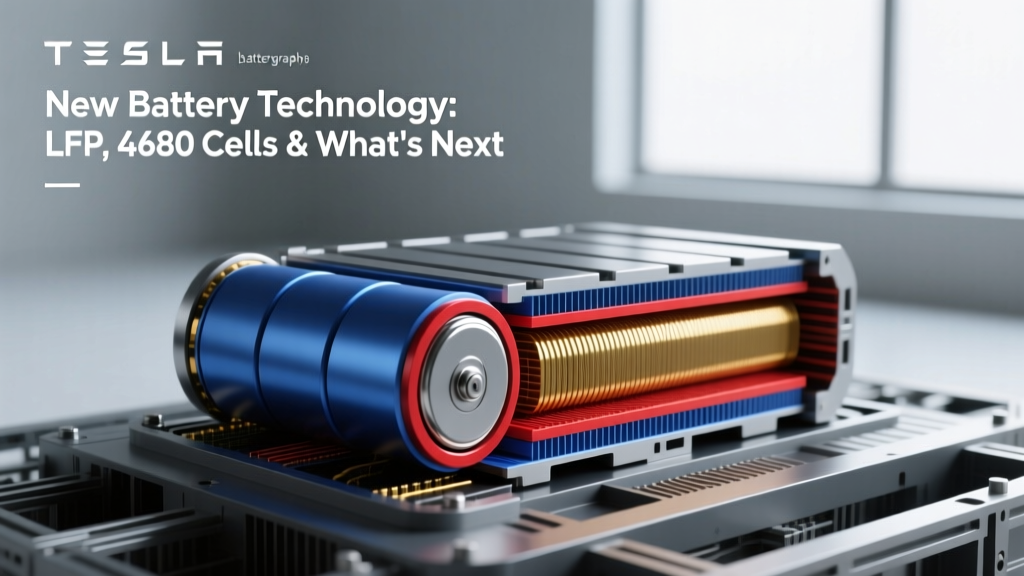
The 4680 cell — named for its 46mm diameter and 80mm height — is Tesla's proprietary cylindrical format, roughly 5× the volume of the older 2170 cells. Key engineering differences include:
- Tabless electrode design: Reduces internal resistance, improving thermal management and enabling faster charge acceptance.
- Structural battery pack: In the Cybertruck, 4680 cells are bonded into a pack that serves as a structural floor member, reducing vehicle weight and part count.
- Dry electrode coating: A manufacturing process Tesla has been scaling that eliminates solvent use, reducing factory footprint and energy consumption.
As of the 2026 model year, 4680 cells are primarily deployed in the Cybertruck and limited Model Y production from Giga Texas. Tesla has signaled broader rollout but has not confirmed timelines for Model 3 or sedan adoption. The 4680's energy density advantage is meaningful for heavier vehicles like the Cybertruck, where the ~123 kWh pack enables an EPA-estimated 340 miles of range.
How Long Do Tesla Batteries Actually Last? Degradation Data
Battery degradation is the percentage of original capacity lost over time and use. Tesla publishes fleet data periodically, and independent researchers like Recurrent have tracked thousands of vehicles over multiple years.
| Milestone | Average Capacity Retained | Notes |
|---|---|---|
| Year 1 / 15,000 mi | ~95-97% | Initial "break-in" loss, then plateau |
| Year 3 / 50,000 mi | ~90-93% | Slow, linear decline phase |
| Year 5 / 100,000 mi | ~85-90% | Most packs still well above warranty threshold |
| Year 8 / 150,000 mi | ~80-87% | Approaching warranty coverage window end |
| 200,000+ mi | ~75-85% | LFP packs tend to retain more; NMC varies |
Several patterns emerge from this data. First, the steepest degradation occurs in the first year or two — typically 3-5% — after which the curve flattens significantly. Second, LFP packs consistently show lower long-term degradation than NMC, owing to their inherently stable chemistry. Third, most Tesla packs retain well above the 70% warranty threshold even at high mileage, meaning outright battery replacement before the vehicle's end of life is uncommon.
According to Tesla's 2024 Impact Report (the most recent comprehensive fleet data published), Model 3 and Model Y packs retained approximately 85% of original capacity at 200,000 miles. That aligns with independent tracking and suggests that for most owners, the battery will outlast the vehicle's practical service life.
Tesla Battery Warranty: What's Covered and for How Long
Tesla's battery and drive unit warranty is one of the more straightforward in the industry. Here are the current terms for 2026 model-year vehicles:
| Model | Warranty Period | Mileage Limit | Minimum Capacity Retention |
|---|---|---|---|
| Model 3 RWD (LFP) | 8 years | 100,000 miles | 70% |
| Model 3 Long Range / Performance | 8 years | 120,000 miles | 70% |
| Model Y (all trims) | 8 years | 120,000 miles | 70% |
| Model S / Model X | 8 years | 150,000 miles | 70% |
| Cybertruck | 8 years | 150,000 miles | 70% |
The warranty covers defects in materials or workmanship AND capacity loss below 70% of the original usable kWh. If your 82 kWh Model Y Long Range pack drops below ~57.4 kWh of usable capacity within the warranty window, Tesla will repair or replace it to bring retention back to at least 70%. The warranty is transferable to subsequent owners, which supports resale value.
Important caveat: the warranty does not cover damage from accidents, flooding, fire (unless caused by a defect), or modifications. It also doesn't cover cosmetic issues or minor range reduction that stays above the 70% threshold. Normal degradation — even if noticeable — is not a warranty claim unless it crosses that line.
EV Battery Replacement Cost: What Tesla Owners Actually Pay
Out-of-warranty battery replacement is the fear that keeps some buyers on the sideline. Here's what the numbers look like in practice:
| Model | Battery Size | Chemistry | Estimated Cost (Parts + Labor) |
|---|---|---|---|
| Model 3 RWD | ~60 kWh | LFP | $10,000 - $13,000 |
| Model 3 Long Range | ~75-82 kWh | NMC/NCA | $13,000 - $16,000 |
| Model Y Long Range | ~75-82 kWh | NMC/NCA | $13,000 - $16,000 |
| Model S / Model X | ~95-100 kWh | NMC/NCA | $18,000 - $22,000 |
| Cybertruck | ~123 kWh | 4680 NMC | $20,000 - $25,000+ |
These figures include the battery pack and installation labor at a Tesla Service Center. Third-party EV repair shops are beginning to offer module-level repairs (replacing individual degraded modules rather than the full pack) for $5,000-$9,000 on older Model S/X vehicles, though this option is less available for newer structural packs.
Context matters here: the vast majority of Tesla batteries never need replacement. Fleet data consistently shows that fewer than 1-2% of packs are replaced under warranty, and out-of-warranty replacements typically occur on vehicles with 200,000+ miles — at which point the car's residual value may not justify the investment. For most owners, the battery is a non-issue over a typical 8-12 year ownership cycle.
Factors That Affect Tesla Battery Life (and What You Can Control)
Not all miles are created equal when it comes to battery wear. The following factors have the most measurable impact on long-term State of Health (SoH):
Battery Care Best Practices
- State of Charge habits: For NMC/NCA packs, set daily charge limit to 80%. Charge to 100% only when departing on a trip. LFP packs should be charged to 100% at least once per week for BMS calibration.
- Avoid prolonged storage at extremes: Don't leave the car sitting at 100% or below 10% for weeks. If storing, target 50% SoC.
- DC fast charging frequency: Occasional Supercharging is fine. Daily DC fast charging accelerates degradation slightly — Tesla's own data suggests ~2-3% additional loss over 100,000 miles for vehicles that primarily fast-charge vs. Level 2 home charging.
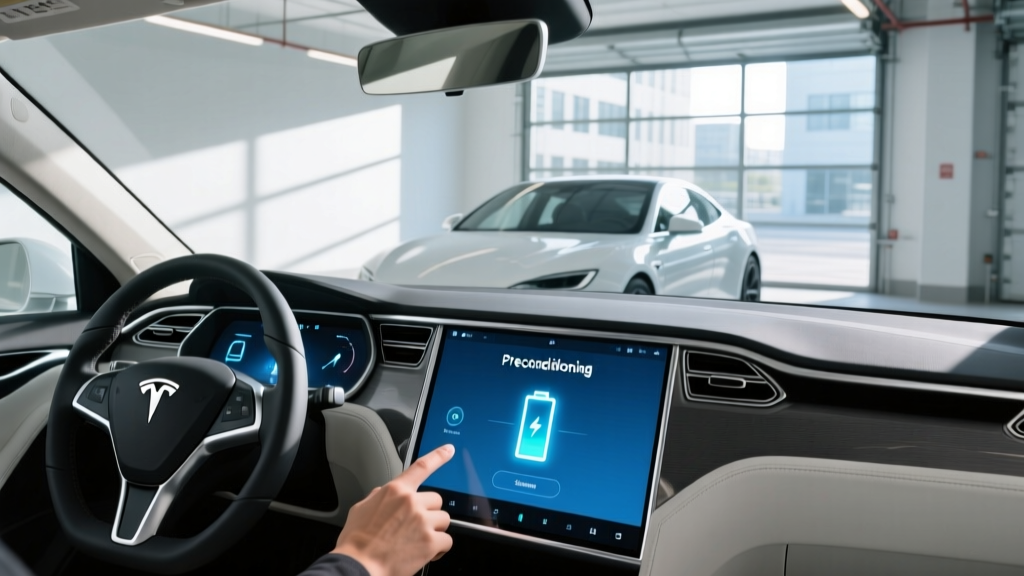
- Thermal management: Tesla's active liquid cooling handles most scenarios. In extreme heat (110°F+), avoid repeated back-to-back Supercharger sessions. In extreme cold, use scheduled departure preconditioning to warm the battery before driving and charging.
- Regen braking settings: Standard regen is fine; it doesn't meaningfully accelerate degradation compared to reduced regen.
- Software updates: Keep your vehicle updated. Tesla periodically refines battery management algorithms that optimize charging profiles and thermal conditioning.
The single highest-impact habit is avoiding sustained high SoC on NMC/NCA packs. Data from Recurrent's fleet tracking shows that vehicles routinely charged to 100% and left sitting in hot climates degrade 5-8% faster over 4 years than those kept between 20-80%.
How to Check Your Tesla's Battery Health (State of Health)
Tesla does not display a simple "battery health percentage" in the vehicle UI the way some competitors do. Here are the methods available to owners:
- In-car range comparison: Note your displayed range at 100% charge (for LFP) or extrapolate from your typical 80% charge. Compare to the original EPA-rated range for your model. A Model Y Long Range originally rated at 330 miles EPA that shows 280 miles at 100% is retaining roughly 85% capacity. (Note: displayed range is affected by driving style and temperature — use as a rough indicator, not a precise measurement.)
- Tesla app energy graph: The Energy tab in the Tesla app shows consumption trends but not direct SoH. It's useful for spotting anomalies.
- Third-party OBD-II tools: Devices like the OBD2 dongle paired with apps such as Tessie or Stats can read the Battery Management System (BMS) directly and report estimated SoH percentage, cell imbalance data, and charge/discharge cycle counts.
- Tesla Service diagnostic: You can request a battery health report from Tesla Service (sometimes available remotely via an over-the-air diagnostic pull). This is the most authoritative source but may require a service appointment.
For buyers evaluating a used Tesla, requesting a pre-purchase battery diagnostic from a Tesla Service Center is strongly recommended. The BMS report will show actual measured capacity vs. original, which is far more reliable than the dashboard range estimate.
What's Next: Solid-State, Silicon Anodes, and Realistic Timelines
Tesla's R&D pipeline includes several next-generation battery technologies. It's important to separate what's in production today from what remains in development:
Silicon anode cells: Tesla has been testing silicon-based anode materials that can increase energy density by 20-40% compared to graphite anodes. The challenge is cycle life — silicon expands significantly during charging, causing mechanical stress. Tesla has filed multiple patents on silicon-nanowire and silicon-carbon composite anodes, but as of 2026, these remain in limited testing and are not in any production vehicle. Realistic timeline for commercial deployment: 2028-2030 at the earliest.
Solid-state batteries: Solid-state cells replace the liquid electrolyte with a solid conductor, promising higher energy density, faster charging, and improved safety. Companies like QuantumScape and Toyota have demonstrated prototype cells, but manufacturing at automotive scale remains unsolved. Tesla has not announced a solid-state production timeline. Industry consensus places solid-state in limited premium-vehicle production around 2029-2032, with mass-market availability likely post-2032. Any claims of solid-state Teslas "coming soon" should be treated as speculative.
Dry electrode 4680 scaling: This is the most immediate "next step" already in progress. Tesla is ramping dry-electrode manufacturing at its Texas cathode plant, which reduces production cost and energy use. As yields improve, expect 4680 cells to appear in more Model Y and potentially Model 3 variants within the next 1-2 model years.
Sodium-ion chemistry: CATL (Tesla's LFP supplier) has begun mass-producing sodium-ion cells, which use cheaper, more abundant materials than lithium. Tesla has not confirmed adoption, but sodium-ion packs could theoretically serve as a lower-cost option for base-model vehicles where range requirements are modest. Timeline: possible in a future affordable Tesla model, no confirmed date.
Frequently Asked Questions
How long do Tesla batteries last in real-world use?
Fleet data indicates most Tesla packs retain 80-87% of original capacity at 150,000 miles (roughly 8 years of average driving). LFP packs tend to outlast NMC in terms of cycle life. Full battery failure before 200,000 miles is rare — fewer than 2% of packs are replaced under warranty according to Tesla's published fleet data.
How much does it cost to replace a Tesla battery?
Out-of-warranty replacement ranges from approximately $10,000-$13,000 for a Model 3 RWD (LFP, ~60 kWh) to $20,000-$25,000+ for a Cybertruck (4680 NMC, ~123 kWh). Under warranty (8 years / 100,000-150,000 miles depending on model), replacement is free if capacity drops below 70%.
What does the Tesla battery warranty cover?
Tesla's battery warranty covers defects in materials and workmanship plus capacity loss below 70% of original usable capacity for 8 years and 100,000-150,000 miles (varies by model). It does not cover accident damage, flooding, modifications, or normal degradation above the 70% threshold.
LFP vs NMC: which Tesla battery is better?
LFP offers longer cycle life (3,000-5,000+ cycles), lower cost, and the convenience of daily 100% charging — but with lower energy density and worse cold-weather performance. NMC delivers more range per kWh and better cold-weather efficiency but requires more careful SoC management (80% daily limit recommended). For high-mileage commuters who charge at home, LFP is often the better fit. For road-trippers who need maximum range, NMC Long Range trims are the practical choice.
How do I check my Tesla's battery State of Health?
The most reliable method is a BMS diagnostic report from Tesla Service. Owners can also use OBD-II dongles with apps like Tessie or Stats to read SoH estimates directly from the Battery Management System. The in-car displayed range at 100% charge provides a rough approximation when compared to original EPA figures.
Does frequent Supercharging damage my Tesla battery?
Occasional Supercharging has minimal impact. Tesla's fleet data suggests that vehicles relying primarily on DC fast charging show approximately 2-3% more degradation over 100,000 miles compared to those charged predominantly on Level 2 home chargers. The effect is measurable but not dramatic — Tesla's thermal management system actively protects the pack during fast charging by preconditioning and managing charge-rate taper.
When will Tesla have solid-state batteries?
Tesla has not announced a solid-state battery production timeline. Industry-wide, solid-state cells remain in prototype and limited pilot production. Realistic estimates place solid-state in limited premium vehicles around 2029-2032, with mass-market availability likely after 2032. Tesla's near-term focus is on scaling 4680 dry-electrode production and potentially evaluating silicon anode improvements.