If you own a Tesla or are shopping for one, the high-voltage traction battery is the single most expensive and consequential component in the vehicle. Recent headlines about Tesla new batteries — from the shift toward lithium iron phosphate (LFP) chemistry in Standard Range models to ongoing research into structural packs and silicon-anode cells — can make it hard to separate marketing from reality. This guide cuts through the noise with exact chemistry specs, real-world degradation data, warranty terms, replacement costs, and actionable care tips grounded in 2026 model-year information.
Before we go further, a critical distinction: kWh (kilowatt-hours) measures the battery's total energy capacity — think of it as the size of the fuel tank. kW (kilowatts) measures the rate of power delivery or charging speed — think of it as the width of the hose filling that tank. A 75 kWh battery charged at 150 kW is receiving energy very quickly; that same battery's usable capacity is what determines your range.
Tesla's Current Battery Chemistries: LFP vs NMC vs NCA
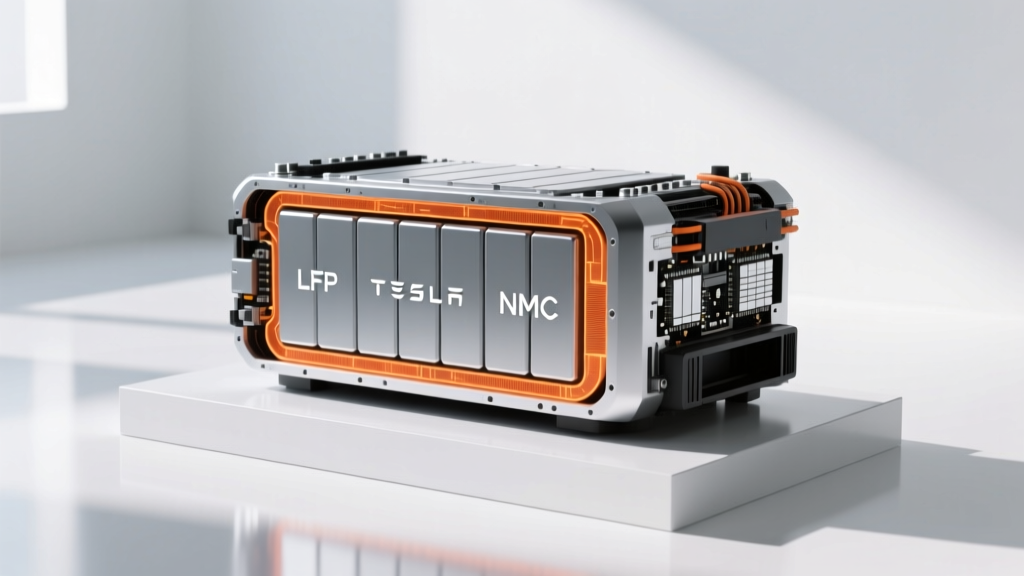
Tesla sources cells from multiple suppliers (CATL, Panasonic, LG Energy Solution) and uses different chemistries depending on the model and trim. Understanding which chemistry is in your Tesla matters because it dictates how you should charge it, what range degradation to expect, and how the pack performs in cold weather.
| Attribute | LFP (Lithium Iron Phosphate) | NMC / NCA (Nickel-based) |
|---|---|---|
| Models/Trims | Model 3 RWD, Model Y RWD (Standard Range) | Model 3/Y Long Range & Performance, Model S, Model X, Cybertruck |
| Typical Usable Capacity | ~57–60 kWh | ~75–100 kWh |
| Energy Density | Lower (~160–180 Wh/kg cell-level) | Higher (~250–300 Wh/kg cell-level) |
| Cycle Life | 3,000–5,000+ cycles | 1,000–2,000 cycles |
| Cold-Weather Performance | More range loss in freezing temps (~30–40%) | Better cold performance (~20–30% loss) |
| Daily Charge Recommendation | 100% daily is fine (Tesla recommends periodic 100% for BMS calibration) | 80% daily; 100% only for trips |
| Cobalt Content | None (cobalt-free) | Contains cobalt and/or nickel |
| Cost per kWh | Lower | Higher |
| Thermal Stability | Excellent (inherently safer chemistry) | Good (requires active thermal management) |
The practical takeaway: If you buy a Standard Range Model 3 or Model Y, you are getting an LFP pack. That means you can (and should) charge to 100% regularly — the chemistry tolerates it well, and Tesla's battery management system (BMS) actually needs periodic full charges to accurately estimate range. If you buy a Long Range or Performance variant, you are getting an NMC or NCA pack, where daily charging to 80% is recommended to minimize degradation.
How Long Do Tesla Batteries Actually Last?
This is the question that drives most battery-related searches, and the answer is more reassuring than the fear-mongering suggests. Tesla's own Impact Report has consistently shown that their battery packs retain a high percentage of original capacity well past 150,000 miles.
Real-World Degradation Data Points
- Model 3/Y (NMC/NCA): Approximately 12% capacity loss at 150,000 miles, based on aggregated fleet data from Tesla's 2024 Impact Report. Degradation is steepest in the first 20,000–30,000 miles (~5–7% loss), then flattens significantly.
- Model 3/Y (LFP): Early fleet data suggests slower degradation curves — approximately 8–10% loss at 150,000 miles — consistent with LFP's superior cycle life. Long-term data is still maturing since LFP Teslas only reached the US market in volume starting in 2022.
- Model S/X (NCA, older packs): Vehicles with the original 85 kWh and 90 kWh packs (2012–2016) showed roughly 10–15% degradation at 150,000 miles. Some early 85 kWh packs experienced cell imbalance issues requiring module-level service.
- High-mileage outliers: Multiple documented cases of Tesla vehicles exceeding 300,000 miles on the original pack with 70–80% capacity remaining, though these often involve owners who followed conservative charging practices.
Bottom line: For the vast majority of owners, the battery will outlast the vehicle's economic life. A complete pack failure outside of warranty is rare. The more realistic concern is gradual range loss — a Long Range Model Y that started at 330 miles EPA may deliver 280–290 miles after 100,000 miles. That is still very usable.
Tesla Battery Warranty: What Is Covered
Tesla's battery and drive unit warranty is one of the more straightforward in the industry, but the details matter — especially the capacity retention threshold.
| Model / Trim | Warranty Period | Mileage Limit | Minimum Capacity Retention |
|---|---|---|---|
| Model 3 RWD (LFP) | 8 years | 100,000 miles | 70% |
| Model Y RWD (LFP) | 8 years | 100,000 miles | 70% |
| Model 3 Long Range / Performance | 8 years | 120,000 miles | 70% |
| Model Y Long Range / Performance | 8 years | 120,000 miles | 70% |
| Model S / Model X | 8 years | 150,000 miles | 70% |
| Cybertruck (AWD / Cyberbeast) | 8 years | 120,000 miles | 70% |
What this means: If your battery drops below 70% of its original usable capacity within the warranty period (whichever comes first — years or miles), Tesla will repair or replace it to bring retention back to at least 70%. The warranty covers defects and excessive degradation, but not damage from accidents, flooding, or unauthorized modifications. Tesla may use a refurbished or remanufactured pack for warranty replacements — not necessarily a brand-new one — but it will meet the 70% threshold.
It is worth noting that the 70% threshold is conservative. Based on fleet degradation data, very few Tesla packs fall below 70% within the warranty window under normal use. The warranty is best understood as a safety net for manufacturing defects and outlier degradation, not a predictor of typical battery life.
Tesla Battery Replacement Cost: What to Budget
For owners outside warranty — or those buying used Teslas with high mileage — replacement cost is a legitimate concern. Here is what the numbers look like as of 2026:
| Model | Pack Size (Usable) | Chemistry | Estimated Replacement Cost |
|---|---|---|---|
| Model 3 Standard Range | ~57–60 kWh | LFP | $10,000–$14,000 |
| Model 3/Y Long Range | ~75–82 kWh | NMC/NCA | $13,000–$18,000 |
| Model S / Model X | ~90–100 kWh | NCA | $16,000–$22,000 |
| Cybertruck | ~123 kWh | NMC (4680 cells) | $18,000–$25,000 (estimated) |
These figures include the pack and labor at a Tesla Service Center. Independent EV shops may offer lower pricing, particularly for older Model S/X vehicles where refurbished packs are more available. Third-party battery repair shops can sometimes replace individual modules rather than the entire pack, reducing costs to $5,000–$9,000 for partial repairs — though this is model-dependent and not offered by Tesla directly.
When is replacement typically needed? Complete pack replacement due to degradation alone is uncommon before 200,000+ miles. Most replacements happen due to:
- Manufacturing defects caught within warranty (Tesla covers this)
- Physical damage from road debris or collisions
- Coolant intrusion or electrical faults in older packs (primarily pre-2018 Model S/X)
Factors That Affect Tesla Battery Life
Not all miles and charge cycles are equal. Several habits and environmental factors meaningfully influence how quickly your pack degrades:
Battery Care Best Practices
- Avoid sustained 100% SoC (NMC/NCA only): For nickel-based packs, regularly sitting at 100% accelerates electrolyte decomposition. Charge to 80% daily; reserve 100% for road trips and depart soon after reaching full charge.
- LFP owners: charge to 100% at least weekly. Tesla recommends this for accurate BMS state-of-charge calibration. LFP's flat voltage curve makes it harder for the BMS to estimate capacity without periodic full charges.
- Minimize DC fast charging when possible: Frequent Supercharging (250 kW) generates significant heat. Tesla's thermal management mitigates this well, but data from Recurrent Auto suggests that vehicles that fast-charge more than 90% of the time show slightly faster degradation (~2–3% more loss over 100,000 miles) compared to primarily Level 2 home charging.
- Precondition before fast charging: Tesla's navigation system automatically preconditions the battery when you route to a Supercharger. This warms the cells to the optimal temperature for accepting a fast charge, reducing stress. Never skip this — navigating to the charger triggers it even if you know the route.
- Avoid extreme SoC in extreme temperatures: Storing a vehicle at 100% SoC in 100°F+ heat, or at very low SoC (below 10%) in sub-zero temperatures, accelerates degradation. If storing for extended periods, aim for 50–60% SoC in moderate temperatures.
- Use Scheduled Charging and Scheduled Departure: These Tesla features let you time charging to finish right before you leave, minimizing time spent at high SoC and ensuring the battery is at optimal temperature for driving.
How to Check Your Tesla's Battery Health (State of Health)
Tesla does not expose a direct State of Health (SoH) percentage in the vehicle's UI the way some other manufacturers do. However, there are reliable methods to assess your pack's condition:
Method 1: Range Comparison at Known SoC
Charge your Tesla to exactly 100% (for LFP) or 90% (for NMC/NCA) and note the displayed rated range. Compare this to the EPA-rated range for your specific model and model year. For example, a 2026 Model 3 Long Range AWD has an EPA range of 363 miles. If your car displays 315 rated miles at 90%, your estimated SoH is roughly (315 / (363 × 0.90)) × 100 = ~96%. This is not perfectly precise because the displayed range uses a fixed consumption model, but it provides a consistent tracking metric over time.
Method 2: Third-Party Apps and OBD-II Scanners
Apps like Tessie, TeslaFi, and Stats can log detailed battery data over time, tracking estimated capacity in kWh by analyzing energy consumed between known SoC points. For more precise readings, an OBD-II Bluetooth scanner paired with apps like Scan My Tesla can read the BMS-reported nominal full-pack capacity (NFP) in kWh — the most direct SoH proxy available to owners.
Method 3: Tesla Service Diagnostic
If you suspect abnormal degradation, Tesla Service can run a full battery health diagnostic. This is sometimes performed during routine service visits and provides the definitive BMS-reported capacity figure. If the result falls below the 70% warranty threshold within the coverage period, you have a clear path to a warranty claim.
What's Next: Tesla's Battery Technology Pipeline
Tesla's battery R&D focuses on reducing cost per kWh, increasing energy density, and improving manufacturing throughput. Here is what is on the horizon — and what is realistic versus speculative:
4680 Cells (Currently in Production)
Tesla's proprietary 4680 cylindrical cells (46mm diameter, 80mm height) are in production at the Austin Gigafactory and are used in some Model Y vehicles and the Cybertruck. These cells use a tabless electrode design for better thermal management and a dry-electrode coating process that reduces manufacturing energy. The structural battery pack design integrates cells directly into the vehicle chassis, reducing weight and part count. As of 2026, 4680 packs are not yet the majority of Tesla's production — most Model 3 and Model Y vehicles still use 2170 cells from Panasonic and CATL — but the transition is ongoing.
Silicon-Anode Technology (Forward-Looking)
Silicon anodes can theoretically store roughly 10x more lithium ions than graphite anodes, promising significant energy density gains. However, silicon swells ~300% during lithiation, causing mechanical degradation and short cycle life. Tesla, along with suppliers and startups, is working on silicon-carbon composite anodes that mitigate this. Expect incremental integration rather than a sudden switchover — likely appearing first in performance-oriented applications where energy density matters most. Realistic timeline: limited production use in the late 2020s.
Solid-State Batteries (Forward-Looking)
Solid-state batteries replace the liquid electrolyte with a solid conductor, promising higher energy density, faster charging, and improved safety. Multiple companies (Toyota, QuantumScape, Samsung SDI) have announced prototypes, but mass production at automotive scale remains unresolved due to manufacturing cost and interfacial resistance challenges. Tesla has not announced a solid-state production timeline. Industry consensus places viable solid-state EV batteries in the 2029–2032 timeframe for premium applications, with mainstream adoption later. Any claims of imminent solid-state Teslas should be treated skeptically.
Sodium-Ion Batteries (Forward-Looking)
CATL, a Tesla supplier, has begun mass-producing sodium-ion batteries that use no lithium, nickel, or cobalt. These offer lower energy density than LFP but excel in cold-weather performance and raw material cost. Tesla has not confirmed sodium-ion adoption for any US-market vehicle, but it is a plausible chemistry for future entry-level models. Timeline: possible in non-US markets first, US availability uncertain.
Frequently Asked Questions
How long do Tesla batteries last in years and miles?
Based on fleet data, most Tesla battery packs retain 85–90% of original capacity at 150,000 miles and 8–10 years of use. LFP packs in Standard Range vehicles are projected to last even longer based on their superior cycle life (3,000–5,000+ cycles). Complete pack failure before 200,000 miles is rare under normal operating conditions. The battery is designed to last the life of the vehicle.
How much does it cost to replace a Tesla battery?
Out-of-warranty replacement costs range from approximately $10,000 for a Model 3 Standard Range LFP pack to $22,000+ for a Model S/X NCA pack, including labor at a Tesla Service Center. Within the 8-year/100,000–150,000-mile warranty window, excessive degradation below 70% capacity is covered at no cost. Most owners will never need a paid replacement.
What does the Tesla battery warranty actually cover?
Tesla's battery warranty guarantees that the pack will retain at least 70% of its original usable capacity for 8 years or 100,000–150,000 miles (depending on model), whichever comes first. It covers manufacturing defects and abnormal degradation. It does not cover damage from accidents, improper use, or unauthorized modifications. Warranty replacements may use refurbished packs that meet the 70% threshold.
How do I check and maximize my Tesla battery health?
Track your rated range at a consistent SoC over time, or use third-party apps (Tessie, TeslaFi) and OBD-II scanners to monitor BMS-reported nominal capacity. To maximize health: charge NMC/NCA packs to 80% daily, charge LFP packs to 100% at least weekly, precondition before Supercharging, minimize time at extreme SoC in extreme temperatures, and favor Level 2 home charging over exclusive DC fast charging.
Is LFP or NMC better for a Tesla battery?
Neither is universally better — they serve different priorities. Choose LFP (Standard Range) if you want lower cost, longer cycle life, the simplicity of daily 100% charging, and cobalt-free chemistry — and can accept slightly less range and more cold-weather range loss. Choose NMC/NCA (Long Range/Performance) if you need maximum range, better cold-weather performance, and higher energy density — and are willing to follow the 80% daily charge guideline. For most daily commutes under 60 miles, LFP's range is more than sufficient.
Does frequent Supercharging damage the battery?
Tesla's thermal management system actively cools and heats the pack during Supercharging to minimize stress. Fleet data shows that the difference between exclusive Supercharging and exclusive Level 2 charging amounts to roughly 2–3% additional degradation over 100,000 miles — a meaningful but not catastrophic difference. For owners without home charging, regular Supercharging is perfectly viable. Just avoid letting the car sit at 100% SoC after a full charge for extended periods.