If you own or are shopping for a Tesla Model Y, the phrase "Tesla Model Y low voltage battery replacement" can trigger immediate concern. But before you panic, it's critical to understand that your Model Y actually has two batteries: the high-voltage traction pack (60–82 kWh) that drives the wheels, and a low-voltage auxiliary battery (12V lead-acid in older builds, 16V lithium-ion in 2022+ models) that powers the electronics, lights, and door handles. This guide covers both — with exact costs, degradation data, warranty terms, and chemistry trade-offs you need to make informed decisions in 2026.
The Two Batteries in Your Tesla Model Y Explained
Every Tesla Model Y on the road contains two separate energy storage systems that serve entirely different functions:
High-Voltage Traction Battery (400V architecture): This is the large lithium-ion pack mounted in the vehicle floor. Depending on the trim and model year, it ranges from approximately 60 kWh (Standard Range/RWD) to 75–82 kWh (Long Range and Performance variants). This battery propels the electric motors and is the component covered by Tesla's 8-year battery warranty.
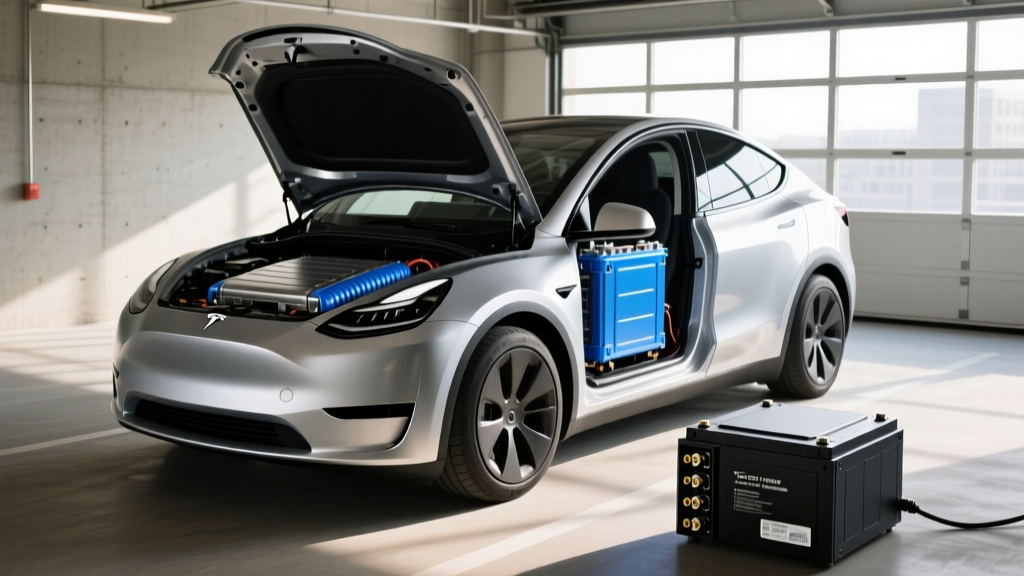
Low-Voltage Auxiliary Battery: This smaller battery powers the vehicle's 12V/16V systems — infotainment, ECU computers, lights, power windows, door handles, and safety systems. It does not affect driving range or propulsion. Early Model Y vehicles (2020–2021) used a conventional 12V lead-acid battery. Starting in late 2021 and standard by 2022, Tesla transitioned to a 16V lithium-ion auxiliary battery (the "16V Li-ion" unit), which is lighter, lasts longer, and rarely needs replacement during the vehicle's life.
Tesla Model Y Low Voltage Battery Replacement: Costs & Timing
The low-voltage auxiliary battery is a maintenance item, much like a windshield wiper or cabin air filter. Here's what to expect:
| Component | Model Years | Typical Lifespan | Replacement Cost |
|---|---|---|---|
| 12V Lead-Acid Auxiliary Battery | 2020–2021 | 3–5 years | $150–$300 (parts + labor at Tesla Service) |
| 16V Lithium-Ion Auxiliary Battery | 2022–2026 | 8–12+ years (often vehicle lifetime) | $400–$700 if needed (rare) |
Signs your low-voltage battery needs attention: The Model Y will display a "12V Battery Needs Replacement" or "Low Voltage Battery" warning on the touchscreen well before failure. You may also notice slower touchscreen boot times, flickering lights, or door handles that are sluggish to present. If you see this warning, schedule service promptly — a dead 12V/16V battery will prevent the car from powering on, even if the traction pack is fully charged.
DIY vs. Tesla Service: On 2020–2021 Model Y vehicles with the lead-acid 12V, some owners replace it themselves with an AGM-compatible battery (group size H5/LN2, ~$120–$160 for the part). However, the vehicle's battery management system (BMS) may need recalibration via the Tesla app or service mode. For 16V lithium-ion units (2022+), Tesla Service Center or Mobile Ranger replacement is strongly recommended due to proprietary connectors and software pairing requirements.
High-Voltage Traction Battery: How Long Does It Last?
The traction battery is the heart of your Model Y's range and performance. The good news: data from thousands of Tesla vehicles shows these packs are engineered to significantly outlast the typical ownership cycle.
Real-World Degradation Data
Based on fleet data aggregated by Tesla's Impact Reports and independent tracking from sources like Tesla's 2023 Impact Report and community-driven databases (e.g., Teslabros, Recurrent Auto):
- At 50,000 miles: ~3–5% capacity loss (a 330-mile EPA Long Range may show ~315–320 miles at 100% SoC)
- At 100,000 miles: ~7–10% capacity loss (~300–305 miles retained on Long Range)
- At 150,000 miles: ~10–14% capacity loss (~285–295 miles retained)
- At 200,000 miles: ~12–18% capacity loss (~270–290 miles retained)
Note: LFP-equipped Standard Range/RWD models tend to show slower degradation curves, often retaining 90%+ capacity past 100,000 miles.
These numbers align with Tesla's published claim that their battery packs retain approximately 88–92% of original capacity at 200,000 miles. The degradation curve is non-linear: the most significant loss occurs in the first 20,000–30,000 miles (roughly 2–3%), after which degradation slows considerably and enters a long, gradual linear decline.
When Is a Full Traction Battery Replacement Needed?
Full traction battery replacement on a Model Y is rare and typically only occurs in two scenarios:
- Warranty-covered failure: The pack drops below 70% of original capacity within the warranty period (8 years / 120,000 miles for Long Range/Performance; 8 years / 100,000 miles for RWD). Tesla replaces or refurbishes the pack at no cost.
- Physical damage: Collision damage, flood submersion, or manufacturing defect outside warranty. This is where out-of-pocket replacement cost applies.
Under normal ownership, the vast majority of Model Y traction batteries will never need replacement. They are designed for 300,000–500,000 miles of usable life before reaching 70% capacity — far beyond the average vehicle lifespan.
Tesla Battery Warranty: What's Covered and For How Long
| Trim | Battery Warranty | Capacity Threshold | Drive Unit Warranty |
|---|---|---|---|
| Model Y RWD (LFP) | 8 years / 100,000 miles | 70% minimum retention | 8 years / 100,000 miles |
| Model Y Long Range AWD | 8 years / 120,000 miles | 70% minimum retention | 8 years / 120,000 miles |
| Model Y Performance | 8 years / 120,000 miles | 70% minimum retention | 8 years / 120,000 miles |
What the warranty covers: Battery capacity degradation below 70% of original kWh, manufacturing defects, and drive unit (motor/inverter) failures. Tesla will repair or replace the battery with one that has at least equivalent energy capacity to the original at the time of replacement (not necessarily a brand-new pack).
What it does NOT cover: Damage from accidents, flooding, fire not caused by the battery, modifications, or failure to follow Tesla's charging guidelines. Cosmetic issues or range reduction from software updates that do not constitute a defect are also excluded.
Transferability: The battery and drive unit warranty transfers automatically to subsequent owners — an important factor for used Model Y buyers. Verify warranty status through the Tesla app or by contacting Tesla Support with the VIN.
High-Voltage Battery Replacement Cost: What You'd Actually Pay
If you need an out-of-warranty traction battery replacement — due to accident damage, extreme neglect, or simply owning the vehicle well past warranty expiration — here are the current estimated costs as of 2026:
| Model Y Variant | Battery Chemistry | Approx. Pack Size | Estimated Replacement Cost |
|---|---|---|---|
| RWD / Standard Range | LFP (CATL) | ~60 kWh | $8,000–$12,000 |
| Long Range AWD | NMC (Panasonic/LG) | ~75–82 kWh | $12,000–$16,000 |
| Performance | NMC (Panasonic 2170) | ~82 kWh | $13,000–$18,000 |
These figures include the battery pack and Tesla Service Center labor. Costs have been declining steadily — in 2020, a Long Range pack replacement could exceed $20,000. As of 2026, continued reductions in cell manufacturing cost (particularly for LFP chemistry) and improved refurbishment processes are pushing prices lower. Third-party EV repair shops are also beginning to offer module-level repairs (replacing individual faulty modules rather than the entire pack) for $3,000–$6,000, though this is not yet widely available for the Model Y's structural battery pack design.
LFP vs NMC Chemistry: Which Is in Your Model Y?
The Model Y's battery chemistry depends on the trim and where it was manufactured. Understanding which chemistry your pack uses directly impacts charging habits, longevity expectations, and cold-weather performance.
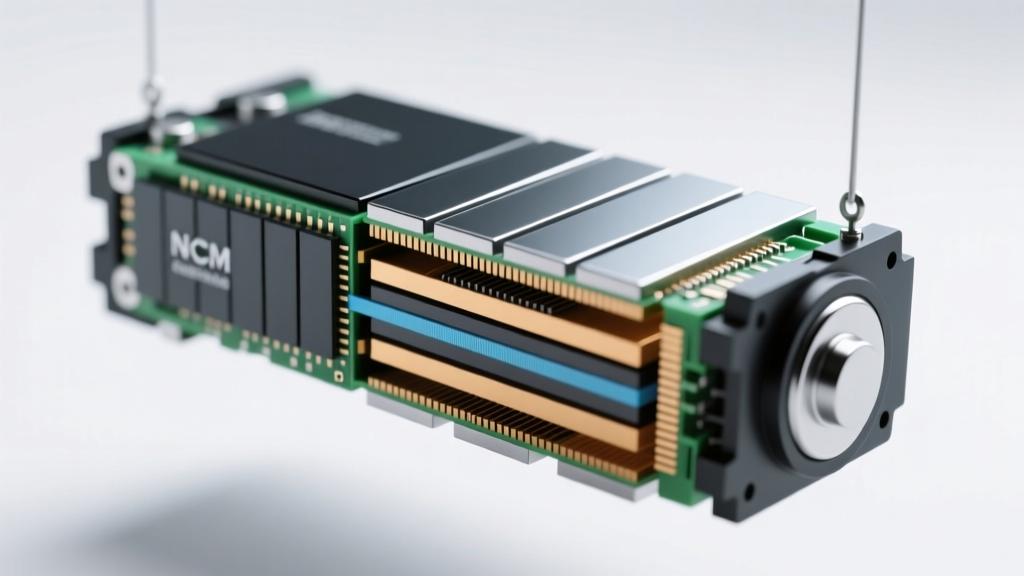
| Attribute | LFP (Lithium Iron Phosphate) | NMC/NCA (Nickel Manganese Cobalt / Nickel Cobalt Aluminum) |
|---|---|---|
| Found In | Model Y RWD (Standard Range), some Made-in-China/Austin builds | Model Y Long Range, Performance (Panasonic/LG cells) |
| Energy Density | Lower (~160–180 Wh/kg cell-level) — heavier pack for same range | Higher (~250–300 Wh/kg) — more range per pound |
| Cycle Life | 3,000–5,000+ cycles — significantly longer lifespan | 1,000–2,000 cycles before notable degradation |
| Charging to 100% | Tesla recommends charging to 100% regularly (weekly minimum) for BMS calibration | Tesla recommends daily limit of 80–90%; 100% only for trips |
| Cold-Weather Performance | More range loss in cold (~35–40% reduction below 20°F); slower cold charging | Better cold performance (~25–30% reduction below 20°F) |
| Cost | Lower — no cobalt or nickel; cheaper to manufacture and replace | Higher — relies on nickel and cobalt supply chains |
| Safety/Thermal Stability | Excellent — inherently more thermally stable, lower thermal runaway risk | Good — requires more robust thermal management systems |
Which is better? It depends on your use case. If you primarily commute in moderate climates and want maximum battery longevity with minimal care, LFP is the superior choice — you can charge to 100% daily without guilt, and the pack will likely retain 90%+ capacity well past 150,000 miles. If you need maximum range (330+ miles EPA), regularly drive in cold climates, or take frequent road trips where DC fast-charging speed matters, NMC/NCA in the Long Range or Performance trim is the better fit.
How to Check and Maximize Your Model Y Battery Health
Checking State of Health (SoH)
Tesla does not expose a direct "battery health percentage" in the vehicle interface the way some competitors do. Here's how to assess your Model Y's traction battery SoH:
- Tesla App / In-Car Display: The estimated range shown at 100% charge (or projected to 100%) compared to the original EPA rating gives a rough degradation indicator. For example, if your Long Range originally showed 330 miles at 100% and now shows 310 miles, that's approximately 6% degradation.
- Third-Party Tools: Apps like Tessie, TeslaFi, or Stats (iOS) log detailed charge data and can calculate a more precise SoH percentage over time by comparing energy added during charges to the battery's known capacity.
- Tesla Service Diagnostic: You can request a battery health report from Tesla Service. They run a diagnostic that provides an accurate capacity assessment — useful before purchasing a used Model Y or filing a warranty claim.
Battery Care Checklist for Maximum Longevity
- Daily charge limit: Set to 80% for NMC/NCA (Long Range/Performance); 100% for LFP (RWD) — charge to 100% at least weekly on LFP for BMS calibration
- Avoid prolonged 100% SoC: On NMC packs, don't leave the car sitting at 100% for more than a few hours — schedule charging to finish just before departure
- Minimize DC fast charging: Supercharging is fine for road trips, but daily use accelerates degradation slightly. Level 2 home charging (7–11.5 kW) is gentler on the pack
- Precondition before Supercharging: Always navigate to a Supercharger via the Tesla nav system — this triggers battery preconditioning, warming the pack for optimal charge speed and reduced stress
- Extreme heat: Avoid leaving the car at high SoC (>90%) in sustained 100°F+ temperatures for days. Tesla's thermal management runs even when parked, but high SoC + high heat is the worst combination for lithium-ion longevity
- Extreme cold: Plug in when possible in sub-freezing weather — the car will use grid power for battery warming rather than draining the pack. Use Scheduled Departure to precondition
- Don't let it sit at 0%: Avoid storing the vehicle at very low SoC. If parking for extended periods, leave it plugged in with a 50% charge limit
Factors That Accelerate Battery Degradation
The three biggest degradation accelerants, backed by battery science:
- High State of Charge + High Temperature: Storing an NMC pack at 100% SoC in hot weather causes accelerated electrolyte decomposition and cathode surface degradation. This is why Tesla recommends 80% daily limits.
- Frequent DC Fast Charging at High Power: Sustained 250 kW Supercharging sessions generate significant internal heat. While Tesla's thermal management is excellent, frequent high-C-rate charging does incrementally increase wear. Fleet data suggests exclusive Supercharging may add 1–3% additional degradation over 100,000 miles vs. primarily Level 2 charging.
- Deep Discharge Cycles: Regularly driving the battery below 10% SoC stresses the cells. The Model Y's buffer (approximately 2–4 kWh hidden below 0% displayed) protects against true deep discharge, but habitual low-SoC driving still contributes to wear.
Emerging Battery Technology: What's Next Beyond 2026
While current Model Y owners are well-served by existing lithium-ion technology, the battery landscape is evolving rapidly:
Silicon-Dominant Anodes: Companies like Sila Nanotechnologies and Group14 are replacing graphite anodes with silicon-composite materials, boosting energy density by 20–40%. Tesla's own 4680 cells (used in some Austin-built Model Y vehicles) incorporate incremental silicon content. Expect broader adoption across the Model Y lineup by 2027–2028, yielding longer range without increasing pack size.
Solid-State Batteries: These replace the liquid electrolyte with a solid ceramic or polymer, promising 2–3x energy density, faster charging, and near-zero degradation. Toyota, Samsung SDI, and QuantumScape are leading development. However, manufacturing scale and cost remain significant hurdles. Realistic timeline for mass-market EVs: 2029–2032. Solid-state will not be available as a retrofit for current Model Y vehicles.
Sodium-Ion Batteries: CATL and BYD have begun deploying sodium-ion cells in Chinese-market EVs. These are cheaper and more cold-tolerant than LFP but have ~30% lower energy density. They may appear in future base-trim Tesla models for price-sensitive markets, though no Model Y application has been announced.
Frequently Asked Questions
How long do Tesla Model Y batteries last in years and miles?
The high-voltage traction battery in a Model Y is designed to last 300,000–500,000 miles before reaching 70% capacity retention. In practical terms, most packs will outlast the vehicle itself. Fleet data shows approximately 88–92% capacity retention at 200,000 miles. The 12V/16V auxiliary battery lasts 3–5 years (lead-acid) or 8–12+ years (lithium-ion).
How much does it cost to replace the Tesla Model Y traction battery?
Out-of-warranty traction battery replacement ranges from approximately $8,000–$12,000 for the LFP Standard Range pack to $12,000–$18,000 for the Long Range/Performance NMC pack. However, the vast majority of Model Y owners will never need this — the battery is covered under warranty for 8 years / 100,000–120,000 miles, and most packs last well beyond that.
What does the Tesla battery warranty actually cover?
Tesla's battery warranty covers capacity loss below 70% of original kWh and manufacturing defects for 8 years / 100,000 miles (RWD) or 8 years / 120,000 miles (Long Range/Performance). It does not cover accident damage, flooding, or modifications. The warranty transfers to subsequent owners automatically.
How do I check my Model Y's battery health?
Compare the estimated range at 100% charge (shown in the Tesla app or on the touchscreen) to the original EPA rating. For more precise tracking, use third-party apps like Tessie or TeslaFi that log charge data and calculate State of Health. You can also request a diagnostic battery health report from Tesla Service.
Is the LFP battery in the Model Y RWD better than NMC in the Long Range?
Neither is universally "better" — they serve different needs. LFP offers superior cycle life (3,000–5,000+ cycles), lower replacement cost, and the ability to charge to 100% daily. NMC offers higher energy density (more range in a lighter pack), better cold-weather performance, and faster DC charging. Choose LFP for commuting longevity; choose NMC for maximum range and road-trip capability.
Does frequent Supercharging damage my Model Y battery?
Not significantly, but it does add marginal wear. Tesla's battery preconditioning (triggered by navigating to a Supercharger) and active thermal management minimize stress. Fleet data suggests exclusive Supercharging may result in 1–3% additional degradation over 100,000 miles compared to primarily Level 2 home charging. For daily charging, a home Level 2 charger (7–11.5 kW) remains the optimal choice for long-term battery health.