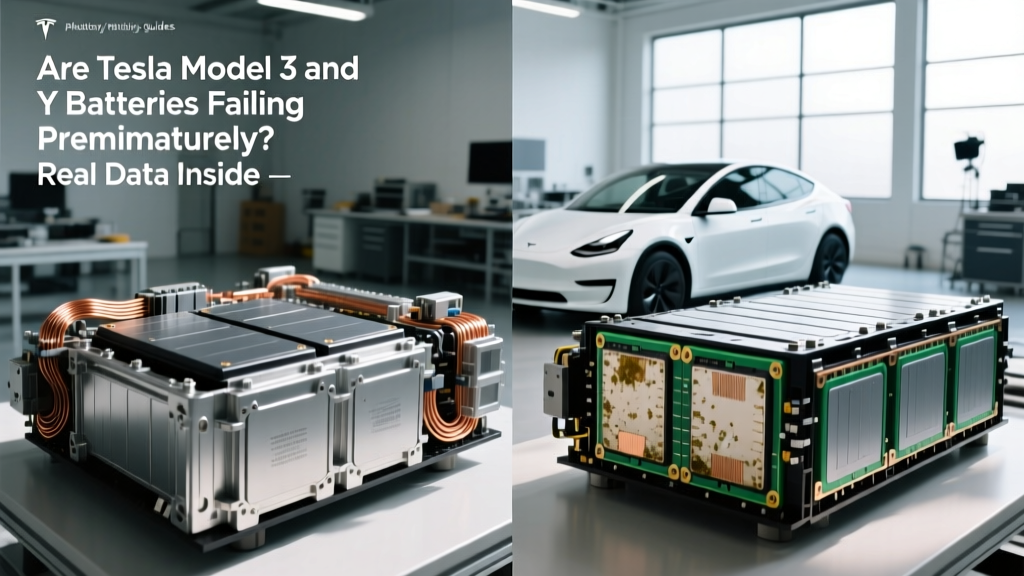
If you have spent any time in EV forums or Reddit threads over the past year, you have likely encountered the claim that Tesla Model 3 and Y batteries are failing prematurely. Viral posts about sudden range drops, warranty claims, and out-of-pocket replacement invoices have rattled prospective buyers and current owners alike. But how much of this is signal, and how much is noise amplified by a few high-profile cases?
As someone who has tracked Tesla battery telemetry data, pored over fleet degradation studies, and spoken with owners at 100,000+ miles, I can tell you the reality is more nuanced — and generally more reassuring — than the headlines suggest. This guide breaks down exactly what the data shows about Model 3 and Model Y battery longevity, what chemistry your car has, how the warranty actually works, and what you can do to maximize your pack's lifespan.
The Premature Failure Claim: What the Data Actually Shows
Let's address the core anxiety directly. Tesla's own 2023 Impact Report (the most recent comprehensive fleet data published) stated that Model 3 and Model Y batteries retain approximately 85% of their original capacity after 150,000 miles. That means an average degradation of roughly 15% over a distance that exceeds what most American drivers cover in a decade.
Independent data from Recurrent Auto, which tracks over 15,000 EVs in real-world conditions, corroborates this general trend. Their fleet analysis shows Tesla Model 3 and Y packs typically lose 5–8% capacity in the first two years (the steepest part of the degradation curve), then settle into a slow, linear decline of roughly 1–2% per year thereafter.
So where do the "premature failure" stories come from? A few identifiable sources:
- 12V auxiliary battery failures — not the high-voltage traction battery. The small 12V lithium-ion auxiliary battery in Teslas has a known history of dying within 2–4 years, which can brick the car's electronics and feel catastrophic to an owner who doesn't understand the distinction. This is a real issue, but it is not a traction battery failure.
- Manufacturing defect outliers — A small percentage of packs (well under 1%) develop cell imbalances or module faults that trigger significant capacity loss or fault codes. These are covered under warranty but get outsized attention online.
- Phantom drain and BMS calibration drift — Some owners see their displayed range drop suddenly, which is often a battery management system (BMS) recalibration rather than actual cell degradation. A full charge cycle can sometimes restore the displayed number.
- High-mileage fleet vehicles — Taxis, rideshare cars, and delivery vehicles that DC fast-charge daily and run 60,000+ miles per year can see accelerated wear. These are not representative of typical ownership.
The bottom line: widespread premature traction battery failure in Model 3 and Y vehicles is not supported by fleet-scale data. Individual cases exist, as they do with any complex manufactured product, but the statistical norm is a pack that outlasts the car's useful economic life.
Battery Chemistry in Your Model 3 or Y: LFP vs. NCA/NMC
Not all Tesla batteries are the same. Depending on your model year, trim, and manufacturing plant, your Model 3 or Y has one of two fundamentally different chemistries. Understanding which one you have matters for longevity, charging habits, and cold-weather performance.
| Attribute | LFP (Lithium Iron Phosphate) | NCA/NMC (Nickel-Cobalt-Aluminum / Nickel-Manganese-Cobalt) |
|---|---|---|
| Found in | Model 3 RWD (Standard Range), Model Y RWD (2025+) | Model 3 Long Range / Performance, Model Y Long Range / Performance |
| Typical usable capacity | 57–60 kWh | 75–82 kWh |
| Energy density | Lower (~160 Wh/kg cell-level) | Higher (~250–270 Wh/kg cell-level) |
| Cycle life | 3,000–5,000+ cycles to 80% SoH | 1,000–2,000 cycles to 80% SoH |
| Cold-weather performance | More range loss in freezing temps (15–30%) | Better cold performance (10–20% loss) |
| Recommended daily charge limit | 100% (Tesla recommends periodic full charges) | 80–90% daily; 100% only for trips |
| Cost to manufacture | Lower (no cobalt or nickel) | Higher (nickel and cobalt exposure) |
| Degradation profile | Very flat curve after initial settling | Steeper early drop, then gradual linear decline |
Which is better? It depends on your use case. If you are a daily commuter who charges at home and wants maximum cycle life with minimal babysitting, LFP is the longevity winner. You can charge to 100% every day without guilt, and the chemistry is inherently more stable and longer-lasting. If you need maximum range per charge, tow frequently, or live in a cold climate where every percentage point of winter range matters, NCA/NMC gives you the energy density advantage — but demands more careful state-of-charge management for long-term health.
The shift toward LFP in base Model 3 and Model Y trims is one reason the "premature failure" narrative doesn't hold up at the fleet level: LFP packs are, by their chemistry, more resistant to degradation over time.
Typical Degradation: What to Expect Over Years and Miles
EV battery degradation is not linear. The pattern across both LFP and NCA/NMC chemistries follows a consistent shape: a relatively sharp drop in the first 12–24 months (or first 20,000–40,000 miles), followed by a much slower, nearly linear decline for the remainder of the pack's life.
Typical Tesla Model 3/Y Degradation Curve (NCA/NMC Long Range):
- Year 1 / ~12,000 mi: 2–4% capacity loss (rapid initial SEI layer formation)
- Year 2 / ~24,000 mi: 4–6% total loss (curve begins to flatten)
- Year 4 / ~48,000 mi: 7–9% total loss
- Year 6 / ~72,000 mi: 9–12% total loss
- Year 8 / ~96,000 mi: 11–15% total loss
- Year 10 / ~120,000 mi: 13–18% total loss (most packs still above warranty threshold)
LFP packs (Model 3 RWD / Model Y RWD) typically show 1–3% loss in year one and settle to a near-flat trajectory, with many fleet examples showing less than 8% total loss at 100,000 miles.
For context, a Model 3 Long Range with an EPA-rated 341 miles that has degraded 12% at 80,000 miles would still show roughly 300 miles of range at full charge — a noticeable but livable reduction. And that is under typical mixed-use conditions. Highway-only driving, extreme heat, and daily DC fast charging will push degradation toward the higher end of these ranges.
According to fueleconomy.gov, modern lithium-ion EV batteries are designed to last the lifetime of the vehicle, and most manufacturers engineer for 80% capacity retention at the warranty boundary.
Tesla's Battery Warranty: What Is Actually Covered
Tesla's new-vehicle limited battery warranty is one of the more straightforward in the industry, but the details matter — especially the capacity retention threshold that triggers a claim.
| Model / Trim | Warranty Period | Mileage Limit | Minimum Capacity Retention |
|---|---|---|---|
| Model 3 RWD (LFP) | 8 years | 100,000 miles | 70% |
| Model 3 Long Range / Performance | 8 years | 120,000 miles | 70% |
| Model Y RWD (LFP) | 8 years | 100,000 miles | 70% |
| Model Y Long Range / Performance | 8 years | 120,000 miles | 70% |
What the warranty covers: Battery failure (non-functional pack) and capacity loss below 70% of original within the time/mileage limit. If your 82 kWh Long Range pack drops below roughly 57.4 kWh of usable capacity before 120,000 miles or 8 years, Tesla will repair or replace it at no cost.
What it does not cover: Normal degradation above the 70% threshold, damage from accidents or environmental events, modifications, or use of the vehicle as a stationary power source outside approved V2H/V2L configurations. Cosmetic issues with the battery casing are also excluded.
The 70% threshold is critical context for the "premature failure" discussion. A pack that has degraded from 341 to 260 miles of range (a ~24% loss) would be a warranty case. But a pack at 85% capacity showing 290 miles is functioning exactly as engineered — even if the owner expected zero loss.
Battery Replacement Cost: The Number Everyone Fears
Out-of-warranty battery replacement is the specter that haunts every EV purchase decision. Let's put real numbers to it.
| Model / Battery | Battery Size | Chemistry | Estimated Replacement Cost |
|---|---|---|---|
| Model 3 RWD | ~60 kWh | LFP | $10,000–$13,000 |
| Model 3 Long Range / Performance | ~79 kWh | NCA/NMC | $13,000–$16,000 |
| Model Y RWD | ~60 kWh | LFP | $10,000–$14,000 |
| Model Y Long Range / Performance | ~79–82 kWh | NCA/NMC | $14,000–$18,000 |
These figures include the battery pack and labor but can vary by service center and whether Tesla uses a new, remanufactured, or refurbished pack. Tesla has increasingly moved toward module-level repairs — replacing individual failed modules rather than the entire pack — which can bring costs down to $3,000–$7,000 for isolated faults.
When is replacement typically needed? Based on current fleet data, the vast majority of Model 3 and Y owners will never need a traction battery replacement during their ownership. Packs are routinely reaching 200,000+ miles with 75–85% capacity retention. The most common replacement scenarios are:
- Manufacturing defects in the first 50,000 miles (covered by warranty)
- Physical damage from road debris or flooding (insurance claim)
- Very high-mileage vehicles (200,000+ mi) used in rideshare or fleet service
For a typical owner driving 12,000–15,000 miles per year, the battery will almost certainly outlast the car's economic value. The fear of a $16,000 surprise bill is real but statistically unlikely to materialize for most buyers.
What Actually Kills EV Batteries: Habits That Accelerate Degradation
While chemistry and manufacturing quality set the baseline, your daily habits determine where on the degradation curve your pack will land. Here are the factors that measurably accelerate capacity loss:
Maximize Your Tesla Battery Lifespan — A Practical Checklist:
- Avoid sustained 100% state of charge (NCA/NMC only): For Long Range and Performance models, set your daily charge limit to 80%. Charge to 100% only when departing on a road trip. LFP owners can and should charge to 100% regularly — Tesla recommends it for accurate BMS calibration.
- Minimize DC fast charging when possible: Supercharging at 150–250 kW generates significant heat. Occasional road-trip Supercharging is fine, but daily DC fast charging (common in rideshare) measurably accelerates degradation. Rely on Level 2 home charging for daily needs.
- Precondition before fast charging: Tesla's navigation-based preconditioning warms the battery to optimal temperature before you arrive at a Supercharger. Always navigate to the charger rather than just driving there — this alone can reduce charging-induced stress significantly.
- Avoid extreme SoC in extreme temperatures: Don't let the car sit at 100% charge in 100°F+ heat. Don't leave it at 5% in sub-zero cold for extended periods. Store between 40–60% if the car will sit unused for weeks.
- Use Scheduled Charging and Scheduled Departure: These Tesla features let you time charging to finish just before you leave, minimizing time spent at high SoC. In cold weather, Scheduled Departure also warms the battery, improving efficiency and reducing cold-charge stress.
- Don't obsess over daily range fluctuations: Displayed range varies with temperature, recent driving style, and BMS calibration. A 10-mile swing day-to-day is normal and does not indicate degradation.
The single most impactful habit for NCA/NMC owners is the 80% daily charge limit. Data consistently shows that batteries held at high state of charge for extended periods experience accelerated calendar aging — the chemical degradation that happens even when the car is parked. A pack that lives between 20% and 80% will outlast one that cycles between 10% and 100% by a significant margin over a decade.
How to Check and Monitor Your Battery's State of Health
Tesla does not expose a direct "State of Health" (SoH) percentage in the vehicle's UI the way some competitors do. But there are several reliable methods to assess your pack's condition:
In-Car Methods
- Displayed range at 100% charge: Charge to 100% (or calculate: displayed range ÷ current SoC percentage × 100). Compare this to the original EPA rating for your specific model year and trim. A 2025 Model 3 Long Range originally rated at 341 miles that shows 310 miles at 100% has roughly 91% SoH.
- Energy screen trip tracker: Reset the trip tracker and monitor your average Wh/mi over several thousand miles. A gradual increase in Wh/mi at consistent driving speeds can indicate capacity loss — though tire condition, alignment, and climate also affect this.
Third-Party Tools
- TeslaFi or Tessie: These third-party apps log detailed telemetry from your Tesla's API, including estimated battery capacity derived from charge sessions. They can plot your degradation curve over time and flag anomalies.
- OBD-II dongles with Scan My Tesla: For more granular data, an OBD-II adapter paired with the Scan My Tesla app can read cell-level voltages, pack impedance, and BMS-estimated capacity — giving you a more precise SoH figure than the displayed range alone.
- Service mode (2025+ vehicles): Some recent Tesla software versions include a battery health test accessible through Service Mode. Check your software version and owner community forums for availability.
If your tracked SoH drops below 75% within the warranty period, or if you notice sudden asymmetric range loss (e.g., losing 30+ miles of displayed range in a matter of weeks without a change in habits), schedule a service appointment. Tesla can run a diagnostic that reads individual module balance and identifies cells that may be failing.
Looking Ahead: Solid-State and Silicon Anode Batteries
The battery technology landscape is evolving rapidly, and it is worth understanding what is on the horizon — and what is not yet real.
Solid-state batteries promise higher energy density, faster charging, and improved safety by replacing the liquid electrolyte with a solid material. Toyota, Samsung SDI, and several startups have announced solid-state prototypes, but mass production for consumer EVs remains 2028–2030 at the earliest based on current manufacturing timelines. Tesla has not announced a solid-state roadmap.
Silicon anode technology — which replaces graphite in the anode with silicon to increase energy storage per unit mass — is closer to reality. Companies like Sila Nanotechnologies and Group14 are supplying silicon-dominant anode materials to battery manufacturers now, and incremental silicon blending is already present in some production cells. Expect gradual adoption through the late 2020s rather than a sudden switchover.
What this means for current owners: If you are buying a Model 3 or Y today, you are buying proven, mature lithium-ion technology that will serve well for a decade or more. Waiting for solid-state is a valid choice if your purchase timeline is flexible, but it is not a reason to fear current battery technology. The packs in today's Teslas are vastly more durable and better-managed than those in early-2010s EVs.
Frequently Asked Questions
How long do Tesla Model 3 and Y batteries actually last?
Based on fleet data, most Model 3 and Y traction batteries retain 80–88% of original capacity at 150,000 miles and are designed to function well beyond 200,000 miles. With proper care, the battery should outlast the vehicle's useful economic life. The 8-year/100,000–120,000-mile warranty provides a floor, not a ceiling, for expected lifespan.
How much does it cost to replace a Tesla Model 3 or Y battery?
Out-of-warranty replacement ranges from approximately $10,000 to $18,000 depending on model and battery size. However, module-level repairs for isolated faults can cost $3,000–$7,000. Most owners will never need a full pack replacement, as batteries routinely exceed 200,000 miles. The vast majority of early failures are covered under the 8-year warranty.
What does the Tesla battery warranty actually cover?
Tesla covers battery failure and capacity loss below 70% of original for 8 years or 100,000 miles (RWD models) / 120,000 miles (Long Range and Performance). Normal degradation above 70% is expected and not covered. The warranty applies to the original and subsequent owners for the warranty duration.
Is LFP better than NMC/NCA for battery longevity?
For pure cycle life and calendar longevity, LFP is superior — it can endure 3,000–5,000+ charge cycles versus 1,000–2,000 for NMC/NCA. LFP also tolerates daily 100% charging without accelerated degradation. However, NMC/NCA offers higher energy density (more range per charge) and better cold-weather performance. "Better" depends on whether you prioritize maximum lifespan or maximum range.
Does frequent Supercharging damage my Tesla's battery?
Occasional Supercharging on road trips has minimal impact. However, daily DC fast charging generates sustained heat that measurably accelerates degradation over time. Fleet data shows vehicles that Supercharge daily (common in rideshare) degrade 2–5% faster than those that primarily use Level 2 home charging. Use Supercharging for trips, Level 2 for daily charging.
How do I check my Tesla battery's health?
Charge to 100% and compare displayed range to your model's original EPA rating. For more precision, use third-party apps like TeslaFi or Tessie that log API data over time, or an OBD-II adapter with Scan My Tesla for cell-level diagnostics. Track your degradation trend monthly rather than fixating on daily fluctuations.
Are Tesla Model 3 and Y batteries failing prematurely in 2025–2026?
Fleet-scale data does not support widespread premature failure. The most common issues owners conflate with battery failure are 12V auxiliary battery deaths, BMS calibration drift, and normal early-life degradation (5–8% in years 1–2). True traction battery failures affecting a significant portion of the fleet are not occurring. Individual warranty claims happen, as with any product, at a rate well under 1% of vehicles.