The Ultimate DC Fast Charging Showdown: Liquid vs. Air Cooling
For many electric vehicle owners, DC fast charging (DCFC) is a double-edged sword. It offers the freedom to cross the country in a single day, but it also brings a lingering anxiety: Is frying my battery with 150 kW of direct current going to cost me thousands in premature degradation? The truth is, not all EV batteries handle rapid energy transfer equally. The secret to long-term battery health during fast charging lies entirely in thermal management.
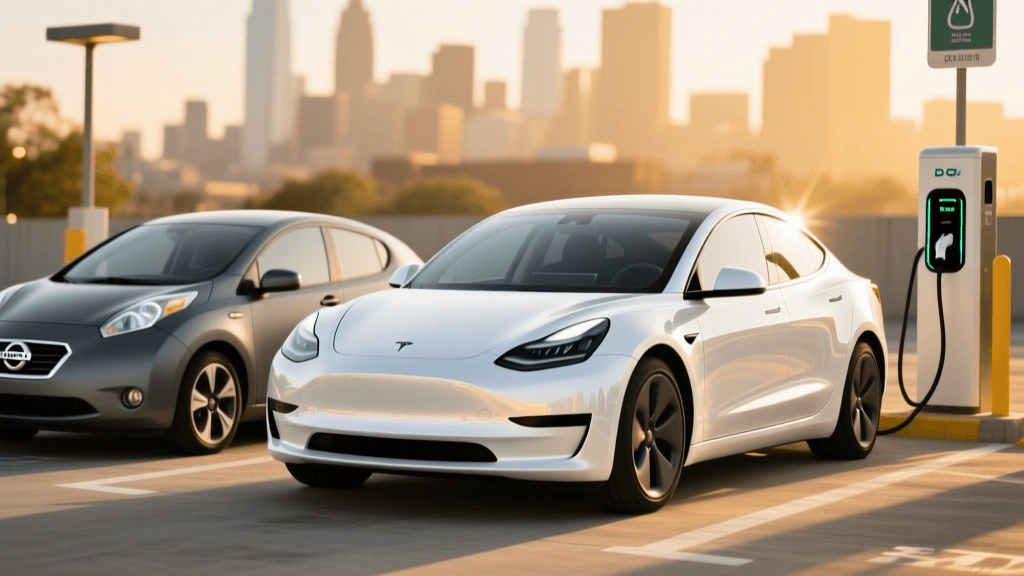
To understand exactly how fast charging affects EV battery degradation long-term, we are putting two of the most iconic EV architectures head-to-head. In the red corner, we have the Tesla Model 3, the poster child for sophisticated, active liquid-cooled battery management. In the blue corner, we have the Nissan Leaf, the mass-market pioneer that relies on passive air cooling. By analyzing real-world data, electrochemical limitations, and total lifecycle costs, this showdown will reveal the true impact of frequent fast charging on your EV's battery health.
The Contenders: Architecture and Chemistry
Tesla Model 3 (Active Liquid Cooling)
The Tesla Model 3 utilizes a highly advanced active liquid thermal management system. A network of cooling tubes runs directly between the battery cells, circulating a glycol-water mixture to absorb and dissipate heat. Whether the battery chemistry is Nickel Cobalt Aluminum (NCA) for Long Range models or Lithium Iron Phosphate (LFP) for Standard Range models, the liquid cooling system ensures the cells remain in their optimal temperature window (typically between 20°C and 40°C) even when subjected to massive 250 kW V3 Supercharger currents.
Nissan Leaf (Passive Air Cooling)
The Nissan Leaf (available in 40 kWh and 62 kWh variants) takes a fundamentally different approach. To keep costs down and simplify the architecture, Nissan opted for a passively air-cooled battery pack using Nickel Manganese Cobalt (NMC) chemistry. The Leaf relies on ambient air flowing over the battery casing to shed heat. While this is perfectly adequate for Level 1 and Level 2 AC charging, it presents severe limitations when high-amperage DC fast charging generates massive internal cell heat.
The Science: Why DC Fast Charging Generates Heat
When you plug into a DC fast charger, you are forcing lithium ions to migrate from the cathode to the anode at an accelerated rate. This rapid movement creates internal electrical resistance, which manifests as heat. If this heat is not removed quickly, two damaging phenomena occur:
- Solid Electrolyte Interphase (SEI) Thickening: Excessive heat accelerates the breakdown of the electrolyte, causing the protective SEI layer on the anode to thicken. This permanently traps lithium ions, reducing the battery's overall capacity.
- Lithium Plating: If the battery is charged too quickly while cold, or if it overheats and the BMS fails to regulate the current, lithium ions can accumulate on the surface of the anode rather than intercalating into it. This "plating" permanently reduces capacity and can create dendrites that pose a safety risk.
According to the U.S. Department of Energy, advanced thermal management systems are critical for mitigating these exact issues, allowing modern EVs to accept high charge rates while preserving long-term battery health.
The Showdown: Real-World Degradation Data
Nissan Leaf: The "Rapidgate" Reality
Because the Nissan Leaf lacks active liquid cooling, frequent DC fast charging causes the battery pack to heat soak rapidly. To prevent catastrophic thermal runaway and severe lithium plating, Nissan's Battery Management System (BMS) implements aggressive software throttling—a phenomenon the EV community dubbed "Rapidgate."
If a Leaf owner attempts to use multiple DC fast chargers on a single road trip, the BMS will drastically reduce the charging speed (sometimes dropping from 50 kW down to 20 kW or less) to protect the cells from heat damage. While this software safeguard does protect the battery from immediate destruction, the long-term degradation data for passively cooled batteries in hot climates remains concerning.
A landmark study by Geotab, which analyzed data from over 6,300 electric vehicles, found that EVs with passive air cooling systems experienced significantly higher degradation rates compared to their liquid-cooled counterparts, especially when exposed to high ambient temperatures and frequent DCFC usage. The Leaf's reliance on ambient air means that a summer road trip involving multiple fast charges will inevitably subject the cells to prolonged heat stress, accelerating capacity loss over a 5-to-10-year lifespan.
Tesla Model 3: The Liquid-Cooled Advantage
The Tesla Model 3 approaches the same DCFC session with a massive advantage. As you navigate to a Supercharger, the car's navigation system actively pre-conditions the battery, heating it or cooling it to the exact optimal temperature for rapid ion transfer. Once plugged in, the liquid cooling system aggressively pumps heat away from the cells.
Because the cells never linger in the "danger zone" of extreme heat, the Model 3 can accept 150 kW to 250 kW charge rates repeatedly without triggering severe throttling or accelerating chemical degradation. Data from Recurrent Auto shows that modern, liquid-cooled EV batteries are routinely outlasting their 8-year warranties with minimal capacity loss, largely because active thermal management neutralizes the primary enemy of fast charging: heat.
Head-to-Head Comparison Table
| Feature | Tesla Model 3 (Long Range) | Nissan Leaf (62 kWh) |
|---|---|---|
| Thermal Management | Active Liquid Cooling / Heating | Passive Air Cooling |
| Max DCFC Rate | Up to 250 kW (V3 Supercharger) | Up to 100 kW (CHAdeMO) |
| Battery Chemistry | NCA (or LFP for RWD) | NMC |
| Pre-conditioning | Active (via Navigation) | Limited / None for DCFC |
| Consecutive DCFC Impact | Maintains peak charge curve | Severe throttling ("Rapidgate") |
| Estimated 5-Year Degradation (Frequent DCFC) | ~8% to 10% | ~14% to 18% (Highly climate-dependent) |
Total Cost of Ownership and Battery Replacement
How does this degradation translate to your wallet? If you are a high-mileage driver who relies on DC fast charging three to four times a week, the Nissan Leaf's passive cooling system will likely result in noticeable range loss by year six or seven. Replacing a 62 kWh Nissan Leaf battery pack currently costs between $8,000 and $10,000 (parts and labor), though refurbished options may be slightly cheaper.
Conversely, the Tesla Model 3's battery pack is vastly more expensive to replace out of warranty—often exceeding $15,000 to $18,000. However, because the liquid cooling system effectively shields the cells from the harshest effects of DCFC degradation, the likelihood of needing a full battery replacement within the first 150,000 miles is statistically much lower. In the head-to-head cost analysis, the Tesla's higher upfront replacement cost is offset by its superior longevity and retained resale value, making it the clear winner for frequent fast-chargers.
Pro Tip: If you drive a passively cooled EV like the Nissan Leaf, you can still use DC fast chargers, but you should avoid doing so in the middle of a hot summer day. Charge early in the morning or late at night when ambient temperatures can help passively draw heat away from the battery casing.
Actionable Advice: How to Fast Charge Without Fear
Regardless of whether you drive a liquid-cooled Tesla or an air-cooled Leaf, you can adopt specific habits to minimize long-term degradation from fast charging:
- Embrace the 80% Rule: The final 20% of a DC fast charging session is where the battery generates the most heat and experiences the most stress due to high internal resistance. Set your charge limit to 80% for road trips, and only charge to 100% at home on a Level 2 charger when absolutely necessary.
- Always Pre-Condition: If your EV supports battery pre-conditioning (like the Model 3, Hyundai Ioniq 5, or Ford Mustang Mach-E), always use the built-in navigation to route to the charger. This prepares the battery chemistry to accept the high current safely.
- Avoid Hot-Soaking: Do not fast charge immediately after a high-speed highway drive in 95°F+ weather if you can avoid it. The battery is already hot; adding fast-charge heat will push the thermal limits of the pack.
- Use Level 2 for Daily Driving: DC fast charging should be viewed as a tool for road trips and occasional top-ups, not a daily replacement for home Level 2 charging. Slow, steady AC charging remains the gold standard for maximizing battery lifecycle.
The Verdict
In the battle of how fast charging affects EV battery degradation long-term, the Tesla Model 3 decisively defeats the Nissan Leaf. The physics of lithium-ion batteries dictate that heat is the ultimate enemy of longevity. Tesla's active liquid cooling system acts as an elite bodyguard for the battery cells, allowing owners to utilize the Supercharger network frequently with minimal long-term capacity loss. The Nissan Leaf, while an excellent and affordable commuter car, simply was not designed for the rigors of repeated high-amperage DC fast charging, and its passive cooling system leaves the battery vulnerable to accelerated degradation in warm climates.
Ultimately, modern EV battery degradation is less about the speed of the charger and more about the sophistication of the car's thermal management. When shopping for your next EV, prioritize active liquid cooling if your lifestyle demands frequent fast charging.