What Tesla Model 3 Battery Degradation Actually Looks Like
If you own a Tesla Model 3 — or are considering a used or new one — battery degradation is likely one of your top concerns. Unlike a gas engine that wears gradually and predictably, an EV battery's health is harder to gauge from the outside. The good news? Real-world fleet data shows that Tesla Model 3 battery degradation is modest, predictable, and rarely catastrophic.
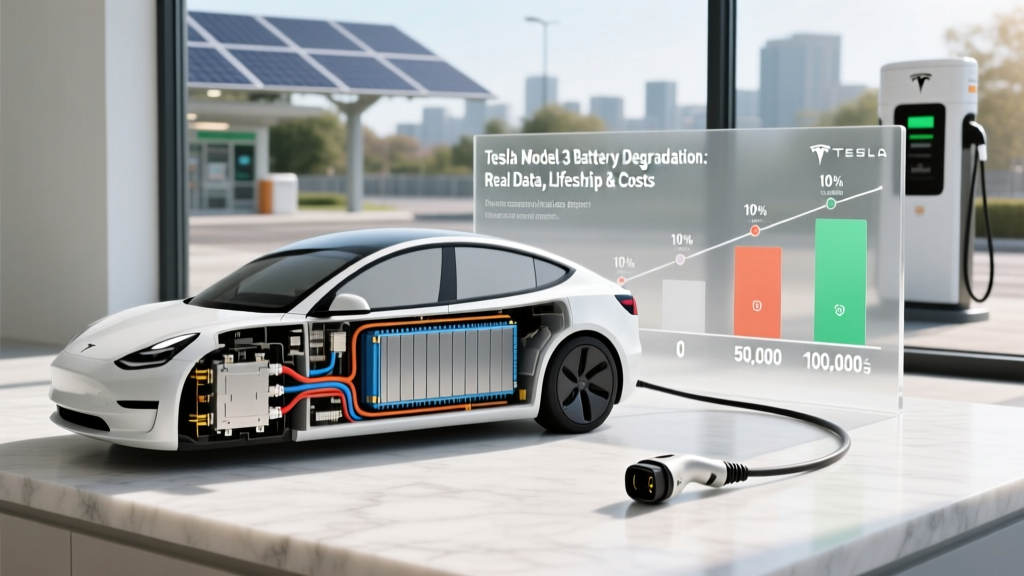
The Model 3 has been on the road since 2017, giving us nearly a decade of real-world degradation data across hundreds of thousands of vehicles. Most Model 3 owners see approximately 5-8% total capacity loss over the first 100,000 miles, with degradation slowing significantly after the initial break-in period. By 200,000 miles, many packs still retain 85-90% of their original capacity.
- 10,000 miles: ~2-3% loss (initial break-in)
- 50,000 miles: ~4-5% loss
- 100,000 miles: ~5-8% loss
- 150,000 miles: ~7-10% loss
- 200,000 miles: ~10-15% loss
Sources: Tesla Impact Reports, Recurrent Auto fleet data (2024-2025). Individual results vary based on charging habits, climate, and chemistry.
The degradation curve is not linear. The steepest drop happens in the first 10,000-20,000 miles as the battery's internal chemistry stabilizes. After that, degradation slows to a gradual, nearly linear decline of roughly 1-2% per year under normal use. This pattern holds across both the lithium iron phosphate (LFP) and nickel manganese cobalt (NMC/NCA) chemistries Tesla uses.
LFP vs NMC/NCA: Which Chemistry Does Your Model 3 Have?
Since 2021, Tesla has offered the Model 3 with two distinct battery chemistries depending on trim. Understanding which one your vehicle has is essential because it changes your charging habits, range expectations, and long-term degradation profile.
| Attribute | LFP (Lithium Iron Phosphate) | NMC/NCA (Nickel-based) |
|---|---|---|
| Trims (2025-2026) | Model 3 RWD (base) | Model 3 Long Range, Performance |
| Energy Density | Lower (~160 Wh/kg cell-level) | Higher (~250-270 Wh/kg cell-level) |
| Usable Capacity | ~57.5 kWh (2025 RWD) | ~75 kWh (2025 Long Range) |
| Cycle Life | 3,000-5,000+ cycles | 1,500-2,500 cycles |
| Recommended Daily SoC | 100% (charge to full regularly) | 80% daily; 100% for trips only |
| Cold-Weather Performance | More range loss in cold (~30-40%) | Moderate cold loss (~20-30%) |
| Degradation Rate | Slower overall; flatter curve | Slightly faster initial, then stabilizes |
| Cost | Lower (no cobalt/nickel) | Higher (critical mineral costs) |
The bottom line: LFP wins on longevity and cost; NMC/NCA wins on range and cold-weather performance. If you're a high-mileage driver who plans to keep the car 10+ years, LFP's superior cycle life is a meaningful advantage. If you need maximum range per charge or live in a cold climate, NMC/NCA is the better fit.
Tesla's LFP cells are primarily supplied by CATL, while NMC/NCA cells come from Panasonic (primarily the 2170 and 4680 form factors). Both chemistries are proven and well-supported by Tesla's thermal management system, which actively heats and cools the pack to keep cells in their optimal temperature range.
Tesla Model 3 Battery Warranty: What's Actually Covered
Tesla's battery warranty is one of the stronger guarantees in the EV industry, and it applies regardless of whether your Model 3 has an LFP or NMC/NCA pack.
| Model 3 Trim | Warranty Period | Mileage Limit | Minimum Capacity Retention |
|---|---|---|---|
| RWD (LFP) | 8 years | 100,000 miles | 70% |
| Long Range AWD (NMC) | 8 years | 120,000 miles | 70% |
| Performance (NMC/NCA) | 8 years | 120,000 miles | 70% |
The warranty covers capacity loss below 70% of the original rated capacity, as well as defects in materials and workmanship. If your battery drops below the 70% threshold within the warranty window, Tesla will repair or replace the pack at no cost. In practice, warranty claims for degradation are rare — fleet data shows that fewer than 1% of Tesla battery packs require warranty replacement due to degradation alone.
It's worth noting that the warranty does not cover damage from accidents, flooding, fire, improper charging equipment, or aftermarket modifications to the high-voltage system. Tesla's official warranty documentation provides the full terms and exclusions.
Battery Replacement Costs: What to Expect (and When)
The most common fear among prospective EV buyers is a catastrophic battery replacement bill. Let's put that in perspective with real numbers.
| Scenario | Battery Size | Estimated Cost (Parts + Labor) | Typical Timing |
|---|---|---|---|
| Model 3 RWD (LFP) — full pack replacement | ~57.5 kWh | $12,000 - $16,000 | 300,000+ miles (if ever) |
| Model 3 Long Range (NMC) — full pack replacement | ~75 kWh | $15,000 - $20,000 | 250,000+ miles (if ever) |
| Individual module replacement (partial repair) | Varies | $3,000 - $7,000 | As needed; rare |
Context matters here. The vast majority of Model 3 batteries never need replacement during the vehicle's useful life. Tesla's own 2024 Impact Report stated that their battery packs are designed to last the lifetime of the vehicle — which they define as 200,000+ miles for the Model 3. Independent data from Recurrent Auto corroborates this: fewer than 1.5% of Tesla packs have required out-of-warranty replacement.
When replacement is needed, Tesla often replaces individual modules rather than the entire pack, significantly reducing cost. Third-party EV repair shops are also increasingly capable of module-level repairs, though Tesla's proprietary diagnostics and parts sourcing still dominate the repair ecosystem.
Factors That Accelerate (or Slow) Degradation
Not all Model 3 batteries age equally. Your charging habits, climate, and driving patterns all influence how quickly your pack loses capacity. Here's what the data shows matters most:
- NMC owners: Set daily charge limit to 80%. Charge to 100% only before long trips.
- LFP owners: Charge to 100% at least once per week (Tesla recommends this for LFP calibration).
- Precondition your battery before DC fast charging — the car does this automatically when you navigate to a Supercharger.
- Avoid prolonged storage above 90% or below 10% state of charge.
- Use Level 2 home charging as your primary method. Daily DC fast charging increases degradation by an estimated 1-3% over 100,000 miles compared to L2-only charging.
- Let the thermal management system work — don't disable preconditioning in cold weather.
- Frequent DC fast charging to 100% (especially without preconditioning)
- Regularly draining below 10% state of charge
- Leaving the car at 100% SoC for days or weeks in hot weather
- Charging in extreme heat without preconditioning (ambient above 95°F)
- Aftermarket modifications to the charging system or battery management software
DC fast charging deserves specific attention. Tesla's Supercharger network delivers up to 250 kW (V3) or 350 kW (V4) to capable Model 3 variants. While occasional Supercharging is fine — and Tesla's battery management system is among the best at managing heat during fast charges — relying exclusively on DC fast charging for daily needs does measurably increase degradation. Studies suggest a 1-3% additional capacity loss over 100,000 miles for vehicles that DC fast charge daily versus those using Level 2.
Temperature is the other major factor. Lithium-ion cells degrade faster when exposed to sustained high temperatures (above 95°F / 35°C). The Model 3's active liquid cooling system mitigates this effectively, but parking in shade or a garage during hot summers still helps. Cold weather doesn't cause permanent degradation, but it does temporarily reduce available capacity — expect 20-40% less range in sub-freezing conditions, depending on chemistry (LFP is more affected).
How to Check Your Model 3 Battery Health (State of Health)
Tesla doesn't display a direct State of Health (SoH) percentage on the vehicle's touchscreen the way some other EVs do. However, you have several ways to assess your battery's condition:
Method 1: Range Comparison
The simplest approach is to compare your current full-charge range estimate to the EPA-rated range when new. Charge to 100% (for LFP) or your maximum daily limit and extrapolate. A 2025 Model 3 Long Range AWD has an EPA-rated range of 363 miles. If your 100% charge shows 330 miles, that's roughly 91% retention — about 9% degradation.
Method 2: Tesla Service Mode
Tesla's Service Mode (accessible through a hidden menu on the touchscreen) provides battery health data including nominal full pack energy and energy buffer. This is the most accurate in-vehicle method, though the interface can be difficult to navigate and Tesla has periodically restricted access in software updates.
Method 3: Third-Party Apps
Apps like TeslaFi, Tessie, and Stats log charging data over time and can calculate SoH trends by comparing the energy added during charges to the battery's original capacity. These require a Tesla API connection and several weeks of data to produce reliable estimates.
Method 4: Tesla Service Center Diagnostic
If you're considering a used Model 3 purchase, you can request a battery health diagnostic at a Tesla Service Center. This provides the most authoritative SoH reading, though it may require an appointment and isn't always free for out-of-warranty vehicles.
What's Next: Solid-State, Silicon Anodes, and Beyond
Current Model 3 batteries use proven, mature lithium-ion technology. But the next generation of battery chemistries promises meaningful improvements in energy density, charging speed, and lifespan. Here's what's realistic and when:
Silicon-dominant anodes: Companies like Sila Nanotechnologies and Group14 are replacing graphite anodes with silicon-based materials, which can store up to 10x more lithium ions per unit mass. Early commercial deployments are targeting 2026-2028 in consumer electronics and premium EVs. Expect 10-20% energy density improvements initially, scaling over time.
Solid-state batteries: These replace the liquid electrolyte with a solid conductor, promising higher energy density, faster charging, and improved safety. Toyota, QuantumScape, and Samsung SDI are leading development, but mass production for affordable vehicles like the Model 3 remains 2028-2032 at the earliest. Early solid-state packs will likely appear in premium vehicles first.
Sodium-ion batteries: CATL has begun shipping sodium-ion packs in Chinese-market vehicles. These use abundant, cheap materials and perform well in cold weather, but have lower energy density than lithium-ion. They may appear in future base-trim Teslas for price-sensitive markets, but are not expected in the US Model 3 lineup in the near term.
For current buyers: today's Model 3 battery technology is mature, well-tested, and offers excellent longevity. There's no practical reason to delay a purchase waiting for next-generation cells unless your timeline extends well into the 2030s.
Tesla Model 3 Battery Degradation FAQ
How long do Tesla Model 3 batteries last in real-world use?
Based on fleet data, most Model 3 batteries retain 85-90% capacity at 200,000 miles and can reasonably be expected to last 300,000-500,000 miles before falling below 70% capacity. That translates to 15-25+ years for the average driver covering 12,000-15,000 miles per year. The battery will very likely outlast the rest of the vehicle.
How much does it cost to replace a Tesla Model 3 battery?
A full pack replacement costs approximately $12,000-$20,000 depending on chemistry and capacity, but full replacements are rare. Module-level repairs cost $3,000-$7,000. In practice, fewer than 1.5% of Tesla battery packs have required out-of-warranty replacement, so this cost is a low-probability event for most owners.
What does the Tesla Model 3 battery warranty cover?
Tesla covers the battery and drive unit for 8 years / 100,000 miles (RWD) or 8 years / 120,000 miles (Long Range and Performance). The warranty guarantees a minimum of 70% capacity retention and covers defects in materials and workmanship. It does not cover damage from accidents, improper charging, or aftermarket modifications.
Should I charge my Model 3 to 100% every day?
It depends on your chemistry. If you have a Model 3 RWD with an LFP battery, Tesla recommends charging to 100% at least once per week for accurate state-of-charge calibration. If you have a Long Range or Performance with an NMC/NCA battery, set your daily limit to 80% and only charge to 100% when you need the full range for a trip.
Does frequent Supercharging damage the battery?
Occasional Supercharging has minimal impact. However, relying on DC fast charging daily — especially without preconditioning — can add an estimated 1-3% of additional degradation over 100,000 miles compared to Level 2 home charging. Tesla's battery management system is effective at managing heat, but physics still favors slower, cooler charging for long-term health.
LFP vs NMC — which is better for a Tesla Model 3?
Neither is universally better. LFP offers longer cycle life (3,000-5,000+ cycles), lower cost, and the convenience of 100% daily charging — but sacrifices some range and cold-weather performance. NMC/NCA provides higher energy density (more range per kWh), better cold-weather range, and faster charging — but requires more careful state-of-charge management (80% daily limit) and has a shorter cycle life. Choose LFP for maximum longevity and simplicity; choose NMC for maximum range and all-climate performance.
Can I check my Tesla Model 3 battery health myself?
Yes, though Tesla doesn't expose a direct SoH percentage. You can compare your full-charge range to the original EPA rating, use Tesla's Service Mode for detailed energy data, or use third-party apps like TeslaFi or Tessie that calculate SoH from charging logs over time. For the most authoritative reading, request a diagnostic at a Tesla Service Center.