The Tesla Model 3 remains one of the most data-rich EVs on the road, and its battery pack is no exception. Whether you're eyeing a Standard Range (Rear-Wheel Drive) or a Long Range AWD, understanding the battery capacity Tesla Model 3 trims actually carry — and how that capacity holds up over 100,000+ miles — is the single most important factor in your purchase decision.
This guide breaks down the exact kWh figures, the LFP vs NMC chemistry split, real-world degradation data pulled from fleet studies, warranty coverage, and what a replacement actually costs in 2026. No fear-mongering, no marketing gloss — just the numbers.
Model 3 Battery Capacity by Trim: The 2026 Lineup
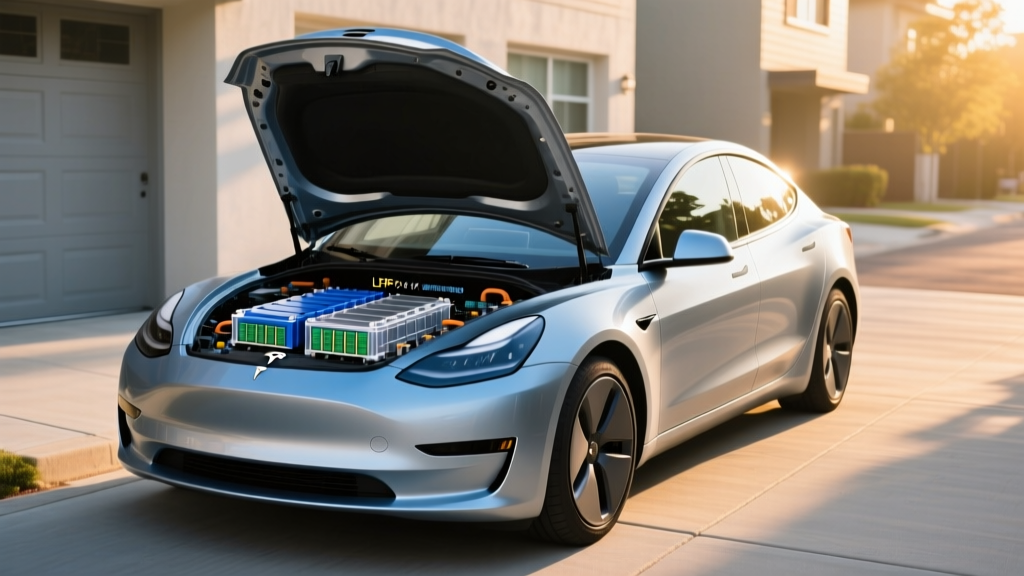
Tesla currently offers the Model 3 in configurations that split along chemistry lines. Here's what's under the floor:
| Trim | Battery Chemistry | Usable Capacity (kWh) | EPA Range | Real-World Range* |
|---|---|---|---|---|
| RWD (Standard Range) | LFP (CATL) | ~60 kWh | 272 mi | ~230–250 mi |
| Long Range AWD | NMC (Panasonic/LG) | ~82 kWh | 363 mi | ~300–330 mi |
| Performance | NMC (Panasonic) | ~82 kWh | 315 mi | ~270–290 mi |
*Real-world range accounts for highway driving at 70+ mph and moderate climate use. Cold weather (below 32°F) can reduce range an additional 15–30% depending on preconditioning habits. Source: fueleconomy.gov.
LFP vs NMC: Which Chemistry Powers Your Model 3?
Tesla's decision to split the Model 3 lineup between two battery chemistries is one of the most consequential in the EV industry. Each has distinct trade-offs that affect your ownership experience.
| Attribute | LFP (Lithium Iron Phosphate) | NMC (Nickel Manganese Cobalt) |
|---|---|---|
| Energy Density | Lower (~160 Wh/kg cell-level) | Higher (~250 Wh/kg cell-level) |
| Cycle Life | 3,000–5,000+ cycles | 1,000–2,000 cycles |
| Cold Performance | Weaker — more range loss below freezing | Better — retains more capacity in cold |
| Cost | Lower — no cobalt or nickel | Higher — commodity-sensitive materials |
| Charging to 100% | Recommended weekly for calibration | Daily 80% limit recommended |
| Typical Trim | RWD (Standard Range) | Long Range, Performance |
Which Is Better?
Neither is universally better — it depends on your driving profile. Choose LFP if you commute under 50 miles daily, charge at home nightly, live in a mild climate, and want maximum cycle longevity. Choose NMC if you regularly road-trip 200+ miles, live in a cold climate, or need maximum single-charge range. The NMC pack's higher energy density gives Long Range models a 90+ mile advantage on the EPA cycle.
LFP's Achilles' heel is cold weather. In sub-freezing conditions, LFP cells experience higher internal resistance, which reduces both available range and DC fast-charging speed unless the battery is preconditioned. Tesla's thermal management system mitigates this, but NMC still outperforms in winter climates like Minnesota or Colorado.
How Long Do Tesla Model 3 Batteries Last?
This is the question that drives purchase decisions, and the data is reassuring. Tesla's 2025 Impact Report showed that Model 3/Y battery packs retain approximately 85% of original capacity after 200,000 miles — roughly 15 years of average driving.
- Year 1 / 15,000 mi: ~3–5% loss (initial settling)
- Year 3 / 45,000 mi: ~7–9% loss
- Year 5 / 75,000 mi: ~9–11% loss
- Year 8 / 120,000 mi: ~12–15% loss
- Year 12 / 180,000 mi: ~15–18% loss
LFP packs degrade more slowly in terms of cycle count but may show similar calendar-aging effects. Fleet data from Tesla's Impact Report and independent trackers like Teslanomics and Recurrent Auto confirm this pattern.
The key insight: degradation is non-linear. You lose the most in the first year or two, then the curve flattens dramatically. A Model 3 Long Range with 82 kWh usable that drops to ~70 kWh after 100,000 miles still delivers roughly 300 miles of real-world range — plenty for most drivers.
When Is Replacement Typically Needed?
For the vast majority of owners, it isn't. Complete battery failure before 200,000 miles is rare. Most Model 3 vehicles will be retired, sold, or traded before the pack degrades below a usable threshold. Replacement becomes a consideration only when capacity drops below ~60–65% and the vehicle is out of warranty — a scenario that typically requires 250,000+ miles or extreme abuse patterns.
Battery Warranty: What Tesla Actually Covers
| Trim | Warranty Period | Mileage Limit | Minimum Capacity Retention |
|---|---|---|---|
| RWD (LFP) | 8 years | 100,000 miles | 70% |
| Long Range AWD | 8 years | 120,000 miles | 70% |
| Performance | 8 years | 120,000 miles | 70% |
Tesla's warranty covers defects and capacity loss below the 70% threshold. If your Long Range Model 3's 82 kWh pack drops below ~57.4 kWh within 8 years or 120,000 miles (whichever comes first), Tesla will repair or replace it at no cost. This aligns with the industry standard set by NHTSA-tracked warranty requirements for EV traction batteries.
What's not covered: Damage from accidents, flooding, or unauthorized modifications. Gradual degradation above 70% is considered normal wear. Also note: the warranty transfers to subsequent owners, which supports resale value.
How Much Does a Tesla Model 3 Battery Replacement Cost?
| Pack Type | Approximate Capacity | Replacement Cost (2026) | When Needed |
|---|---|---|---|
| LFP (RWD) | ~60 kWh | $10,000–$13,000 | Rarely; 200,000+ mi |
| NMC (Long Range / Perf) | ~82 kWh | $13,000–$16,000 | Rarely; 200,000+ mi |
These figures include the pack and labor at a Tesla Service Center. Costs have declined steadily — a Model 3 pack replacement in 2019 could exceed $20,000 — and Tesla's growing remanufactured-pack program offers lower-cost options for out-of-warranty vehicles. Independent EV shops are also beginning to offer module-level repairs for $5,000–$8,000, though availability varies by region.
To put this in perspective: a gas car's engine or transmission replacement at 200,000 miles runs $4,000–$8,000, and you've already spent $15,000–$25,000 more on fuel over that same distance. The "battery replacement bankruptcy" narrative doesn't survive contact with the math.
Factors That Affect Model 3 Battery Life
- Exclusive DC fast charging: Daily Supercharging (150–250 kW) generates sustained heat. Occasional road-trip use is fine; daily reliance adds ~2–4% extra loss over 100k miles vs. Level 2.
- Sitting at 100% SoC: NMC packs held at full charge for days experience accelerated calendar aging. LFP packs tolerate 100% better and Tesla recommends weekly full charges for SoC calibration.
- Extreme heat exposure: Regularly parking in 110°F+ environments without plugged-in thermal management stresses cells.
- Deep discharges: Regularly running the pack to 0–5% stresses the chemistry. Tesla's buffer protects against true zero, but habitually arriving at low SoC adds wear.
- Daily Level 2 home charging: Slower charge rates (7–11 kW) generate minimal heat.
- NMC: Set charge limit to 80% for daily use; bump to 100% only before road trips.
- LFP: Charge to 100% at least weekly per Tesla's recommendation — this keeps the BMS calibrated.
- Precondition while plugged in before fast charging or cold-weather drives.
- Keep the car plugged in during extreme temperatures so thermal management can run on grid power.
How to Check Your Model 3 Battery Health (SoH)
Tesla doesn't expose a direct State of Health percentage in the app the way some competitors do, but you can derive it:
- In-car energy graph: Navigate to Controls > Trips > Energy. The "Projected" range at 100% SoC compared to original EPA range gives a rough degradation estimate.
- Third-party apps: Tools like Tessie, Stats (iOS), or TeslaFi pull detailed battery data via the Tesla API, including estimated SoH, charge energy in vs. range added, and degradation trends over time.
- Service Mode: Tesla's Service Mode (accessible in newer software versions) shows a high-voltage battery health screen with nominal full-pack capacity in kWh.
- Dealer diagnostic: A Tesla Service Center can run a full pack health report — useful before buying a used Model 3.
For used-car buyers: a 4-year-old Long Range Model 3 showing 310 miles at 100% (vs. 363 EPA) implies roughly 14–15% degradation — consistent with the fleet data above and nothing to worry about.
What's Next: Solid-State and Silicon Anode Batteries
The next frontier in battery technology includes solid-state batteries (replacing liquid electrolyte with a solid conductor) and silicon anode cells (replacing graphite to boost energy density). These promise 20–40% more energy density, faster charging, and improved safety.
Realistic timeline: Solid-state packs from Toyota, Samsung SDI, and QuantumScape are expected in limited production vehicles around 2028–2030, likely debuting in premium models at $70,000+. Silicon anode technology (already used in small quantities by companies like Sila Nanotechnologies) is scaling more incrementally and may appear in higher-volume EVs by 2027–2028.
If you're buying a Model 3 today, don't wait for solid-state. Current NMC and LFP packs are mature, well-warrantied, and will outlast the ownership cycle for most buyers. The technology gap between today's packs and solid-state is real, but the timeline to affordable, mass-market availability remains 4–6 years out.
Tesla Model 3 Battery FAQ
How long do Tesla Model 3 batteries last in years and miles?
Fleet data shows Model 3 packs retaining ~85% capacity at 200,000 miles, which translates to roughly 15–20 years of average use. Most packs will outlast the vehicle itself.
Is the Tesla Model 3 battery covered under warranty?
Yes. Tesla covers the battery for 8 years / 100,000 miles (RWD) or 8 years / 120,000 miles (Long Range and Performance), guaranteeing at least 70% capacity retention. Defects are covered regardless of degradation level.
How much does it cost to replace a Tesla Model 3 battery?
Between $10,000 and $16,000 depending on the pack (LFP vs NMC), including labor at a Tesla Service Center. This is rarely needed — most packs last well beyond 200,000 miles. Remanufactured packs and module-level repairs offer lower-cost alternatives.
Should I charge my Model 3 to 100% every day?
It depends on your chemistry. LFP (RWD) owners should charge to 100% at least weekly for BMS calibration. NMC (Long Range/Performance) owners should set the daily limit to 80% and only charge to 100% before long trips.
Does frequent Supercharging damage the Model 3 battery?
Exclusive DC fast charging adds modest extra degradation — roughly 2–4% more over 100,000 miles compared to primarily Level 2 charging. Occasional Supercharging on road trips has negligible impact. Daily reliance without Level 2 access is the pattern to avoid.
Can I check my Model 3's battery degradation myself?
Yes. Use the in-car Energy graph to compare projected range at 100% to the original EPA figure, or use third-party apps like Tessie or TeslaFi for detailed SoH estimates via the Tesla API.
Is LFP better than NMC for the Model 3?
For daily commuting in mild climates, LFP offers superior cycle life and lower cost. For road trips, cold climates, and maximum range, NMC's higher energy density is the better choice. Neither is universally superior — it depends on your driving pattern.