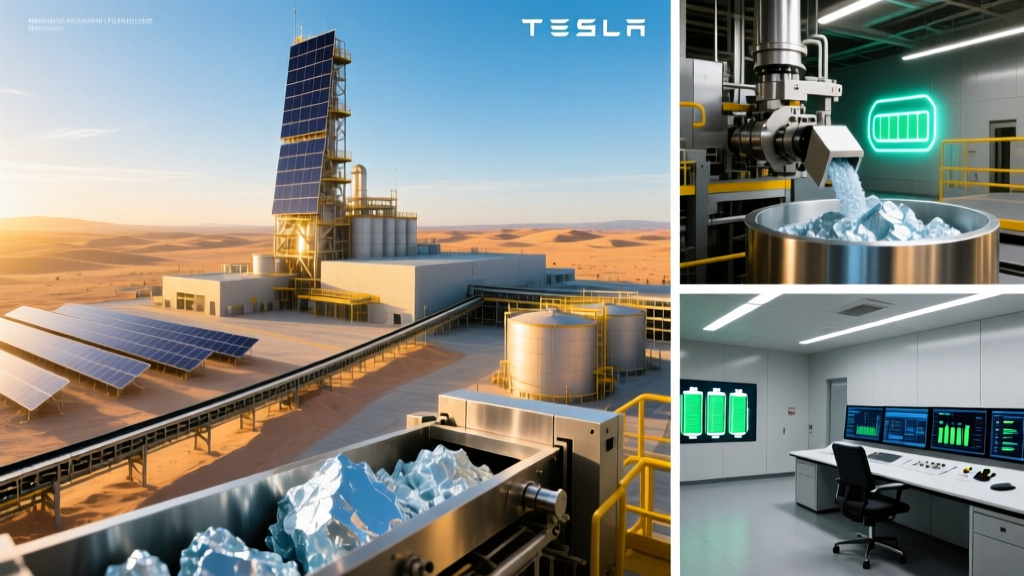
Tesla broke ground on its first in-house lithium refinery in Corpus Christi, Texas, in 2023, with initial production of battery-grade lithium hydroxide coming online in late 2024 and capacity ramping through 2025 and into 2026. The facility — officially called Tesla Lithium Refining — is designed to convert spodumene concentrate (a lithium-bearing mineral, mostly sourced from Australia) into the lithium hydroxide needed for Tesla's high-nickel NMC and NCA cathode chemistries. At full capacity, Tesla says the plant will produce enough lithium hydroxide to support roughly 50 GWh of annual cell production, enough for approximately 500,000 to 700,000 vehicles depending on pack size.
But the refinery is only one node in a complex battery supply chain that ultimately determines the chemistry, longevity, and cost of the pack in your EV. For buyers and owners, the more pressing questions are practical: What chemistry is in my battery? How long will it last? What happens when it degrades? This guide breaks down the technology from mine to module — and gives you the exact numbers you need to evaluate battery health, warranty coverage, and total cost of ownership.
Why Tesla Built a Lithium Refinery in Texas
Most automakers buy finished cathode material or cells from suppliers like CATL, LG Energy Solution, or Panasonic. Tesla's decision to refine its own lithium — the first automaker to do so at scale in North America — is driven by three factors:
- Supply security: China controls roughly 60-65% of global lithium refining capacity. By processing spodumene domestically, Tesla reduces its exposure to geopolitical supply disruptions.
- Cost reduction: Cutting out intermediate refiners and traders reduces the per-kWh cost of cathode material, a significant input given that the cathode accounts for roughly 30-40% of a cell's material cost.
- Tax credit compliance: Under the IRS §30D clean vehicle credit, vehicles must source a growing percentage of critical minerals from the U.S. or free-trade-agreement partners. Domestic refining directly supports compliance with these sourcing thresholds.
The Corpus Christi plant is strategically located near the Port of Corpus Christi, simplifying spodumene imports from Australian mines. Tesla has also signaled it will explore processing recycled lithium from end-of-life packs at the facility, though that capability is still in early development as of 2026.
LFP vs NMC/NCA: Which Chemistry Is in Your Battery?
Not all EV batteries use the same chemistry, and the differences matter for range, longevity, cold-weather performance, and price. Tesla uses both major chemistries across its lineup, and most other automakers follow a similar split.
| Attribute | LFP (Lithium Iron Phosphate) | NMC / NCA (Nickel-Manganese-Cobalt / Nickel-Cobalt-Aluminum) |
|---|---|---|
| Energy density | ~160-180 Wh/kg (cell level) | ~220-300 Wh/kg (cell level) |
| Cycle life | 3,000-5,000+ cycles to 80% capacity | 1,000-2,000 cycles to 80% capacity |
| Cold-weather performance | Greater range loss below 32°F; slower charge acceptance when cold | Better low-temp discharge; less range penalty in winter |
| Charging to 100% | Recommended regularly (helps BMS calibration) | Best kept at 80% daily; 100% only for trips |
| Cost (per kWh) | Lower — no cobalt or nickel | Higher — nickel and cobalt price exposure |
| Thermal stability | Higher — more resistant to thermal runaway | Lower — requires more active thermal management |
| Typical use | Standard Range / RWD trims (Model 3, Model Y) | Long Range / Performance trims; most luxury EVs |
The trade-off in plain terms: LFP packs are cheaper, last more charge cycles, and tolerate daily 100% charging — but they're heavier and lose more range in freezing temperatures. NMC/NCA packs deliver more range per pound and handle cold better, but they degrade faster if routinely charged to 100% and cost more to produce. For a commuter who charges at home nightly and lives in a mild climate, LFP is often the smarter choice. For road-trippers or cold-climate drivers, NMC's energy density and winter performance justify the premium.
How Long Do EV Batteries Actually Last?
The short answer: far longer than most buyers expect. Data aggregated from fleet operators, Tesla's own impact reports, and independent analyses by researchers at Recurrent Auto consistently show that modern liquid-cooled EV batteries retain 85-92% of their original capacity after 100,000 miles and 5-7 years of typical use.
Typical degradation curve (liquid-cooled NMC/NCA packs, aggregated fleet data):
- Year 1 / 15,000 mi: ~2-4% capacity loss (initial formation loss)
- Year 3 / 45,000 mi: ~5-8% total loss
- Year 5 / 75,000 mi: ~7-10% total loss
- Year 8 / 120,000 mi: ~10-15% total loss
- Year 10 / 150,000 mi: ~12-18% total loss (varies significantly by climate and charging habits)
LFP packs tend to show even slower degradation in cycle-life testing, though their lower starting energy density means the absolute range loss may feel comparable. The key insight is that degradation is nonlinear — most capacity loss occurs in the first year or two, after which the curve flattens considerably. A battery that has lost 8% after three years is unlikely to suddenly drop off a cliff.
For context, the average American driver covers roughly 13,500 miles per year according to FHWA data. At that rate, reaching 150,000 miles takes over 11 years — and the vast majority of packs will still hold 80%+ capacity at that point.
What the Battery Warranty Actually Covers
Federal law mandates a minimum 8-year / 100,000-mile warranty on EV battery packs for emissions-related compliance, and most automakers exceed this baseline. The warranty covers capacity loss below a specified threshold — not cosmetic issues or 12V auxiliary battery failures.
| Manufacturer | Warranty Period | Mileage Limit | Minimum Capacity Retention |
|---|---|---|---|
| Tesla (Model 3/Y Standard Range — LFP) | 8 years | 100,000 miles | 70% |
| Tesla (Model 3/Y Long Range, Model S/X) | 8 years | 120,000 miles (S/X: 150,000) | 70% |
| Hyundai / Kia | 10 years | 100,000 miles | 70% |
| Ford (Mustang Mach-E, F-150 Lightning) | 8 years | 100,000 miles | 70% |
| GM (Ultium-based EVs) | 8 years | 100,000 miles | 70% (some models: 60% threshold) |
| Rivian | 8 years | 175,000 miles (Max pack) | 70% |
| BMW | 8 years | 100,000 miles | 70% |
Critical fine print: The warranty threshold (typically 70%) means the manufacturer will repair or replace the pack only if measured capacity falls below that level within the warranty period. A pack at 72% capacity at year 7 is technically within spec, even though you've lost 28% of your original range. In practice, very few liquid-cooled packs breach the 70% threshold under normal use within the warranty window. Warranty claims are overwhelmingly driven by manufacturing defects (bad cells, BMS failures, coolant leaks) rather than gradual degradation.
EV Battery Replacement Costs: What You'd Actually Pay
If your battery does fail outside warranty — or you're buying a used EV with a depleted pack — replacement is the big-ticket concern. Here's what the numbers look like as of 2026, based on manufacturer service pricing and third-party EV repair shops:
| Vehicle | Pack Size (usable kWh) | Estimated Replacement Cost (parts + labor) | Notes |
|---|---|---|---|
| Tesla Model 3 Standard Range | ~57 kWh (LFP) | $12,000 – $16,000 | LFP packs less common to need replacement; module-level repair sometimes possible |
| Tesla Model Y Long Range | ~75 kWh (NMC) | $14,000 – $20,000 | Structural pack design complicates partial repair |
| Tesla Model S (2024+) | ~95 kWh (NMC) | $18,000 – $25,000 | Larger pack, higher cell count |
| Hyundai Ioniq 5 | ~72.6 kWh (NMC) | $13,000 – $18,000 | E-GMP platform; module replacement may be an option |
| Ford F-150 Lightning Extended Range | ~131 kWh (NMC) | $22,000 – $32,000 | Largest consumer pack on market; very high parts cost |
| Chevrolet Bolt EV/EUV | ~65 kWh (NMC) | $14,000 – $16,000 | Post-recall replacement packs; GM has reduced pricing over time |
Context that matters: These figures are worst-case scenarios. The overwhelming majority of EV batteries never need full replacement. When they do, it's usually due to a manufacturing defect caught under warranty, physical damage from a collision, or coolant system failure — not end-of-life degradation. Module-level repair (replacing individual cell groups rather than the full pack) is increasingly available through specialized EV shops and can cut costs by 40-60%. And as the supply of second-life and remanufactured packs grows through the late 2020s, out-of-pocket costs are expected to decline further.
What Actually Kills a Battery — and What Doesn't
Separating myth from data on battery longevity is essential. Here's what the evidence shows about the factors that do — and don't — materially affect pack life:
Factors that accelerate degradation
- Repeated DC fast charging without preconditioning: Charging at 150+ kW into a cold battery causes lithium plating on the anode. Always use the car's navigation-based preconditioning (e.g., navigating to a Supercharger or EA station) so the thermal system warms the pack first.
- Prolonged storage at 100% SoC in heat: Leaving an NMC pack fully charged in a hot garage for weeks accelerates electrolyte decomposition. If storing, aim for 50-60% SoC.
- Extreme ambient heat without active cooling: Sustained battery temps above 104°F (40°C) — common in desert climates without garage parking — increase calendar degradation. Liquid-cooled packs handle this far better than passively cooled ones (the Nissan Leaf's historic weakness).
- Deep discharge cycles (below 10% SoC): Regularly running the battery to near-zero stresses the cells. Most BMS systems reserve a buffer, but habitually arriving at 0% isn't ideal.
Factors that are less impactful than commonly feared
- Occasional DC fast charging: Using Superchargers or 350 kW stations on road trips has a negligible effect on long-term health. It's the daily, un-preconditioned fast charging that matters.
- Cold weather operation: Cold reduces available range temporarily (10-30% loss depending on temperature and trip length), but it doesn't permanently damage the battery. In fact, cool storage slows calendar degradation.
- High mileage alone: Cycle count matters more than odometer reading. A 150,000-mile EV that was mostly charged at Level 2 to 80% may have a healthier pack than a 60,000-mile car that was DC fast-charged to 100% daily.
How to Check and Monitor Your Battery's State of Health
State of Health (SoH) is expressed as a percentage of original capacity. A new pack is 100% SoH; a pack that now holds 68 kWh of its original 75 kWh is at roughly 90.7% SoH. Here's how to check it:
- Tesla: The in-car service menu (available in recent software updates) shows a battery health test result. You can also perform a manual calculation: charge to 100%, note the displayed range, and compare it to the EPA-rated range when new. Divide displayed by original and multiply by 100 for an approximate SoH. Third-party apps like Tessie or TeslaFi log this data over time with more granularity.
- Hyundai/Kia: The infotainment EV menu displays a battery health indicator. Dealership diagnostic tools (accessible during service visits) provide a more precise SoH reading from the BMS.
- General Motors (Ultium): The myChevrolet/myCadillac app includes a battery health estimate. OnStar diagnostics can also pull BMS data remotely.
- Ford: FordPass shows battery state of charge but not SoH directly. A dealership OBD-II scan is the most reliable method for Ford EVs.
- OBD-II scanners: Devices like the OBDLink MX+ paired with apps such as ABRP (A Better Route Planner) or Car Scanner can read BMS-reported SoH on most EVs. This is the most accessible DIY method across brands.
When to be concerned: If your SoH drops more than 3-4% in a single year after the initial break-in period, or if you notice sudden range drops that don't correlate with temperature, have the pack evaluated under warranty. Uneven cell degradation (visible in BMS cell-voltage delta readings) can signal a failing module that may be repairable without a full pack swap.
What's Next: Solid-State, Silicon Anodes, and Realistic Timelines
Next-generation battery technologies are frequently hyped, but here's where they actually stand as of 2026:
- Solid-state batteries: Toyota has announced limited production of solid-state cells for 2027-2028, initially in low-volume models. Samsung SDI and QuantumScape are also targeting 2027-2028 for initial automotive applications. Solid-state promises higher energy density (~400+ Wh/kg at cell level), faster charging, and improved safety — but manufacturing scale and cost remain unsolved challenges. Expect solid-state to appear in premium, low-volume vehicles first, with mass-market availability no earlier than 2030.
- Silicon-dominant anodes: Companies like Sila Nanotechnologies and Group14 are already supplying silicon-composite anode materials to manufacturers including Mercedes-Benz and Porsche. These anodes increase energy density by 20-40% compared to graphite and are appearing in 2025-2026 model-year performance vehicles. This is the most commercially mature "next-gen" technology.
- Sodium-ion batteries: CATL has begun shipping sodium-ion packs for Chinese-market EVs. Sodium-ion is cheaper and performs well in cold weather but has significantly lower energy density (~120-150 Wh/kg). It's suited for budget city cars and energy storage, not long-range vehicles. No U.S.-market EVs use sodium-ion as of 2026.
- LMFP (lithium manganese iron phosphate): An evolution of LFP that adds manganese for ~15-20% higher energy density while retaining LFP's safety and cost advantages. Tesla and other automakers are evaluating LMFP for next-generation Standard Range models, potentially arriving in 2027-2028.
None of these technologies change the near-term buying calculus. Today's NMC and LFP packs are proven, well-warrantied, and demonstrably long-lasting. If you're deciding whether to buy now or wait for solid-state, the math almost always favors buying now — the incremental gains from future chemistries are unlikely to offset years of gas expenses while you wait.
Frequently Asked Questions
Where exactly is Tesla's lithium refinery?
Tesla's lithium refinery is located in Corpus Christi, Texas, near the port. It processes imported spodumene concentrate into battery-grade lithium hydroxide. The facility began initial production in late 2024 and has been ramping capacity through 2025-2026, targeting roughly 50 GWh of annual cell-equivalent output at full scale.
How long do EV batteries last in years and miles?
Most modern liquid-cooled EV batteries retain 85-92% of original capacity after 100,000 miles and 5-7 years. At 150,000 miles and 10+ years, typical retention is 82-88%. Full pack failure before 200,000 miles is rare under normal use. Many packs will outlast the vehicle's body, electronics, and suspension components.
How much does an EV battery cost to replace?
Full pack replacement ranges from approximately $12,000 for a Tesla Model 3 LFP pack to $32,000 for a Ford F-150 Lightning Extended Range pack (parts and labor). Module-level repairs, when available, can reduce costs by 40-60%. However, the vast majority of packs never require replacement — most failures are covered under the 8-year/100,000-mile warranty.
What does the battery warranty cover?
EV battery warranties typically cover capacity loss below 70% of original capacity within 8 years or 100,000 miles (some brands offer 10 years). They also cover manufacturing defects, BMS failures, and coolant system issues that damage the pack. They do not cover the 12V auxiliary battery, physical damage from accidents, or degradation above the threshold.
LFP vs NMC — which is better and why?
Neither is universally better. LFP wins on cost, cycle life, thermal safety, and tolerance for daily 100% charging — making it ideal for commuters and mild-climate drivers. NMC wins on energy density, cold-weather range, and charge acceptance in low temperatures — making it better for road-trippers and cold-climate owners. Your driving pattern and climate should determine the choice, not marketing.
Does frequent Supercharging ruin my battery?
Occasional DC fast charging on road trips has minimal impact on long-term health. The risk comes from daily fast charging into a cold, un-preconditioned pack. Always use your vehicle's navigation to route through a fast charger — this triggers battery preconditioning, which warms the pack to optimal temperature and significantly reduces lithium-plating risk. If you have Level 2 home charging, use it for daily needs and reserve DC fast charging for trips.
Can I check my battery health myself?
Yes. Tesla owners can access a battery health test in the service menu or use apps like Tessie/TeslaFi. For other brands, OBD-II scanners like OBDLink MX+ paired with apps such as ABRP or Car Scanner can read BMS-reported State of Health. You can also do a rough manual check: charge to 100%, compare displayed range to the original EPA figure, and calculate the percentage.